Cell Potential Under
Nonstandard Conditions
Master the Nernst equation to predict how changing concentrations, pressures, and temperatures shift the voltage of electrochemical cells.
What Is Cell Potential?
Cell potential (\( E_{\text{cell}} \)) measures the driving force of an electrochemical reaction: how strongly electrons are pushed from the anode to the cathode. It is measured in volts (V).
Why Nonstandard Matters
Real-world batteries and biological systems never operate at exactly \(1 \text{ M}\) and \(1 \text{ atm}\). As a reaction proceeds, concentrations change and so does the voltage.
Key Terms Review
The Nernst Equation
At \( 25^\circ\text{C} \) (\( 298 \text{ K} \)), the equation simplifies to:
The \( 25^\circ\text{C} \) Shortcut
On the AP exam, most problems are at \(25^\circ\text{C}\). Converting \(\ln\) to \(\log_{10}\) gives a convenient form:
Both forms are equivalent. Use whichever version is most convenient for the given \( Q \).
A gas electrode has a real interface
 At 25 °C and unit hydrogen pressure relative to its standard pressure, the hydrogen reduction potential decreases about 0.0592 V per pH unit relative to the standard hydrogen electrode. Measuring voltage requires a complete cell with a reference half-cell.
Hydrogen potential falls as pH rises
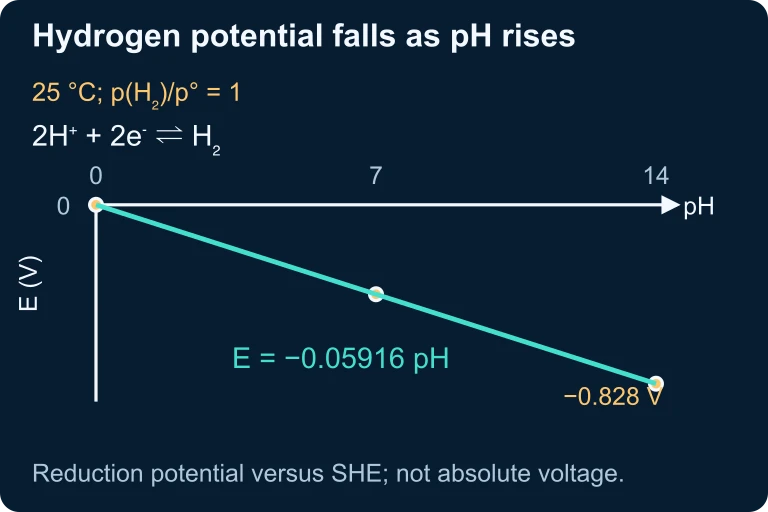 At 25 °C and unit hydrogen pressure relative to its standard pressure, the hydrogen reduction potential decreases about 0.0592 V per pH unit relative to the standard hydrogen electrode. Measuring voltage requires a complete cell with a reference half-cell.
Gas flow, electrode and junction are distinct
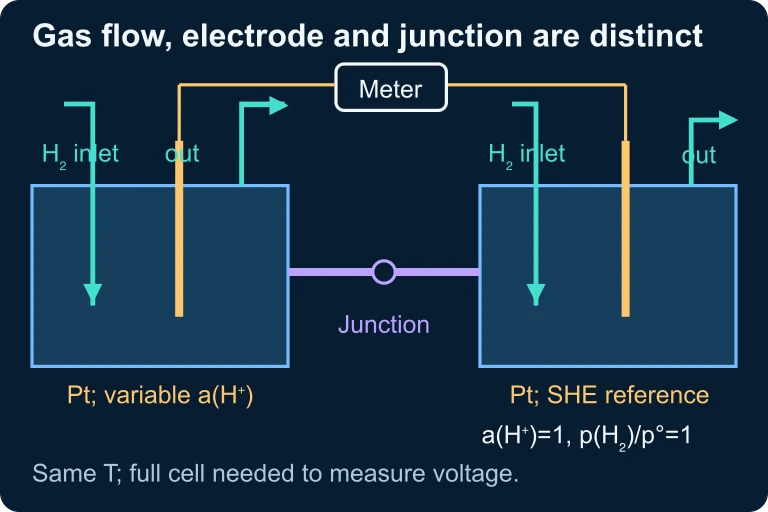 A full cell separates a variable-pH hydrogen half-cell from a standard hydrogen reference, with a junction and an external voltage measurement.
Standard vs Nonstandard
| Standard | Nonstandard | |
|---|---|---|
| Concentrations | All \(1 \text{ M}\) | Any value |
| Gas pressures | \(1 \text{ atm}\) | Any value |
| \( Q \) value | \( Q = 1 \) | \( Q \neq 1 \) |
| Equation | \( E_{\text{cell}} = E^\circ_{\text{cell}} \) | Nernst equation |
| \( \ln Q \) term | \( \ln 1 = 0 \) | \( \neq 0 \) |
How \( Q \) Affects \( E_{\text{cell}} \)
How to Apply the Nernst Equation
Example 1: Zinc-Copper Cell
Problem: Calculate \( E_{\text{cell}} \) for the Daniell cell when \([\text{Zn}^{2+}] = 0.10 \text{ M}\) and \([\text{Cu}^{2+}] = 2.0 \text{ M}\) at \(25^\circ\text{C}\).
One connected zinc-copper cell
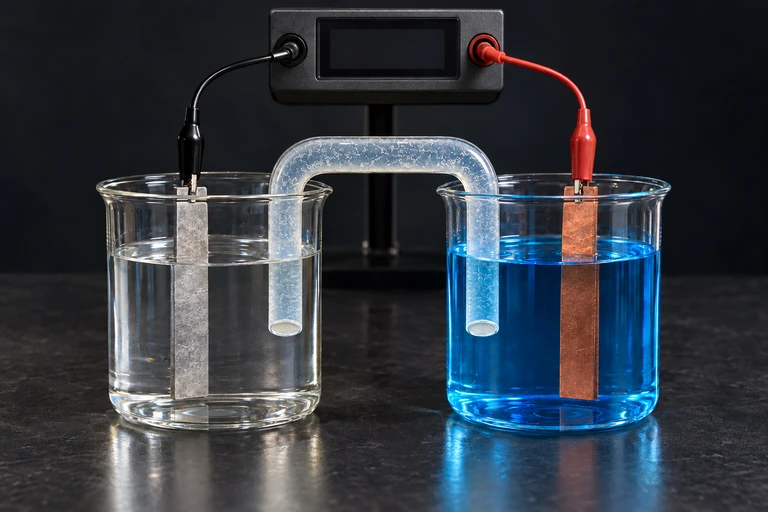 A zinc–copper cell connects two half-cells through an external circuit and a salt bridge.
Example 2: High \( Q \) Scenario
Problem: Same Daniell cell, but now \([\text{Zn}^{2+}] = 5.0 \text{ M}\) and \([\text{Cu}^{2+}] = 0.010 \text{ M}\).
Example 3: Concentration Cell
A concentration cell has the same electrode material on both sides. Here \( E^\circ_{\text{cell}} = 0 \), so all voltage comes from the concentration difference.
The cell generates voltage solely from the concentration gradient: nature drives toward equilibrium.
One silver concentration cell
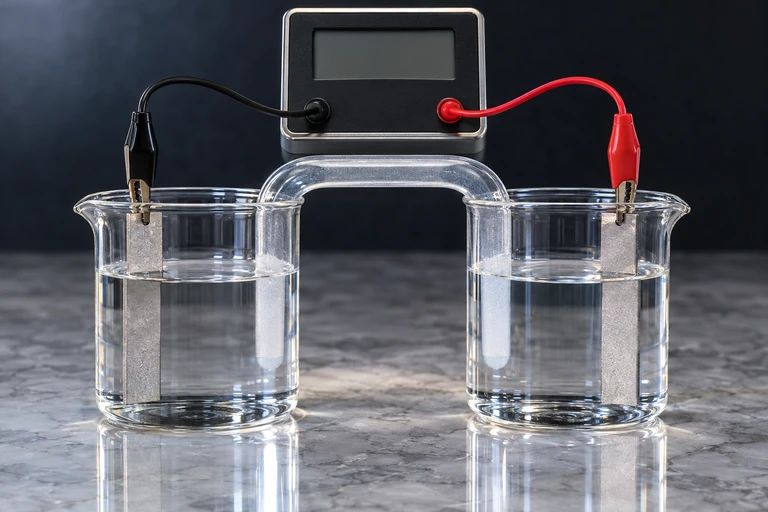 A silver concentration cell uses identical electrode materials with different silver-ion concentrations in its half-cells.
Linking \( E \), \( \Delta G \), and \( K \)
From \( K \) to \( E^\circ \)
At equilibrium, \( E_{\text{cell}} = 0 \) and \( Q = K \). Substituting into the Nernst equation:
This means if you know \( K \), you can find \( E^\circ_{\text{cell}} \), and vice versa.
Common Mistakes
Summary Table
| Condition | \( Q \) vs \( K \) | \( E_{\text{cell}} \) | \( \Delta G \) |
|---|---|---|---|
| Spontaneous forward | \( Q < K \) | \( > 0 \) | \( < 0 \) |
| Equilibrium | \( Q = K \) | \( = 0 \) | \( = 0 \) |
| Non-spontaneous | \( Q > K \) | \( < 0 \) | \( > 0 \) |
Question 1 of 5
In the Nernst equation \( E_{\text{cell}} = E^\circ_{\text{cell}} - \frac{0.0592}{n}\log Q \), what does \( n \) represent?
Question 2 of 5
For a galvanic cell at \(25^\circ\text{C}\) with \( E^\circ_{\text{cell}} = +0.46 \text{ V} \), \( n = 2 \), and \( Q = 100 \), what is \( E_{\text{cell}} \)?
Question 3 of 5
A concentration cell has \( E^\circ_{\text{cell}} = 0 \). If the dilute side has \([\text{Ag}^+] = 0.001 \text{ M}\) and the concentrated side has \([\text{Ag}^+] = 1.0 \text{ M}\), with \( n = 1 \), what is \( E_{\text{cell}} \) at \(25^\circ\text{C}\)?
Question 4 of 5
At equilibrium, which of the following is true for an electrochemical cell?
Question 5 of 5
If a cell has \( E^\circ_{\text{cell}} = +1.10 \text{ V} \) and \( n = 2 \), what is the equilibrium constant \( K \) at \(25^\circ\text{C}\)?