Cell Potential &
Free Energy
Explore how electrochemical cell potential connects to thermodynamic spontaneity through the relationship \( \Delta G^\circ = -nFE^\circ_{\text{cell}} \).
What Is Cell Potential?
Cell potential, \( E_{\text{cell}} \), is the driving force that pushes electrons through an electrochemical cell. It measures the voltage difference between the cathode and the anode and tells us whether a redox reaction can do electrical work.
What Is Gibbs Free Energy?
Gibbs free energy, \( \Delta G \), quantifies the maximum useful work a system can perform at constant temperature and pressure. In electrochemistry, it determines whether electrons flow spontaneously.
Connecting \( E_{\text{cell}} \) and \( \Delta G \)
Cell potential and free energy are two sides of the same coin. A positive cell potential corresponds to a negative free energy, and both indicate a spontaneous process.
The Core Equation
Non-Standard Conditions: Nernst Equation
When concentrations differ from \( 1\,\text{M} \), the cell potential shifts. The Nernst equation relates \( E_{\text{cell}} \) under any conditions to the standard value.
At \( 25^\circ\text{C} \), this simplifies to:
Linking \( E^\circ_{\text{cell}} \) to \( K \)
At equilibrium, \( \Delta G = 0 \) and \( Q = K \). Setting \( \Delta G^\circ = -RT \ln K \) and \( \Delta G^\circ = -nFE^\circ_{\text{cell}} \) equal gives:
Galvanic vs. Electrolytic Cells
| Galvanic (Voltaic) | Electrolytic | |
|---|---|---|
| \( E_{\text{cell}} \) | Positive | Negative |
| \( \Delta G \) | Negative | Positive |
| Spontaneity | Spontaneous | Non-spontaneous |
| Energy | Produces electricity | Requires electricity |
| Example | Battery discharging | Electroplating |
The Thermodynamic Triangle
How to Calculate \( \Delta G^\circ \)
Example 1: Zinc-Copper Cell
Find \( \Delta G^\circ \) for the Daniell cell:
One connected zinc-copper cell
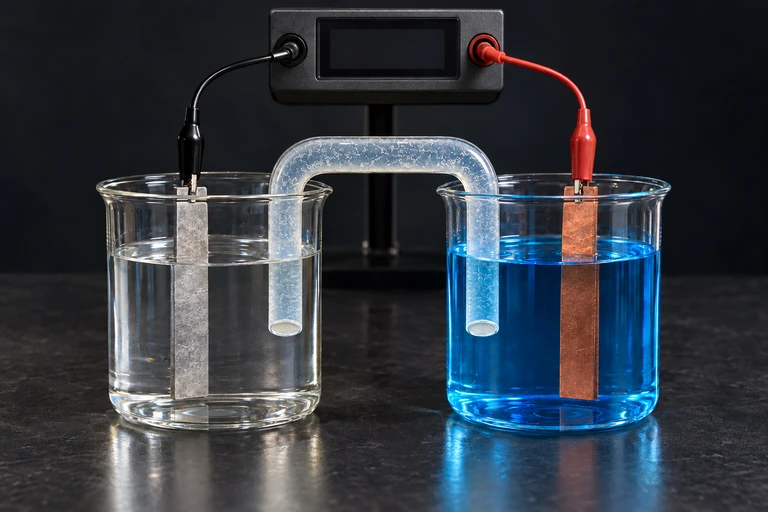 A zinc–copper cell connects two half-cells through an external circuit and a salt bridge.
Example 2: Finding \( K \) from \( E^\circ \)
For the same Zn-Cu cell with \( E^\circ_{\text{cell}} = \)\( +1.10\,\text{V} \) and \( n = 2 \), find the equilibrium constant \( K \).
Example 3: Nernst Equation
For the Zn-Cu cell at \( 25^\circ\text{C} \) with \( [\text{Cu}^{2+}] = 0.010\,\text{M} \) and \( [\text{Zn}^{2+}] = 1.0\,\text{M} \), find \( E_{\text{cell}} \) and \( \Delta G \).
\( E_{\text{cell}} \) vs. \( \ln Q \)
Common Mistakes
Summary of Key Relationships
| Condition | \( E^\circ_{\text{cell}} \) | \( \Delta G^\circ \) | \( K \) | Reaction |
|---|---|---|---|---|
| Spontaneous | \( > 0 \) | \( < 0 \) | \( > 1 \) | Favors products |
| Equilibrium | \( = 0 \) | \( = 0 \) | \( = 1 \) | No net change |
| Non-spontaneous | \( < 0 \) | \( > 0 \) | \( < 1 \) | Favors reactants |
Question 1 of 5
A galvanic cell has \( E^\circ_{\text{cell}} = +0.46\,\text{V} \) and \( n = 2 \). What is \( \Delta G^\circ \)?
Question 2 of 5
If a cell reaction has \( \Delta G^\circ = -474\,\text{kJ} \) and \( n = 2 \), what is \( E^\circ_{\text{cell}} \)?
Question 3 of 5
Which statement is always true for a spontaneous electrochemical reaction at standard conditions?
Question 4 of 5
The standard reduction potentials are \( E^\circ(\text{Ag}^+/\text{Ag}) = +0.80\,\text{V} \) and \( E^\circ(\text{Fe}^{2+}/\text{Fe}) = -0.44\,\text{V} \). What is \( E^\circ_{\text{cell}} \) for a cell with Ag cathode and Fe anode?
Question 5 of 5
Using the Nernst equation at \( 25^\circ\text{C} \), if \( Q \) increases while \( E^\circ_{\text{cell}} \) is positive, what happens to \( E_{\text{cell}} \)?