01 / 21

Catalysts
Speeding Up Reactions

Explore how catalysts lower activation energy, accelerate reaction rates, and remain unchanged after the process.

AP Chemistry

What Is a Catalyst?

A catalyst is a substance that increases the rate of a chemical reaction without being consumed in the overall process. It participates in the reaction mechanism but is regenerated by the end, so its net amount remains unchanged.

Lowering \( E_a \): Energy Diagram

Reaction Progress Energy Reactants Products Uncatalyzed Catalyzed \( E_a \) \( E_a' \) \( \Delta H \)

Why Do Catalysts Matter?

★ Industrial Chemistry
The Haber process uses an iron catalyst to synthesize \( \text{NH}_3 \) at feasible temperatures.
★ Biochemistry
Enzymes are biological catalysts that allow life-sustaining reactions at body temperature.
★ Environmental
Catalytic converters transform toxic exhaust gases (\( \text{CO}, \text{NO}_x \)) into safer products.

The Arrhenius Equation

$$ k = A \, e^{-E_a / RT} $$

k
Rate constant: larger \( k \) means a faster reaction.
A
Frequency factor: related to collision frequency and orientation.
\( E_a \)
Activation energy: a catalyst lowers this value, directly increasing \( k \).
R, T
Gas constant (\( 8.314 \, \text{J mol}^{-1}\text{K}^{-1} \)) and temperature in Kelvin.

How Catalysts Work: Alternative Pathway

\( A \) High \( E_a \) (one step) \( \text{Products} \) \( A + \text{Cat} \) Low \( E_a \) \( \text{Intermediate} \) Low \( E_a \)
\( \text{Products} \) \( + \text{Cat} \)

Homogeneous vs Heterogeneous

Homogeneous
Catalyst is in the same phase as the reactants. Example: \( \text{H}^+ \) ions catalyzing ester hydrolysis in aqueous solution.
Heterogeneous
Catalyst is in a different phase. Example: solid Pt surface catalyzing gas-phase \( \text{H}_2 + \text{O}_2 \) reaction.

Enzymes: Biological Catalysts

Enzymes are proteins that act as highly specific catalysts in living organisms. They bind substrates at an active site, forming an enzyme-substrate complex that lowers \( E_a \).

Enzyme Substrate E-S Complex

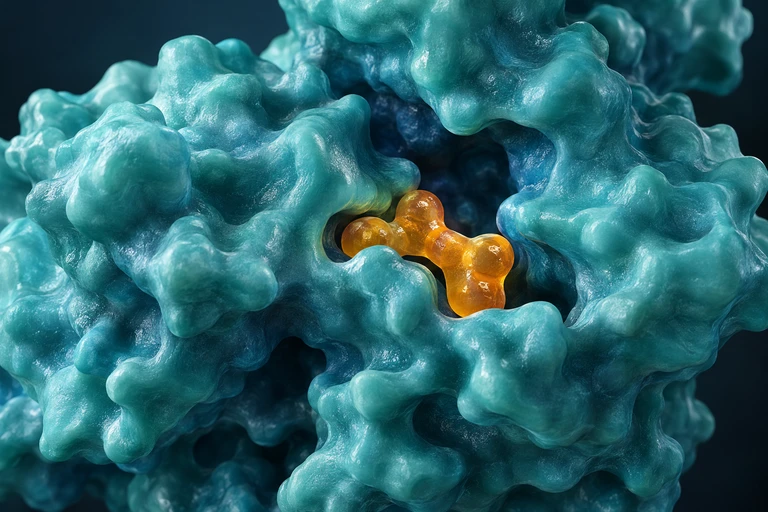
One schematic enzyme binding pocket

One schematic enzyme binding pocketAn enzyme binding pocket brings a substrate into contact with the catalytic environment.

What Catalysts Do NOT Do

1
Do not change \( \Delta H \) or \( \Delta G \): The thermodynamic favorability of a reaction is unchanged.
2
Do not shift equilibrium position: Both forward and reverse rates increase equally, so \( K_{eq} \) stays the same.
3
Do not make impossible reactions happen: If \( \Delta G > 0 \), a catalyst cannot force the reaction forward.
4
Are not consumed: They participate in the mechanism but are fully regenerated.

Catalysts and Equilibrium

Time Concentration Slow Fast Equilibrium

How to Identify a Catalyst

1
Write out all elementary steps of the proposed mechanism.
2
Sum the steps to get the overall balanced equation. Cancel species that appear on both sides.
3
Catalyst: any species that appears as a reactant in an early step and a product in a later step, canceling out overall.
4
Intermediate: any species that is produced in an early step and consumed in a later step, also canceling out.

Example 1: Identifying Catalyst and Intermediate

+
Overall: \( 2\text{H}_2\text{O}_2 \rightarrow 2\text{H}_2\text{O} + \text{O}_2 \)
C
\( \text{I}^- \) is the catalyst: consumed in Step 1, regenerated in Step 2.
I
\( \text{IO}^- \) is the intermediate: produced in Step 1, consumed in Step 2.

Example 2: Effect on Rate Constant

A reaction has \( E_a = 100 \, \text{kJ/mol} \) uncatalyzed and \( E_a = 60 \, \text{kJ/mol} \) catalyzed at \( T = 300 \, \text{K} \). By what factor does the rate constant increase?

Example 3: Heterogeneous Catalysis Steps

The catalytic hydrogenation of ethene on a Pt surface follows these steps:

1
Adsorption: \( \text{C}_2\text{H}_4 \) and \( \text{H}_2 \) bind to the Pt surface.
2
Activation: \( \text{H}_2 \) dissociates into two H atoms on the surface.
3
Reaction: H atoms migrate and bond to \( \text{C}_2\text{H}_4 \), forming \( \text{C}_2\text{H}_6 \).
4
Desorption: \( \text{C}_2\text{H}_6 \) leaves the surface, freeing active sites.

Hydrogen adsorption on a platinum surface
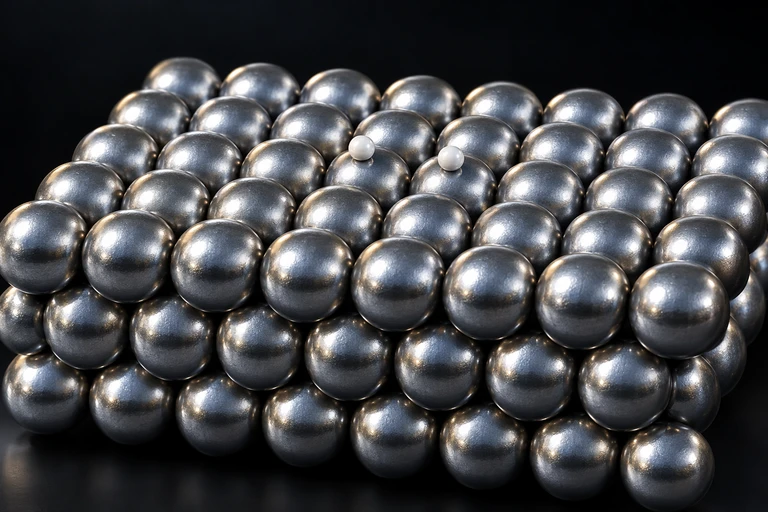
Hydrogen adsorption on a platinum surfaceHydrogen adsorbs at sites on a platinum surface during heterogeneous catalysis.

A blocked site on a catalyst surface
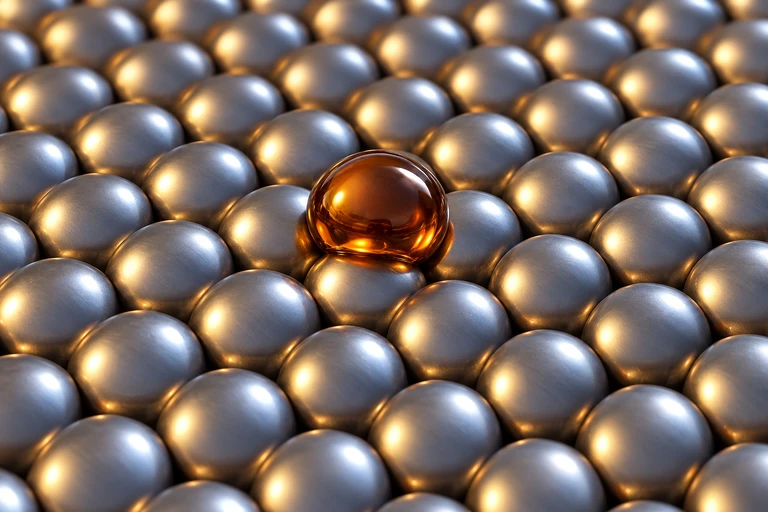
A blocked site on a catalyst surfaceA species bound to a catalyst surface can block a site that would otherwise participate in catalysis.

Common Mistakes

✕ "Catalysts shift equilibrium"
Catalysts increase both forward and reverse rates equally. \( K_{eq} \) is unchanged.
✕ "Catalysts are consumed"
A catalyst participates in the mechanism but is fully regenerated. It does not appear in the net equation.
✕ "Catalysts change \( \Delta H \)"
Only \( E_a \) is lowered. The enthalpy change between reactants and products is a state function and remains the same.

Summary Comparison

Property Uncatalyzed Catalyzed
Activation Energy \( E_a \) Higher Lower
Rate Constant \( k \) Smaller Larger
Reaction Rate Slower Faster
\( \Delta H \) Same Same
\( K_{eq} \) Same Same
Mechanism Single high-\( E_a \) step Multi-step, lower \( E_a \)

Question 1 of 5

A catalyst increases the rate of a reaction by:

Question 2 of 5

Given the mechanism:
Step 1: \( \text{NO}_2 + \text{F}_2 \rightarrow \text{NO}_2\text{F} + \text{F} \)
Step 2: \( \text{NO}_2 + \text{F} \rightarrow \text{NO}_2\text{F} \)

Which species is a reaction intermediate?

Question 3 of 5

When a catalyst is added to a system at equilibrium, what happens?

Question 4 of 5

A reaction has \( E_a = 80 \, \text{kJ/mol} \) without a catalyst and \( E_a = 50 \, \text{kJ/mol} \) with a catalyst. Which statement is true?

Question 5 of 5

In the catalytic decomposition of \( \text{H}_2\text{O}_2 \) by \( \text{MnO}_2 \), which observation confirms \( \text{MnO}_2 \) is a catalyst?