Calculating the
Equilibrium Constant
Master the quantitative side of chemical equilibrium: learn how to write, compute, and interpret \( K_{eq} \) for any reversible reaction.
What Is Chemical Equilibrium?
In a reversible reaction, both the forward and reverse reactions occur simultaneously. Equilibrium is the state where the rate of the forward reaction equals the rate of the reverse reaction: the concentrations of reactants and products remain constant over time.
Introducing \( K_{eq} \)
The equilibrium constant \( K_{eq} \) quantifies the position of equilibrium. It is a fixed value at a given temperature for a specific reaction.
Why Does \( K \) Matter?
The equilibrium constant is one of the most powerful tools in chemistry. It allows you to:
The Law of Mass Action
For a general reversible reaction at equilibrium:
The equilibrium-constant expression is:
Products go in the numerator (each raised to its coefficient), and reactants go in the denominator. Brackets denote molar concentrations at equilibrium.
\( K_c \) vs. \( K_p \)
For gas-phase reactions, we can express \( K \) in terms of concentrations or partial pressures.
| \( K_c \) | \( K_p \) | |
|---|---|---|
| Based on | Molar concentrations (\(\text{mol/L}\)) | Partial pressures (\(\text{atm}\)) |
| Units | Depends on exponents | Depends on exponents |
| Relationship | \( K_p = K_c(RT)^{\Delta n} \) | |
| \( \Delta n \) | \( (\text{moles of gas products}) - (\text{moles of gas reactants}) \) | |
\( K \) vs. \( Q \): The Key Distinction
The reaction quotient \( Q \) has the same formula as \( K \), but is calculated at any point in time, not just at equilibrium.
Rules for Writing \( K \) Expressions
How to Calculate \( K_c \)
A red iron-thiocyanate sample cuvette
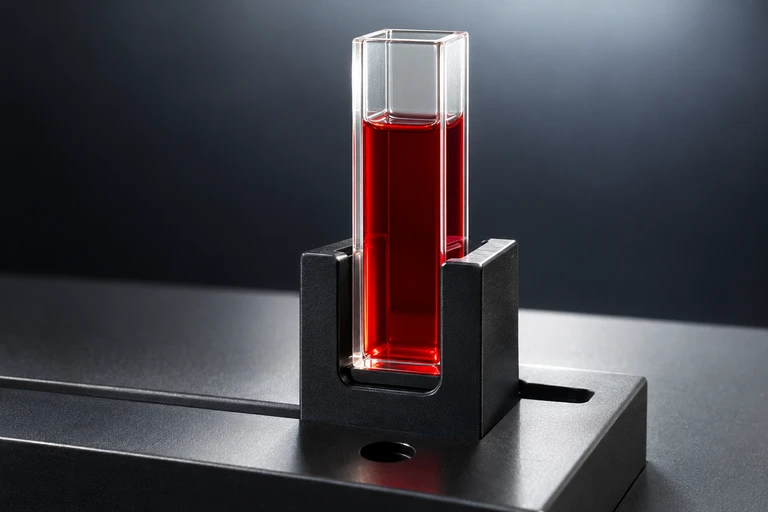 The red iron–thiocyanate complex absorbs light. Its equilibrium concentration can be measured spectrophotometrically and used to calculate the equilibrium constant.
Example 1: Simple Gas-Phase Reaction
Step 1: Write the \( K_c \) expression:
Step 2: Substitute and calculate:
Example 2: Heterogeneous Equilibrium
Key insight: Both \( \text{CaCO}_3 \) and \( \text{CaO} \) are pure solids: they are omitted from the expression.
Solid phases and gas in an equilibrium vessel
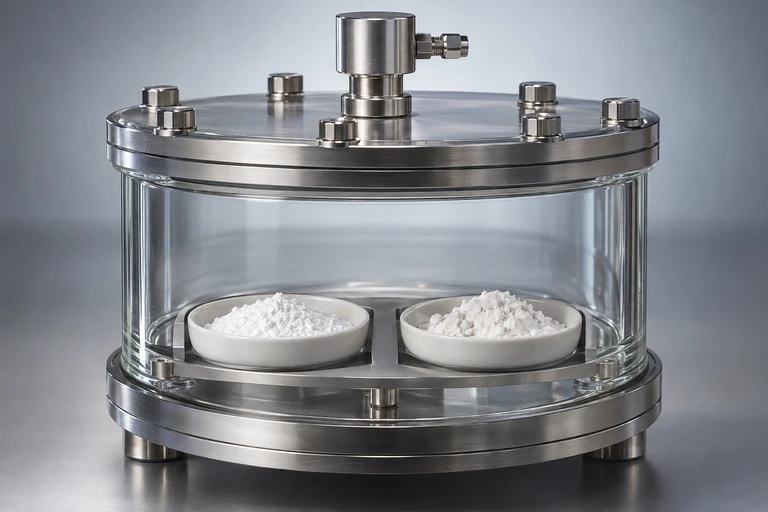 Solid phases can coexist with a gas in a closed heterogeneous-equilibrium system.
Example 3: Converting \( K_c \) to \( K_p \)
Step 1: Calculate \( \Delta n \):
Step 2: Apply the conversion formula \( (R = 0.08206 \frac{\text{L} \cdot \text{atm}}{\text{mol} \cdot \text{K}}) \):
Manipulating \( K \) Values
When you modify a balanced equation, the equilibrium constant changes in a predictable way:
The ICE Table Method
When you know \( K \) and initial concentrations but need to find equilibrium concentrations, use an ICE table. For a general reaction \( aA + bB \rightleftharpoons cC \):
| \( aA \) | \( bB \) | \( cC \) | |
|---|---|---|---|
| Initial | \( [A]_0 \) | \( [B]_0 \) | 0 |
| Change | \( -ax \) | \( -bx \) | \( +cx \) |
| Equilibrium | \( [A]_0 - ax \) | \( [B]_0 - bx \) | \( cx \) |
Common Mistakes to Avoid
Summary of Key Relationships
| Concept | Expression / Rule | Key Detail |
|---|---|---|
| \( K_c \) | \( \frac{[\text{products}]^n}{[\text{reactants}]^m} \) | Concentrations at equilibrium |
| \( K_p \) | \( \frac{(P_{\text{prod}})^n}{(P_{\text{react}})^m} \) | Partial pressures (gases only) |
| \( K_p \leftrightarrow K_c \) | \( K_p = K_c(RT)^{\Delta n} \) | \( \Delta n = (\text{moles of gas products}) - (\text{moles of gas reactants}) \) |
| Reverse rxn | \( K' = 1/K \) | Take the reciprocal |
| Multiply by \( n \) | \( K' = K^n \) | Raise to the \( n \)th power |
| Add reactions | \( K = K_1 \times K_2 \) | Multiply the constants |
Question 1 of 5
For the reaction \( 2\text{SO}_2(g) + \text{O}_2(g) \rightleftharpoons 2\text{SO}_3(g) \), what is the correct \( K_c \) expression?
Question 2 of 5
For the reaction \( \text{CaCO}_3(s) \rightleftharpoons \text{CaO}(s) + \text{CO}_2(g) \), which expression is correct?
Question 3 of 5
At equilibrium, \( [\text{H}_2] = 0.10\;\text{M} \), \( [\text{I}_2] = 0.10\;\text{M} \), and \( [\text{HI}] = 0.80\;\text{M} \) for: $$ \text{H}_2(g) + \text{I}_2(g) \rightleftharpoons 2\text{HI}(g) $$ What is \( K_c \)?
Question 4 of 5
If the equilibrium constant for a reaction is \( K = 4.0 \), what is the equilibrium constant for the reverse reaction?
Question 5 of 5
For the reaction \( \text{N}_2(g) + 3\text{H}_2(g) \rightleftharpoons 2\text{NH}_3(g) \), if \( K_c = 2.96 \) at \( 500\;\text{K} \) and \( R = 0.08206 \), what is \( \Delta n \) for calculating \( K_p \)?