01 / 21

Buffer
Capacity

Understand how buffers resist pH changes, what determines their strength, and how to calculate the limits of their effectiveness.

AP Chemistry

What Is a Buffer?

A buffer solution resists changes in pH when small amounts of strong acid or strong base are added. It contains a weak acid and its conjugate base (or a weak base and its conjugate acid) in appreciable concentrations.

Weak Acid
Neutralizes added \(\text{OH}^-\) ions by donating \(\text{H}^+\)
Conjugate Base
Neutralizes added \(\text{H}^+\) ions by accepting protons

How Buffers Work

Buffer Solution \(\text{HA}\) + \(\text{A}^-\) \(+\text{H}^+\) \(+\text{OH}^-\) \(\text{H}^+ + \text{A}^- \to \text{HA}\) \(\text{OH}^- + \text{HA} \to \text{A}^- + \text{H}_2\text{O}\) pH \(\approx\) stable

Defining Buffer Capacity

Buffer capacity (\(\beta\)) is the quantitative measure of a buffer's resistance to pH change. It equals the moles of strong acid or base that must be added to one liter of buffer to change the pH by one unit.

Buffer capacity depends on two factors: the total concentration of the buffering pair and the ratio of weak acid to conjugate base.

The Henderson-Hasselbalch Equation

\(\text{p}K_a\)
Sets the center pH of the buffer: buffer works best when \(\text{pH} \approx \text{p}K_a\)
\(\log \frac{[\text{A}^-]}{[\text{HA}]}\)
Adjusts pH above or below \(\text{p}K_a\) based on the ratio

Factors That Affect Buffer Capacity

1
Total concentration: More moles of HA and \(\text{A}^-\) means more acid/base can be neutralized before the buffer fails.
2
Ratio \([\text{A}^-]/[\text{HA}]\): Buffer capacity is maximized when this ratio equals 1, i.e., \([\text{A}^-] = [\text{HA}]\) and \(\text{pH} = \text{p}K_a\).
3
Effective range: A buffer works within approximately \(\text{p}K_a \pm 1\). Outside this range, the buffer capacity drops sharply.

Buffer Capacity vs. Concentration

Total Buffer Concentration (M)
Buffer Capacity (\(\beta\))
0.1 0.3 0.5 0.7 1.0
\(\beta \propto C\)

Two buffers look alike until the challenge
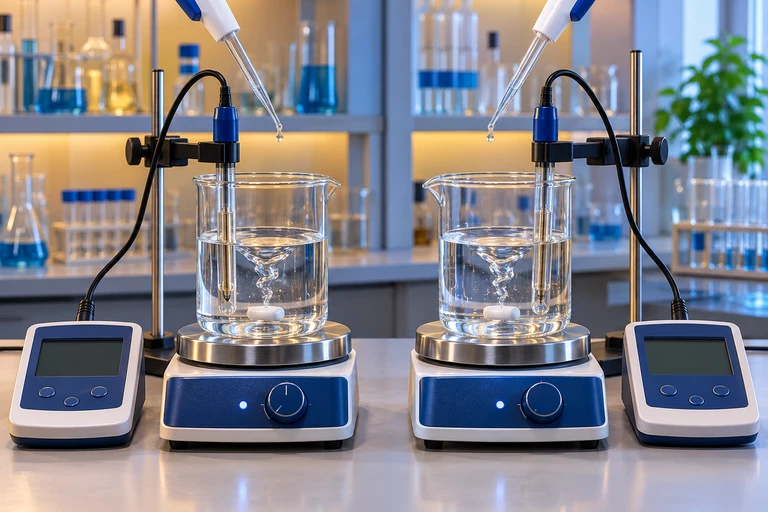
Two colorless stirred samples, separate pH probes and matched dispensing pipettes accompany exact inventory bars and calculated pH changes.Compare two 100 mL acetic-acid buffers with pKa = 4.76 and a tenfold difference in total concentration. Adding 0.50 mmol HCl changes their pH from about 4.76 to 4.72 and 4.29, respectively, when the added volume is negligible.

Equal pH is not equal reserve
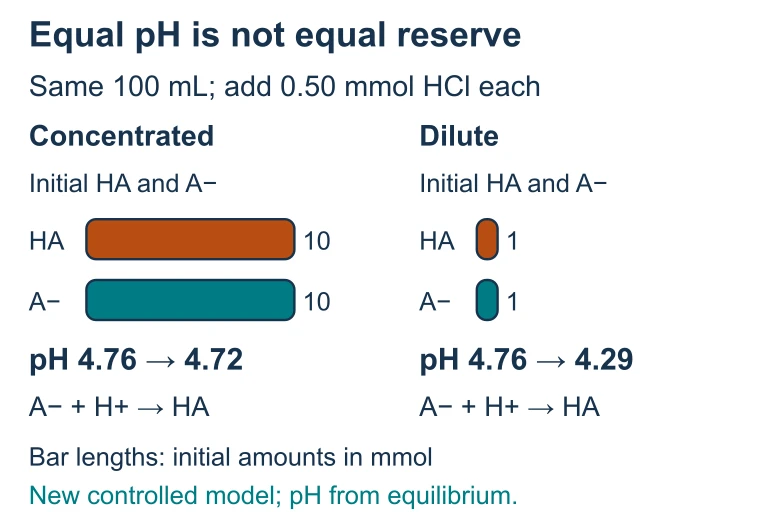
Equal pH is not equal reserve. Compare two 100 mL acetic-acid buffers with pKa = 4.76 and a tenfold difference in total concentration. Adding 0.50 mmol HCl changes their pH from about 4.76 to 4.72 and 4.29, respectively, when the added volume is negligible.Compare two 100 mL acetic-acid buffers with pKa = 4.76 and a tenfold difference in total concentration. Adding 0.50 mmol HCl changes their pH from about 4.76 to 4.72 and 4.29, respectively, when the added volume is negligible.

Buffer Capacity vs. Ratio

pH
Buffer Capacity (\(\beta\))
\(\text{p}K_a\)
\(\text{p}K_a - 1\)
\(\text{p}K_a + 1\)
Effective Range

Capacity vs. Range

Buffer Capacity Buffer Range
Definition Amount of acid/base a buffer can absorb pH interval over which buffering occurs
Units \(\text{mol}/\text{L}/\Delta\text{pH}\) pH units (dimensionless)
Depends on Concentration and ratio \(\text{p}K_a\) of the weak acid
Typical value Varies (e.g., 0.05 to 1.0) \(\text{p}K_a \pm 1\)
Analogy Size of the sponge Where you place the sponge

Evaluating Buffer Capacity: Steps

1
Identify the weak acid (HA) and its conjugate base (\(\text{A}^-\)). Note their molar concentrations.
2
Check the ratio \([\text{A}^-]/[\text{HA}]\). If it is between 0.1 and 10, the system is within the effective buffer range.
3
Calculate the pH using Henderson-Hasselbalch: \(\text{pH} = \text{p}K_a + \log([\text{A}^-]/[\text{HA}])\).
4
Determine moles that can be absorbed: the buffer can neutralize up to the limiting component (whichever of HA or \(\text{A}^-\) has fewer moles).
5
Compare: Higher total concentration at ratio ≈ 1 means higher buffer capacity.

Example 1: Comparing Two Buffers

Which buffer has a greater capacity? Both use acetic acid (\(\text{p}K_a = 4.76\)).

Buffer A
0.10 M \(\text{CH}_3\text{COOH}\) + 0.10 M \(\text{CH}_3\text{COO}^-\)
Buffer B
1.00 M \(\text{CH}_3\text{COOH}\) + 1.00 M \(\text{CH}_3\text{COO}^-\)

Example 2: Adding Strong Acid

A buffer contains 0.50 mol \(\text{CH}_3\text{COOH}\) and 0.50 mol \(\text{CH}_3\text{COO}^-\) in 1.00 L. What happens when 0.10 mol HCl is added?

1
Reaction: \(\text{H}^+ + \text{CH}_3\text{COO}^- \to \text{CH}_3\text{COOH}\)
2
New moles: HA = 0.50 + 0.10 = 0.60 mol; \(\text{A}^-\) = 0.50 − 0.10 = 0.40 mol
3
New pH: \(\text{pH} = 4.76 + \log(0.40/0.60) = 4.76 + \log(0.667) = 4.76 - 0.18 = \) 4.58

Example 3: When a Buffer Fails

Same buffer: 0.50 mol HA / 0.50 mol \(\text{A}^-\) in 1.00 L. Now add 0.50 mol HCl.

1
All \(\text{A}^-\) consumed: 0.50 − 0.50 = 0.00 mol \(\text{A}^-\)
2
Buffer destroyed: With no conjugate base remaining, H-H equation no longer applies.
3
pH crashes: The solution is now just 1.00 M acetic acid: pH drops dramatically (well below 4).

Buffer Region on a Titration Curve

Volume NaOH added (mL) pH 0 2 4 6 8 10 12 14 Buffer Region ½ eq. pt.
\(\text{pH} = \text{p}K_a\)
Eq. point

Common Mistakes

✕ Confusing Capacity with Range
Capacity is how much acid/base can be absorbed; range is over what pH buffering occurs. High concentration raises capacity, not range.
✕ Ignoring Stoichiometry
When strong acid is added, \(\text{A}^-\) decreases and HA increases by the same moles. Students often forget to adjust both concentrations.
✕ Using Weak Acid for Both
A solution of only a weak acid is not a buffer. You need both HA and \(\text{A}^-\) in significant amounts. A tiny amount of conjugate base from auto-dissociation does not count.

Buffer Capacity Summary

Increases Capacity Decreases Capacity
Concentration Higher \([\text{HA}]\) and \([\text{A}^-]\) Lower \([\text{HA}]\) and \([\text{A}^-]\)
Ratio \([\text{A}^-]/[\text{HA}]\) close to 1 Ratio far from 1 (>10 or <0.1)
pH vs. pKa pH near pKa pH far from pKa

Question 1 of 5

Which of the following changes would increase the buffer capacity of an acetic acid/sodium acetate buffer?

Question 2 of 5

A buffer is prepared with 0.30 mol \(\text{NH}_3\) and 0.30 mol \(\text{NH}_4\text{Cl}\) in 1.0 L. The \(\text{p}K_b\) of \(\text{NH}_3\) is 4.74. What is the pH of this buffer?

Question 3 of 5

A buffer contains 0.40 mol \(\text{HA}\) and 0.60 mol \(\text{A}^-\). If 0.20 mol \(\text{NaOH}\) is added, what are the new moles of \(\text{HA}\) and \(\text{A}^-\)?

Question 4 of 5

At which point on a weak acid titration curve is buffer capacity at its maximum?

Question 5 of 5

A student wants to prepare a buffer at \(\text{pH } 5.00\) using one of the acids below. Which acid gives the greatest buffer capacity at that pH?

Acid X
\(\text{p}K_a = 3.20\)
Acid Y
\(\text{p}K_a = 4.90\)
Acid Z
\(\text{p}K_a = 7.40\)