Beer-Lambert
Law
Understand how light absorption relates to concentration and path length in solution spectrophotometry.
What Is Spectrophotometry?
Spectrophotometry measures how much light a substance absorbs as it passes through a solution. A device called a spectrophotometer shines a specific wavelength of light through a sample and detects the light that emerges on the other side.
Transmittance and Absorbance
Light Through a Cuvette
One filter-based absorption photometer
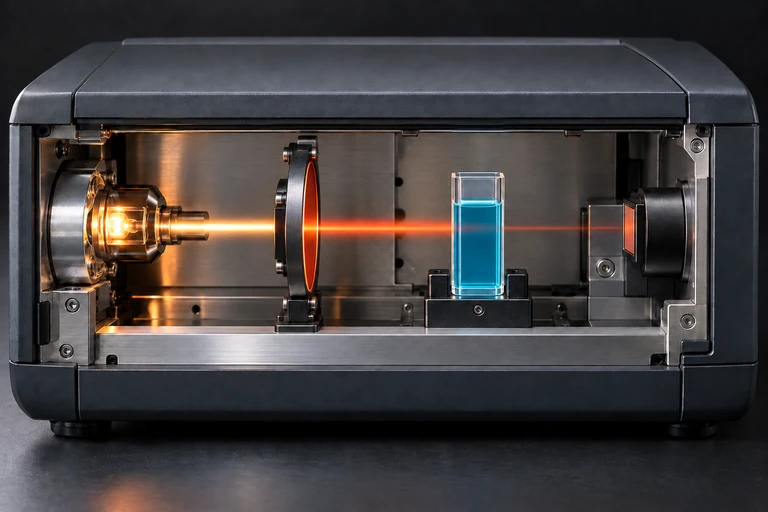 A photometer directs selected light through a cuvette and measures the transmitted light at a detector.
The Beer-Lambert Law
The absorbance of a solution is directly proportional to the concentration of the absorbing species and the path length of the light through the solution:
Molar Absorptivity (\(\varepsilon\))
Molar absorptivity (also called the molar extinction coefficient) is a constant that describes how strongly a substance absorbs light at a particular wavelength. It depends on:
Blue solution in an optical cuvette
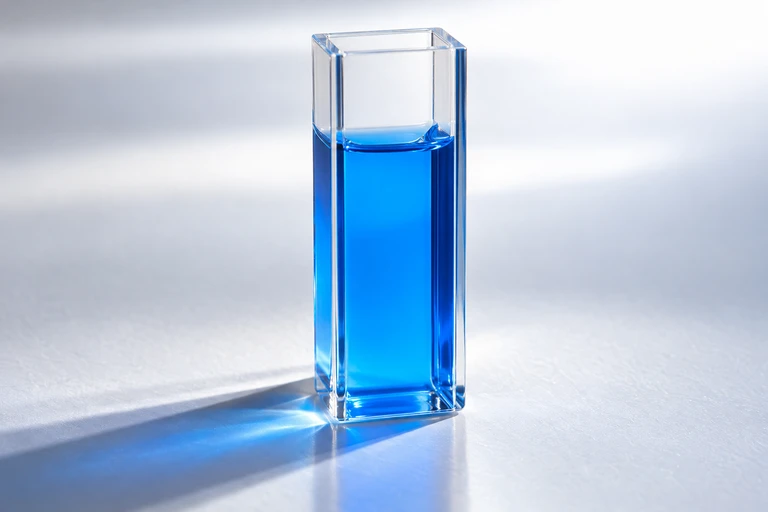 A blue solution transmits some visible wavelengths more strongly than others; its absorption depends on wavelength.
Linear Relationship: \(A\) vs \(c\)
Transmittance vs Absorbance
| Transmittance (\(T\)) | Absorbance (\(A\)) | |
|---|---|---|
| Definition | \( T = I / I_0 \) | \( A = -\log_{10}(T) \) |
| Scale | 0 to 1 (or 0-100%) | 0 to ~2 (practical) |
| Relationship to conc. | Exponential decay | Linear (Beer-Lambert) |
| Preferred for calculations | Rarely | Almost always |
Absorbance vs Absorption
When Does the Law Hold?
How to Apply Beer-Lambert
Example 1: Finding Absorbance
A solution of \(\text{KMnO}_4\) has a concentration of \(c = 0.0020 \;\text{mol/L}\). The molar absorptivity at 525 nm is \(\varepsilon = 2400 \;\text{L mol}^{-1}\text{cm}^{-1}\). The cuvette path length is \(\ell = 1.00 \;\text{cm}\). Find the absorbance.
Example 2: Finding Concentration
A spectrophotometer reads an absorbance of \(A = 0.600\) for a dye solution. The molar absorptivity is \(\varepsilon = 1.50 \times 10^4 \;\text{L mol}^{-1}\text{cm}^{-1}\) and the cuvette is \(\ell = 1.00 \;\text{cm}\). Find the concentration.
Example 3: Calibration Curve
A student prepares 5 standard solutions and plots absorbance vs concentration. The best-fit line has slope \( m = 1200 \;\text{L mol}^{-1} \) with a 1.00 cm cuvette. An unknown gives \(A = 0.480\).
Common Mistakes
Summary of Key Relationships
| Relationship | Equation | Key Insight |
|---|---|---|
| Beer-Lambert Law | \( A = \varepsilon \ell c \) | \(A\) is proportional to \(c\) |
| Transmittance | \( T = I / I_0 \) | Fraction of light passing through |
| \(A\) from \(T\) | \( A = -\log_{10}(T) \) | Converts \(T\) to linear scale |
| Solve for \(c\) | \( c = A / (\varepsilon \ell) \) | Most common lab calculation |
| Calibration slope | \( m = \varepsilon \ell \) | Slope of \(A\) vs \(c\) plot |
Question 1 of 5
According to Beer-Lambert Law, if the concentration of a solution is doubled (while all else remains constant), what happens to the absorbance?
Question 2 of 5
A solution has a transmittance of 25%. What is its absorbance?
Question 3 of 5
A dye has \(\varepsilon = 8.00 \times 10^3 \;\text{L mol}^{-1}\text{cm}^{-1}\). Using a 1.00 cm cuvette, an unknown solution gives \(A = 0.400\). What is the concentration?
Question 4 of 5
Which of the following would cause Beer-Lambert Law to fail?
Question 5 of 5
In a calibration curve of absorbance vs concentration, the slope of the best-fit line equals: