Acid-Base
Titrations
Master the quantitative technique of determining unknown concentrations through controlled neutralization reactions and equivalence point analysis.
What Is a Titration?
A titration is a laboratory technique where a solution of known concentration (the titrant) is gradually added to a solution of unknown concentration (the analyte) until the reaction reaches completion.
The Neutralization Reaction
In an acid-base titration, the acid and base react to form water and a salt. The net ionic equation for a strong acid-strong base titration is:
This 1:1 molar ratio is the foundation of titration calculations. Every mole of \(\text{H}^+\) requires exactly one mole of \(\text{OH}^-\) for complete neutralization.
The Titration Setup
One complete titration setup
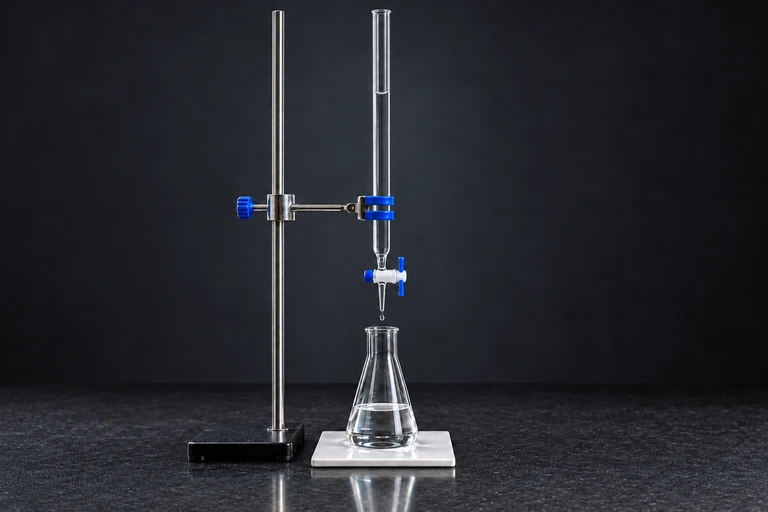 A buret delivers measured titrant into a flask containing the solution being analyzed.
The Equivalence Point
The equivalence point is the moment in a titration when the moles of titrant added equal the moles of analyte present. At this point, all of the analyte has been completely neutralized.
The Core Titration Equation
Titration Curve: Strong Acid + Strong Base
Weak Acid + Strong Base Curve
Strong vs. Weak Acid Titrations
| Strong Acid + Strong Base | Weak Acid + Strong Base | |
|---|---|---|
| Initial pH | Low (~1) | Higher (~3) |
| Buffer Region | None | Yes |
| Equivalence pH | \( = 7 \) | \( > 7 \) |
| Best Indicator | Bromothymol blue | Phenolphthalein |
| Steep Region | Very sharp jump | Less dramatic jump |
The Half-Equivalence Point
At the half-equivalence point, exactly half of the analyte has been neutralized. The concentration of the weak acid equals the concentration of its conjugate base:
This is derived from the Henderson-Hasselbalch equation:
How to Solve Titration Problems
Example 1: Finding Unknown Molarity
A 25.0 mL sample of HCl is titrated with 0.150 M NaOH. It takes 18.5 mL of NaOH to reach the equivalence point. What is the molarity of the HCl?
Example 2: Diprotic Acid Titration
A 20.0 mL sample of \(\text{H}_2\text{SO}_4\) is titrated with 0.200 M NaOH. It requires 32.0 mL of NaOH to reach the equivalence point. Find \(M_{\text{H}_2\text{SO}_4}\).
Example 3: pH at the Half-Equivalence Point
A 30.0 mL sample of 0.100 M acetic acid (\(K_a = 1.8 \times 10^{-5}\)) is titrated with 0.100 M NaOH. What is the pH after 15.0 mL of NaOH has been added?
Common Mistakes to Avoid
Summary: Key Titration Facts
| Titration Type | Eq. Point pH | Recommended Indicator | Buffer Region? |
|---|---|---|---|
| Strong Acid + Strong Base | \( = 7 \) | Bromothymol blue | No |
| Weak Acid + Strong Base | \( > 7 \) | Phenolphthalein | Yes |
| Strong Acid + Weak Base | \( < 7 \) | Methyl red | Yes |
| Weak Acid + Weak Base | Depends on \(K_a\) vs \(K_b\) | Not recommended | Yes |
Question 1 of 5
A 50.0 mL sample of HNO\(_3\) is titrated with 0.200 M KOH. If it takes 25.0 mL of KOH to reach the equivalence point, what is the molarity of HNO\(_3\)?
Question 2 of 5
When a weak acid is titrated with a strong base, the pH at the equivalence point is:
Question 3 of 5
At the half-equivalence point of a weak acid titration, which statement is true?
Question 4 of 5
How many mL of 0.250 M NaOH are required to completely neutralize 35.0 mL of 0.100 M H\(_2\)SO\(_4\)?
Question 5 of 5
Which indicator is most appropriate for titrating 0.10 M acetic acid with 0.10 M NaOH?