Acid-Base Reactions
and Buffers
Master the chemistry of proton transfer, equilibrium constants \(K_a\) and \(K_b\), and how buffer solutions resist changes in pH.
What Are Acids and Bases?
Conjugate Acid-Base Pairs
The pH Scale
\(K_a\) and \(K_b\): Strength Constants
Strong vs Weak Acids and Bases
| Strong | Weak | |
|---|---|---|
| Dissociation | Complete (100%) | Partial (equilibrium) |
| \(K_a\) or \(K_b\) | Very large (\(\gg 1\)) | Small (\(< 1\)) |
| Acid Examples | \(HCl\), \(HNO_3\), \(H_2SO_4\) | \(CH_3COOH\), \(HF\) |
| Base Examples | \(NaOH\), \(KOH\) | \(NH_3\), \(CH_3NH_2\) |
| Reaction Arrow | \(\rightarrow\) (one way) | \(\rightleftharpoons\) (equilibrium) |
The Henderson-Hasselbalch Equation
This equation connects the \(\text{pH}\) of a buffer solution directly to the ratio of conjugate base \([A^-]\) to weak acid \([HA]\) and the acid's \(\text{p}K_a\) value (\(\text{p}K_a = -\log K_a\)).
What Is a Buffer Solution?
A buffer is a solution that resists changes in pH when small amounts of acid or base are added. It consists of a weak acid and its conjugate base (or a weak base and its conjugate acid) in comparable concentrations.
How Buffers Work: Step by Step
Titration Curves
Buffer Capacity and Limitations
A buffer can only neutralize a limited amount of added acid or base. Its capacity depends on the concentrations of the weak acid and conjugate base.
Two buffers look alike until the challenge
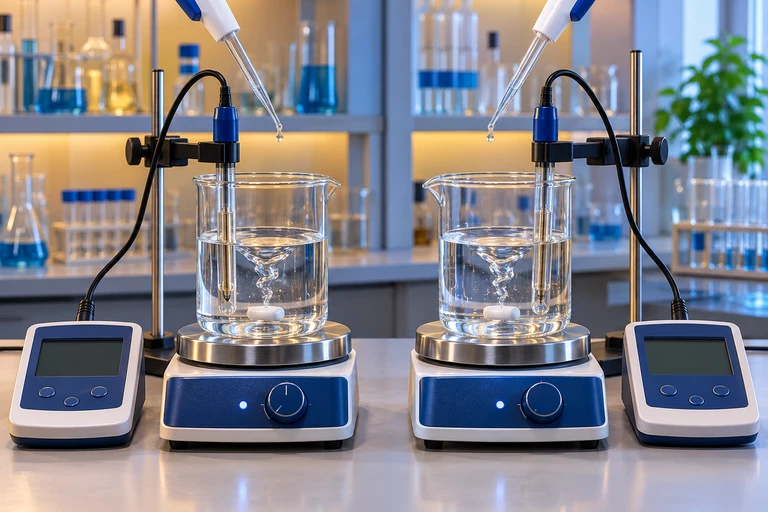 Compare two 100 mL acetic-acid buffers with pKa = 4.76 and a tenfold difference in total concentration. Adding 0.50 mmol HCl changes their pH from about 4.76 to 4.72 and 4.29, respectively, when the added volume is negligible.
Equal pH is not equal reserve
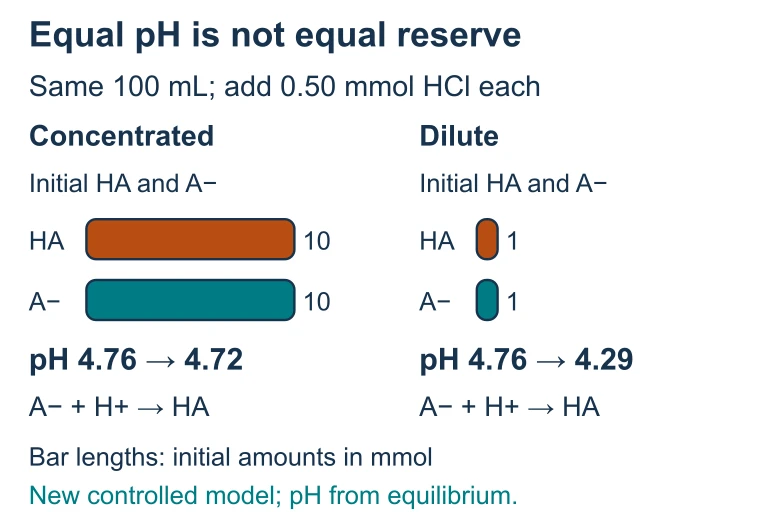 Compare two 100 mL acetic-acid buffers with pKa = 4.76 and a tenfold difference in total concentration. Adding 0.50 mmol HCl changes their pH from about 4.76 to 4.72 and 4.29, respectively, when the added volume is negligible.
Example 1: Calculating Buffer pH
Example 2: Adding Acid to a Buffer
Example 3: Preparing a Target-pH Buffer
Common Mistakes to Avoid
Summary: Key Equations and Concepts
| Concept | Equation / Rule | Key Insight |
|---|---|---|
| pH Definition | \(\text{pH} = -\log[H^+]\) | Lower pH = more acidic |
| Ion Product of Water | \(K_w = [H^+][OH^-] = 10^{-14}\) | Connects \(K_a\) and \(K_b\) |
| Henderson-Hasselbalch | \(\text{pH} = \text{p}K_a + \log\frac{[A^-]}{[HA]}\) | Core buffer equation |
| Buffer Capacity | Higher concentrations = more capacity | Best at \(\text{pH} = \text{p}K_a\) |
| Half-Equivalence Point | \([HA] = [A^-]\) | \(\text{pH} = \text{p}K_a\) exactly |
Question 1 of 5
According to the Brønsted-Lowry definition, a base is a species that:
Question 2 of 5
What is the pH of a buffer containing 0.50 M \(NH_3\) and 0.50 M \(NH_4Cl\)? (\(K_b\) for \(NH_3 = 1.8 \times 10^{-5}\))
Question 3 of 5
During the titration of a weak acid with a strong base, at the half-equivalence point:
Question 4 of 5
A buffer is made from 0.40 M \(HF\) and 0.60 M \(NaF\). If \(K_a = 6.8 \times 10^{-4}\) for \(HF\), what is the buffer pH?
Question 5 of 5
Which of the following mixtures would NOT form an effective buffer?