Absolute Entropy &
Entropy Change
Explore how disorder is measured, why absolute entropy matters, and how to calculate entropy change for chemical reactions using standard values.
What is Entropy?
Entropy, symbolized \( S \), is a thermodynamic quantity that measures the number of possible microstates (arrangements) available to a system. The more ways particles can be arranged while maintaining the same macroscopic properties, the higher the entropy.
In everyday terms, entropy is often described as a measure of "disorder" or "randomness", but more precisely it quantifies how energy is dispersed among particles.
The Third Law and Absolute Entropy
The Third Law of Thermodynamics states that the entropy of a perfect crystalline substance at absolute zero (0 K) is exactly zero: \( S = 0 \) at \( T = 0 \, \text{K} \).
Why Does Entropy Matter?
Factors Affecting Absolute Entropy
One chloride hydration environment
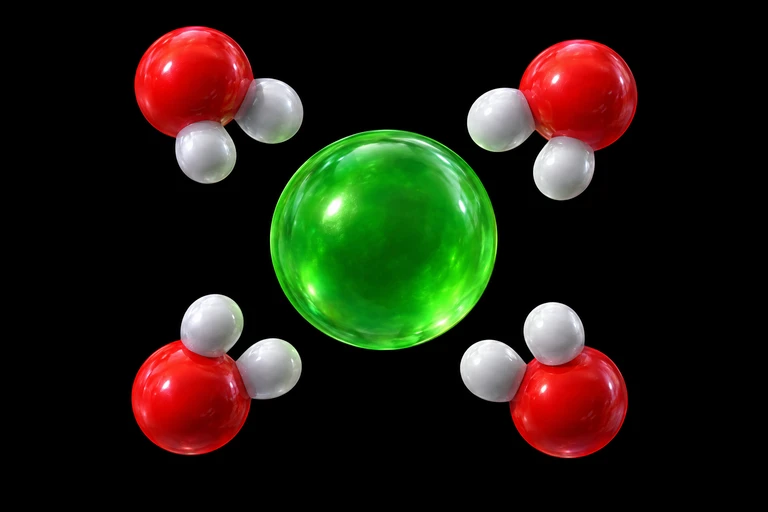 Water molecules orient their partially positive hydrogen atoms toward a chloride ion.
Standard Molar Entropy Values
\( S^\circ \) values are measured at standard conditions (298 K, 1 atm) and reported in units of \( \text{J/(mol} \cdot \text{K)} \). Unlike \( \Delta H_f^\circ \), elements in their standard state do not have \( S^\circ = 0 \).
| Substance | Phase | \( S^\circ \) (J/mol·K) |
|---|---|---|
| \( \text{C(s, diamond)} \) | Solid | 2.4 |
| \( \text{H}_2\text{O(l)} \) | Liquid | 69.9 |
| \( \text{H}_2\text{O(g)} \) | Gas | 188.7 |
| \( \text{O}_2\text{(g)} \) | Gas | 205.0 |
| \( \text{CO}_2\text{(g)} \) | Gas | 213.7 |
The Entropy Change Equation
The standard entropy change of a reaction is calculated using the same products-minus-reactants approach as enthalpy:
If \( \Delta S^\circ_{\text{rxn}} > 0 \), the reaction increases disorder. If \( \Delta S^\circ_{\text{rxn}} < 0 \), the reaction decreases disorder.
Predicting the Sign of \( \Delta S \)
You can often predict whether \( \Delta S^\circ \) is positive or negative without calculating by looking for these patterns:
\( S^\circ \) vs. \( \Delta S^\circ \): Key Distinction
| Feature | \( S^\circ \) (Absolute) | \( \Delta S^\circ \) (Change) |
|---|---|---|
| What it measures | Total disorder of one substance | Change in disorder for a reaction |
| Reference point | Third Law: \( S = 0 \) at 0 K | Products minus reactants |
| Sign | Always positive (\( S^\circ > 0 \)) | Can be positive or negative |
| Units | \( \text{J/(mol}\cdot\text{K)} \) | \( \text{J/K} \) (per mol rxn) |
| For elements | Not zero (unlike \( \Delta H_f^\circ \)) | Depends on the reaction |
How to Calculate \( \Delta S^\circ_{\text{rxn}} \)
Worked Example: Combustion of Methane
| Substance | \( n \) | \( S^\circ \) (J/mol·K) | \( n \times S^\circ \) |
|---|---|---|---|
| \( \text{CH}_4\text{(g)} \) | 1 | 186.3 | 186.3 |
| \( \text{O}_2\text{(g)} \) | 2 | 205.0 | 410.0 |
| \( \text{CO}_2\text{(g)} \) | 1 | 213.7 | 213.7 |
| \( \text{H}_2\text{O(g)} \) | 2 | 188.7 | 377.4 |
Interpreting the Result
We found \( \Delta S^\circ = -5.2 \, \text{J/K} \). This is a small negative value. Let's verify this makes sense:
Worked Example: Decomposition of \( \text{CaCO}_3 \)
Given \( S^\circ \) values:
\( S^\circ(\text{CaCO}_3) = 92.9 \), \( S^\circ(\text{CaO}) = 39.7 \), \( S^\circ(\text{CO}_2) = 213.7 \) (all in J/mol·K)
Worked Example: Synthesis of Ammonia
Given: \( S^\circ(\text{N}_2) = 191.6 \), \( S^\circ(\text{H}_2) = 130.7 \), \( S^\circ(\text{NH}_3) = 192.3 \) (J/mol·K)
Entropy and Phase Changes
During a phase change at constant temperature and pressure, the entropy change can be calculated as:
Vaporization produces a much larger entropy increase than fusion because gas particles have vastly more freedom of motion than liquid particles.
Common Mistakes to Avoid
Summary of Key Concepts
| Concept | Key Idea | Formula / Rule |
|---|---|---|
| Third Law | Perfect crystal at 0 K has zero entropy | \( S = 0 \text{ at } T = 0 \, \text{K} \) |
| Absolute Entropy | Total entropy of a substance at 298 K | \( S^\circ > 0 \) always |
| Entropy Change | Products minus reactants | \( \Delta S^\circ = \Sigma n S^\circ_p - \Sigma n S^\circ_r \) |
| Phase Change | Entropy change at constant T | \( \Delta S = \frac{\Delta H}{T} \) |
| Gibbs Link | Entropy drives spontaneity | \( \Delta G = \Delta H - T\Delta S \) |
Question 1 of 5
According to the Third Law of Thermodynamics, what is the entropy of a perfect crystal at absolute zero?
Question 2 of 5
For the reaction \( 2\,\text{SO}_2\text{(g)} + \text{O}_2\text{(g)} \rightarrow 2\,\text{SO}_3\text{(g)} \), predict the sign of \( \Delta S^\circ \).
Question 3 of 5
Which statement about \( S^\circ \) values is correct?
Question 4 of 5
Calculate \( \Delta S^\circ \) for: \( \text{N}_2\text{(g)} + 3\,\text{H}_2\text{(g)} \rightarrow 2\,\text{NH}_3\text{(g)} \)
Given: \( S^\circ(\text{N}_2) = 191.6 \), \( S^\circ(\text{H}_2) = 130.7 \), \( S^\circ(\text{NH}_3) = 192.3 \)
Question 5 of 5
The decomposition \( \text{CaCO}_3\text{(s)} \rightarrow \text{CaO(s)} + \text{CO}_2\text{(g)} \) has \( \Delta S^\circ = +160.5 \, \text{J/K} \). Which factor most accounts for this large positive value?