
SECTION 1
Historical Context & Motivation
Chemistry's central enterprise has always been understanding how substances transform into new substances, and the effort to classify these transformations stretches back centuries. Early alchemists recognized that metals could be dissolved in acids and that combustion consumed materials in air, but they lacked a systematic framework to organize these observations. The modern classification of chemical reaction types emerged gradually as chemists developed balanced equations, conservation laws, and theories of bonding that revealed the mechanistic patterns underlying seemingly disparate reactions.
1774 • Lavoisier & Conservation of Mass
1808 • Dalton's Atomic Theory
1884 • Arrhenius & Electrolyte Theory
1923 • Brønsted–Lowry Acid–Base Model
1960s • Modern Reaction Taxonomy
The central question that reaction classification addresses is both practical and predictive: given a set of reactants, can we forecast the products and identify the thermodynamic or kinetic driving force? Mastering reaction types is not merely taxonomic—it equips you to write net ionic equations, assign oxidation states, and connect macroscopic observations to particulate-level changes on the AP Chemistry exam.
SECTION 2
Core Principles & Definitions
Chemical reactions can be organized along two complementary axes. The first, often introduced in general chemistry, focuses on structural pattern—how atoms rearrange (synthesis, decomposition, single replacement, double replacement). The second axis, emphasized heavily on the AP exam, focuses on driving force—why the reaction proceeds (precipitation, acid–base neutralization, or electron transfer). Both frameworks are useful; the AP exam expects fluency in both.
Synthesis (Combination)
Decomposition
Single Replacement (Redox)
Double Replacement (Metathesis)
Combustion
SECTION 3
Visual Explanation — Reaction Type Flowchart
The flowchart above captures the AP-level diagnostic approach. When two aqueous ionic compounds are mixed, the first test is whether any combination of ions forms an insoluble product according to the solubility rules—if so, the reaction is a precipitation reaction. If no precipitate forms, check whether a proton transfer occurs between an acid and a base. Absent both of those driving forces, examine whether oxidation states change, which signals a redox process. This three-step triage is the backbone of FRQ reaction-prediction questions.
SECTION 4
Driving Forces & Net Ionic Equations
Understanding reaction types at the AP level requires writing net ionic equations that strip away spectator ions and expose the actual chemical change. The process involves three steps: write the balanced molecular equation, dissociate all strong electrolytes into ions (the complete ionic equation), and then cancel species that appear identically on both sides.
PRECIPITATION — NET IONIC
Silver ion and chloride ion combine to form insoluble silver chloride. Na⁺ and NO₃⁻ are spectator ions omitted from the net ionic equation.
ACID–BASE NEUTRALIZATION — NET IONIC
For strong acid + strong base reactions, the net ionic equation always reduces to proton transfer yielding water. Weak acids/bases remain in molecular form.
REDOX — HALF-REACTIONS
In single replacement, zinc is oxidized (loses electrons) and copper(II) is reduced (gains electrons). The activity series predicts that Zn, being more active, will displace Cu²⁺.
COMBUSTION OF A HYDROCARBON
Complete combustion of any hydrocarbon CₓHᵧ produces carbon dioxide and water. Carbon is oxidized from a negative or zero state to +4, while oxygen is reduced from 0 to −2.
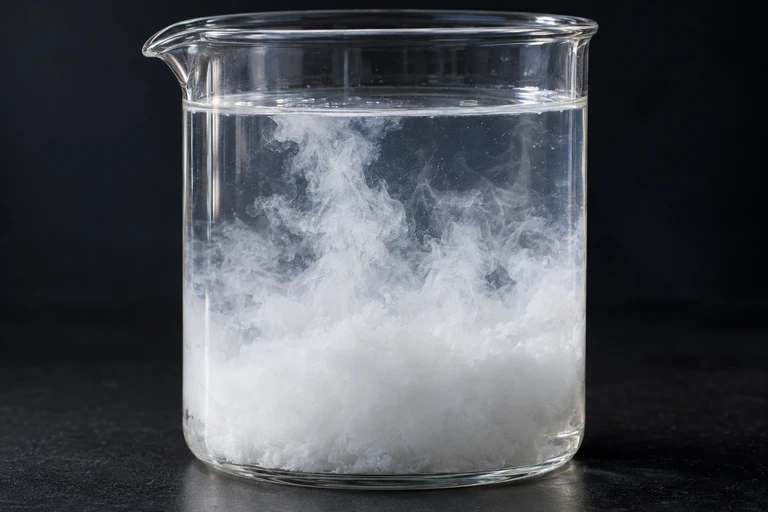 Calcium ions and carbonate ions can combine to form a white calcium carbonate precipitate.
SECTION 5
Detailed Classification & Solubility Rules
Predicting the products of double-replacement reactions hinges on knowing which ionic compounds are soluble and which precipitate. The AP exam provides a truncated set of solubility rules on the reference sheet, but internalizing the most common patterns significantly accelerates problem solving. The table below organizes the key rules that appear most frequently on the exam.
| Ion(s) | Solubility | Key Exceptions |
|---|---|---|
| Na⁺, K⁺, NH₄⁺, NO₃⁻, CH₃COO⁻ | Always soluble | No common exceptions |
| Cl⁻, Br⁻, I⁻ | Generally soluble | Insoluble with Ag⁺, Pb²⁺, Hg₂²⁺ |
| SO₄²⁻ | Generally soluble | Insoluble with Ba²⁺, Pb²⁺, Ca²⁺ (slightly) |
| OH⁻ | Generally insoluble | Soluble with Group 1 cations, Ba²⁺, Sr²⁺, Ca²⁺ (slightly) |
| CO₃²⁻, PO₄³⁻, S²⁻ | Generally insoluble | Soluble with Group 1 cations and NH₄⁺ |
Common Solubility Rules for AP Chemistry
For single replacement reactions, the activity series functions as a predictive tool grounded in standard reduction potentials. A free metal can only displace a cation from solution if the free metal has a more negative (or less positive) standard reduction potential—meaning it is more readily oxidized. The AP exam will not always provide reduction potential tables for these questions; instead, you are expected to apply the activity series qualitatively. A parallel logic applies to halogens: F₂ > Cl₂ > Br₂ > I₂ in oxidizing ability, so Cl₂(aq) can displace Br⁻ from solution but I₂ cannot displace Cl⁻.
SECTION 6
Worked Example — Identifying & Balancing a Reaction
Let's work through a complete example that mirrors an AP FRQ reaction-prediction question. When aqueous solutions of lead(II) nitrate and potassium iodide are mixed, identify the reaction type, write the balanced molecular equation, and derive the net ionic equation.
Worked example
- 1
Step 1 — Identify Possible Products
This is a double-replacement scenario: cations swap anions. The possible products are PbI₂ and KNO₃. Consult solubility rules: I⁻ is generally soluble except with Ag⁺, Pb²⁺, and Hg₂²⁺. Since Pb²⁺ is present, PbI₂ is insoluble and precipitates.Driving force: precipitation of PbI₂(s) - 2
Step 2 — Write the Balanced Molecular Equation
Balance the formula units: Pb²⁺ requires two I⁻ ions, so two moles of KI are needed per mole of Pb(NO₃)₂.Pb(NO₃)₂(aq) + 2 KI(aq) → PbI₂(s) + 2 KNO₃(aq) - 3
Step 3 — Write the Complete Ionic Equation
Dissociate all soluble strong electrolytes into ions. PbI₂ is a solid and remains intact.Pb²⁺(aq) + 2 NO₃⁻(aq) + 2 K⁺(aq) + 2 I⁻(aq) → PbI₂(s) + 2 K⁺(aq) + 2 NO₃⁻(aq) - 4
Step 4 — Derive the Net Ionic Equation
Cancel spectator ions (K⁺ and NO₃⁻) that appear unchanged on both sides.Pb²⁺(aq) + 2 I⁻(aq) → PbI₂(s) - 5
Step 5 — Classify the Reaction
By structural pattern, this is a double-replacement (metathesis) reaction. By driving force, it is a precipitation reaction. No oxidation states change (Pb remains +2, I remains −1), confirming it is not redox.
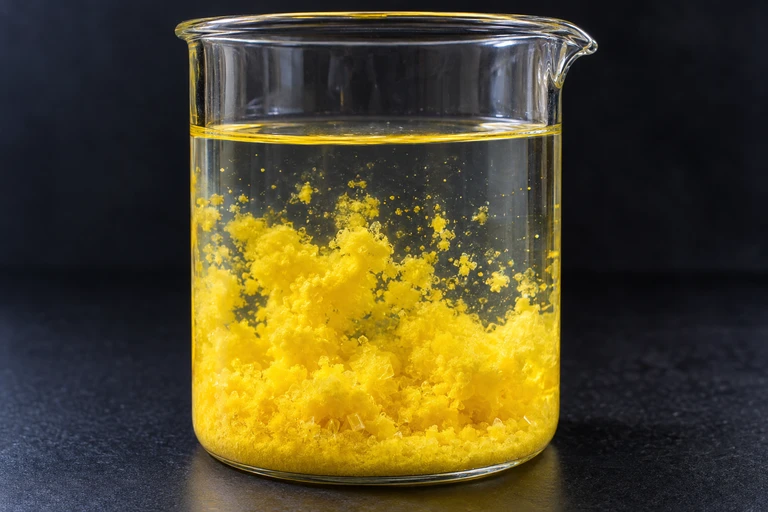 Lead ions and iodide ions combine to form a yellow lead iodide precipitate.
SECTION 7
Strengths & Limitations of Classification Schemes
No single classification scheme captures every nuance of chemical reactivity, and the AP exam sometimes presents reactions that blur the boundaries between categories. Understanding the strengths and limitations of each framework prevents over-reliance on rote categorization and fosters deeper mechanistic thinking.
| Classification Scheme | Strengths | Limitations |
|---|---|---|
| Structural pattern (synthesis, decomposition, SR, DR) | Easy to apply visually; matches how equations look on paper; useful for predicting product formulas. | Does not explain why reactions occur; combustion and disproportionation don't fit neatly. |
| Driving force (precipitation, acid–base, redox) | Explains the thermodynamic impetus; directly linked to net ionic equations; matches AP FRQ expectations. | Some reactions have multiple driving forces (e.g., redox + gas evolution); requires memorizing solubility rules. |
| Oxidation-state analysis | Universal: every reaction can be checked for electron transfer. Precisely identifies the reducing and oxidizing agents. | Assigning oxidation states to polyatomic ions or organic molecules can be ambiguous; doesn't capture proton-transfer chemistry well. |
Comparison of Reaction Classification Approaches
SECTION 8
Connections to Thermodynamics & Electrochemistry
The reaction types introduced in this lesson reappear throughout the AP curriculum in increasingly quantitative contexts. Precipitation reactions connect to solubility equilibria (Ksp), acid–base reactions lead to buffer chemistry and titration curves, and redox reactions form the basis of electrochemistry and cell-potential calculations using the Nernst equation.
| Reaction Type (This Lesson) | Advanced Topic (Later Units) | Key Equation / Concept |
|---|---|---|
| Precipitation | Solubility equilibrium (Unit 7) | Ksp = [cation]ᵐ[anion]ⁿ; Q vs Ksp predicts precipitation |
| Acid–Base | Buffers & Titrations (Unit 8) | Henderson–Hasselbalch: pH = pKa + log([A⁻]/[HA]) |
| Redox | Electrochemistry (Unit 9) | E°cell = E°cathode − E°anode; ΔG° = −nFE° |
| Combustion | Thermochemistry (Unit 5) | ΔH°rxn = ΣΔH°f(products) − ΣΔH°f(reactants) |
How Reaction Types Connect to Advanced AP Chemistry Topics
Mastering reaction classification now pays compound dividends. When you encounter a Ksp problem in Unit 7, you are really predicting whether a precipitation reaction occurs under specific concentration conditions. When you balance a galvanic cell in Unit 9, you are applying the same half-reaction logic from single-replacement reactions but in a quantitative electrochemical framework. The taxonomy you learn here is not a set of labels to memorize—it is the conceptual scaffolding upon which the rest of the course is built.
SECTION 9
Practice Problems
Question 1: CONCEPTUAL
- A. Acid–base neutralization; NaCl precipitates
- B. Precipitation; BaSO₄ is the insoluble product
- C. Oxidation–reduction; Ba is oxidized
- D. Precipitation; NaCl is the insoluble product
Show answer (B)
Question 2: BASIC CALCULATION
- A. 0 to +2
- B. +3 to 0
- C. 0 to +3
- D. 0 to +1
Show answer (C)
Question 3: INTERMEDIATE
- A. H⁺(aq) + OH⁻(aq) → H₂O(l)
- B. HF(aq) + OH⁻(aq) → F⁻(aq) + H₂O(l)
- C. HF(aq) + NaOH(aq) → NaF(aq) + H₂O(l)
- D. H⁺(aq) + F⁻(aq) + Na⁺(aq) + OH⁻(aq) → NaF(aq) + H₂O(l)
Show answer (B)
Question 4: APPLIED
Show answer
Question 5: CRITICAL THINKING