

SECTION 1
Historical Context & Motivation
The question of what holds atoms together in compounds is one of the oldest in chemistry. Early alchemists intuited that some force of "affinity" governed the combination of substances, but a mechanistic understanding had to wait for the discovery of the electron and the development of quantum theory. The notion that atoms might exchange or share electrons to achieve stability transformed chemistry from a descriptive science into one grounded in electronic structure. By the early twentieth century, two landmark models — the Lewis electron-pair model and the Kossel ionic model — provided the conceptual scaffolding upon which our modern understanding of chemical bonding rests.
1897 • Discovery of the Electron
1916 • Lewis & Kossel Models
1932 • Pauling's Electronegativity Scale
1939 • The Nature of the Chemical Bond
The central question this lesson addresses is straightforward yet profound: why do atoms form bonds, and what determines whether a bond is ionic, covalent, or metallic? Answering this question requires us to connect atomic properties — especially electronegativity and ionization energy — to the macroscopic properties of compounds we observe in the laboratory.
SECTION 2
Core Principles & Definitions
Chemical bonding arises because most isolated atoms are energetically unstable relative to bonded configurations. When atoms bond, the resulting arrangement of nuclei and electrons occupies a lower potential energy state than the separated atoms. The type of bond that forms depends primarily on the electronegativity difference (Δχ) between the bonding atoms and on whether the atoms involved are metals, nonmetals, or a combination thereof. It is essential to recognize that bonding exists on a continuum — the categories of ionic, covalent, and metallic are idealizations that describe the dominant character of an interaction rather than rigid, mutually exclusive classes.
Ionic Bonding
Covalent Bonding
Metallic Bonding
Bond Polarity
SECTION 3
Visualizing the Bonding Continuum
The diagram above captures the central organizing principle: electronegativity difference governs bond character. In Cl2, both atoms have identical electronegativity (χ = 3.16), so the shared pair sits symmetrically between the nuclei — a nonpolar covalent bond. In HCl, chlorine's higher electronegativity pulls electron density toward itself, producing a polar covalent bond with partial charges δ+ on hydrogen and δ− on chlorine. In NaCl, the electronegativity gap is so large that sodium effectively transfers its valence electron to chlorine, yielding discrete Na+ and Cl− ions held together by Coulombic attraction. Metallic bonding, shown at the bottom, is distinct because it involves only metals — valence electrons are delocalized across the entire lattice, creating the characteristic "electron sea."
SECTION 4
Quantitative Framework
While bonding type is often assessed qualitatively on the AP exam, several quantitative relationships underpin the energetics of bond formation. Coulomb's law is the most directly relevant equation for ionic bonding, and lattice energy calculations allow us to predict relative stabilities of ionic compounds. For covalent bonds, bond dissociation energy (BDE) quantifies the energy required to homolytically cleave a bond in the gas phase.
COULOMB'S LAW (IONIC INTERACTION ENERGY)
Where E = potential energy of the ion pair, k = Coulomb's constant (8.99 × 10⁹ N·m²/C²), q₁, q₂ = charges on the ions, and d = distance between ion centers. A more negative E indicates a stronger ionic interaction.
LATTICE ENERGY TREND
Lattice energy increases with higher ion charges and decreases with larger ionic radii. This is why MgO (2+/2− charges, small ions) has a much higher lattice energy (3850 kJ/mol) than NaCl (1+/1−, larger ions, 787 kJ/mol).
BOND ENERGY & ENTHALPY OF REACTION
Bond dissociation energies are always positive (endothermic to break). Breaking bonds requires energy input; forming bonds releases energy. The sign convention produces negative ΔH° for exothermic reactions when more energy is released in bond formation than consumed in bond breaking.
SECTION 5
Classifying Bonds & Predicting Properties
The type of bonding in a substance directly determines its macroscopic properties — melting point, electrical conductivity, solubility, and hardness. Being able to move from an atomic-level description of bonding to predictions about bulk behavior is a core AP Chemistry skill. The table below summarizes the key property correlations for each bonding type, while the diagram that follows provides a decision-tree approach to classifying unknown substances.
| Property | Ionic | Covalent (Molecular) | Metallic |
|---|---|---|---|
| Melting / Boiling Point | High (strong lattice) | Low (weak IMFs between molecules) | Variable; generally high |
| Electrical Conductivity (solid) | No (ions locked) | No (no free charges) | Yes (delocalized e⁻) |
| Conductivity (liquid/aq) | Yes (mobile ions) | No | Yes (liquid metal) |
| Hardness / Brittleness | Hard but brittle | Soft, flexible | Malleable, ductile |
| Solubility in Water | Often soluble (ion–dipole) | Polar in polar; nonpolar in nonpolar | Insoluble |
Macroscopic properties correlated with bonding type
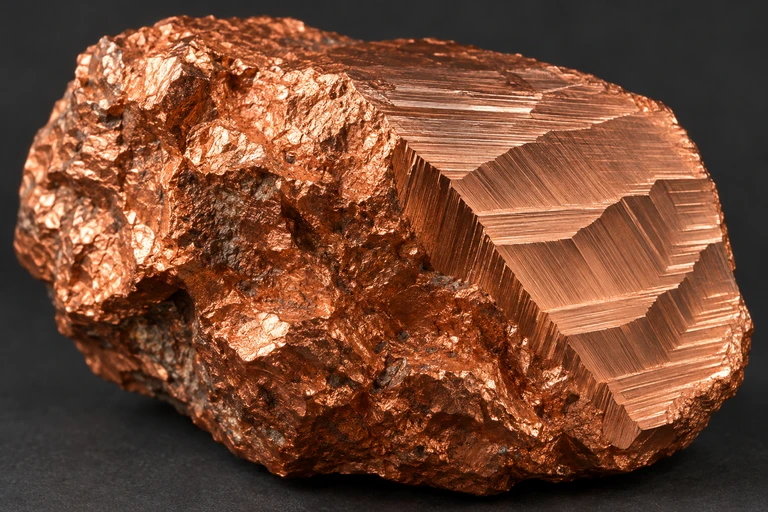 Copper is a metallic solid whose atoms form an ordered crystal structure.
SECTION 6
Worked Example
Worked example
- 1
Step 1 — Identify Atom Types
For MgCl₂: Mg is a metal (Group 2), Cl is a nonmetal (Group 17). For CCl₄: C and Cl are both nonmetals.MgCl₂ → metal + nonmetal; CCl₄ → nonmetal + nonmetal - 2
Step 2 — Determine Electronegativity Differences
Using Pauling values: χ(Mg) = 1.31, χ(C) = 2.55, χ(Cl) = 3.16. For MgCl₂: Δχ = 3.16 − 1.31 = 1.85. For CCl₄: Δχ = 3.16 − 2.55 = 0.61.MgCl₂: Δχ = 1.85 (> 1.7 → ionic); CCl₄: Δχ = 0.61 (polar covalent) - 3
Step 3 — Classify Bond Type
MgCl₂ is classified as an ionic compound — Mg transfers two electrons to form Mg²⁺, and each Cl gains one electron to form Cl⁻. CCl₄ features four polar covalent C–Cl bonds. However, due to the tetrahedral symmetry of CCl₄, the individual bond dipoles cancel, making the molecule nonpolar overall.MgCl₂ = ionic compound; CCl₄ = molecular compound (polar bonds, nonpolar molecule) - 4
Step 4 — Predict Macroscopic Properties
MgCl₂: high melting point (714 °C), conducts electricity when molten or dissolved in water, soluble in water. CCl₄: low melting point (−23 °C), does not conduct electricity in any phase, insoluble in water but soluble in nonpolar solvents.Ionic MgCl₂ → high mp, conducts when dissolved. Molecular CCl₄ → low mp, nonconducting, nonpolar solvent-soluble.
SECTION 7
Comparing Bond Types: Strengths & Limitations
Each bonding model captures an idealized extreme of electron behavior: complete transfer, equal sharing, or full delocalization. Real compounds often exhibit characteristics of more than one model, and understanding where these idealizations break down is just as important as knowing the models themselves.
| Feature | Strengths of the Model | Limitations / Exceptions |
|---|---|---|
| Ionic Model | Accurately predicts lattice energies, solubility trends, and conductivity of salts via Coulomb's law. | No bond is 100% ionic; even NaCl has ~67% ionic character. Fajans' rules show high-charge, small cations polarize anions (partial covalent character). |
| Covalent Model | Lewis structures, VSEPR, and bond energies reliably predict molecular geometry, polarity, and reactivity for most molecular compounds. | Fails for electron-deficient species (BH₃), hypervalent species (SF₆) without expanded octet or MO arguments, and for metallic or delocalized systems. |
| Metallic Model | Explains conductivity, malleability, and luster qualitatively through the electron sea. Band theory extends this quantitatively. | The simple electron sea model cannot explain why some metals are better conductors than others or the existence of semiconductors — band theory is needed. |
Strengths and limitations of each bonding model
SECTION 8
Connection to Advanced Bonding Theories
The Lewis model and electronegativity-based classification you have learned are powerful but inherently approximate. Two advanced frameworks — Valence Bond (VB) Theory and Molecular Orbital (MO) Theory — provide a quantum mechanical foundation for bonding. VB theory introduces hybridization (sp, sp², sp³) to explain observed geometries, while MO theory constructs bonding and antibonding orbitals from linear combinations of atomic orbitals, correctly predicting the paramagnetism of O₂ — something Lewis structures alone cannot do.
| Aspect | Lewis / VSEPR (This Lesson) | MO Theory (Advanced) |
|---|---|---|
| Electron localization | Electrons localized between bonding atoms or as lone pairs | Electrons occupy molecular orbitals delocalized over entire molecule |
| Bond order | Counting shared pairs: single = 1, double = 2, triple = 3 | Bond order = (bonding e⁻ − antibonding e⁻) / 2; can be fractional |
| Paramagnetism of O₂ | Cannot explain (Lewis shows O₂ as diamagnetic) | Correctly predicts two unpaired electrons in π* orbitals |
| Scope | Sufficient for most AP-level questions on structure and properties | Required for diatomic MO diagrams, band theory in solids, and spectroscopy |
Lewis/VSEPR vs. Molecular Orbital Theory
For the AP exam, you should be comfortable drawing MO diagrams for homonuclear diatomics (H₂, N₂, O₂, F₂) and using them to determine bond order and magnetic properties. Band theory — an extension of MO theory to an infinite array of atoms — explains the continuum between metallic conductors, semiconductors, and insulators. These advanced topics build directly on the foundational concepts of electron sharing and transfer you have studied in this lesson.
SECTION 9
Practice Problems
Question 1: CONCEPTUAL
- A. Solid NaCl has no ions, but melting creates ions from neutral atoms.
- B. In the solid, ions are held in fixed lattice positions and cannot move; melting liberates the ions to migrate under an applied electric field.
- C. Melting breaks the covalent bonds in NaCl, freeing electrons to carry current.
- D. The metallic character of sodium only manifests above the melting point.
Show answer (B)
Question 2: BASIC CALCULATION
- A. O–H (Δχ = 1.24)
- B. Na–Cl (Δχ = 2.23)
- C. H–Cl (Δχ = 0.96)
- D. Na–O (Δχ = 2.51)
Show answer (D)
Question 3: INTERMEDIATE
- A. CaO < NaF < KBr
- B. KBr < NaF < CaO
- C. NaF < KBr < CaO
- D. KBr < CaO < NaF
Show answer (B)
Question 4: APPLIED
Show answer
Question 5: CRITICAL THINKING