
SECTION 1
Historical Context & Motivation
For much of the nineteenth century, chemists implicitly assumed that every reaction produced the product with the lowest possible free energy—the most thermodynamically stable outcome. Yet experimental observations in organic synthesis repeatedly defied this expectation: certain reactions at low temperatures yielded one major product, while the same reactions at higher temperatures gave a completely different one. These puzzling results could not be explained by thermodynamics alone, and they pushed the discipline toward a deeper understanding of how reaction rates compete with equilibrium stability to determine product distributions.
1884 • Van 't Hoff & Reaction Kinetics
1889 • Arrhenius Equation
1930s • Transition-State Theory
1960s–70s • Kinetic vs. Thermodynamic Enolates
The central question this lesson addresses is deceptively simple: when a reaction can yield more than one product, what determines which product actually accumulates? The answer lies in the interplay between the heights of activation energy barriers (kinetics) and the depths of free-energy wells (thermodynamics), modulated by temperature, time, and reversibility.
SECTION 2
Core Principles & Definitions
At the heart of this topic lies a single scenario: a common set of reactants can proceed along two (or more) pathways to give different products. One product sits in a deeper free-energy minimum—it is the thermodynamic product. Another product forms through a lower activation-energy barrier—it is the kinetic product. Which one dominates in practice depends on the reaction conditions.
Kinetic Product
Thermodynamic Product
Reversibility Is Key
Temperature as the Switch
SECTION 3
Energy Diagram — Kinetic vs. Thermodynamic Pathways
The diagram above encapsulates the essence of kinetic versus thermodynamic control. Both pathways originate from the same set of reactants at the same free-energy level. The kinetic pathway crosses a lower transition state (TS₁), so at low temperatures the Boltzmann distribution heavily favors molecules that can clear this smaller barrier. The thermodynamic pathway requires surmounting a taller barrier (TS₂), but the resulting product occupies a much deeper free-energy well. At elevated temperatures—or given sufficient time for the reversible kinetic product to re-cross its barrier and funnel into the lower well—the thermodynamic product predominates.
SECTION 4
Mathematical Framework
Two quantitative pillars underpin kinetic and thermodynamic control: the Arrhenius equation, which describes how rate constants depend on activation energy and temperature, and the Gibbs free energy equation, which determines the position of equilibrium. Kinetic control depends on the relative magnitudes of rate constants, while thermodynamic control depends on the relative stabilities captured by ΔG.
ARRHENIUS EQUATION
k = rate constant; A = pre-exponential (frequency) factor; Eₐ = activation energy (J mol−1); R = 8.314 J mol−1 K−1; T = temperature (K). A smaller Eₐ yields a larger k, meaning that product forms faster.
RATIO OF RATE CONSTANTS
When Eₐ₂ > Eₐ₁ the exponent is positive, so k₁ > k₂ and the kinetic product dominates at all temperatures. As T → ∞, the exponential → 1 and the ratio approaches A₁/A₂, reducing kinetic selectivity.
GIBBS FREE ENERGY & EQUILIBRIUM
K = equilibrium constant; a more negative ΔG° corresponds to a larger K, meaning the thermodynamic product is more favored at equilibrium. Under thermodynamic control, the product ratio reflects K, not rate constants.
GIBBS-HELMHOLTZ RELATIONSHIP
At low T, ΔH° dominates; at high T, the TΔS° term grows. The thermodynamic product is the one with the most favorable ΔG°. This equation also explains why increasing temperature can shift the equilibrium product distribution.
SECTION 5
Classic Examples & Temperature Dependence
The concept of kinetic versus thermodynamic control surfaces throughout chemistry. Below we examine the classic examples most frequently tested at the AP level, followed by a diagram showing how product distribution shifts with temperature.
Example 1: Addition of HBr to 1,3-Butadiene
When HBr adds to 1,3-butadiene, two products can form: the 1,2-addition product (kinetic, formed faster via the more stable allylic carbocation intermediate attacking the nearer carbon) and the 1,4-addition product (thermodynamic, more stable due to greater substitution of the resulting double bond). At −80 °C, the 1,2-product predominates (~80%). At 40 °C with equilibration time, the 1,4-product predominates (~80%) because the reaction becomes reversible and the system relaxes toward the lower-energy product.
Example 2: Diamond vs. Graphite
Graphite is the thermodynamic product of carbon at standard conditions (ΔG°f = 0 by convention), while diamond is a kinetic product—metastable because the activation energy for the diamond-to-graphite conversion is astronomically high. This is a vivid AP-relevant example of kinetic trapping: the kinetic product persists indefinitely because the reverse barrier is insurmountable at ambient conditions.
Example 3: Allotropes of Sulfur
Rhombic sulfur (S₈) is the thermodynamically stable allotrope below 95.3 °C, while monoclinic sulfur is stable above that temperature. Rapidly cooling molten sulfur can trap the monoclinic form as a kinetic product, which slowly converts to rhombic sulfur at room temperature—a process governed by the high activation energy for the solid-state rearrangement.
SECTION 6
Worked Example
Worked example
- 1
Step 1 — Read the Energy Diagram
A reaction coordinate diagram shows reactant R at G = 0 kJ mol−1 (relative). Product A has G = −20 kJ mol−1 with Eₐ = 50 kJ mol−1. Product B has G = −40 kJ mol−1 with Eₐ = 80 kJ mol−1. - 2
Step 2 — Identify the Kinetic Product
The kinetic product is the one formed through the pathway with the lower activation energy. Since Eₐ(A) = 50 kJ mol⁻¹ < Eₐ(B) = 80 kJ mol⁻¹, product A forms faster.Kinetic product = A - 3
Step 3 — Identify the Thermodynamic Product
The thermodynamic product is the one in the deeper free-energy well. Product B has G = −40 kJ mol⁻¹ compared with A's G = −20 kJ mol⁻¹, so B is more stable.Thermodynamic product = B - 4
Step 4 — Predict Low-Temperature Outcome
At low temperature, most molecules lack the energy to surmount the 80 kJ mol⁻¹ barrier to B. The majority cross the 50 kJ mol⁻¹ barrier and form A. If the reaction is irreversible under these conditions, A accumulates.Low T → product A (kinetic control) - 5
Step 5 — Predict High-Temperature Outcome
At high temperature, both barriers are accessible. If the reaction to A is reversible, molecules that initially form A can revert to R and then proceed over the higher barrier to form B. Given enough time, equilibrium favors B because it has the more negative ΔG.High T → product B (thermodynamic control)
SECTION 7
Kinetic Control vs. Thermodynamic Control — Side by Side
| Feature | Kinetic Control | Thermodynamic Control |
|---|---|---|
| Determining factor | Relative rates (k values) | Relative stabilities (ΔG values) |
| Key parameter | Activation energy (Eₐ) | Gibbs free energy change (ΔG°) |
| Favored at | Low temperature, short time | High temperature, long time |
| Reversibility | Often irreversible under conditions | Requires reversibility to equilibrate |
| Product is | Fastest-forming, not necessarily most stable | Most stable, not necessarily fastest-forming |
| Classic example | 1,2-addition to 1,3-butadiene (−80 °C) | 1,4-addition to 1,3-butadiene (40 °C) |
Summary comparison of kinetic and thermodynamic control
SECTION 8
Connections to Advanced Theory & Other AP Topics
The kinetic-versus-thermodynamic framework extends well beyond organic addition reactions. In electrochemistry, the overpotential required to drive a cell reaction is essentially a kinetic barrier; the cell potential E° reflects thermodynamic favorability. In biochemistry, enzymes achieve selectivity by lowering the activation energy for one pathway over another—effectively enforcing kinetic control on reactions that might otherwise yield a different thermodynamic product in solution.
| AP Chemistry Topic | Connection to Kinetic/Thermo Control |
|---|---|
| Le Chatelier's Principle | Shifting equilibrium by temperature change is essentially toggling toward thermodynamic control (heating an exothermic rxn shifts toward reactants, the thermodynamic position). |
| Catalysis | A catalyst lowers Eₐ for both forward and reverse reactions equally, reaching equilibrium faster without changing which product is thermodynamically favored. It can, however, be designed to selectively lower Eₐ for one pathway (selective catalysis). |
| Electrochemistry | Cell potential (E°) is a thermodynamic quantity (ΔG° = −nFE°). Overpotential is the kinetic barrier for electron transfer at an electrode surface. |
| Phase Diagrams | Supercooling and superheating are kinetic phenomena where phase transitions are delayed past their thermodynamic transition temperatures due to nucleation barriers. |
In advanced coursework, you will encounter Hammond's postulate, which connects the structure of a transition state to the nearest energy minimum—early transition states resemble reactants and late transition states resemble products. You may also study Curtin-Hammett conditions, where two rapidly interconverting intermediates funnel into products solely through their respective barrier heights, making product ratio independent of intermediate populations. These ideas represent natural extensions of the kinetic/thermodynamic framework you are mastering here.
SECTION 9
Practice Problems
Question 1: CONCEPTUAL
- A. X is the thermodynamic product and Y is the kinetic product.
- B. X is the kinetic product and Y is the thermodynamic product.
- C. Both X and Y are kinetic products because they have different activation energies.
- D. Y is both the kinetic and thermodynamic product because it has the lower free energy.
Show answer (B)
Question 2: BASIC CALCULATION
- A. 500 K
- B. 750 K
- C. 1000 K
- D. 1500 K
Show answer (C)
Question 3: INTERMEDIATE
- A. P is the thermodynamic product because it predominates at the lower temperature where equilibrium is more favorable for exothermic reactions.
- B. Q is the thermodynamic product because it predominates when the system has sufficient energy and time to reach equilibrium.
- C. A catalyst was added at the higher temperature, changing the equilibrium constant to favor Q.
- D. The reaction mechanism changes at higher temperature, so kinetic/thermodynamic labels do not apply.
Show answer (B)
Question 4: APPLIED
Show answer
Question 5: CRITICAL THINKING
Show answer
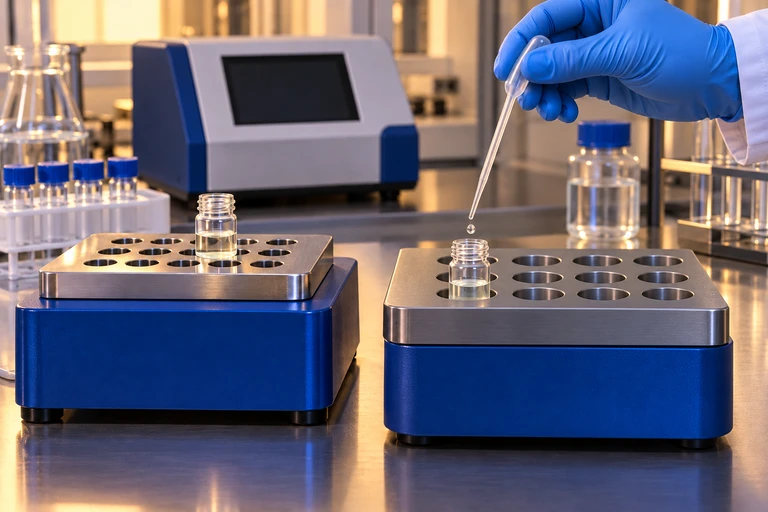 At 400 K, the given product distribution changes from 50% N after 5 minutes to 80% N after 120 minutes. Cooling an aliquot can approximately preserve its distribution if interconversion becomes sufficiently slow.
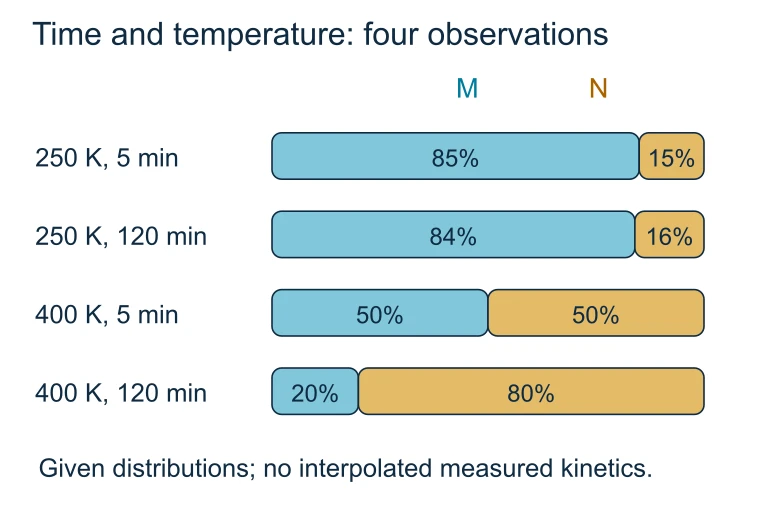 At 400 K, the given product distribution changes from 50% N after 5 minutes to 80% N after 120 minutes. Cooling an aliquot can approximately preserve its distribution if interconversion becomes sufficiently slow.
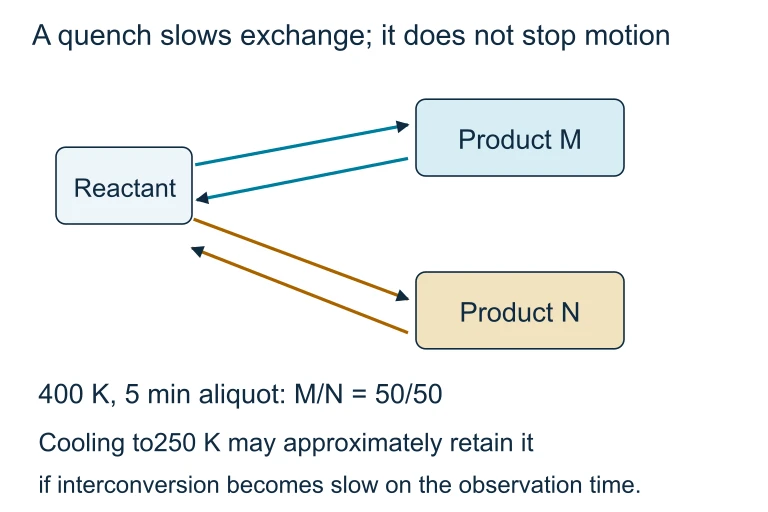 A 400 K aliquot with a 50:50 M:N distribution may approximately retain that distribution on cooling to 250 K if interconversion slows sufficiently.