

SECTION 1
Historical Context & Motivation
Humans have shaped metals for millennia—copper, bronze, and iron each defined entire ages of civilization—yet a coherent atomic-level picture of why metals conduct electricity, bend without shattering, and gleam with characteristic luster arrived only in the twentieth century. Early metallurgists understood empirically that mixing tin into copper produced a harder alloy (bronze), but they could not explain the mechanism. The development of X-ray crystallography and quantum mechanics finally revealed that the macroscopic properties of metals arise from two intertwined features: a regular crystal lattice of cations and a delocalized sea of electrons that permeates the structure.
~3300 BCE • Bronze Age Begins
1912 • X-ray Diffraction of Crystals
1913 • Bragg's Law & Metallic Structures
1927–1928 • Free Electron Model
1930s–Present • Band Theory & Modern Alloy Design
The central question this lesson addresses is: How does the arrangement of atoms and the nature of metallic bonding account for the physical properties of pure metals and their alloys? Understanding the answer is essential not only for AP Chemistry but for appreciating materials science broadly.
SECTION 2
Core Principles of Metallic Bonding
Metallic bonding differs fundamentally from ionic and covalent bonding. In a metallic solid, each atom releases one or more valence electrons into a communal pool that is not associated with any single atom. The resulting structure consists of an ordered array of metal cations immersed in a delocalized electron sea. Because these valence electrons are shared by all cations simultaneously—rather than being transferred (ionic) or shared between two atoms (covalent)—the bonding is nondirectional and extends uniformly throughout the solid.
Electron Sea Model
Close-Packed Lattice
Nondirectional Bonding
Electrical & Thermal Conductivity
KEY TAKEAWAY
SECTION 3
Visualizing the Metallic Lattice
In the diagram above, the regularity of the cation positions reflects the crystalline order found in real metals. Notice that the electrons are not localized between specific pairs of cations the way a covalent bond would be; instead, the cyan dots are scattered throughout the lattice. This delocalization is what makes metallic bonding fundamentally different from covalent or ionic interactions. When an electric field is applied across the solid, these mobile electrons drift in one direction, constituting an electrical current. Similarly, when one face of the metal is illuminated, the free electrons oscillate in response to the electromagnetic wave and re-emit light, producing the characteristic metallic luster.
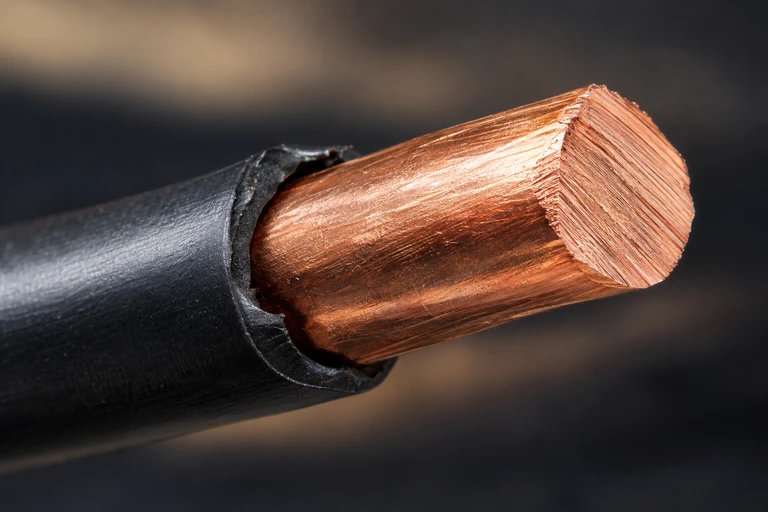 Mobile electrons in copper allow charge to move through the conductor.
SECTION 4
Crystal Packing & Unit Cells
The arrangement of atoms in a metallic crystal is described by its unit cell—the smallest repeating three-dimensional pattern that, when translated in all directions, regenerates the entire lattice. Three unit-cell types dominate metallic elements: body-centered cubic (BCC), face-centered cubic (FCC), and hexagonal close-packed (HCP). The packing efficiency and coordination number differ among these, directly influencing density and mechanical behavior.
| Property | BCC | FCC | HCP |
|---|---|---|---|
| Atoms per unit cell | 2 | 4 | 6 (hexagonal cell) |
| Coordination number | 8 | 12 | 12 |
| Packing efficiency | 68% | 74% | 74% |
| Edge–radius relation | a = 4r / √3 | a = 2√2 · r | a = 2r |
| Example metals | Fe, W, Cr, Na | Cu, Au, Ag, Al | Mg, Zn, Ti |
Comparison of the three common metallic crystal structures
DENSITY FROM UNIT CELL
ρ = density (g/cm³); n = atoms per unit cell; M = molar mass (g/mol); Nₐ = Avogadro's number (6.022 × 10²³ mol⁻¹); a = edge length (cm)
FCC EDGE–RADIUS RELATIONSHIP
In an FCC cell, atoms touch along the face diagonal. The face diagonal equals 4r, and because the face diagonal of a cube is a√2, solving gives a = 4r / √2 = 2√2 · r.
Both FCC and HCP achieve the theoretical maximum packing fraction of 74%, meaning only 26% of the crystal volume is void space. BCC structures are slightly less efficient at 68%. These differences matter: FCC metals like copper and gold are generally more ductile because their close-packed planes allow more slip systems, while BCC metals like iron exhibit greater hardness at room temperature. When the AP exam asks you to relate crystal structure to macroscopic properties, the coordination number and packing efficiency are the key links.
SECTION 5
Alloys — Substitutional and Interstitial
An alloy is a mixture of a metal with one or more other elements (metallic or nonmetallic) that retains metallic bonding and properties. Alloys are not compounds with fixed stoichiometric ratios; rather, they are solid solutions whose composition can vary continuously over some range. The two principal types—substitutional alloys and interstitial alloys—differ in how the solute atoms fit into the host lattice.
For a substitutional alloy to form readily, the Hume-Rothery rules provide useful guidelines: the atomic radii of the two metals should differ by no more than about 15%, the metals should have similar electronegativities and crystal structures, and they should share the same valence. Brass (Cu–Zn) is the classic example—copper and zinc have comparable radii and both adopt FCC or HCP structures under the right compositions. In contrast, interstitial alloys form when the solute atom is much smaller than the host. Carbon (atomic radius ≈ 77 pm) fits into the interstitial holes of the iron lattice (atomic radius ≈ 126 pm), producing steel. The small interstitial atoms impede the motion of dislocations—line defects in the lattice—thereby increasing hardness and tensile strength relative to the pure metal.
AP Exam Tip
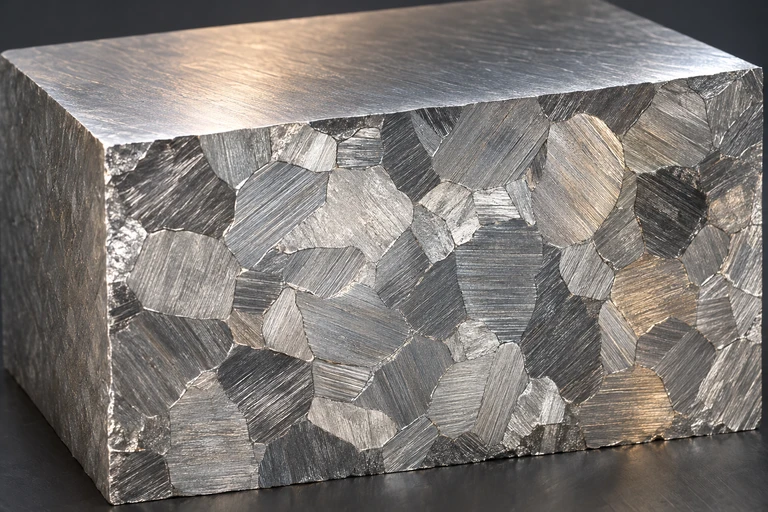 An alloy’s microstructure contains crystalline grains separated by grain boundaries.
SECTION 6
Worked Example — Calculating Density from a Unit Cell
A common AP-level problem asks you to calculate the density of a metal from its unit-cell type and atomic radius. The following example walks through the complete calculation for gold, which crystallizes in an FCC lattice.
Density of Gold from its FCC Unit Cell
- 1
Step 1 — Identify Given Information
Gold crystallizes in an FCC structure. Its atomic radius is r = 144 pm = 1.44 × 10⁻⁸ cm. Molar mass M = 196.97 g/mol. FCC cells contain n = 4 atoms per unit cell. - 2
Step 2 — Calculate Edge Length (a)
For FCC: a = 2√2 · r = 2(1.414)(1.44 × 10⁻⁸ cm) = 4.073 × 10⁻⁸ cm.a = 4.073 × 10⁻⁸ cm - 3
Step 3 — Calculate Unit Cell Volume
V = a³ = (4.073 × 10⁻⁸ cm)³ = 6.756 × 10⁻²³ cm³.V = 6.756 × 10⁻²³ cm³ - 4
Step 4 — Apply the Density Formula
ρ = (n × M) / (Nₐ × a³) = (4 × 196.97 g/mol) / (6.022 × 10²³ mol⁻¹ × 6.756 × 10⁻²³ cm³). Numerator = 787.88 g/mol. Denominator = 40.67 cm³/mol.ρ ≈ 19.4 g/cm³ - 5
Step 5 — Verify Reasonableness
The accepted density of gold is 19.3 g/cm³. Our calculated value of 19.4 g/cm³ matches within rounding, confirming both the FCC model and our arithmetic.
SECTION 7
Properties of Metals vs. Other Solid Types
AP Chemistry expects you to compare metallic solids with ionic, covalent-network, and molecular solids. The electron-sea model predicts metallic properties; contrasting it with the bonding in other solid types clarifies why each class behaves differently.
| Property | Metallic Solid | Ionic Solid | Covalent Network | Molecular Solid |
|---|---|---|---|---|
| Particles | Cations + e⁻ sea | Cations + anions | Atoms (covalent bonds) | Molecules (IMFs) |
| Conductivity (solid) | High (mobile e⁻) | None (ions fixed) | None (usually) | None |
| Malleability | High | Brittle | Very hard, brittle | Soft |
| Melting point | Variable (Hg to W) | High | Very high | Low |
| Luster | Shiny (e⁻ re-emit light) | No | No | No |
Comparison of the four classes of crystalline solids
KEY TAKEAWAY
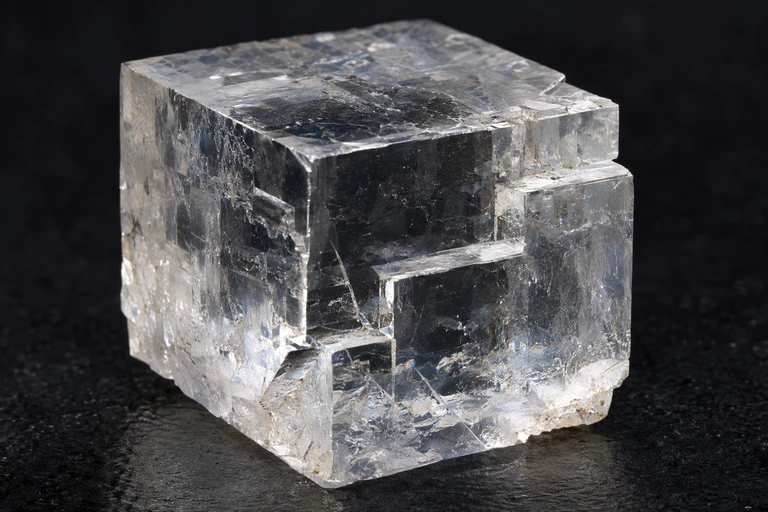 An ionic crystal can cleave when displacement brings like charges into neighboring positions.
SECTION 8
Connection to Band Theory
The electron-sea model is a powerful qualitative tool, but a more rigorous quantum-mechanical treatment leads to band theory. When N atoms come together in a metallic solid, their N discrete atomic orbitals overlap and split into a near-continuous band of N closely spaced molecular orbitals. The lower-energy portion of this band is filled with electrons while the upper portion remains empty, and because the energy gaps between adjacent levels are negligibly small, electrons can be promoted with essentially zero energy input—this is the quantum explanation for metallic conductivity.
| Feature | Electron-Sea Model | Band Theory |
|---|---|---|
| Electron description | Free, delocalized gas of e⁻ | Electrons fill a continuum of energy levels (bands) |
| Conductivity | Mobile e⁻ carry current | Partially filled band allows electron promotion with negligible energy |
| Insulators explained? | Not directly | Yes—large band gap prevents electron promotion |
| Semiconductors? | Not explained | Small band gap; conductivity increases with temperature |
| AP relevance | Sufficient for qualitative questions | Beyond AP scope; useful for advanced understanding |
Electron-sea model vs. band theory
For the AP Chemistry exam, you are not required to invoke band theory, but understanding that the electron-sea model is a simplified version of a deeper quantum picture helps you appreciate its limitations. When a question asks why metals conduct but ionic solids do not in the solid state, the electron-sea answer—mobile delocalized electrons versus fixed ions in a lattice—is perfectly sufficient and expected.
SECTION 9
Practice Problems
Question 1: CONCEPTUAL
- A. Metallic bonds are weaker than ionic bonds, so metal atoms separate more easily under stress.
- B. In metals, delocalized electrons allow layers of cations to slide without disrupting the bonding, whereas shifting ions in an ionic solid aligns like charges, causing repulsion and fracture.
- C. Metal atoms are smaller than ions, so they can rearrange more freely in the lattice.
- D. Metallic solids lack a regular lattice structure, so there are no defined planes to fracture along.
Show answer (B)
Question 2: BASIC CALCULATION
- A. 288 pm
- B. 333 pm
- C. 407 pm
- D. 576 pm
Show answer (C)
Question 3: INTERMEDIATE
- A. Steel is substitutional; brass is interstitial.
- B. Steel is interstitial; brass is substitutional.
- C. Both are substitutional because both involve metallic elements.
- D. Both are interstitial because the solute atoms are always smaller than the solvent atoms.
Show answer (B)
Question 4: APPLIED
4 ptsShow answer
Question 5: CRITICAL THINKING
4 ptsShow answer
SUMMARY
Lesson Summary
Summary
Metallic solids consist of metal cations arranged in a crystal lattice held together by a delocalized sea of valence electrons. This nondirectional bonding explains the hallmark properties of metals: electrical and thermal conductivity (mobile electrons), malleability and ductility (layers slide without breaking bonds), and metallic luster (electrons absorb and re-emit visible light). The three dominant unit-cell types—BCC, FCC, and HCP—differ in coordination number and packing efficiency, and the density formula ρ = nM/(Nₐa³) connects the atomic-scale unit cell to a measurable macroscopic property.
Alloys are solid solutions that modify metallic properties. In substitutional alloys (e.g., brass), solute atoms of similar size replace host atoms at lattice sites. In interstitial alloys (e.g., steel), much smaller atoms such as carbon occupy the holes between host atoms. Both types disrupt the regular lattice, increasing hardness by impeding dislocation motion. For the AP exam, connect the electron-sea model to conductivity and malleability, distinguish substitutional from interstitial alloys by relative atomic size, and apply unit-cell geometry to density calculations.