

SECTION 1
Historical Context & Motivation
The observation that certain minerals cleave along perfectly flat planes—producing faces that meet at characteristic angles—fascinated natural philosophers long before atoms were confirmed. When René-Just Haüy accidentally dropped a calcite crystal in 1781, the resulting fragments all displayed the same rhombohedral shape, leading him to propose that crystals are built from repeating "integrant molecules." This was among the first suggestions that macroscopic regularity reflects microscopic periodicity. By the early twentieth century, the discovery of X-ray diffraction would transform Haüy's conjecture into a quantitative science, revealing the precise three-dimensional arrangements of ions in salts such as NaCl.
1781 • Haüy's Crystal Hypothesis
1895 • Discovery of X-rays
1912 • X-ray Diffraction by Crystals
1913 • Bragg Solves NaCl Structure
1918 • Born–Landé Equation
The Braggs' determination of the NaCl structure was a watershed moment: it showed that no discrete "NaCl molecules" exist in the solid. Instead, each Na⁺ is surrounded by six Cl⁻ ions and vice versa, forming an extended three-dimensional lattice held together by electrostatic forces. Understanding how and why ions adopt specific arrangements remains central to predicting the physical properties of ionic compounds—melting point, solubility, electrical conductivity, and mechanical behavior.
SECTION 2
Core Principles of Ionic Solid Structure
Ionic solids are composed of cations and anions held in a rigid, repeating three-dimensional pattern by Coulombic (electrostatic) attractions. Because these attractions act in all directions, ionic solids do not contain individual molecules; instead, the empirical formula merely records the simplest whole-number ratio of ions. Several foundational ideas govern how these lattices form and behave.
Crystal Lattice & Unit Cell
Coordination Number
Coulomb's Law & Lattice Energy
Radius Ratio Rule
Properties from Structure
KEY TAKEAWAY
SECTION 3
Visualizing the NaCl Unit Cell
The most commonly studied ionic structure on the AP Chemistry exam is the rock-salt (NaCl) structure. In this arrangement, each Na⁺ ion is surrounded by six Cl⁻ ions (octahedral coordination), and each Cl⁻ ion is likewise surrounded by six Na⁺ ions. The unit cell is face-centered cubic (FCC): Cl⁻ ions sit at the corners and face centers, while Na⁺ ions occupy all edge-center and the body-center positions (or equivalently, both ions form interpenetrating FCC sublattices).
Counting ions in the unit cell is an essential AP skill. Corner ions are shared among eight unit cells (contributing ⅛ each), edge-center ions among four cells (¼ each), face-center ions among two cells (½ each), and a body-center ion belongs entirely to one cell. For NaCl, this yields 4 formula units per unit cell: 4 Na⁺ and 4 Cl⁻. This counting technique applies to every crystal structure you will encounter.
SECTION 4
Mathematical Framework — Coulomb's Law & Lattice Energy
The stability of an ionic solid is quantified by its lattice energy (U), defined as the energy released when gaseous cations and anions condense into one mole of crystalline solid (exothermic by convention, though some texts define it as the endothermic reverse). The AP exam does not require you to calculate lattice energy numerically, but understanding the Coulombic relationship that underlies it is essential for comparing ionic compounds.
COULOMB'S LAW (ION PAIR)
E = electrostatic potential energy; k = Coulomb's constant (8.99 × 10⁹ N·m²/C²); q₊ and q₋ = ion charges; d = distance between ion centers (sum of ionic radii). A more negative E means a stronger attraction.
For the full lattice, the Born–Landé equation accounts for the geometry of the crystal through the Madelung constant (M), which sums all pairwise Coulombic interactions in the lattice. While the AP exam will not ask you to use the Madelung constant directly, the underlying principle is straightforward: higher ion charges and shorter interionic distances produce larger lattice energies.
BORN–LANDÉ EQUATION (REFERENCE)
NA = Avogadro's number; M = Madelung constant (1.748 for NaCl); r₀ = equilibrium interionic distance; n = Born exponent (~5–12). This is beyond the AP syllabus but illustrates why lattice energy scales with charge product and inversely with distance.
AP EXAM TIP
LATTICE ENERGY TREND (QUALITATIVE)
This proportionality is the key relationship for the AP exam. Doubling either charge roughly quadruples lattice energy (since the product of charges quadruples for a compound like MgO vs. NaCl); decreasing ionic radii also increases lattice energy.
SECTION 5
Common Crystal Structure Types
Although the NaCl rock-salt structure is the most widely tested, ionic compounds adopt various crystal structures depending on the radius ratio (r⁺/r⁻) and stoichiometry. The radius ratio rule offers a rough prediction of coordination number and therefore structure type: when the cation is much smaller than the anion, fewer anions can pack around it, yielding lower coordination numbers.
| Structure Type | Example | CN (cation : anion) | r⁺/r⁻ Range | Ions per Unit Cell |
|---|---|---|---|---|
| Zinc blende | ZnS | 4 : 4 | 0.225 – 0.414 | 4 ZnS |
| Rock salt | NaCl | 6 : 6 | 0.414 – 0.732 | 4 NaCl |
| Cesium chloride | CsCl | 8 : 8 | > 0.732 | 1 CsCl |
| Fluorite | CaF₂ | 8 : 4 | > 0.732 | 4 CaF₂ |
Common ionic crystal structure types and their key parameters.
SECTION 6
Worked Example — Counting Ions and Comparing Lattice Energies
Counting Ions in the NaCl Unit Cell
- 1
Step 1 — Identify ion positions
In the NaCl unit cell, Cl⁻ ions occupy corner positions (8 corners) and face-center positions (6 faces). Na⁺ ions occupy edge-center positions (12 edges) and the single body center. - 2
Step 2 — Apply fractional counting for Cl⁻
Corner ions: 8 × (1/8) = 1. Face-center ions: 6 × (1/2) = 3. Total Cl⁻ per unit cell = 1 + 3 = 4.4 Cl⁻ per unit cell - 3
Step 3 — Apply fractional counting for Na⁺
Edge-center ions: 12 × (1/4) = 3. Body-center ion: 1 × 1 = 1. Total Na⁺ per unit cell = 3 + 1 = 4.4 Na⁺ per unit cell - 4
Step 4 — Confirm stoichiometry
Ratio of Na⁺ : Cl⁻ = 4 : 4 = 1 : 1, consistent with the formula NaCl. There are 4 formula units per unit cell.4 NaCl formula units per unit cell ✓
Ranking Lattice Energies: NaF, NaCl, MgO
- 1
Step 1 — Identify charges
NaF: +1/−1. NaCl: +1/−1. MgO: +2/−2. The charge product for MgO (|2 × 2| = 4) is four times that of NaF and NaCl (|1 × 1| = 1). - 2
Step 2 — Compare ionic radii
For the 1+/1− pair: F⁻ (133 pm) < Cl⁻ (181 pm), so the interionic distance in NaF is shorter than in NaCl. For MgO: Mg²⁺ (72 pm) + O²⁻ (140 pm) = 212 pm, which is comparable to NaF but with four times the charge product. - 3
Step 3 — Rank lattice energies
Lattice energy ∝ (q₊ × q₋)/(r₊ + r₋). MgO has the highest lattice energy due to its 2+/2− charges. Between NaF and NaCl, NaF has higher lattice energy because F⁻ is smaller than Cl⁻ (shorter distance).MgO > NaF > NaCl
SECTION 7
Properties of Ionic Solids — Strengths & Limitations
The extended lattice model explains the characteristic physical properties of ionic solids. Because every ion is held in place by strong Coulombic forces from multiple neighbors, disrupting the lattice requires substantial energy. At the same time, the lack of directionality in electrostatic forces means that once the lattice is disrupted—say, by a mechanical shear—the crystal shatters rather than deforms, because like charges are forced into contact.
| Property | Observation | Structural Explanation |
|---|---|---|
| High melting/boiling points | NaCl: 801 °C; MgO: 2852 °C | Strong, non-directional Coulombic attractions require large energy input to overcome. |
| Hardness but brittleness | Crystals resist scratching but shatter on impact | Displacing one layer by half a unit cell aligns like charges → repulsion → fracture. |
| Electrical conductivity | Insulators as solids; conductors when molten or dissolved | Ions are locked in lattice positions in the solid state; they become mobile in the liquid or in aqueous solution. |
| Solubility in polar solvents | Many ionic compounds dissolve in water | Ion–dipole interactions with water molecules can compensate for the lattice energy, favoring dissolution. |
Key physical properties of ionic solids and their lattice-based explanations.
KEY TAKEAWAY
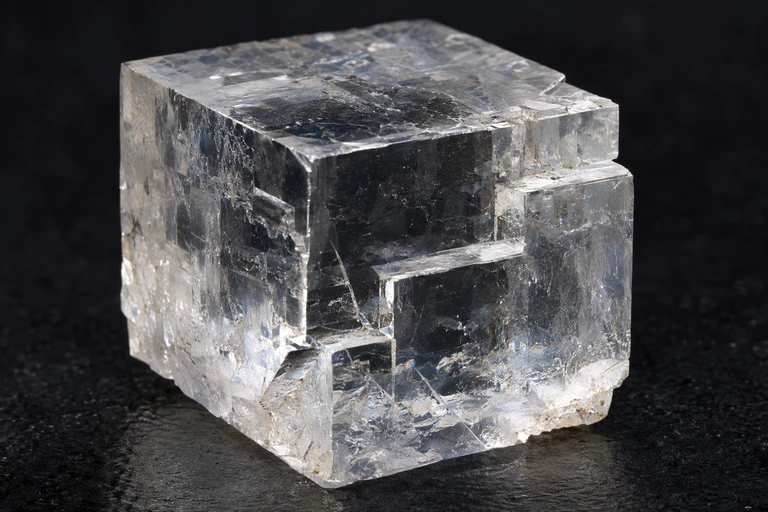 An ionic crystal can cleave when displacement brings like charges into neighboring positions.
 Dissolved ions carry charge through saltwater between immersed electrodes.
SECTION 8
Ionic Solids in the Broader Solids Landscape
AP Chemistry requires you to distinguish four major categories of crystalline solids—ionic, metallic, covalent-network, and molecular—based on the types of interactions holding them together. Each category produces distinct physical behaviors that are directly testable.
| Property | Ionic | Metallic | Covalent-Network | Molecular |
|---|---|---|---|---|
| Particles | Cations & anions | Metal cations & delocalized e⁻ | Atoms (covalent bonds) | Molecules (IMFs) |
| Melting point | High | Variable (often high) | Very high | Low |
| Hardness | Hard, brittle | Variable, malleable | Very hard | Soft |
| Conductivity (solid) | No | Yes | No (except graphite) | No |
| Conductivity (liquid) | Yes | Yes | No | No |
Comparison of the four types of crystalline solids.
Beyond the AP syllabus, advanced solid-state chemistry explores defect chemistry (Schottky and Frenkel defects), non-stoichiometric compounds, and band theory descriptions of ionic insulators. For now, focus on the qualitative relationships: the lattice model, Coulomb's law trends, and how ion charges and sizes predict physical properties. These ideas directly connect to thermodynamic topics like the Born–Haber cycle, which uses lattice energy alongside ionization energy, electron affinity, and enthalpy of formation to construct Hess's law cycles for ionic compound formation.
SECTION 9
Practice Problems
Question 1: CONCEPTUAL
- A. Melting breaks covalent bonds within NaCl molecules, releasing free electrons.
- B. In the solid, ions are fixed in lattice positions and cannot move; in the liquid, ions are mobile and can carry charge.
- C. Solid NaCl contains neutral atoms; melting ionizes them into Na⁺ and Cl⁻.
- D. The metallic bonding in solid NaCl prevents electron flow, but melting converts it to ionic bonding.
Show answer (B)
Question 2: BASIC CALCULATION
- A. 1
- B. 2
- C. 4
- D. 8
Show answer (A)
Question 3: INTERMEDIATE
- A. CaO < NaCl < LiF
- B. NaCl < LiF < CaO
- C. LiF < NaCl < CaO
- D. NaCl < CaO < LiF
Show answer (B)
Question 4: APPLIED
5 ptsShow answer
Question 5: CRITICAL THINKING
5 ptsShow answer
SUMMARY
Summary — Structure of Ionic Solids
Summary
Ionic solids consist of cations and anions arranged in a repeating crystal lattice held together by Coulombic (electrostatic) attractions. No discrete molecules exist—the empirical formula represents only the simplest ion ratio. The unit cell is the smallest repeating portion of the lattice; counting shared ions yields the number of formula units per cell. The coordination number—determined largely by the radius ratio (r⁺/r⁻)—dictates the crystal structure type: zinc blende (CN = 4), rock salt (CN = 6), or cesium chloride (CN = 8).
Lattice energy increases with higher ion charges and smaller ionic radii, as predicted by the qualitative form of Coulomb's law: U ∝ (q⁺ × q⁻)/(r⁺ + r⁻). This relationship directly explains trends in melting point, hardness, and brittleness. Ionic solids are electrical insulators as solids (ions are immobile) but conduct electricity when molten or dissolved because their ions become free to migrate.