AP Chemistry • Properties of Substances and Mixtures

Solutions and Mixtures

Understanding how intermolecular forces govern the formation, behavior, and properties of homogeneous and heterogeneous mixtures.

AP Chemistry illustration with a laboratory flask, atom, and microscope
Inside this lesson 9 sections 5 questions 9 figures

SECTION 1

Historical Context & Motivation

The study of solutions and mixtures has been central to chemistry since alchemists first attempted to dissolve metals in acids and separate components from ores. Early chemists recognized that combining substances did not always produce new compounds—sometimes the components retained their identities and could be recovered by physical means. This fundamental distinction between chemical change and physical mixing laid the groundwork for understanding matter at the molecular level, eventually revealing that intermolecular forces—not just stoichiometry—dictate whether one substance will dissolve in another.

1803 • Henry's Law

William Henry quantified the relationship between the pressure of a gas above a liquid and its solubility, establishing one of the first mathematical models for solution behavior.

1887 • Raoult's Law & van 't Hoff Factor

François-Marie Raoult described how solute particles lower vapor pressure, while Jacobus van 't Hoff generalized colligative property equations to account for ionic dissociation.

1923 • Debye–Hückel Theory

Peter Debye and Erich Hückel modeled the behavior of electrolyte solutions by considering ion–ion interactions, explaining deviations from ideal dilute solution behavior.

1960s • Modern Computational Chemistry

Advances in molecular dynamics simulations allowed chemists to model solvation shells and predict solubility from first principles, bridging macroscopic observations with molecular-level theory.

The central question driving the study of solutions is deceptively simple: Why do some substances dissolve in certain solvents and not others, and how do dissolved particles alter the physical properties of the solvent? Answering this question requires a deep understanding of intermolecular forces, thermodynamics, and the energetic trade-offs that govern the dissolution process.

SECTION 2

Core Principles & Definitions

A mixture is any combination of two or more substances in which each substance retains its own chemical identity. Mixtures are broadly classified as homogeneous (uniform composition throughout) or heterogeneous (visibly distinguishable phases or regions of non-uniform composition). A solution is a special case of a homogeneous mixture in which a solute is dispersed at the molecular or ionic level in a solvent. The solvent is typically the component present in the greatest amount.

1

Like Dissolves Like

Polar solutes dissolve in polar solvents; nonpolar solutes dissolve in nonpolar solvents. The driving factor is the compatibility of intermolecular forces between solute and solvent particles.
2

Energetics of Dissolution

Dissolving requires breaking solute–solute and solvent–solvent interactions (endothermic) and forming solute–solvent interactions (exothermic). The net enthalpy change (ΔHsoln) and the entropy increase together determine spontaneity.
3

Concentration & Saturation

A solution is unsaturated when it can dissolve more solute, saturated at equilibrium with undissolved solute, and supersaturated when it temporarily holds more solute than the equilibrium amount.
4

Colligative Properties

Properties such as boiling-point elevation, freezing-point depression, vapor-pressure lowering, and osmotic pressure depend on the number of dissolved particles, not their identity.

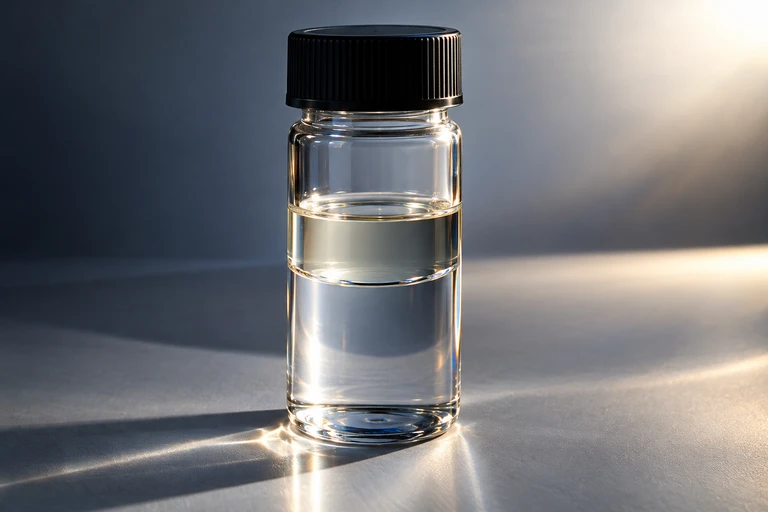
Separated water and hexane layersWater and hexane separate into layers because mixing their molecules is unfavorable under these conditions.
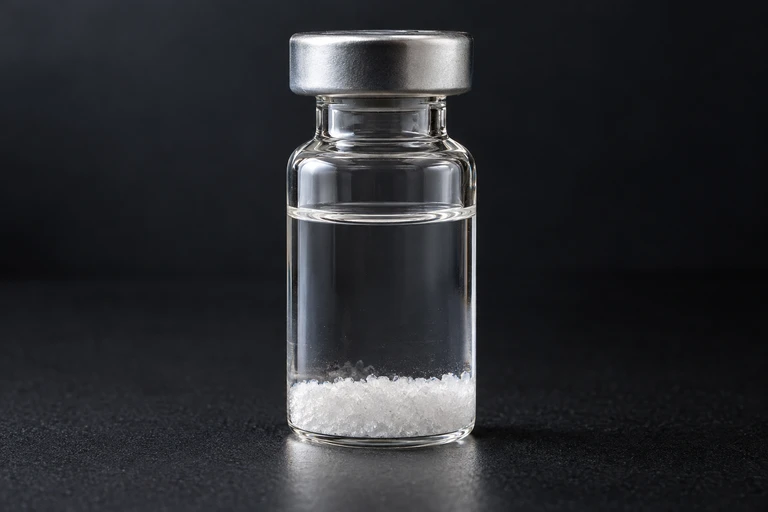
Solid and saturated solution in contactA saturated solution can remain in contact with undissolved solid while dissolution and crystallization continue.

SECTION 3

Visual Explanation — Dissolution at the Molecular Level

Dissolution of NaCl in Water — Three Stages1. Ionic CrystalNa⁺Cl⁻Na⁺Cl⁻Na⁺Cl⁻Na⁺Cl⁻Na⁺Alternating cation/anion lattice→2. Water Attacks SurfaceNa⁺Cl⁻Cl⁻Na⁺H₂OH₂Oδ⁻ of O faces Na⁺;δ⁺ of H faces Cl⁻→3. Hydrated IonsNa⁺Cl⁻Solvation shellssurround each ionNa⁺Cl⁻H₂O
The three stages of NaCl dissolution: (1) the intact ionic lattice with alternating Na+ and Cl− ions; (2) water molecules orient their partial charges toward surface ions, weakening lattice forces; (3) fully hydrated ions dispersed throughout the solvent, each surrounded by a solvation shell.

The diagram above illustrates the molecular-level process of dissolution for an ionic compound. In stage 1, the crystalline lattice is held together by strong electrostatic attractions between cations and anions. In stage 2, polar water molecules approach the surface and orient so that the partial negative charge on oxygen faces Na+ ions while the partial positive charges on hydrogen atoms face Cl− ions. These ion–dipole interactions must be strong enough to overcome the lattice energy. In stage 3, each ion is surrounded by a solvation shell (or hydration shell when water is the solvent), stabilizing the ions in solution. The balance between the energy required to disrupt the lattice and the energy released upon hydration determines whether ΔHsoln is exothermic or endothermic; in either case, the entropy increase upon mixing usually provides an additional thermodynamic driving force.
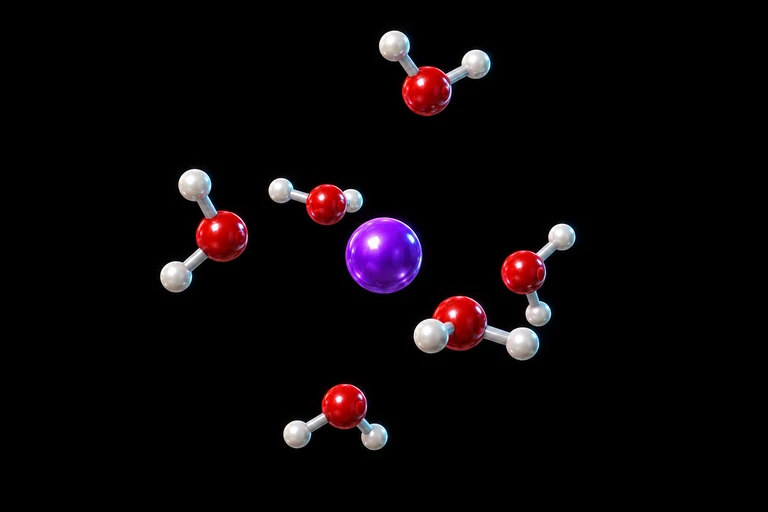
Water orientation around one sodium ionWater molecules orient their partially negative oxygen atoms toward a sodium ion.

SECTION 4

Mathematical Framework — Concentration & Colligative Properties

Quantifying the amount of solute in a solution requires well-defined concentration units. AP Chemistry emphasizes molarity and molality, and their connections to colligative property equations. Below are the key relationships.

MOLARITY

M=nsolute/VsolutionM = n_solute / V_solution

M = molarity (mol·L⁻¹), nsolute = moles of solute, Vsolution = volume of solution in liters. Molarity is temperature-dependent because volume changes with temperature.

MOLALITY

m=nsolute/msolvent(kg)m = n_solute / m_solvent (kg)

m = molality (mol·kg⁻¹), msolvent = mass of solvent in kilograms. Unlike molarity, molality is temperature-independent because mass does not change with temperature.

BOILING-POINT ELEVATION

ΔTb=i×Kb×mΔT_b = i × K_b × m

ΔTb = change in boiling point, i = van 't Hoff factor (number of particles per formula unit), Kb = ebullioscopic constant of solvent (0.512 °C·kg·mol⁻¹ for water), m = molality.

FREEZING-POINT DEPRESSION

ΔTf=i×Kf×mΔT_f = i × K_f × m

ΔTf = change in freezing point, Kf = cryoscopic constant (1.86 °C·kg·mol⁻¹ for water). The freezing point decreases, so the new Tf = T°f − ΔTf.

ℹ
The van 't Hoff Factor

SECTION 5

Classification of Mixtures & Separation Techniques

Mixtures span a continuum of particle size, from true solutions at the molecular scale to coarse suspensions visible to the naked eye. The classification below is essential for predicting physical behavior and choosing appropriate separation methods.

Classification of Mixtures by Particle Size~0.1 nm~1–100 nm>100 nmParticle Diameter →TRUE SOLUTION• Transparent• Passes through filter• Won't settle• No Tyndall effecte.g., saltwater, ethanol/waterCOLLOID• Often translucent• Passes through filter• Won't settle easily• Shows Tyndall effecte.g., milk, fog, gelatinSUSPENSION• Often opaque• Blocked by filter• Settles over time• Scatters light stronglye.g., muddy water, sand/water
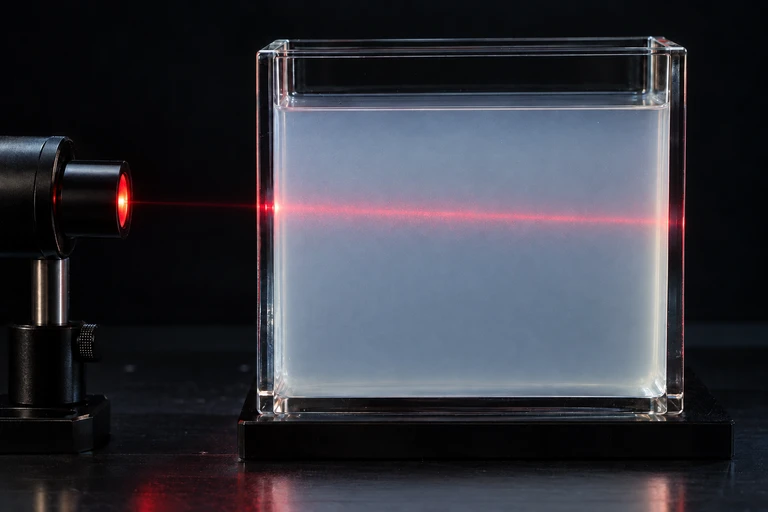
Comparison of the three categories of mixtures by particle size. True solutions have particles < 1 nm; colloids range from ≈1–100 nm; suspensions contain particles > 100 nm. The Tyndall effect (scattering of a light beam) is the classic diagnostic test distinguishing colloids from true solutions.
Separation MethodPrincipleBest For
FiltrationParticle size; solid trapped by filter mediumSuspensions, precipitates
DistillationDifferences in boiling pointsMiscible liquid–liquid solutions
ChromatographyDifferential affinity for stationary vs. mobile phaseComplex mixtures with similar components
EvaporationSolvent removed by heating; solute remainsDissolved solid in liquid

Common Physical Separation Techniques

A light beam scattered by a colloidParticles in a colloid scatter light, making the beam visible through the mixture.

SECTION 6

Worked Example — Freezing-Point Depression

Suppose 29.2 g of NaCl (molar mass = 58.44 g·mol⁻¹) is dissolved in 500.0 g of water. Calculate the expected freezing point of the solution, assuming complete dissociation.

Worked example

  1. 1

    Step 1 — Calculate moles of solute

    n = mass / molar mass = 29.2 g / 58.44 g·mol⁻¹
    n = 0.4997 mol ≈ 0.500 mol NaCl
  2. 2

    Step 2 — Calculate molality

    m = n / mass of solvent (kg) = 0.500 mol / 0.5000 kg
    m = 1.00 mol·kg⁻¹
  3. 3

    Step 3 — Determine the van 't Hoff factor

    NaCl is a strong electrolyte that fully dissociates into Na⁺ and Cl⁻ in dilute solution.
    i = 2
  4. 4

    Step 4 — Apply the freezing-point depression equation

    ΔTf = i × Kf × m = 2 × 1.86 °C·kg·mol⁻¹ × 1.00 mol·kg⁻¹
    ΔTfT_f = 3.72 °C
  5. 5

    Step 5 — Calculate the new freezing point

    Tf = 0.00 °C − 3.72 °C
    TfT_f = −3.72 °C
ℹ
Why "Expected"?

SECTION 7

Electrolyte vs. Nonelectrolyte Solutions

Whether a dissolved solute produces ions dictates both the electrical conductivity of the solution and the magnitude of its colligative properties. Distinguishing between strong electrolytes, weak electrolytes, and nonelectrolytes is a frequent theme on the AP exam.

PropertyStrong ElectrolyteWeak ElectrolyteNonelectrolyte
DissociationComplete (≈100%)Partial (equilibrium)None
van 't Hoff factor (i)= number of ions (ideal)1 < i < max ionsi = 1
ConductivityHighLow~Zero
ExamplesNaCl, HCl, KNO₃CH₃COOH, HF, NH₃C₆H₁₂O₆, C₂H₅OH

Electrolyte Classification

SECTION 8

Connections to Advanced Theory — Ideal vs. Real Solutions

The colligative-property equations presented in Section 4 assume ideal dilute solution behavior, where solute–solute interactions are negligible and the solvent obeys Raoult's law (Psolvent = χsolvent × P°solvent). Real solutions deviate when the enthalpy of mixing is significantly nonzero—positive deviations occur when solute–solvent interactions are weaker than the pure-component interactions, and negative deviations arise when they are stronger.

FeatureIdeal Solution (AP Level)Non-Ideal / Real Solution
ΔH_mix≈ 0Significantly positive or negative
Raoult's lawObeyed over all compositionsShows positive or negative deviations
i factorInteger (exact for dilute)Non-integer; depends on concentration
ExampleBenzene + tolueneEthanol + water (negative); acetone + CS₂ (positive)

Ideal vs. Non-Ideal Solutions

On the AP exam, you will primarily work within the ideal framework, but understanding when and why deviations occur—particularly the role of strong hydrogen bonding or ion-pairing effects—demonstrates the kind of conceptual depth that earns full credit on free-response questions. In college-level physical chemistry courses, activity coefficients replace concentrations to correct for non-ideal behavior, connecting this topic to thermodynamic potentials and the Gibbs–Duhem equation.

SECTION 9

Practice Problems

Question 1: CONCEPTUAL

A student dissolves equal masses of glucose (C₆H₁₂O₆, molar mass 180 g·mol⁻¹) and sodium chloride (NaCl, molar mass 58.44 g·mol⁻¹) in separate 1.00 kg samples of water. Which solution has the lower freezing point? (A) The glucose solution, because glucose has a higher molar mass. (B) The NaCl solution, because NaCl dissociates into two ions and contributes more particles per gram. (C) The glucose solution, because it is a nonelectrolyte. (D) They have the same freezing point because equal masses of solute were added.
  • A. The glucose solution, because glucose has a higher molar mass.
  • B. The NaCl solution, because NaCl dissociates into two ions and contributes more particles per gram.
  • C. The glucose solution, because it is a nonelectrolyte.
  • D. They have the same freezing point because equal masses of solute were added.
Show answer (B)
Correct: (B). Freezing-point depression depends on the total number of dissolved particles. For equal masses, NaCl produces far more moles (lower molar mass) and each mole yields 2 ions (i = 2), dramatically increasing the particle count compared to glucose. (A) is wrong because higher molar mass means fewer moles and fewer particles per gram. (C) is wrong because nonelectrolyte status gives glucose fewer particles, not more. (D) is wrong because equal mass does not mean equal moles or equal particle count.

Question 2: BASIC CALCULATION

What is the molality of a solution prepared by dissolving 11.7 g of NaCl (molar mass = 58.44 g·mol⁻¹) in 250.0 g of water? (A) 0.200 mol·kg⁻¹ (B) 0.400 mol·kg⁻¹ (C) 0.800 mol·kg⁻¹ (D) 1.60 mol·kg⁻¹
  • A. 0.200 mol·kg⁻¹
  • B. 0.400 mol·kg⁻¹
  • C. 0.800 mol·kg⁻¹
  • D. 1.60 mol·kg⁻¹
Show answer (C)
Correct: (C). Moles of NaCl = 11.7 g / 58.44 g·mol⁻¹ = 0.200 mol. Molality = 0.200 mol / 0.2500 kg = 0.800 mol·kg⁻¹. (A) is wrong—it divides by 1.00 kg instead of 0.2500 kg. (B) is wrong—it likely results from an arithmetic error halving the correct answer. (D) is wrong—it incorrectly doubles the correct value, perhaps by applying i = 2 to molality, which is not appropriate since molality describes formula units, not particles.

Question 3: INTERMEDIATE

An aqueous CaCl₂ solution (i = 2.7 due to ion pairing) has a molality of 0.50 mol·kg⁻¹. What is the expected boiling point of this solution? (KbK_b for water = 0.512 °C·kg·mol⁻¹) (A) 100.26 °C (B) 100.69 °C (C) 100.77 °C (D) 101.54 °C
  • A. 100.26 °C
  • B. 100.69 °C
  • C. 100.77 °C
  • D. 101.54 °C
Show answer (B)
Correct: (B). ΔTbT_b = i × KbK_b × m = 2.7 × 0.512 × 0.50 = 0.691 °C. New boiling point = 100.00 + 0.69 = 100.69 °C. (A) is wrong—it uses i = 1 (0.512 × 0.50 = 0.256). (C) is wrong—it uses ideal i = 3 (3 × 0.512 × 0.50 = 0.768). (D) is wrong—it uses i = 3 and m = 1.0 or an equivalent error doubling the result.

Question 4: APPLIED

A chemist measures the freezing point of a solution prepared by dissolving 5.00 g of an unknown nonelectrolyte in 100.0 g of water and finds ΔTfT_f = 1.86 °C (KfK_f for water = 1.86 °C·kg·mol⁻¹). (a) Determine the molality of the solution. (b) Calculate the molar mass of the unknown solute. (c) If the measured ΔTfT_f had been 2.79 °C instead, and the solute were an electrolyte, calculate the apparent van 't Hoff factor. (d) Suggest a possible identity for the electrolyte solute in part (c), given a molar mass consistent with your answer.
Show answer
(a) [1 pt] ΔTfT_f = i × KfK_f × m. For a nonelectrolyte i = 1, so m = ΔTfT_f / KfK_f = 1.86 / 1.86 = 1.00 mol·kg⁻¹. (b) [1 pt] moles = m × kg solvent = 1.00 × 0.1000 = 0.100 mol. Molar mass = 5.00 g / 0.100 mol = 50.0 g·mol⁻¹. (c) [1 pt] Using ΔTfT_f = i × KfK_f × m with the same molality: i = 2.79 / (1.86 × 1.00) = 1.50. The apparent van 't Hoff factor is 1.50. (d) [1 pt] A van 't Hoff factor of 1.5 suggests partial dissociation into 2 ions (ideal i = 2). A weak electrolyte with molar mass ≈50 g·mol⁻¹ could be methanoic acid (formic acid, HCOOH, M = 46.03 g·mol⁻¹), which partially ionizes in water.

Question 5: CRITICAL THINKING

A student prepares four aqueous solutions at the same molality (0.10 m) and measures their freezing-point depressions. The data are shown below. | Solution | Solute | ΔTfT_f (°C) | |---|---|---| | I | C₆H₁₂O₆ (glucose) | 0.186 | | II | NaCl | 0.348 | | III | MgCl₂ | 0.489 | | IV | Al₂(SO₄)₃ | 0.558 | KfK_f for water = 1.86 °C·kg·mol⁻¹. (a) Calculate the experimental van 't Hoff factor for each solution. (b) Compare the experimental i values to the theoretical (ideal) values. For which solute is the deviation greatest? Explain why. (c) Predict how the experimental i for MgCl₂ would change if the solution were diluted from 0.10 m to 0.001 m. Justify your answer. (d) A student claims that measuring ΔTfT_f is sufficient to determine whether an unknown solute is an electrolyte. Evaluate this claim — under what conditions could it fail?
Show answer
(a) [1 pt] i = ΔTfT_f / (KfK_f × m). Solution I: 0.186 / (1.86 × 0.10) = 1.00. Solution II: 0.348 / 0.186 = 1.87. Solution III: 0.489 / 0.186 = 2.63. Solution IV: 0.558 / 0.186 = 3.00. (b) [1 pt] Ideal values: glucose = 1, NaCl = 2, MgCl₂ = 3, Al₂(SO₄)₃ = 5. The greatest deviation is Al₂(SO₄)₃ (experimental i = 3.00 vs. ideal 5). This is because Al₂(SO₄)₃ produces highly charged ions (Al³⁺ and SO₄²⁻) that experience strong ion–ion attractions, forming ion pairs and clusters that reduce the effective particle count far below the ideal. (c) [1 pt] At 0.001 m, ions are farther apart on average, so ion pairing decreases. The experimental i for MgCl₂ would increase, approaching the ideal value of 3. At infinite dilution, ion–ion interactions become negligible and i → 3. (d) [1 pt] The claim has limitations. ΔTfT_f measurement could be misleading if: (1) a nonelectrolyte has an unknown molar mass—without knowing moles, one cannot distinguish a nonelectrolyte with more moles from an electrolyte with fewer moles. (2) A weak electrolyte with i slightly above 1 might be mistaken for a nonelectrolyte if measurement precision is low. Independent determination of molar mass (e.g., mass spectrometry) is needed alongside ΔTfT_f to reliably determine electrolyte character.

Varsity Tutors • AP Chemistry • Solutions and Mixtures