

SECTION 1
Historical Context & Motivation
The systematic study of the states of matter ranks among the oldest pursues in natural philosophy. Ancient Greek thinkers, most notably Empedocles and Aristotle, classified all matter under four elemental categories—earth, water, air, and fire—a taxonomy that, while philosophically elegant, lacked the quantitative rigor required for prediction. The transition from philosophical speculation to experimental science required centuries of careful measurement, beginning with the pioneering gas-law experiments of the seventeenth century and culminating in the kinetic-molecular theory of the nineteenth century, which unified the behavior of solids, liquids, and gases under a single microscopic framework.
1662 • Boyle's Law
1787 • Charles's Law
1834 • Clapeyron & the Ideal Gas Law
1873 • van der Waals Equation
1905 • Einstein & Brownian Motion
These historical milestones converge on a central question that the AP Chemistry curriculum expects you to address with precision: how do the microscopic properties of particles—their kinetic energy, spacing, and intermolecular forces—determine the macroscopic properties we observe in solids, liquids, and gases? Answering this question forms the foundation for understanding phase transitions, colligative properties, and the thermodynamic behavior of real substances.
SECTION 2
Core Principles & Definitions
The three common states of matter—solid, liquid, and gas—arise from the competition between intermolecular forces (IMFs), which pull particles together, and kinetic energy, which drives them apart. When IMFs dominate, particles are locked into fixed positions and the substance is a solid. When kinetic energy overwhelms all attractive forces, the substance exists as a gas with particles in rapid, random motion. The liquid state occupies the intermediate regime where particles maintain close contact yet possess enough energy to flow past one another. Understanding this balance is essential for predicting physical properties such as boiling point, vapor pressure, viscosity, and compressibility.
Solids
Liquids
Gases
Kinetic-Molecular Theory
Intermolecular Forces
KEY TAKEAWAY
SECTION 3
Visual Explanation — Particle Arrangement in Three Phases
Notice that the relative size of the particles decreases from solid to gas not because particles physically shrink, but because the distances between them increase dramatically—gas molecules at standard conditions are separated, on average, by roughly ten molecular diameters. This enormous spacing is why gases are readily compressible: there is significant empty space between molecules that external pressure can eliminate. In contrast, compressing a solid or liquid requires forcing electron clouds to overlap, which demands extraordinarily high pressures. The diagram also illustrates why liquids conform to the shape of their container while maintaining a definite volume: the particles have enough kinetic energy to rearrange but not enough to overcome the intermolecular attractions that keep them in close proximity.
 Solid, liquid and gas phases differ in particle arrangement and motion. Solid particles vibrate around ordered positions; liquids and gases permit particles to move past one another.
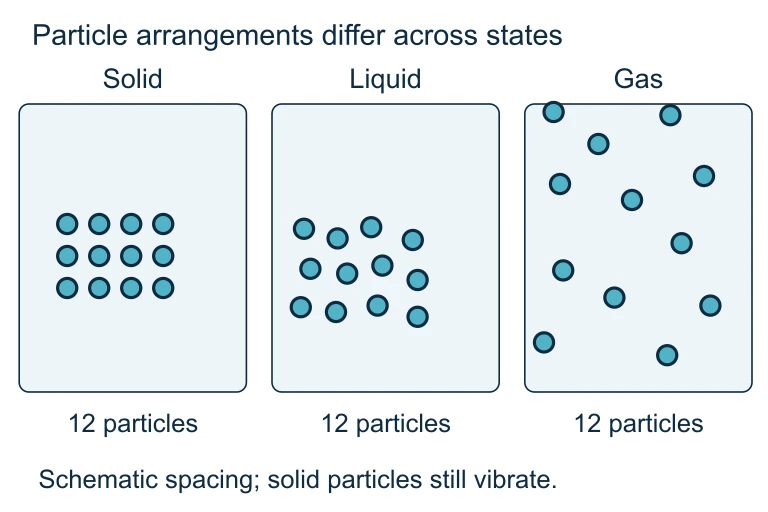 Solid particles vibrate around ordered positions, liquid particles remain close but mobile, and gas particles are more widely separated and mobile.
SECTION 4
Mathematical Framework — Gas Laws & Kinetic Energy
The gaseous state is the most amenable to mathematical description because intermolecular forces are negligible relative to kinetic energy, allowing us to construct simple models. The ideal gas law unifies the empirical observations of Boyle, Charles, and Avogadro into a single equation. From kinetic-molecular theory, we can also derive an expression relating the macroscopic property of temperature to the microscopic property of molecular speed. These equations form the quantitative backbone for AP Chemistry questions about gas behavior.
IDEAL GAS LAW
P = pressure (atm or Pa), V = volume (L or m³), n = moles of gas, R = gas constant (0.08206 L·atm·mol⁻¹·K⁻¹ or 8.314 J·mol⁻¹·K⁻¹), T = absolute temperature (K). Valid when gas particles have negligible volume and no intermolecular attractions.
AVERAGE KINETIC ENERGY
k = Boltzmann constant (1.381 × 10⁻²³ J·K⁻¹), T = absolute temperature (K). This equation reveals that average kinetic energy depends only on temperature, not on the identity or mass of the gas.
ROOT-MEAN-SQUARE SPEED
urms = root-mean-square speed (m/s), R = 8.314 J·mol⁻¹·K⁻¹, T = temperature (K), M = molar mass (kg/mol). Lighter gases travel faster at the same temperature.
VAN DER WAALS EQUATION (REAL GAS CORRECTION)
a = intermolecular attraction correction (L²·atm·mol⁻²), b = molecular volume correction (L·mol⁻¹). The term an²/V² corrects for attractive forces that reduce the pressure exerted on container walls; nb corrects for the finite volume occupied by gas particles.
AP Exam Tip
SECTION 5
Phase Diagrams & Intermolecular Forces
A phase diagram maps the stable state of a substance as a function of temperature and pressure, providing a complete picture of when a substance exists as a solid, liquid, or gas. The boundaries between regions represent conditions at which two phases coexist in dynamic equilibrium. The triple point is the unique temperature–pressure combination at which all three phases coexist simultaneously, while the critical point marks the temperature and pressure above which the liquid and gas phases become indistinguishable, forming a supercritical fluid. The slope of the solid–liquid boundary is positive for most substances but negative for water, reflecting the unusual decrease in density upon freezing.
| IMF Type | Strength | Example | Effect on Phase Behavior |
|---|---|---|---|
| London Dispersion | Weakest; increases with molar mass and surface area | Ar, CH₄, I₂ | Low boiling points for small nonpolar molecules; noble gases are gases at room temperature |
| Dipole–Dipole | Moderate; between polar molecules | HCl, CH₂Cl₂ | Higher boiling points than nonpolar molecules of similar molar mass |
| Hydrogen Bonding | Strong; H bonded to N, O, or F | H₂O, NH₃, HF | Anomalously high boiling points; water is liquid at room temperature despite low molar mass |
| Ion–Dipole | Very strong; ion interacting with polar solvent | NaCl in H₂O | Drives dissolution of ionic solids; not a phase-determining IMF within a pure substance |
Comparison of intermolecular forces and their effect on phase behavior
 The liquid–gas coexistence curve ends at the critical point. Above both the critical temperature and critical pressure, the ordinary liquid–vapor boundary disappears.
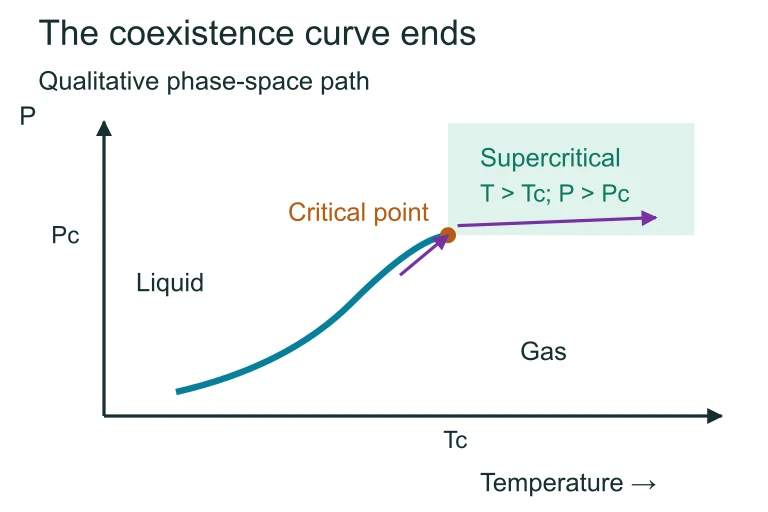 The liquid–gas coexistence curve ends at the critical point. Above both the critical temperature and critical pressure, the ordinary liquid–vapor boundary disappears.
SECTION 6
Worked Example — Applying the Ideal Gas Law
Consider the following AP-style problem: A 2.50 L rigid container holds 0.120 mol of N₂ gas at 25.0 °C. Calculate the pressure in the container, then predict how the behavior would deviate from ideality if the container were cooled to −150 °C at 200 atm.
Calculating Gas Pressure & Predicting Deviations
- 1
Step 1 — Identify Known Values
n = 0.120 mol, V = 2.50 L, T = 25.0 °C = 298.15 K, R = 0.08206 L·atm·mol⁻¹·K⁻¹. We need to find P. - 2
Step 2 — Rearrange PV = nRT for P
P = nRT / V = (0.120 mol)(0.08206 L·atm·mol⁻¹·K⁻¹)(298.15 K) / (2.50 L) - 3
Step 3 — Calculate
Numerator: 0.120 × 0.08206 × 298.15 = 2.936 L·atm. Dividing by 2.50 L gives P = 1.17 atm.P = 1.17 atm - 4
Step 4 — Predict Deviation at Low T and High P
At −150 °C (123 K) and 200 atm, two factors promote deviation. First, at high pressure the finite volume of N₂ molecules (correction factor b) becomes significant relative to the container volume, causing the real volume to exceed the ideal prediction. Second, at low temperature the kinetic energy decreases and intermolecular attractive forces (correction factor a) become significant, causing the real pressure to be lower than predicted by the ideal gas law. The van der Waals equation would yield a more accurate result under these extreme conditions.Significant negative deviation in pressure (P_real < P_ideal)
SECTION 7
Comparing Macroscopic Properties Across Phases
| Property | Solid | Liquid | Gas |
|---|---|---|---|
| Shape | Definite | Takes shape of container | Fills entire container |
| Volume | Definite | Definite | Indefinite; expands to fill container |
| Compressibility | Essentially incompressible | Nearly incompressible | Highly compressible |
| Particle Motion | Vibration about fixed positions | Translational and rotational; constrained | Rapid, random translational motion |
| Density | High | Moderate to high | Low (≈ 1/1000 of liquid) |
| IMF Dominance | Strong—dominates over KE | Comparable to KE | Negligible relative to KE |
Comparison of macroscopic and microscopic properties across the three common phases of matter
KEY TAKEAWAY
SECTION 8
Connection to Advanced Theory — Real Gases & Condensed Matter
The ideal gas model provides a powerful framework for understanding gas behavior, but real substances deviate from ideality in ways that connect directly to topics tested on the AP Chemistry exam and encountered in college-level physical chemistry. Below is a comparison of the ideal gas assumptions and the corrections or extensions required for a more complete description of matter.
| Ideal Gas Assumption | Real Behavior / Advanced Treatment |
|---|---|
| Gas particles have zero volume | Real molecules occupy finite volume (van der Waals b correction); significant at high pressure |
| No intermolecular attractions | Attractive forces (van der Waals a correction) reduce measured pressure; dominate at low temperature |
| All collisions are elastic | Inelastic collisions can transfer energy to vibrational modes in polyatomic molecules, affecting heat capacity |
| KE depends only on T | True for translational KE; rotational and vibrational modes contribute additional degrees of freedom (equipartition theorem) |
| Applies uniformly to all gases | Gases with stronger IMFs (e.g., NH₃, H₂O vapor) deviate more; noble gases approach ideality best |
Ideal gas assumptions vs. real gas behavior
In more advanced coursework, you will encounter the Clausius–Clapeyron equation, which quantitatively relates vapor pressure to temperature through the enthalpy of vaporization. You will also study statistical thermodynamics, where the Boltzmann distribution function provides the probability of finding a molecule with a particular speed or energy. These tools allow scientists and engineers to predict phase equilibria, design distillation columns, and model atmospheric chemistry with remarkable precision. For the AP exam, ensure you can qualitatively explain deviations from ideality and connect macroscopic properties of all three phases to the microscopic forces and motions of their constituent particles.
SECTION 9
Practice Problems
Question 1: CONCEPTUAL
- A. Br₂ molecules have enough kinetic energy to move past one another but not enough to overcome all intermolecular attractions, so they remain in close contact.
- B. Br₂ molecules are held in a rigid crystal lattice but can vibrate, allowing them to slowly flow.
- C. Br₂ molecules have negligible intermolecular forces, so they spread out but are held together by external atmospheric pressure.
- D. Br₂ molecules form covalent network bonds that allow flexibility but prevent expansion.
Show answer (A)
Question 2: BASIC CALCULATION
- A. 11.2 L
- B. 12.3 L
- C. 22.4 L
- D. 24.6 L
Show answer (B)
Question 3: INTERMEDIATE
- A. HF has the highest molar mass in the series, resulting in the strongest London dispersion forces.
- B. HF molecules engage in hydrogen bonding due to the high electronegativity and small size of fluorine, an interaction far stronger than the dipole–dipole forces in HCl, HBr, and HI.
- C. The H–F bond is the weakest covalent bond in the series, so more energy is required to vaporize HF.
- D. HF is the only ionic compound in the series, and ionic compounds have higher boiling points than molecular compounds.
Show answer (B)
Question 4: APPLIED
10 ptsShow answer
Question 5: CRITICAL THINKING
8 ptsShow answer
SUMMARY
Summary — Solids, Liquids, and Gases
Summary
The three common phases of matter arise from the competition between intermolecular forces and kinetic energy. Solids have particles locked in fixed positions with definite shape and volume. Liquids maintain close contact (definite volume) but flow freely (indefinite shape). Gases have widely spaced particles that expand to fill any container and are highly compressible. The kinetic-molecular theory connects macroscopic properties to microscopic particle behavior, with the average translational kinetic energy proportional to absolute temperature (KE = 3/2 kT).
The ideal gas law (PV = nRT) describes gas behavior when molecular volume and IMFs are negligible. Real gases deviate at high pressures and low temperatures, as described by the van der Waals equation. The type and strength of IMFs—London dispersion forces, dipole–dipole interactions, and hydrogen bonding—determine boiling points, melting points, and the shape of a substance's phase diagram, including the locations of its triple point and critical point.