
SECTION 1
Historical Context & Motivation
Long before chemistry emerged as a formal discipline, humans separated mixtures to obtain useful materials — extracting salt from seawater, panning gold from river sediment, and distilling alcohol from fermented grain. These empirical techniques relied on differences in physical properties such as boiling point, solubility, and density, even though the practitioners had no molecular-level understanding of why the methods worked. As the atomic theory of matter developed in the eighteenth and nineteenth centuries, chemists recognized that separation techniques could be systematized according to the intermolecular forces and phase-change behavior of each component in a mixture.
~3000 BCE • Early Evaporative Salt Production
~800 CE • Distillation by Jābir ibn Hayyān
1901 • Chromatography Invented by Tswett
1952 • Gas Chromatography by Martin & James
The fundamental question driving all separation science is deceptively simple: which measurable physical property differs enough between the components of a mixture to allow their isolation? On the AP Chemistry exam, you must connect each separation technique to the underlying property it exploits — boiling point, particle size, polarity, or volatility — and explain how intermolecular forces govern that property.
SECTION 2
Core Principles of Separation
All separation methods rest on a single overarching principle: the components of a mixture retain their individual chemical identities and therefore their individual physical properties. Because no chemical bonds are formed between the species in a mixture (unlike in a compound), a purely physical process — one that does not break or form covalent or ionic bonds — can isolate each component. The choice of technique depends on whether the mixture is homogeneous (a solution, uniform at the molecular level) or heterogeneous (non-uniform, with distinguishable phases), and on the specific property difference that can be leveraged.
Boiling-Point Differences
Particle Size Differences
Differential Solubility
Volatility Differences
SECTION 3
Visual Overview of Separation Techniques
The flowchart above encapsulates the logic you should apply on the AP exam when asked to justify a separation technique. Start by classifying the mixture, then identify the key property difference. For heterogeneous mixtures containing an undissolved solid, filtration is almost always the answer. For homogeneous solutions, the choice between distillation, evaporation, and chromatography hinges on whether you need the solvent, the solute, or multiple dissolved species resolved from one another.
SECTION 4
How Each Technique Works at the Molecular Level
Filtration
In filtration, a mixture is poured through a porous barrier — typically filter paper with pore sizes on the order of micrometers. Dissolved ions and small molecules in solution pass through the pores as filtrate, while undissolved solid particles too large to pass through are retained on the paper as residue. Gravity filtration relies on the weight of the liquid; vacuum filtration applies reduced pressure below the filter to accelerate the process. The underlying physical property exploited is particle size.
Distillation
In distillation, a liquid mixture is heated until the component with the lower boiling point vaporizes preferentially. The vapor travels into a condenser where it is cooled back to the liquid phase and collected as the distillate. The effectiveness of distillation depends on the magnitude of the boiling-point gap between components; a larger gap means cleaner separation. At the molecular level, the component with weaker intermolecular forces has a lower boiling point because less thermal energy is required to overcome attractions and enter the gas phase.
Evaporation & Crystallization
When the goal is to recover a nonvolatile solute from a volatile solvent, simple evaporation is used. Heating the solution drives off the solvent (often water), leaving the solute as a solid residue. If controlled cooling is employed instead of full evaporation, crystallization occurs: as temperature drops, solubility decreases, and the solute precipitates in an ordered crystalline lattice, often yielding higher purity than simple evaporation.
Chromatography
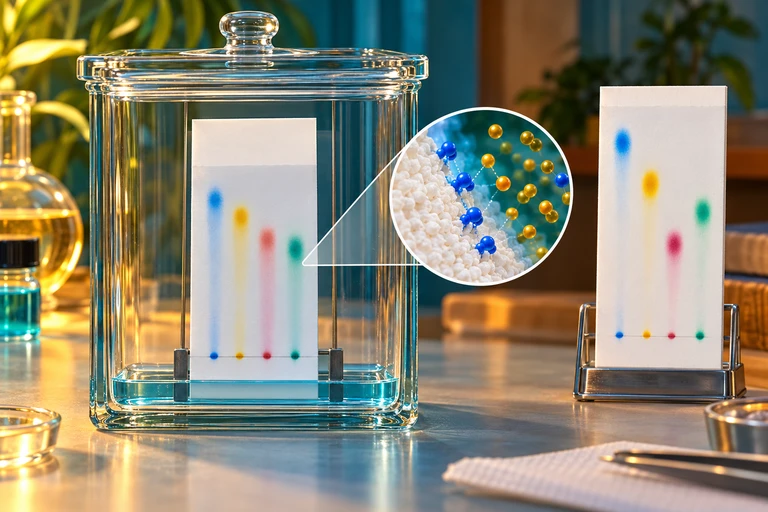
In chromatography, a mixture dissolved in a mobile phase (a liquid or gas) is passed over a stationary phase (a solid or immobilized liquid). Components that interact more strongly with the stationary phase move more slowly and therefore travel a shorter distance in a given time, while components with weaker attraction to the stationary phase travel farther with the mobile phase. The property exploited is differential solubility or polarity. In paper chromatography, a polar water-cellulose stationary phase retains polar molecules, so nonpolar pigments migrate farther up the paper.
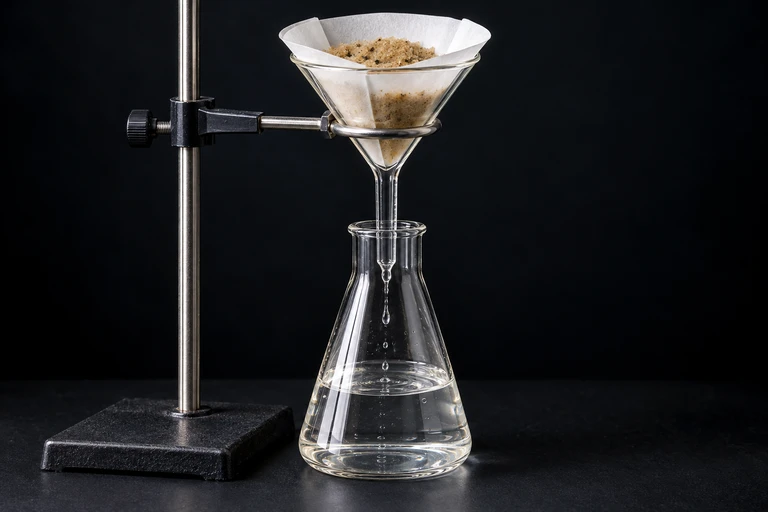 Filter paper retains suspended sand while water and dissolved salt pass into the receiving flask.
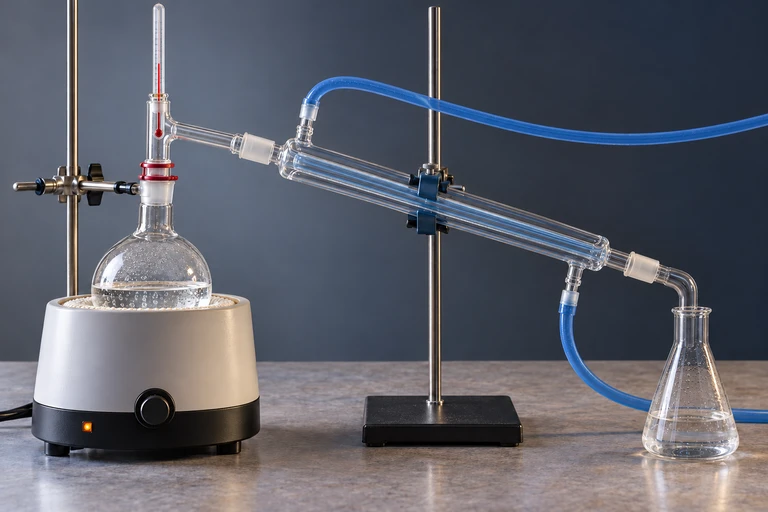 Distillation vaporizes a volatile component and condenses the vapor in a cooled tube.
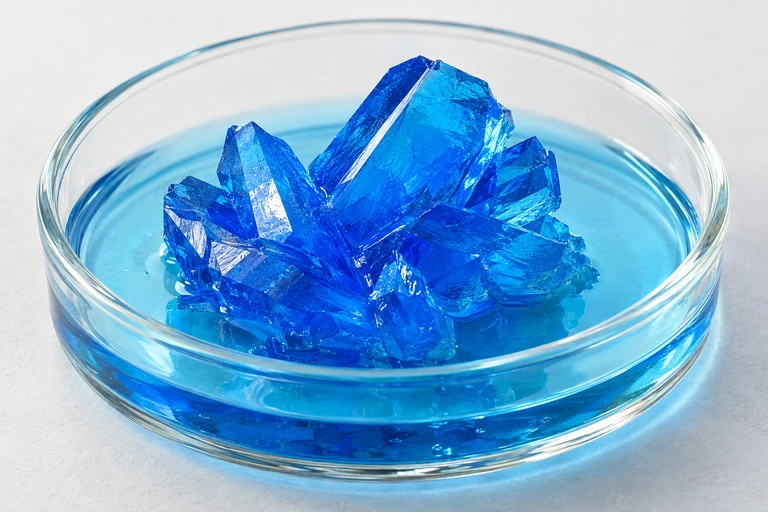 Crystals grow as dissolved material joins an ordered solid at the solution–crystal interface.
SECTION 5
Chromatography in Detail & the Rf Value
Chromatography deserves special attention because it is the only common separation technique capable of resolving multiple dissolved components from one another simultaneously. On the AP Chemistry exam, paper chromatography and thin-layer chromatography (TLC) appear most frequently, and you may be asked to calculate or interpret the retention factor (Rf), which quantifies how far a component travels relative to the solvent front.
RETENTION FACTOR
Rf is dimensionless and ranges from 0 to 1. A value near 1 means the substance has low affinity for the stationary phase (it 'rides' with the mobile phase), while a value near 0 indicates strong retention.
In the diagram above, component B travels farther because it is less polar and therefore has weaker interactions with the polar cellulose stationary phase. It partitions more readily into the mobile phase (the solvent moving up the paper). Component A, being more polar, is retained more strongly by the stationary phase and migrates only a short distance. The Rf value for each spot is characteristic under a given set of conditions (same solvent, same temperature, same stationary phase) and can be used to identify unknown substances by comparison to reference values.
SECTION 6
Worked Example: Interpreting a Chromatogram
Worked example
- 1
Step 1 — Read the Data
A paper chromatography experiment is performed using a nonpolar solvent. The solvent front travels 8.0 cm from the origin. Three spots are visible: Spot X at 2.0 cm, Spot Y at 5.6 cm, and Spot Z at 7.2 cm from the origin. - 2
Step 2 — Calculate Rf for Each Spot
Apply the formula Rf = (distance traveled by substance) / (distance traveled by solvent front).Rf(X) = 2.0 / 8.0 = 0.25 ; Rf(Y) = 5.6 / 8.0 = 0.70 ; Rf(Z) = 7.2 / 8.0 = 0.90 - 3
Step 3 — Interpret Polarity
Because a nonpolar solvent (mobile phase) was used with polar cellulose paper (stationary phase), substances with higher Rf values are more nonpolar — they preferentially dissolve in the nonpolar mobile phase and travel farther.Polarity ranking: X (most polar) > Y > Z (least polar) - 4
Step 4 — Identify by Comparison
A reference table lists a known dye with Rf = 0.70 under identical conditions. Spot Y matches this reference value, so Y is tentatively identified as that dye. Note that Rf comparison is only valid when all conditions are identical.Spot Y = known dye (Rf = 0.70)
 Measure every chromatography distance from the same origin. With an 8.0 cm solvent front, spot distances of 2.0, 5.6 and 7.2 cm give Rf values of 0.25, 0.70 and 0.90 under the same development conditions.
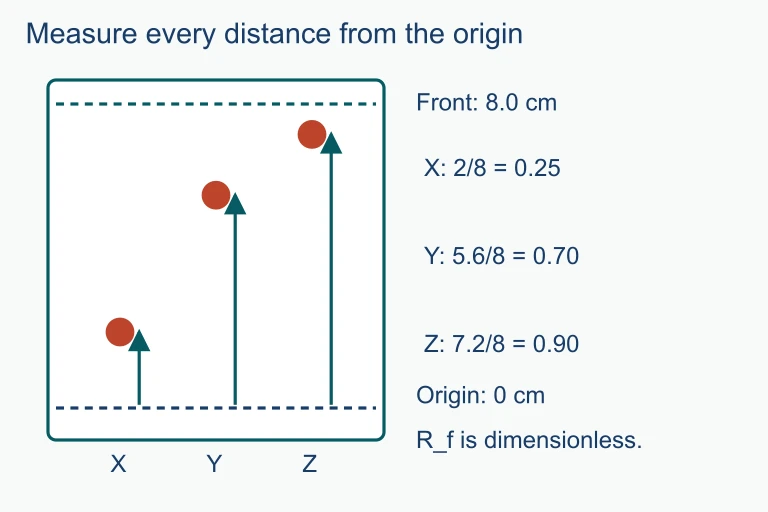 Measure every chromatography distance from the same origin. With an 8.0 cm solvent front, spot distances of 2.0, 5.6 and 7.2 cm give Rf values of 0.25, 0.70 and 0.90 under the same development conditions.
SECTION 7
Comparing Separation Techniques
| Technique | Property Exploited | Best For | Limitation |
|---|---|---|---|
| Filtration | Particle size | Removing undissolved solid from liquid | Cannot separate dissolved substances |
| Distillation | Boiling point (IMF strength) | Separating two miscible liquids | Ineffective when boiling points are very close |
| Evaporation | Volatility | Recovering nonvolatile solute from solution | Solvent is lost; solute may decompose if heated |
| Chromatography | Differential solubility / polarity | Resolving multiple dissolved components | Requires careful choice of mobile and stationary phases |
Summary comparison of four major separation techniques tested on the AP Chemistry exam
SECTION 8
Connections to Advanced Separation Science
The techniques introduced at the AP level form the conceptual foundation for far more sophisticated separation methods used in research and industry. Understanding why a technique works — the intermolecular-force basis — enables you to predict the behavior of more complex systems. Gas chromatography (GC), high-performance liquid chromatography (HPLC), and mass spectrometry are all extensions of the same core principle: exploiting differential physical or chemical interactions to resolve mixtures into individual components.
| AP-Level Technique | Advanced Extension | Key Enhancement |
|---|---|---|
| Paper chromatography | HPLC (High-Performance Liquid Chromatography) | High-pressure pumps and fine particle columns give vastly superior resolution and speed |
| Simple distillation | Fractional distillation / Reflux columns | Repeated vaporization-condensation cycles within a fractionating column separate liquids with close boiling points |
| Filtration | Ultrafiltration / Dialysis membranes | Nanoporous membranes separate molecules by molecular weight, used in kidney dialysis and water purification |
| Evaporation | Rotary evaporation (rotovap) | Reduced pressure lowers boiling point, enabling solvent removal without thermal decomposition of heat-sensitive products |
As you progress through college chemistry, you will encounter these advanced methods in analytical and organic chemistry courses. The conceptual thread remains the same: identify the relevant physical property, then engineer conditions that maximize the separation factor. Mastering the AP-level principles ensures you have a robust mental model onto which more complex techniques can be mapped.
SECTION 9
Practice Problems
Question 1: CONCEPTUAL
- A. Distillation followed by chromatography
- B. Filtration followed by evaporation
- C. Evaporation followed by filtration
- D. Chromatography followed by filtration
Show answer (B)
Question 2: BASIC CALCULATION
- A. 0.035
- B. 0.35
- C. 2.86
- D. 3.50
Show answer (B)
Question 3: INTERMEDIATE
- A. Filtration, then distillation, then evaporation
- B. Distillation to collect ethanol, then continued distillation to collect water, leaving KNO₃ residue
- C. Evaporation to remove ethanol, then chromatography to separate water from KNO₃
- D. Chromatography to separate all three simultaneously
Show answer (B)
Question 4: APPLIED
Show answer
Question 5: CRITICAL THINKING