
SECTION 1
Historical Context & Motivation
Chemistry advanced for centuries without a unified language for describing reactions. Early alchemists recorded transformations in cryptic symbols and allegories, making it nearly impossible to reproduce results across laboratories. The quest for a systematic, universal notation drove the development of chemical equations — shorthand representations that encode the identities, quantities, and phases of reactants and products in a single line. Understanding the evolution of these representations reveals why modern chemists employ multiple formats — each highlighting different aspects of the same transformation.
1789 • Lavoisier's Conservation of Mass
1814 • Berzelius Introduces Modern Symbols
1834 • Faraday and Ionic Theory
1884 • Arrhenius Electrolyte Theory
1960s–Present • Particulate-Level Diagrams
The central question this lesson addresses is: How do chemists translate a single chemical change into multiple complementary representations — and why is each one indispensable? On the AP Chemistry exam, you must move fluently among balanced molecular equations, complete ionic equations, net ionic equations, and particulate diagrams, interpreting and constructing each.
SECTION 2
Core Principles & Definitions
A chemical reaction rearranges atoms: bonds break in reactants and form in products. Representing that change accurately requires attention to composition, stoichiometry, phase, and ionic dissociation. The four primary representations used in AP Chemistry each foreground a different layer of information.
Balanced Molecular Equation
Complete Ionic Equation
Net Ionic Equation
Particulate Diagram
KEY TAKEAWAY
Two additional principles apply across all representations. First, the law of conservation of mass demands that atoms are neither created nor destroyed; every representation must be balanced in both atoms and charge. Second, state symbols — (s) for solid, (l) for liquid, (g) for gas, and (aq) for aqueous — provide essential phase information. Strong electrolytes written as (aq) in molecular form are split into ions in ionic equations; species written as (s), (l), or (g) remain intact.
SECTION 3
Visual Explanation — From Formula to Particles
The diagram below traces a single double-displacement reaction — the mixing of aqueous lead(II) nitrate with aqueous potassium iodide — through all four representation levels. Study how each level highlights different information about the same transformation.
Notice several key details. In tier 2, the strong electrolytes Pb(NO₃)₂, KI, and KNO₃ are written as separated ions because they are soluble ionic compounds in aqueous solution. PbI₂ remains as a formula unit because it precipitates as a solid — insoluble compounds do not dissociate. In tier 3, the spectator ions K⁺ and NO₃⁻ cancel, leaving only the ions that form the precipitate. In the particulate diagram, every atom present in the reactants must appear in the products, and the relative counts must match the stoichiometric coefficients.
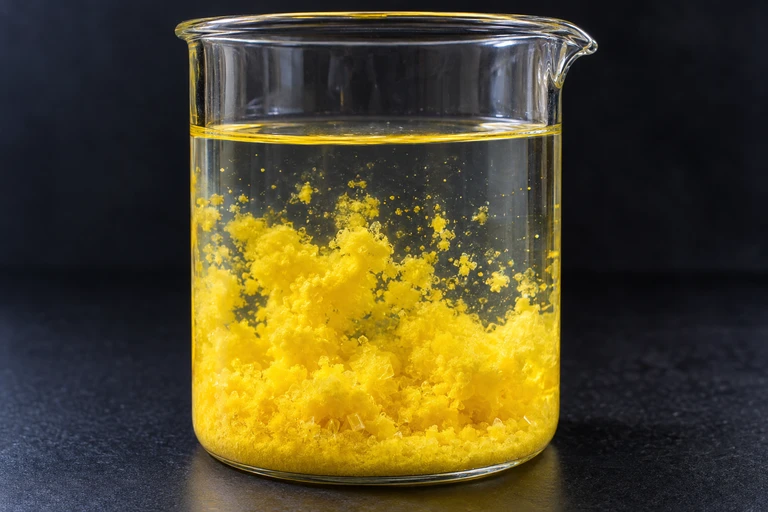 Lead ions and iodide ions combine to form a yellow lead iodide precipitate.
SECTION 4
How to Write Each Representation
Step-by-Step Algorithm
- Step 1 — Write the unbalanced molecular equation. Identify all reactants and products using correct chemical formulas and assign state symbols using solubility rules and knowledge of common gases and liquids.
- Step 2 — Balance the molecular equation. Adjust coefficients so that every element has equal atom counts on both sides. Verify that total charge is balanced (it should be zero on each side for a molecular equation with neutral formulas).
- Step 3 — Write the complete ionic equation. Split every soluble ionic compound and strong acid/base marked (aq) into its constituent ions with correct coefficients. Leave molecular compounds, weak electrolytes, precipitates (s), pure liquids (l), and gases (g) in their formula form.
- Step 4 — Identify and cancel spectator ions. Any ion that appears with the same coefficient and charge on both sides is a spectator. Remove them.
- Step 5 — Write the net ionic equation. The remaining species form the net ionic equation. Verify that atoms and charge balance.
Rules for Splitting Into Ions
| Species Type | Split into ions? | Examples |
|---|---|---|
| Soluble ionic compounds (aq) | Yes | NaCl, KNO₃, Ba(OH)₂ |
| Strong acids (aq) | Yes | HCl, HNO₃, H₂SO₄ (first proton) |
| Strong bases (aq) | Yes | NaOH, KOH, Ca(OH)₂ |
| Weak acids / weak bases (aq) | No | CH₃COOH, NH₃, HF |
| Insoluble ionic compounds (s) | No | AgCl, BaSO₄, PbI₂ |
| Molecular compounds, H₂O, gases | No | H₂O(l), CO₂(g), C₆H₁₂O₆(aq) |
Dissociation rules for writing ionic equations
AP Exam Tip
SECTION 5
Particulate Diagrams in Depth
The AP Chemistry exam places heavy emphasis on particulate diagrams — representations that depict atoms, ions, or molecules as distinct particles (circles, clusters, or structural sketches). These diagrams test whether you truly understand the submicroscopic reality behind a balanced equation. A correct particulate diagram must satisfy three criteria: conservation of atoms (same number of each element on both sides), correct stoichiometric ratios between species, and appropriate depiction of phases (e.g., gaseous molecules spread apart, solid lattice particles clustered, aqueous ions surrounded by solvent).
Common Particulate Diagram Pitfalls
- Unbalanced particle counts: Drawing three water molecules from two H₂ and one O₂ violates conservation. Always count atoms before and after.
- Incorrect bonding: Showing free atoms when molecules should be depicted (e.g., lone H atoms instead of H₂O molecules in products).
- Ignoring limiting reagent: If a problem provides an excess of one reactant, some of those particles must appear unchanged in the product box.
- Phase inconsistency: Aqueous ions should appear dispersed with space between them, whereas solid precipitates should be clustered together.
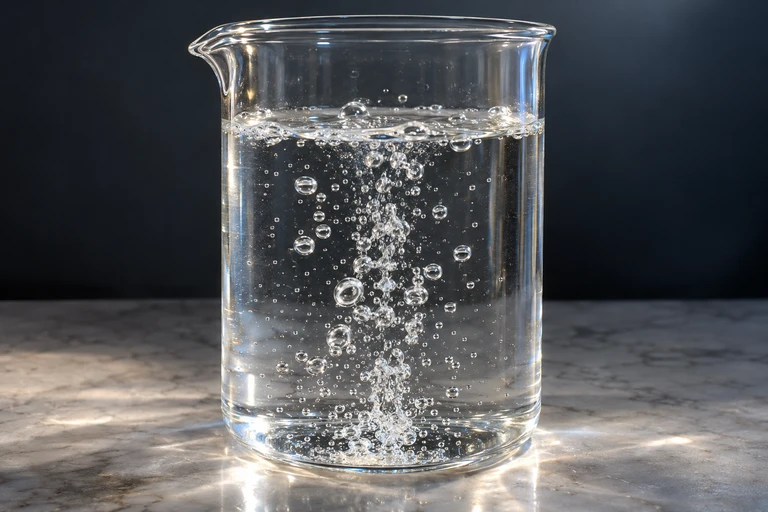 An acid–carbonate reaction produces carbon dioxide bubbles.
SECTION 6
Worked Example — Silver Nitrate + Sodium Chloride
Aqueous silver nitrate is mixed with aqueous sodium chloride. A white precipitate forms. Write the balanced molecular equation, complete ionic equation, and net ionic equation for this reaction.
Full Solution
- 1
Step 1 — Identify Reactants and Products
The reactants are AgNO₃(aq) and NaCl(aq). A double-displacement reaction swaps cation–anion partners to produce AgCl and NaNO₃. Consulting solubility rules: AgCl is insoluble (silver halide exception), so it precipitates as (s). NaNO₃ is soluble, so it remains (aq). - 2
Step 2 — Write and Balance the Molecular Equation
AgNO₃(aq) + NaCl(aq) → AgCl(s) + NaNO₃(aq). Check: 1 Ag, 1 N, 3 O, 1 Na, 1 Cl on each side. The equation is already balanced with all coefficients equal to 1.AgNO₃(aq) + NaCl(aq) → AgCl(s) + NaNO₃(aq) - 3
Step 3 — Write the Complete Ionic Equation
Split every aqueous strong electrolyte into ions. AgNO₃ → Ag⁺ + NO₃⁻; NaCl → Na⁺ + Cl⁻; NaNO₃ → Na⁺ + NO₃⁻. AgCl(s) stays intact because it is a precipitate.Ag⁺(aq) + NO₃⁻(aq) + Na⁺(aq) + Cl⁻(aq) → AgCl(s) + Na⁺(aq) + NO₃⁻(aq) - 4
Step 4 — Cancel Spectator Ions
Na⁺(aq) appears on both sides with a coefficient of 1. NO₃⁻(aq) also appears identically on both sides. These are spectators — remove them. - 5
Step 5 — Write the Net Ionic Equation
After removing spectators, we are left with the ions that actually form the precipitate. Verify: 1 Ag and 1 Cl on each side ✓. Charge: +1 + (−1) = 0 on the left; 0 on the right ✓.Ag⁺(aq) + Cl⁻(aq) → AgCl(s)
SECTION 7
Strengths & Limitations of Each Representation
| Representation | Strengths | Limitations |
|---|---|---|
| Balanced Molecular Equation | Shows overall stoichiometry, identifies all substances and phases, useful for mass-to-mass calculations. | Obscures the ionic nature of dissolved compounds; does not reveal which species actually react. |
| Complete Ionic Equation | Reveals all ionic species present in solution; essential bridge to the net ionic equation. | Cluttered with spectator ions; harder to see the essential chemistry at a glance. |
| Net Ionic Equation | Shows only the species that undergo change; highlights driving force (precipitate, gas, or water formation). | Does not reveal identities of spectator ions or full stoichiometry for gravimetric calculations. |
| Particulate Diagram | Directly tests conceptual understanding of atomic rearrangement, limiting reagents, and conservation of atoms. | Becomes unwieldy for large stoichiometric coefficients; cannot convey energy changes or kinetics. |
Comparison of reaction representations
KEY TAKEAWAY
SECTION 8
Connection to Advanced Theory
The representations introduced here form the foundation for several advanced topics you will encounter later in AP Chemistry and in college-level courses. Understanding how to transition among symbolic, ionic, and particulate levels enables deeper analysis of reaction thermodynamics, kinetics, and equilibrium.
| This Lesson | Advanced Extension |
|---|---|
| Balanced molecular equation with stoichiometric coefficients | Stoichiometric coefficients appear in rate laws, equilibrium expressions (Kₑ), and Hess's law enthalpy calculations. |
| Net ionic equation isolating reacting species | Net ionic equations are used to write Ksp expressions, predict precipitation in Q vs. K comparisons, and construct electrochemical half-reactions. |
| Particulate diagrams showing atom rearrangement | Particle-level reasoning extends to reaction coordinate diagrams, transition-state theory, and Le Châtelier's principle (shifting equilibrium at the molecular level). |
| Spectator ions identified and removed | In electrochemistry, spectator ions carry current as the 'salt bridge' ions; in colligative properties, all dissolved species — including spectators — affect boiling point and freezing point. |
How representations of reactions connect to advanced AP Chemistry topics
As you progress through the AP Chemistry curriculum, you will find that nearly every quantitative problem begins with a properly balanced equation. Whether you are computing ΔH° from bond enthalpies, calculating Ksp for a sparingly soluble salt, or balancing a redox half-reaction, the skills you developed here — correctly writing formulas, assigning states, dissociating strong electrolytes, and tracking particles — will serve as the essential first step.
SECTION 9
Practice Problems
Question 1: CONCEPTUAL
- A. An ion that is produced as a product in the net ionic equation
- B. An ion that appears in the complete ionic equation but not in the net ionic equation because it is unchanged on both sides
- C. An ion that precipitates out of solution during the reaction
- D. An ion that acts as a catalyst, speeding up the reaction without being consumed
Show answer (B)
Question 2: BASIC CALCULATION
- A. BaCl₂(aq) + Na₂SO₄(aq) → BaSO₄(s) + 2 NaCl(aq)
- B. Ba²⁺(aq) + 2 Cl⁻(aq) + 2 Na⁺(aq) + SO₄²⁻(aq) → BaSO₄(s) + 2 Na⁺(aq) + 2 Cl⁻(aq)
- C. Ba²⁺(aq) + SO₄²⁻(aq) → BaSO₄(s)
- D. Ba²⁺(aq) + SO₄²⁻(aq) → Ba²⁺(aq) + SO₄²⁻(aq)
Show answer (C)
Question 3: INTERMEDIATE
- A. H⁺(aq) + OH⁻(aq) → H₂O(l)
- B. CH₃COOH(aq) + OH⁻(aq) → CH₃COO⁻(aq) + H₂O(l)
- C. CH₃COO⁻(aq) + Na⁺(aq) → CH₃COONa(aq)
- D. CH₃COOH(aq) + NaOH(aq) → CH₃COONa(aq) + H₂O(l)
Show answer (B)
Question 4: APPLIED
4 ptsShow answer
Question 5: CRITICAL THINKING
5 ptsShow answer
SUMMARY
Summary
Summary
Chemical reactions can be represented at multiple levels. The balanced molecular equation provides complete formulas with stoichiometric coefficients and state symbols, making it ideal for mass calculations. The complete ionic equation splits all strong electrolytes into ions, revealing the true solution composition. The net ionic equation removes spectator ions to isolate the species that undergo chemical change, exposing the reaction's driving force — whether that is precipitate formation, gas evolution, or water formation.
Particulate diagrams translate these symbolic representations into visual, atom-by-atom depictions that enforce conservation of mass and correct stoichiometric ratios. On the AP exam, fluency among all four representations — writing them, interpreting them, and converting between them — is essential for success on both multiple-choice and free-response questions.