

SECTION 1
Historical Context & Motivation
The concept of chemical equilibrium did not emerge in a single flash of insight but rather developed over decades as chemists grappled with reversible reactions—reactions that never seem to go fully to completion. Early industrial chemistry, particularly the synthesis of ammonia and sulfuric acid, demanded a quantitative framework for predicting how far a reaction would proceed under given conditions. The equilibrium constant became that framework, translating the abstract notion of 'balance' into a single, calculable number that encodes the thermodynamic favorability of a reaction at a given temperature.
1864 • Law of Mass Action
1884 • Le Châtelier's Principle
1901 • Van 't Hoff Equation
1923 • Thermodynamic Formalism
With the equilibrium constant established, a natural question arose: what happens to K when we reverse a reaction, multiply its coefficients, or combine two equations into a single overall process? Understanding these algebraic properties of K is essential for solving multi-step equilibrium problems and for connecting equilibrium to thermodynamic quantities. This lesson explores each of these properties in depth, complete with mathematical derivations and worked examples.
SECTION 2
Core Properties of K
The equilibrium constant is not merely a static number attached to a balanced equation; it is a dynamic quantity that transforms in predictable, mathematically rigorous ways whenever the equation itself is manipulated. Mastery of these transformations allows you to derive K values for new reactions from known data, a skill heavily tested on the AP Chemistry exam. The following core properties govern how K responds to changes in the stoichiometric equation.
Reversing a Reaction
Multiplying Coefficients
Adding Reactions (Hess's Law Analog)
K Depends Only on Temperature
KEY TAKEAWAY
SECTION 3
Visual Explanation: How K Transforms
The diagram above provides a visual roadmap for the three transformations you will use most frequently. Notice that each operation on the balanced equation corresponds to a specific algebraic operation on K. The reverse → reciprocal relationship follows directly from flipping the numerator and denominator in the equilibrium expression. The multiply → power rule arises because every exponent in the expression is scaled by the same factor. The sum → product relationship is the equilibrium analog of Hess's law for enthalpy, and it works because intermediate species cancel algebraically, leaving only the reactants and products of the overall process.
SECTION 4
Mathematical Framework
Each property of K can be derived rigorously from the definition of the equilibrium expression. Consider a generic reaction in which lowercase letters represent stoichiometric coefficients and uppercase letters represent chemical species. The derivations below use the standard equilibrium expression written in terms of molar concentrations for a homogeneous system, though the logic applies identically to Kp expressions written in terms of partial pressures.
GENERAL EQUILIBRIUM EXPRESSION
Brackets denote equilibrium molar concentrations; a, b, c, d are stoichiometric coefficients.
Property 1: Reversing the Reaction
REVERSE REACTION
Swapping products and reactants inverts the fraction. Hence Krev = 1/Kfwd.
Property 2: Multiplying All Coefficients by n
SCALED EQUATION
Each exponent in the expression is multiplied by n, so the entire expression becomes K raised to the nth power. This applies to any positive real n, including fractions (e.g., halving an equation means Knew = K1/2 = √K).
Property 3: Adding Reactions
SUM OF REACTIONS
When two equilibrium expressions are multiplied together, intermediate species cancel. The result is the equilibrium expression for the net reaction. This generalizes to any number of summed reactions: Koverall = K₁ × K₂ × K₃ × …
Connecting to Free Energy
SECTION 5
, , and Excluded Species
A complete understanding of the properties of K requires distinguishing between Kc (expressed in molar concentrations) and Kp (expressed in partial pressures). These two forms are related by the ideal gas law and differ by a factor that depends on the change in moles of gas. Additionally, pure solids and pure liquids are excluded from the equilibrium expression because their concentrations (activities) are constant and incorporated into the value of K itself.
RELATIONSHIP BETWEEN Kp AND Kc
Δn = (moles of gaseous products) − (moles of gaseous reactants); R = 0.08206 L·atm·mol⁻¹·K⁻¹; T in Kelvin. When Δn = 0, Kp = Kc.
A common AP Chemistry pitfall is forgetting to exclude pure solids and pure liquids from the expression. For example, in the decomposition of calcium carbonate (CaCO₃(s) ⇌ CaO(s) + CO₂(g)), the equilibrium expression contains only the CO₂ term: Kp = PCO₂. The two solids do not appear. This occurs because the thermodynamic activity of a pure substance in its standard state is defined as 1.
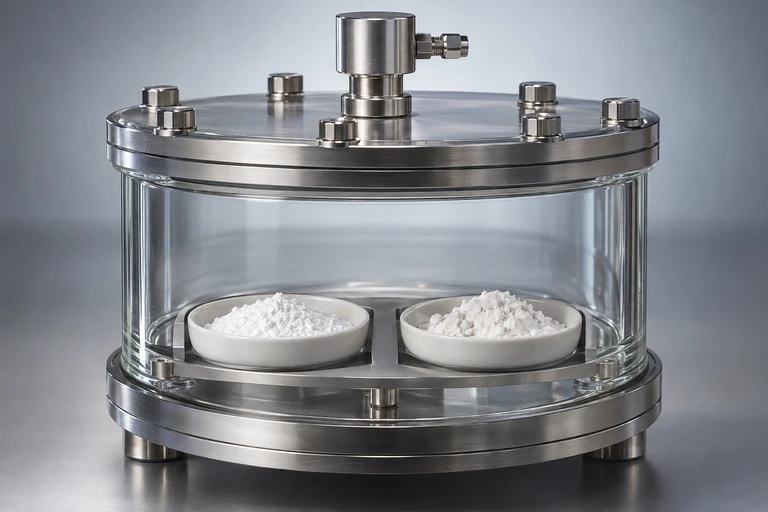 Solid phases can coexist with a gas in a closed heterogeneous-equilibrium system.
SECTION 6
Worked Example: Combining Equilibria
Consider the following problem: determine Kc for the reaction 2 SO₃(g) ⇌ 2 SO₂(g) + O₂(g) given that the formation reaction SO₂(g) + ½ O₂(g) ⇌ SO₃(g) has Kc = 2.8 × 10² at a certain temperature.
Finding K for a Modified Reaction
- 1
Step 1 — Identify the given reaction and target
Given: SO₂(g) + ½ O₂(g) ⇌ SO₃(g), K₁ = 2.8 × 10². Target: 2 SO₃(g) ⇌ 2 SO₂(g) + O₂(g). - 2
Step 2 — Reverse the given reaction
Reversing gives SO₃(g) ⇌ SO₂(g) + ½ O₂(g). By the reciprocal rule, Krev = 1/K₁ = 1/(2.8 × 10²) = 3.57 × 10⁻³.Krev = 3.57 × 10⁻³ - 3
Step 3 — Multiply all coefficients by 2
The target reaction has coefficients that are exactly double those of the reversed reaction: 2 SO₃(g) ⇌ 2 SO₂(g) + O₂(g). By the power rule, Ktarget = (Krev)² = (3.57 × 10⁻³)². - 4
Step 4 — Calculate the final value
(3.57 × 10⁻³)² = 3.57² × 10⁻⁶ = 12.7 × 10⁻⁶ = 1.27 × 10⁻⁵. Alternatively, you can apply both operations at once: Ktarget = (1/K₁)² = 1/K₁² = 1/(2.8 × 10²)² = 1/(7.84 × 10⁴) = 1.28 × 10⁻⁵.Ktarget ≈ 1.3 × 10⁻⁵ - 5
Step 5 — Interpret the result
Because Ktarget ≪ 1, the decomposition of SO₃ into SO₂ and O₂ is reactant-favored at this temperature. This is consistent with the original K₁ being much greater than 1 for the forward (formation) direction.
SECTION 7
Common Mistakes & Clarifications
| Common Mistake | Why It's Wrong | Correct Approach |
|---|---|---|
| Adding K values when reactions are summed | Hess's law uses addition for ΔH, but equilibrium constants are multiplicative because the equilibrium expression is a ratio of products. | Multiply K values: Koverall = K₁ × K₂ |
| Multiplying K by n when coefficients are scaled | Scaling coefficients scales the exponents in the equilibrium expression, not the base value. | Raise K to the nth power: Knew = Kⁿ |
| Claiming K changes when concentration changes | Adding or removing a reactant/product shifts Q away from K and changes the position of equilibrium, but K itself depends only on temperature. | K is constant at fixed T. The system re-establishes equilibrium by shifting until Q = K again. |
| Including solids or liquids in the expression | The activities of pure solids and liquids are 1 by convention and are absorbed into K. | Only include gaseous and aqueous species in Kc or Kp expressions. |
Common errors students make when manipulating equilibrium constants
EXAM TIP
SECTION 8
Connection to Thermodynamics & Advanced Theory
The properties of the equilibrium constant become even more elegant when viewed through the lens of thermodynamics. The relationship ΔG° = −RT ln K is the bridge that connects the macroscopic spontaneity of a reaction to the equilibrium position. Since free energy is a state function—its value depends only on the initial and final states—any algebraic manipulation of the balanced equation has a predictable, corresponding effect on ΔG° and, by extension, on K.
| Equation Operation | Effect on ΔG° | Effect on K |
|---|---|---|
| Reverse | ΔG°rev = −ΔG°fwd | Krev = 1/Kfwd |
| Multiply coefficients by n | ΔG°new = n × ΔG° | Knew = Kⁿ |
| Sum two reactions | ΔG°overall = ΔG°₁ + ΔG°₂ | Koverall = K₁ × K₂ |
| Change temperature | ΔG° changes (via ΔH° and ΔS°) | K changes; governed by the van 't Hoff equation |
Parallel transformations in ΔG° and K
The logarithmic nature of the ΔG°–K relationship is the mathematical engine behind all three rules. Logarithms convert multiplication into addition (explaining the product rule), convert exponentiation into multiplication (explaining the power rule), and convert reciprocals into sign changes (explaining the reversal rule). Students preparing for the AP exam should recognize that the same ΔG° = −RT ln K equation also connects to the van 't Hoff equation, ln(K₂/K₁) = −ΔH°/R × (1/T₂ − 1/T₁), which describes how K changes with temperature—a topic explored in a companion lesson on Le Châtelier's principle and temperature effects.
SECTION 9
Practice Problems
Question 1: CONCEPTUAL
- A. 6.0 × 10⁵
- B. −6.0 × 10⁵
- C. 1.7 × 10⁻⁶
- D. 3.6 × 10¹¹
Show answer (C)
Question 2: BASIC CALCULATION
- A. 2.0 × 10³
- B. 63.2
- C. 1.6 × 10⁷
- D. 8.0 × 10³
Show answer (B)
Question 3: INTERMEDIATE
- A. (K₁ × K₂)²
- B. 1 / (K₁ × K₂)²
- C. K₁² / K₂²
- D. 2 / (K₁ × K₂)
Show answer (B)
Question 4: APPLIED
5 ptsShow answer
Question 5: CRITICAL THINKING
4 ptsShow answer
SUMMARY
Lesson Summary
Summary
The equilibrium constant K is tied to the balanced equation: reversing the reaction takes the reciprocal (K' = 1/K), multiplying all coefficients by n raises K to the nth power (K' = Kⁿ), and summing reactions multiplies their K values (Koverall = K₁ × K₂). These rules follow directly from the structure of the equilibrium expression and from the relationship ΔG° = −RT ln K.
Remember that K depends only on temperature, that pure solids and liquids are excluded from the equilibrium expression, and that Kp and Kc are interconverted via Kp = Kc(RT)^Δn. When solving multi-step problems, apply each transformation sequentially—reverse first, scale second, combine last—and always verify that the final expression matches the target equation.