
SECTION 1
Historical Context & Motivation
The distinction between physical changes and chemical changes lies at the very foundation of chemistry as a discipline. Before the modern atomic theory was established, alchemists and early natural philosophers struggled to explain why some transformations—such as melting gold—could be reversed trivially, while others—such as burning wood—produced entirely different materials with no obvious path back to the original substance. The quest to classify and understand these transformations drove centuries of experimental work, ultimately culminating in the laws of conservation and the molecular theory of matter that underpin modern chemistry.
1661 • Boyle's The Sceptical Chymist
1774 • Lavoisier's Conservation of Mass
1808 • Dalton's Atomic Theory
1869 • Mendeleev's Periodic Table
The central question this lesson addresses is deceptively simple: How do we rigorously determine whether a given transformation has altered the chemical identity of a substance? On the AP Chemistry exam, this distinction underpins stoichiometric reasoning, thermochemistry, and equilibrium analysis, making it essential to master the criteria at both macroscopic and particulate levels.
SECTION 2
Core Principles & Definitions
At the particulate level, the critical distinction rests on whether the intramolecular bonds (covalent or ionic bonds within a compound) are broken and reformed. A physical change alters only intermolecular forces or the spatial arrangement of particles—phase, shape, or degree of dispersion—without disrupting the chemical bonds that define molecular identity. A chemical change breaks and forms intramolecular bonds, producing one or more new substances with distinct compositions and properties.
Physical Change
Chemical Change
Macroscopic Evidence
Conservation of Mass
KEY TAKEAWAY
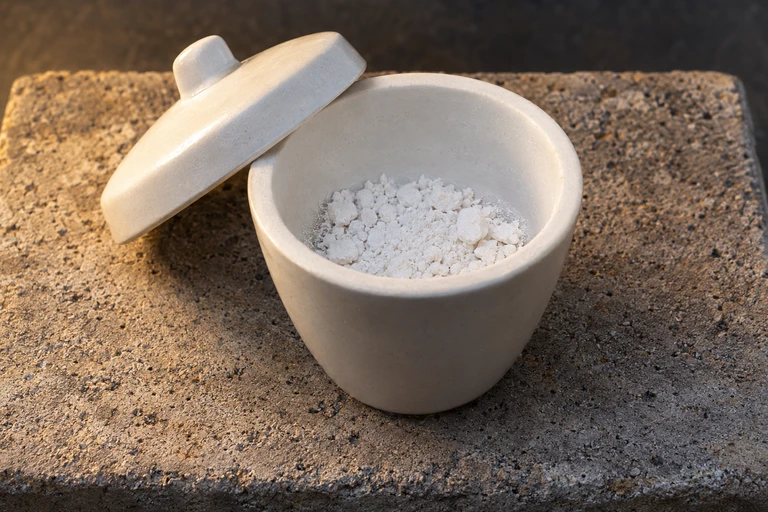 A heated carbonate can release carbon dioxide through an open crucible, decreasing the mass left in the vessel.
SECTION 3
Visual Explanation — Particulate View
The diagram above illustrates the particulate-level distinction that the AP Chemistry exam repeatedly tests. In the physical change panel, notice that the circles representing H₂O remain the same color and bonding pattern—only the spacing between molecules changes as hydrogen bonds weaken during melting. In the chemical change panel, the violet hydrogen atoms and red oxygen atoms sever their original diatomic bonds and recombine into a bent triatomic molecule with entirely new covalent bonds. This visual reinforces the principle that chemical identity is encoded in intramolecular bonding, not in the arrangement of molecules relative to one another.
SECTION 4
Energetic Framework — Enthalpy of Physical vs. Chemical Change
Both physical and chemical changes involve energy transfer, but the magnitudes and molecular origins differ significantly. Quantifying these energy changes provides a rigorous, measurable criterion for classifying transformations and connects directly to thermochemistry topics on the AP exam.
ENTHALPY OF PHASE TRANSITION
q = heat absorbed or released (J); n = moles of substance; ΔHtransition = molar enthalpy of fusion, vaporization, or sublimation (kJ/mol). These values reflect the energy needed to overcome intermolecular forces without breaking covalent bonds. For water: ΔHfus = 6.01 kJ/mol; ΔHvap = 40.7 kJ/mol.
ENTHALPY OF REACTION (BOND ENERGY METHOD)
ΔH°rxn = standard enthalpy of reaction; BDE = bond dissociation energy (kJ/mol). Since chemical changes involve breaking and forming covalent bonds, ΔH°rxn values are typically 10–100× larger than phase transition enthalpies for the same number of moles.
HESS'S LAW (FORMATION ENTHALPY METHOD)
ΔH°f = standard enthalpy of formation. This equation is used when tabulated formation enthalpies are available, allowing calculation of ΔH° for any chemical change without knowing individual bond energies.
AP EXAM TIP
SECTION 5
Detailed Classification & Evidence
Classifying a transformation as physical or chemical requires evaluating evidence at multiple levels. The following diagram provides a systematic decision flowchart, and the table below catalogs common examples with their particulate-level justifications.
| Transformation | Type | Particulate-Level Reasoning |
|---|---|---|
| Boiling ethanol | Physical | C₂H₅OH molecules separate; hydrogen bonds break, but O–H and C–H covalent bonds remain intact. |
| Combustion of propane | Chemical | C–H and C–C bonds in C₃H₈ and O=O bonds break; new C=O and O–H bonds form in CO₂ and H₂O. |
| Dissolving NaCl in water | Physical | Ionic lattice dissociates into Na⁺(aq) and Cl⁻(aq); ions are separated and hydrated, not transformed into new species. |
| Dissolving Zn in HCl | Chemical | Zn is oxidized to Zn²⁺ and H⁺ is reduced to H₂(g); electron transfer and new bond formation occur. |
| Sublimation of dry ice | Physical | CO₂ molecules move from a crystalline solid directly to gas; London dispersion forces are overcome, but C=O bonds persist. |
| Photosynthesis | Chemical | 6CO₂ + 6H₂O → C₆H₁₂O₆ + 6O₂; multiple covalent bonds are broken and reformed, producing glucose. |
Common transformations classified with particulate-level evidence
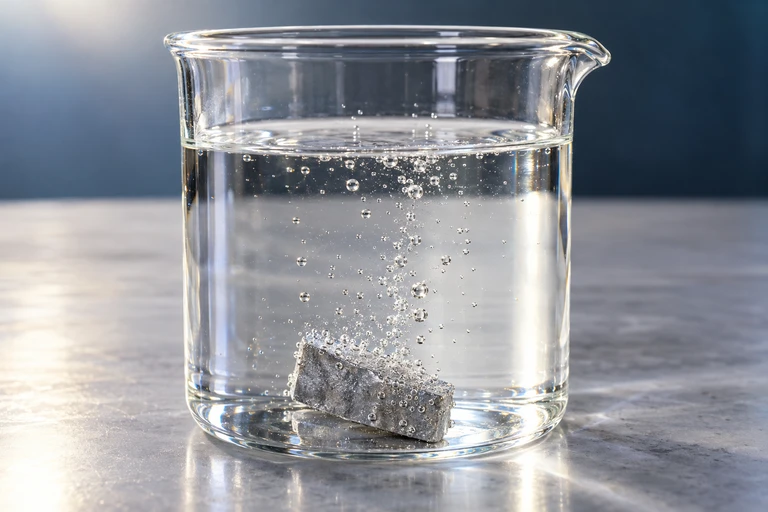 Zinc reacts with acid, forming dissolved zinc ions and hydrogen gas.
SECTION 6
Worked Example — Classifying and Quantifying a Change
Consider the following scenario: A student heats 36.0 g of liquid water from 25.0 °C to 100.0 °C, then boils it completely to steam, and separately combusts 2.00 mol of H₂(g) with excess O₂. Classify each process and calculate the energy involved.
Classifying and Quantifying Energy Changes
- 1
Step 1 — Classify Each Process
Heating water from 25 °C to 100 °C is a physical change (increasing kinetic energy of H₂O molecules, weakening hydrogen bonds, but no covalent bonds break). Boiling water at 100 °C is also a physical change (H₂O liquid → H₂O gas; overcoming hydrogen bonds). Combustion of H₂ with O₂ is a chemical change (2H₂ + O₂ → 2H₂O; H–H and O=O bonds break, new O–H bonds form). - 2
Step 2 — Calculate Energy for Heating Water
Use q = mcΔT where m = 36.0 g, c = 4.184 J/(g·°C), and ΔT = 100.0 − 25.0 = 75.0 °C.q = 36.0 × 4.184 × 75.0 = 11,300 J ≈ 11.3 kJ - 3
Step 3 — Calculate Energy for Boiling Water
n = 36.0 g ÷ 18.02 g/mol = 2.00 mol. Using q = nΔHvap with ΔHvap = 40.7 kJ/mol.q = 2.00 × 40.7 = 81.4 kJ - 4
Step 4 — Calculate Energy for Combustion of H₂
The balanced equation is 2H₂(g) + O₂(g) → 2H₂O(l), with ΔH° = −571.6 kJ for 2 mol H₂. Since we have 2.00 mol H₂, the energy released equals the full stoichiometric amount.q = −571.6 kJ (exothermic) - 5
Step 5 — Compare and Interpret
The physical changes (heating + boiling) required 11.3 + 81.4 = 92.7 kJ total. The chemical change released 571.6 kJ—roughly 6× more energy for the same number of moles. This dramatic difference in energy scale reflects the fundamental distinction: overcoming intermolecular forces (physical) requires far less energy than breaking and forming covalent bonds (chemical).Chemical changes involve ~6× more energy than the corresponding physical changes for 2 mol H₂O
SECTION 7
Strengths & Limitations of Classification Criteria
While the physical/chemical change framework is powerful, it has important limitations that AP Chemistry students must understand. The macroscopic observations students often learn first—color change, gas evolution, temperature change—are necessary clues but insufficient evidence on their own. A rigorous classification always requires particulate-level reasoning.
| Criterion | Strengths | Limitations |
|---|---|---|
| Color change | Easy to observe; often correlates with changes in electron configuration or new chromophores. | Dissolving a dye is a physical change that produces dramatic color change. Not diagnostic alone. |
| Gas evolution | Bubble formation often signals decomposition or acid–base reaction producing CO₂ or H₂. | Boiling and degassing dissolved gases are physical processes that also produce bubbles. |
| Temperature change | Exothermic/endothermic reactions often cause noticeable temperature shifts. | Dissolving ammonium nitrate (physical) is strongly endothermic. Mixing concentrated acids with water (physical) releases heat. |
| Precipitate formation | Strong indicator of a double-replacement reaction forming an insoluble product. | Supersaturated solutions crystallizing is a physical process that resembles precipitate formation. |
| Reversibility | Physical changes are generally reversible by physical means; a useful heuristic. | Many chemical reactions are reversible (equilibrium), and some physical changes (denaturation) are practically irreversible. |
Macroscopic criteria: useful clues but not definitive evidence
KEY TAKEAWAY
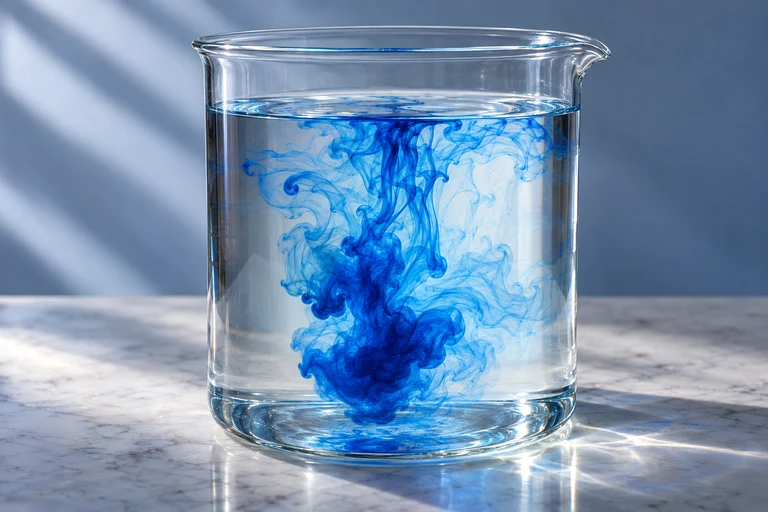 A dye can disperse through water and change its color without forming a new reaction product.
SECTION 8
Connection to Advanced Theory — Thermodynamics & Kinetics
The physical/chemical change distinction connects directly to two pillars of advanced chemistry: thermodynamics and kinetics. Both physical and chemical changes can be analyzed through the lens of Gibbs free energy (ΔG = ΔH − TΔS), which predicts spontaneity. For physical changes like phase transitions, the entropy term (TΔS) plays a dominant role at the transition temperature where ΔG = 0. For chemical changes, both ΔH and ΔS contribute, and the magnitude of activation energy (Ea) determines reaction rate.
| Feature | Physical Change | Chemical Change |
|---|---|---|
| Driving force | Entropy increase (ΔS > 0 for melting, vaporization); ΔG becomes negative at transition T | Interplay of ΔH and ΔS; ΔG < 0 determines thermodynamic favorability |
| Activation energy | Typically very low or negligible; phase transitions occur readily at the appropriate T | Often significant; catalysts lower Eₐ without changing ΔG |
| Equilibrium | Phase equilibria (e.g., vapor pressure); described by Clausius–Clapeyron equation | Chemical equilibria described by K expressions; Le Châtelier's principle applies |
| Entropy change magnitude | ΔSvap ≈ 85–90 J/(mol·K) for most liquids (Trouton's rule) | Highly variable; depends on Δngas and molecular complexity of products vs. reactants |
Thermodynamic and kinetic comparison of physical vs. chemical changes
As you progress through the AP curriculum to units on thermodynamics (Unit 6), equilibrium (Unit 7), and kinetics (Unit 5), the foundational understanding of bond-level changes developed here will allow you to connect enthalpy diagrams, rate laws, and equilibrium constants back to the molecular events that define each transformation. Nuclear reactions—which alter the identity of atoms themselves—represent a further extension beyond the chemical/physical dichotomy and are addressed in nuclear chemistry.
SECTION 9
Practice Problems
Question 1: CONCEPTUAL
- A. Endothermic processes are always chemical changes, so the student's logic is actually correct.
- B. The dissolution is chemical because KNO₃ decomposes into K⁺ and NO₃⁻, which are new chemical species.
- C. Dissolution of an ionic compound disrupts only ionic lattice interactions, not intramolecular bonds, so it is a physical change despite being endothermic.
- D. The temperature decrease is due to experimental error; dissolving KNO₃ is actually exothermic.
Show answer (C)
Question 2: BASIC CALCULATION
- A. 6.01 kJ
- B. 30.0 kJ
- C. 203 kJ
- D. 540 kJ
Show answer (B)
Question 3: INTERMEDIATE
- A. Sublimation of solid iodine (I₂) to iodine vapor
- B. Dissolving table sugar (C₁₂H₂₂O₁₁) in water
- C. Magnetizing a piece of iron
- D. Converting oxygen gas (O₂) to ozone (O₃)
Show answer (D)
Question 4: APPLIED
4 ptsShow answer
Question 5: CRITICAL THINKING
5 ptsShow answer
SUMMARY
Summary — Physical and Chemical Changes
Summary
Physical changes alter only the intermolecular forces or spatial arrangement of particles, preserving molecular identity and chemical formula. Examples include phase transitions, dissolution of ionic and molecular solids, and changes in shape or state. Chemical changes involve the breaking and forming of intramolecular bonds, producing new substances with different chemical formulas and properties. Both obey conservation of mass.
Macroscopic observations—color change, gas evolution, temperature change, and precipitate formation—are useful clues but are insufficient without particulate-level reasoning. The energy scales differ dramatically: physical changes involve enthalpies on the order of 1–50 kJ/mol (intermolecular forces), while chemical changes often involve 100–1000+ kJ/mol (covalent/ionic bonds). On the AP exam, always anchor your classification in bond-level analysis—identify which bonds break and which form—to earn full credit on free-response questions.