

SECTION 1
Historical Context & Motivation
The relationship between pH and solubility has been central to chemistry since the earliest attempts to understand why certain minerals dissolve in acidic waters but remain stubbornly insoluble in neutral streams. Miners in the sixteenth century observed that acidic mine drainage could dissolve metal ores that resisted dissolution in clean water, though they lacked a theoretical framework to explain the phenomenon. It was not until the development of ionic theory and the quantitative pH scale that chemists could rigorously connect hydrogen ion concentration to the dissolution behavior of sparingly soluble salts. This connection lies at the intersection of two pillars of general chemistry: acid–base equilibrium and solubility equilibrium, and understanding their interplay is essential for predicting precipitation, designing buffer systems, and interpreting real-world phenomena such as ocean acidification and kidney stone formation.
1887 • Arrhenius Ion Theory
1909 • The pH Scale
1923 • Brønsted–Lowry Theory
1938 • Systematic Ksp Measurements
1960s • Environmental Applications
The central question this lesson addresses is deceptively simple: Why does changing the pH of a solution alter the solubility of certain ionic compounds but not others? Answering this question requires combining Le Châtelier's principle with Ksp expressions and acid–base chemistry—skills that are heavily tested on the AP Chemistry exam and foundational for future work in analytical chemistry, geochemistry, and biochemistry.
SECTION 2
Core Principles & Definitions
Before examining the pH–solubility relationship in detail, it is necessary to establish several foundational concepts. The solubility product constant (Ksp) is the equilibrium constant for the dissolution of a sparingly soluble ionic compound in water. Unlike a simple solubility value expressed in g/L, Ksp is expressed in terms of ion concentrations raised to stoichiometric powers. The key insight is that when the anion of a sparingly soluble salt is the conjugate base of a weak acid, added H+ ions can react with that anion and shift the dissolution equilibrium to the right, thereby increasing solubility. Conversely, anions derived from strong acids (such as Cl− and NO3−) do not react appreciably with H+, so the solubility of those salts is essentially pH-independent.
Solubility Product (Ksp)
Common Ion Effect
pH-Dependent Solubility
pH-Independent Solubility
Le Châtelier's Principle
KEY TAKEAWAY
SECTION 3
Visual Explanation
How pH Shifts the Dissolution Equilibrium
The diagram above illustrates the conceptual core of pH-dependent solubility. For CaF2, the fluoride ion is the conjugate base of HF (Ka = 6.6 × 10⁻⁴), so in acidic solution F⁻ is consumed by protonation. Le Châtelier's principle then demands that additional CaF2 dissolves to replenish the fluoride. By contrast, for AgCl the chloride ion derives from HCl, a strong acid with no meaningful tendency to accept a proton, so pH has no thermodynamic leverage on the dissolution equilibrium. When analyzing any salt on the AP exam, the first question to ask is: What acid does the anion come from, and is that acid weak or strong?
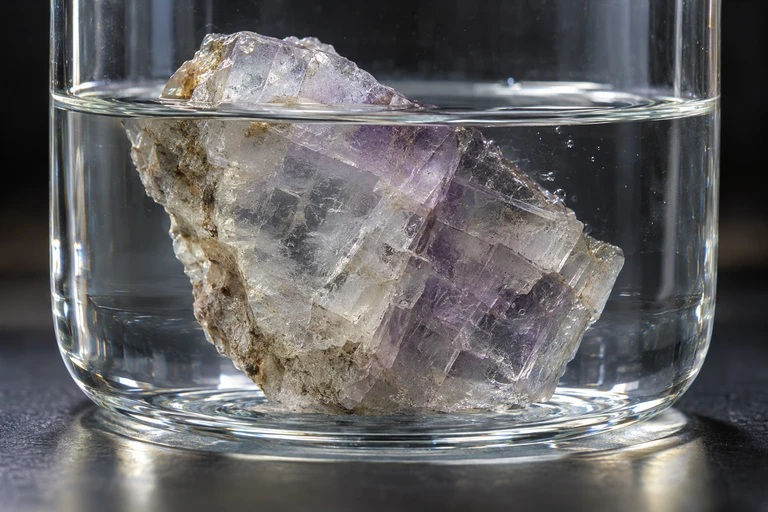 Fluorite, calcium fluoride, contacts a solution in which dissolved fluoride can participate in acid–base equilibria.
SECTION 4
Mathematical Framework
To treat pH and solubility quantitatively, we combine the Ksp expression for dissolution with the Ka expression for the anion's protonation. When both equilibria operate simultaneously, the overall process has an effective equilibrium constant that is the product of Ksp and 1/Ka (or Kb of the anion), as governed by Hess's law applied to equilibrium constants.
SOLUBILITY PRODUCT EXPRESSION
For CaF2(s) ⇌ Ca²⁺(aq) + 2 F⁻(aq). Ksp = 3.45 × 10⁻¹¹ at 25 °C. In pure water, molar solubility s yields [Ca²⁺] = s and [F⁻] = 2s.
ANION PROTONATION EQUILIBRIUM
Since HF is a weak acid, its conjugate base F⁻ is a reasonably effective proton acceptor. The large value of 1/Ka means this reaction lies far to the right, ensuring significant anion removal in acidic solution.
OVERALL DISSOLUTION IN ACID
The overall equilibrium constant K = Ksp × (1/Ka)² = (3.45 × 10⁻¹¹)(1.5 × 10³)² ≈ 7.8 × 10⁻⁵. Because K > Ksp by many orders of magnitude, solubility is dramatically enhanced in acid.
AP Exam Tip
SECTION 5
Classifying Salts by pH Sensitivity
A systematic approach to predicting pH effects on solubility begins with classifying the anion. The table below organizes common sparingly soluble salts by whether their solubility increases, decreases, or remains unchanged as pH decreases. Note that hydroxide salts represent a special case: the anion is OH⁻, so adding H⁺ directly neutralizes it, and solubility increases dramatically in acidic solution. Similarly, salts of polyprotic acid anions (CO32−, PO43−, S²⁻) are especially pH-sensitive because multiple protonation steps can occur.
| Anion | Parent Acid | Acid Strength | pH Effect on Solubility | Example Salt |
|---|---|---|---|---|
| OH⁻ | H₂O | Amphiprotic | Increases | Fe(OH)₃ |
| F⁻ | HF | Weak | Increases | CaF₂ |
| CO₃²⁻ | H₂CO₃ | Weak (diprotic) | Increases strongly | CaCO₃ |
| PO₄³⁻ | H₃PO₄ | Weak (triprotic) | Increases strongly | Ca₃(PO₄)₂ |
| S²⁻ | H₂S | Weak (diprotic) | Increases | CuS |
| Cl⁻ | HCl | Strong | No change | AgCl |
| Br⁻ | HBr | Strong | No change | AgBr |
| I⁻ | HI | Strong | No change | PbI₂ |
Classification of common anions by pH sensitivity of their sparingly soluble salts
The graph reinforces a critical pattern: the weaker the parent acid, the more basic the anion, and the more dramatically pH affects solubility. Carbonate (from H2CO3, Ka1 = 4.3 × 10⁻⁷, Ka2 = 4.7 × 10⁻¹¹) is an exceptionally basic anion, so CaCO3 dissolves readily even in mildly acidic solution—a fact that explains why limestone caves form in regions where slightly acidic groundwater contacts calcium carbonate bedrock over geological timescales.
SECTION 6
Worked Example
Will CaF₂ Dissolve More in a pH 3.00 Buffer Than in Pure Water?
Predicting the Effect of Acid on CaF₂ Solubility
- 1
Step 1 — Write the Dissolution Equilibrium
CaF2(s) ⇌ Ca²⁺(aq) + 2 F⁻(aq), with Ksp = 3.45 × 10⁻¹¹.Ksp = 3.45 × 10⁻¹¹ - 2
Step 2 — Identify the Anion and Its Parent Acid
The anion F⁻ is the conjugate base of HF, a weak acid with Ka = 6.6 × 10⁻⁴. Because HF is weak, F⁻ will react with H⁺ in the buffered solution.F⁻ is a basic anion → pH-dependent solubility - 3
Step 3 — Apply Le Châtelier's Principle
At pH 3.00, [H⁺] = 1.0 × 10⁻³ M. The protonation reaction F⁻ + H⁺ → HF removes F⁻ from solution. This lowers the ion product Q relative to Ksp, so additional CaF2 dissolves to restore equilibrium.Equilibrium shifts RIGHT → more CaF₂ dissolves - 4
Step 4 — Calculate Solubility in Pure Water (Baseline)
Let s = molar solubility. Then [Ca²⁺] = s and [F⁻] = 2s. Ksp = (s)(2s)² = 4s³. Solving: s = (Ksp/4)1/3 = (3.45 × 10⁻¹¹/4)1/3 = (8.63 × 10⁻¹²)1/3 ≈ 2.05 × 10⁻⁴ M.s (pure water) ≈ 2.05 × 10⁻⁴ M - 5
Step 5 — Conclude
Because F⁻ is protonated at pH 3.00, the effective solubility of CaF2 in the buffer is significantly greater than 2.05 × 10⁻⁴ M. On an AP free-response question, a full-credit answer would state: "CaF2 is more soluble at pH 3.00 because F⁻, the conjugate base of the weak acid HF, reacts with H⁺ to form HF. This removes F⁻ from the dissolution equilibrium, shifting it to the right and increasing solubility."CaF₂ is MORE soluble in the pH 3.00 buffer than in pure water.
SECTION 7
Strengths & Limitations of the pH–Solubility Model
The qualitative model presented above—asking whether the anion is the conjugate base of a weak acid—is powerful and sufficient for the AP Chemistry exam. However, like all models in chemistry, it has boundaries. The table below compares the strengths and limitations of this approach, and identifies situations where more advanced treatments are required.
| Strengths | Limitations |
|---|---|
| Simple decision rule: identify the anion's parent acid and check if it is weak or strong. | Does not account for ion pairing or activity coefficients at high ionic strength. |
| Correctly predicts direction of solubility change for the vast majority of common salts. | Cannot quantify exact solubility in buffered solutions without simultaneous equilibrium calculations. |
| Integrates Le Châtelier's principle with Ksp and Ka, reinforcing conceptual unity. | Metal hydroxide amphoterism (e.g., Al(OH)₃ dissolving in base) requires additional consideration of complex-ion formation. |
| Applicable across environmental, biological, and industrial contexts. | Temperature dependence of Ksp is neglected in most AP-level analyses. |
Strengths and limitations of the qualitative pH–solubility model
KEY TAKEAWAY
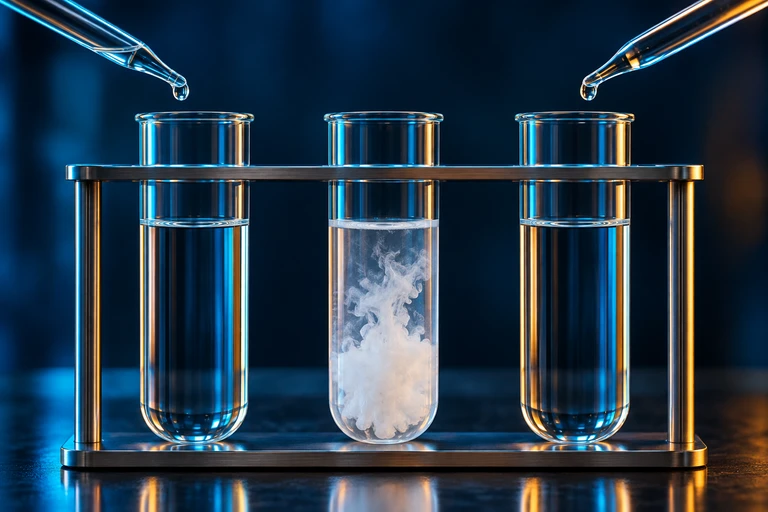 Aluminum hydroxide is amphoteric: acid dissolves it by forming water and hydrated dissolved aluminum, while excess strong base forms soluble Al(OH)₄⁻.
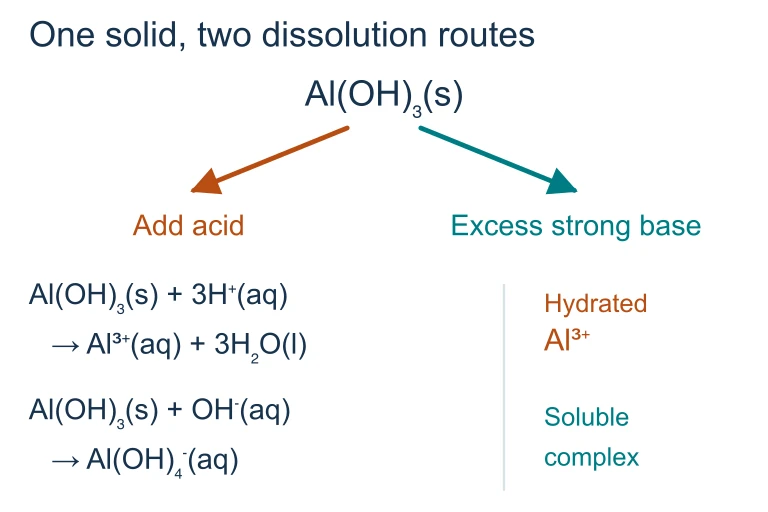 Aluminum hydroxide is amphoteric: acid dissolves it by forming water and hydrated dissolved aluminum, while excess strong base forms soluble Al(OH)₄⁻.
SECTION 8
Connections to Advanced Theory
The pH–solubility relationship studied in AP Chemistry is a gateway to several more sophisticated topics encountered in upper-division and graduate courses. Understanding how equilibrium constants combine when multiple reactions occur simultaneously prepares you for simultaneous equilibrium calculations, complex-ion formation, and speciation diagrams (alpha plots) used in analytical and environmental chemistry.
| AP Chemistry Level | Advanced / Graduate Level |
|---|---|
| Qualitative prediction: solubility increases or stays the same at lower pH. | Quantitative speciation: alpha (α) fraction plots showing distribution of all protonated forms as a function of pH. |
| Combine Ksp with 1/Ka to get an overall K. | Solve systems of mass balance, charge balance, and multiple equilibrium expressions simultaneously (e.g., using logarithmic concentration diagrams). |
| Assume ideal behavior: concentrations ≈ activities. | Apply Debye–Hückel or Davies equations to correct for non-ideal activity coefficients at high ionic strength. |
| pH affects dissolution only via anion protonation. | pH also affects complex-ion formation (e.g., Al(OH)₄⁻ in base), redox equilibria, and surface adsorption in environmental contexts. |
AP-level treatment versus advanced analytical chemistry
One particularly elegant extension is the concept of conditional solubility product, Ksp′, which incorporates the fraction of the anion that exists in its fully deprotonated form at a given pH. At low pH, only a small fraction of total dissolved fluoride exists as F⁻ (the rest is HF), so the apparent solubility product is much larger than the thermodynamic Ksp. This formalism is central to gravimetric analysis, where analysts choose pH conditions to selectively precipitate one ion while keeping others in solution. Mastering the AP-level treatment now provides the conceptual scaffolding for these powerful techniques.
SECTION 9
Practice Problems
Question 1: CONCEPTUAL
- A. AgCl
- B. PbI₂
- C. Ca₃(PO₄)₂
- D. BaSO₄
Show answer (C)
Question 2: BASIC CALCULATION
- A. 5.6 × 10⁻² M
- B. 1.1 × 10⁻⁴ M
- C. 5.6 × 10⁻¹² M
- D. 2.4 × 10⁻⁶ M
Show answer (A)
Question 3: INTERMEDIATE
- A. 3.0
- B. 5.0
- C. 7.0
- D. 3.2
Show answer (D)
Question 4: APPLIED
10 ptsShow answer
Question 5: CRITICAL THINKING
10 ptsShow answer
SUMMARY
pH and Solubility — Summary
Summary
The solubility of a sparingly soluble salt depends on pH when its anion is the conjugate base of a weak acid. In acidic solution, H⁺ protonates the anion, removing it from the dissolution equilibrium. By Le Châtelier's principle, the equilibrium shifts to the right, and additional solid dissolves. Anions such as F⁻, OH⁻, CO₃²⁻, PO₄³⁻, and S²⁻ exhibit this behavior. By contrast, anions from strong acids (Cl⁻, Br⁻, I⁻, NO₃⁻) show pH-independent solubility because they do not react with H⁺.
Quantitatively, the overall equilibrium constant for dissolution in acid is K = Ksp × (1/Ka)ⁿ, where n is the stoichiometric coefficient of the anion. The weaker the parent acid (smaller Ka), the larger 1/Ka and the more dramatically solubility increases at low pH. On the AP exam, focus on identifying the anion's parent acid, writing the dissolution and protonation equilibria explicitly, and applying Le Châtelier's principle to justify the direction of the solubility change.