

SECTION 1
Historical Context & Motivation
The macroscopic gas laws discovered during the seventeenth and eighteenth centuries—Boyle's law, Charles's law, and Avogadro's hypothesis—described reliable quantitative relationships among pressure, volume, temperature, and amount of gas. Yet these empirical laws offered no explanation for why gases behave as they do. Scientists recognized that a deeper, microscopic model was needed—one that could derive all of these macroscopic observations from a small set of assumptions about the particles themselves. This search culminated in the kinetic molecular theory (KMT), a framework that links the average kinetic energy of molecules to bulk properties such as temperature and pressure.
1738 • Bernoulli's Hydrodynamica
1857 • Clausius Formalizes KMT
1860 • Maxwell's Speed Distribution
1871 • Boltzmann's Statistical Mechanics
1905 • Einstein and Brownian Motion
The central question KMT addresses is straightforward yet profound: how do the invisible, random motions of individual particles give rise to the predictable, measurable properties of a gas—pressure, temperature, volume, and diffusion rate? Answering this question requires bridging the microscopic world of molecular collisions with the macroscopic world of thermometers and barometers, and that bridge is the kinetic molecular theory.
SECTION 2
Core Postulates of KMT
The kinetic molecular theory rests on a set of idealizing assumptions that describe a perfect, or ideal gas. Although no real gas satisfies every postulate exactly, many gases approximate ideal behavior under ordinary conditions—particularly at high temperatures and low pressures. Understanding these postulates is essential for predicting when the ideal gas law applies and when deviations (real-gas behavior) become significant.
Negligible Particle Volume
Continuous, Random Motion
Elastic Collisions
No Intermolecular Forces
KE ∝ Temperature
KEY TAKEAWAY
SECTION 3
Visualizing Molecular Motion
One of the most intuitive ways to understand KMT is to visualize the gas particles inside a container. The diagram below represents a snapshot of an ideal gas at two different temperatures. At a lower temperature (left), molecules move more slowly on average and strike the walls less forcefully; at a higher temperature (right), the same molecules have greater average speeds and impart more momentum per collision, producing higher pressure if volume is held constant.
Several features of this diagram merit attention. First, the particles are drawn as tiny dots to emphasize postulate 1—their individual volumes are negligible. Second, the velocity arrows vary in length even within the same box, illustrating that at any temperature there is a distribution of speeds rather than a single uniform speed. Third, the arrows point in random directions—there is no preferred orientation for molecular motion in an ideal gas. Finally, because the collisions are perfectly elastic, the total kinetic energy in each box remains constant over time, even though individual particles continuously exchange energy.
SECTION 4
Mathematical Framework
The power of KMT lies not merely in its qualitative postulates but in its ability to derive macroscopic gas behavior from molecular-level quantities. The central mathematical result of KMT connects the pressure exerted by an ideal gas to the average translational kinetic energy of its particles. From this single derivation, every classical gas law follows as a natural consequence.
PRESSURE FROM MOLECULAR MOTION
P = pressure (Pa), N = number of particles, V = volume (m³), m = mass of one particle (kg), urms = root-mean-square speed (m/s). This equation shows that pressure arises from the cumulative momentum transfer of particles striking the walls.
AVERAGE TRANSLATIONAL KINETIC ENERGY
KEavg = average translational kinetic energy per particle (J), kB = Boltzmann constant (1.381 × 10⁻²³ J·K⁻¹), T = absolute temperature (K). This is the cornerstone result of KMT: temperature is a direct measure of average molecular kinetic energy.
ROOT-MEAN-SQUARE SPEED
urms = root-mean-square speed (m/s), R = 8.314 J·mol⁻¹·K⁻¹, T = absolute temperature (K), M = molar mass (kg/mol). Lighter molecules travel faster at a given temperature—H₂ molecules at 300 K are nearly four times faster than O₂ molecules.
MOLAR KINETIC ENERGY
When working with moles rather than individual particles, multiply both sides of KEavg = (3/2)kBT by Avogadro's number NA. Since NAkB = R, the per-mole expression uses R = 8.314 J·mol⁻¹·K⁻¹.
AP Exam Tip
SECTION 5
Maxwell–Boltzmann Speed Distribution
A critical prediction of KMT is that the speeds of gas molecules in a sample are not uniform but instead follow a characteristic statistical distribution known as the Maxwell–Boltzmann distribution. This distribution is asymmetric—it rises steeply from zero, peaks at the most probable speed (ump), and then tails off gradually toward very high speeds. At higher temperatures or for lighter molecules, the entire distribution broadens and shifts to the right, meaning more molecules occupy higher-speed ranges.
Three characteristic speeds are commonly referenced when describing a Maxwell–Boltzmann distribution: the most probable speed (ump = √(2RT/M)), the average speed (uavg = √(8RT/πM)), and the root-mean-square speed (urms = √(3RT/M)). The ordering is always ump < uavg < urms, a consequence of the distribution's right-skewed shape. For the AP exam, urms is the most commonly tested.
Key Relationship
SECTION 6
Worked Example: Comparing Molecular Speeds
Let us apply the root-mean-square speed equation to compare the speeds of two gases at the same temperature, a classic AP Chemistry calculation.
Calculate u_rms for O₂ and H₂ at 25.0 °C
- 1
Step 1 — Convert Temperature to Kelvins
T = 25.0 °C + 273.15 = 298.15 K ≈ 298 K. The absolute temperature is required because KMT defines kinetic energy relative to absolute zero.T = 298 K - 2
Step 2 — Identify Molar Masses in kg/mol
For O₂: M = 32.00 g/mol = 0.03200 kg/mol. For H₂: M = 2.016 g/mol = 0.002016 kg/mol. The urms formula uses SI units, so molar mass must be in kg/mol.M(O₂) = 0.03200 kg/mol; M(H₂) = 0.002016 kg/mol - 3
Step 3 — Apply u_rms = √(3RT/M) for O₂
urms(O₂) = √(3 × 8.314 J·mol⁻¹·K⁻¹ × 298 K / 0.03200 kg·mol⁻¹) = √(3 × 8.314 × 298 / 0.03200) = √(232,100) ≈ 482 m/s.u_rms(O₂) ≈ 482 m/s - 4
Step 4 — Apply u_rms = √(3RT/M) for H₂
urms(H₂) = √(3 × 8.314 × 298 / 0.002016) = √(3,690,000) ≈ 1920 m/s.u_rms(H₂) ≈ 1920 m/s - 5
Step 5 — Compare and Interpret
The ratio urms(H₂)/urms(O₂) = 1920/482 ≈ 3.98 ≈ 4. This ratio equals √(M(O₂)/M(H₂)) = √(32.00/2.016) = √(15.87) ≈ 3.98. At the same temperature, H₂ molecules move approximately 4 times faster than O₂ molecules because they are about 16 times lighter.H₂ moves ~4× faster than O₂ at 298 K
 Effusion occurs through an aperture much smaller than the mean free path into near vacuum. At equal temperature, hydrogen and oxygen have equal mean translational kinetic energy, while hydrogen effuses about 3.98 times faster.
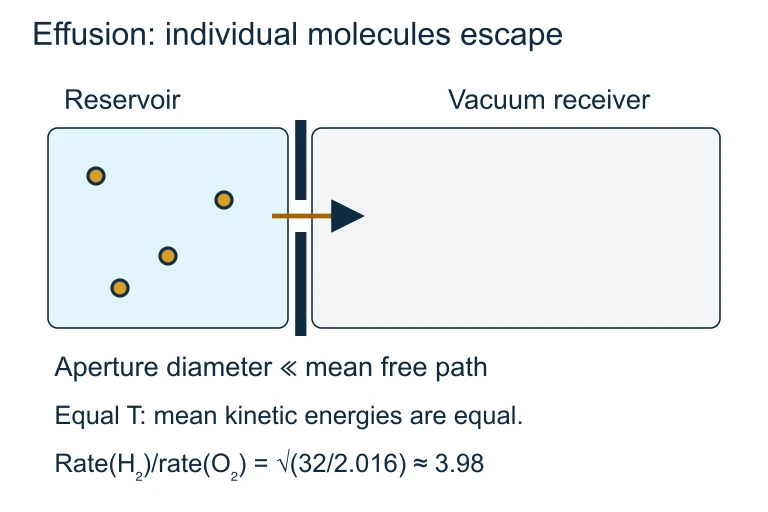 Effusion occurs through an aperture much smaller than the mean free path into near vacuum. At equal temperature, hydrogen and oxygen have equal mean translational kinetic energy, while hydrogen effuses about 3.98 times faster.
SECTION 7
Ideal Gas Assumptions: Strengths & Limitations
While the ideal gas model is remarkably powerful, real gases deviate from ideal behavior under certain conditions. Understanding when and why these deviations occur is essential for the AP Chemistry exam, and the van der Waals equation provides a quantitative correction to the ideal gas law.
| KMT Postulate | When It Holds (Ideal Behavior) | When It Fails (Real Gas Deviations) |
|---|---|---|
| Negligible particle volume | Low pressure → large container volume relative to molecular volume | High pressure → molecules crowded together, their volume becomes a significant fraction of total volume |
| No intermolecular forces | High temperature → KE greatly exceeds IMF strength | Low temperature → molecules move slowly enough that attractive forces significantly alter trajectories and reduce pressure |
| Elastic collisions | Good approximation for all gases at all accessible conditions | Inelastic effects negligible for translational motion; energy can transfer to rotational/vibrational modes, but total energy is still conserved |
| KE ∝ T | Universally valid for translational KE of any gas | Still holds; deviations in pressure/volume arise from the other postulates, not from this one |
Summary of when each KMT postulate holds and when it breaks down for real gases
KEY TAKEAWAY
SECTION 8
Connection to Advanced Theory
KMT provides the foundation upon which more sophisticated models are built. Two extensions are particularly relevant: the van der Waals equation and Graham's law of effusion. The table below contrasts the ideal gas treatment with these refinements, showing how the core ideas of KMT extend into more realistic and applied scenarios.
| Feature | Ideal Gas (KMT) | van der Waals / Advanced Models |
|---|---|---|
| Equation of State | PV = nRT | (P + an²/V²)(V − nb) = nRT |
| Molecular Volume | Zero (point particles) | Finite; corrected by the 'b' parameter, which reduces available volume |
| Intermolecular Forces | None | Attractive forces modeled by the 'a' parameter; reduce measured pressure below ideal prediction |
| Effusion / Diffusion | Predicted qualitatively via u_rms ∝ 1/√M | Graham's law: rate₁/rate₂ = √(M₂/M₁), directly derived from KMT speed equations |
| Phase Transitions | Cannot explain condensation or critical points | Van der Waals equation predicts critical temperature and pressure; connects gas behavior to liquid–gas transitions |
Ideal gas (KMT) versus advanced real-gas models
On the AP exam, you should be comfortable explaining how Graham's law follows directly from the KMT speed equations and how the van der Waals corrections address specific failures of the ideal model. Beyond the AP, KMT leads naturally into the Boltzmann distribution in statistical thermodynamics, where it forms the starting point for understanding energy distributions in all phases of matter, chemical reaction rates (collision theory), and transport phenomena such as viscosity and thermal conductivity in gases.
SECTION 9
Practice Problems
Question 1: CONCEPTUAL
- A. The Ne molecules have a greater average translational kinetic energy than the Ar molecules.
- B. The Ar molecules have a greater root-mean-square speed than the Ne molecules.
- C. The Ne molecules have a greater root-mean-square speed than the Ar molecules.
- D. The Ar molecules have the same root-mean-square speed as the Ne molecules because both are at the same temperature.
Show answer (C)
Question 2: BASIC CALCULATION
- A. 267 m/s
- B. 517 m/s
- C. 731 m/s
- D. 1920 m/s
Show answer (B)
Question 3: INTERMEDIATE
- A. 400 K
- B. 600 K
- C. 800 K
- D. 1600 K
Show answer (C)
Question 4: APPLIED
4 ptsShow answer
Question 5: CRITICAL THINKING
4 ptsShow answer
SUMMARY
Kinetic Molecular Theory — Summary
Summary
The kinetic molecular theory models gases as vast collections of tiny particles in continuous, random motion undergoing perfectly elastic collisions with no intermolecular forces and negligible particle volume. Its cornerstone result, KE_avg = (3/2) T, establishes that temperature is a direct measure of average translational kinetic energy, and the root-mean-square speed equation urms = √(3RT/M) reveals that lighter molecules travel faster at a given temperature.
The Maxwell–Boltzmann distribution describes the spread of molecular speeds at any temperature, broadening and shifting right as temperature increases. KMT successfully derives Boyle's, Charles's, and Avogadro's laws from microscopic assumptions but breaks down at high pressure and low temperature, where the van der Waals equation corrects for finite molecular volume and intermolecular attractions. Master these postulates, equations, and their limitations, and you will have a powerful framework for tackling gas-phase problems on the AP Chemistry exam.