

SECTION 1
Historical Context & Motivation
The need to determine the exact concentration of a dissolved substance has driven analytical chemistry for centuries. Long before modern instrumental methods existed, chemists relied on carefully controlled chemical reactions to quantify unknown solutions—a process we now call titration. The word itself derives from the French titre, meaning a standard or title of fineness, reflecting the technique's original use in assaying precious metals and determining the purity of alloys. From its roots in eighteenth-century France, titration evolved into the cornerstone of volumetric analysis, a discipline that remains essential in pharmaceutical quality control, environmental monitoring, and clinical diagnostics.
1729 • Claude-Joseph Geoffroy
1806 • François Descroizilles
1855 • Karl Friedrich Mohr
1894 • Sørensen & Indicator Theory
1900s • Instrumental & Automated Titrations
The fundamental question titration answers is deceptively simple: How much solute is dissolved in a given solution? By reacting a solution of known concentration (the titrant) with the unknown solution (the analyte) and measuring exactly how much titrant is required to reach the stoichiometric completion of the reaction, we can calculate the analyte's concentration with high accuracy. This principle—quantification through controlled reaction—is the essence of every titration you will encounter on the AP Chemistry exam.
SECTION 2
Core Principles & Definitions
A successful titration hinges on several interconnected ideas. Understanding the vocabulary and logic behind the procedure will ensure you can both perform titrations in the lab and solve them quantitatively on paper. The following foundational concepts form the backbone of every titration calculation and every AP Chemistry free-response question on the topic.
Titrant & Analyte
Equivalence Point
End Point & Indicator
Stoichiometric Ratio
Standard Solution & Standardization
KEY TAKEAWAY
SECTION 3
Visual Explanation — The Titration Setup
In a typical acid–base titration, the flask contains an acid (or base) of unknown concentration, plus a few drops of indicator. The titrant—a base (or acid) of known concentration—is added from the burette in small increments while swirling. As the reaction proceeds, the indicator remains one color because excess analyte is still present. At the equivalence point, all the analyte has reacted, and a single additional half-drop of titrant causes the indicator to undergo a sharp, persistent color change—the end point. Reading the burette volume at this moment provides the critical data needed for calculation.
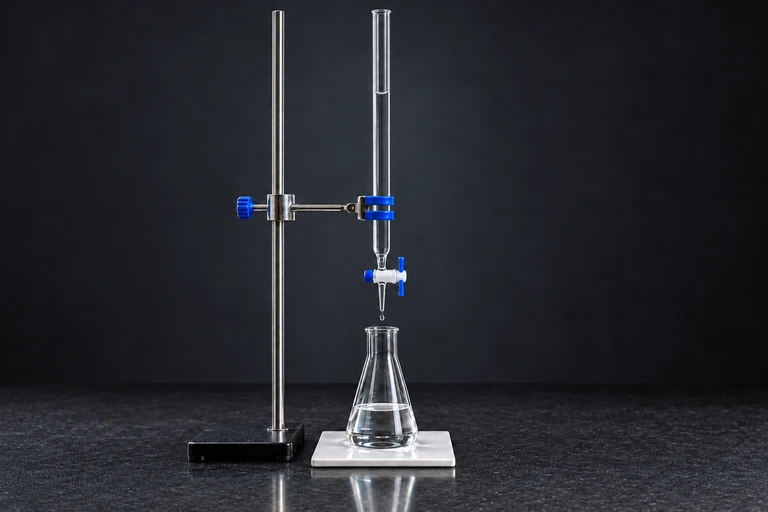 A buret delivers measured titrant into a flask containing the solution being analyzed.
SECTION 4
Mathematical Framework
Titration calculations rest on a single fundamental principle: at the equivalence point, the moles of titrant delivered equal the moles of analyte present, adjusted by the stoichiometric ratio. This relationship, combined with the definition of molarity, generates the equations you will use on the AP exam.
MOLES FROM MOLARITY
where n = moles of solute, M = molarity (mol/L), and V = volume in liters. Always convert mL to L before substituting.
STOICHIOMETRIC EQUIVALENCE
For a balanced equation aA + bB → products, the moles of A (nₐ) and moles of B (nb) satisfy this ratio at equivalence.
TITRATION EQUATION (1:1 RATIO)
This simplified form applies when the acid and base react in a 1:1 mole ratio (e.g., HCl + NaOH → NaCl + H2O). For other ratios, include the stoichiometric coefficients.
GENERAL TITRATION EQUATION
Here, a and b are the stoichiometric coefficients of the acid and base in the balanced equation. For example, 2 HCl + Ba(OH)2 → BaCl2 + 2 H2O gives a = 2 and b = 1.
AP Exam Tip
SECTION 5
Titration Curves & Indicator Selection
A titration curve is a plot of pH (y-axis) versus volume of titrant added (x-axis). The shape of the curve reveals important information about the nature of the acid and base involved, the location of the equivalence point, and the appropriate indicator to use. For a strong acid–strong base titration, the curve has a characteristic S-shape (sigmoidal) with a very steep rise around pH 7 at the equivalence point. In contrast, a weak acid–strong base titration produces a curve with a more gradual slope, a buffer region before equivalence, and an equivalence point above pH 7 because the conjugate base of the weak acid is basic. Understanding these features is essential for selecting the correct indicator whose color-change range overlaps the steep portion of the curve.
| Indicator | pH Range | Color Change | Best Used For |
|---|---|---|---|
| Methyl orange | 3.1 – 4.4 | Red → Yellow | Strong acid–strong base |
| Bromothymol blue | 6.0 – 7.6 | Yellow → Blue | Strong acid–strong base |
| Phenolphthalein | 8.2 – 10.0 | Colorless → Pink | Weak acid–strong base |
| Alizarin yellow R | 10.1 – 12.0 | Yellow → Red | Strong acid–weak base |
Common acid–base indicators and their suitable titration types
The key principle in indicator selection is that the indicator's color-transition pH range must overlap the steep portion of the titration curve surrounding the equivalence point. For a strong acid–strong base titration, the steep region spans roughly pH 3–11, so almost any indicator works. For a weak acid–strong base titration, the equivalence point is above pH 7, making phenolphthalein (pH 8.2–10.0) an excellent choice because its transition range captures the steep rise in the curve.
SECTION 6
Worked Example
A student titrates 25.00 mL of an unknown HCl solution with 0.1500 M NaOH. The end point is reached when 18.32 mL of NaOH has been added. Determine the molarity of the HCl solution.
Finding the Molarity of HCl by Titration
- 1
Step 1 — Write the Balanced Equation
The net ionic equation for the reaction of hydrochloric acid with sodium hydroxide is: HCl(aq) + NaOH(aq) → NaCl(aq) + H2O(l). The stoichiometric ratio of HCl to NaOH is 1:1.Mole ratio = 1 : 1 - 2
Step 2 — Convert Volumes to Liters
VNaOH = 18.32 mL × (1 L / 1000 mL) = 0.01832 L. VHCl = 25.00 mL × (1 L / 1000 mL) = 0.02500 L.V_NaOH = 0.01832 L, V_HCl = 0.02500 L - 3
Step 3 — Calculate Moles of NaOH
nNaOH = MNaOH × VNaOH = 0.1500 mol/L × 0.01832 L = 0.002748 mol.n_NaOH = 2.748 × 10⁻³ mol - 4
Step 4 — Use Stoichiometry to Find Moles of HCl
Since the mole ratio is 1:1, the moles of HCl equal the moles of NaOH at equivalence: nHCl = 0.002748 mol.n_HCl = 2.748 × 10⁻³ mol - 5
Step 5 — Calculate Molarity of HCl
MHCl = nHCl / VHCl = 0.002748 mol / 0.02500 L = 0.1099 M. Rounding to four significant figures gives 0.1099 M.M_HCl = 0.1099 M
Significant Figures
SECTION 7
Types of Titrations & Common Limitations
While acid–base titrations are the most frequently tested type on the AP Chemistry exam, titrations encompass a broader family of quantitative techniques. Each type exploits a different kind of chemical reaction, but all share the same core logic: deliver a reactant of known concentration until the analyte is completely consumed, then calculate from stoichiometry.
| Type | Reaction Basis | Common Indicators / Detection |
|---|---|---|
| Acid–Base | Neutralization (H⁺ + OH⁻ → H₂O) | Phenolphthalein, bromothymol blue, pH meter |
| Redox | Electron transfer between oxidant and reductant | KMnO₄ (self-indicating purple color), starch–iodine |
| Complexometric | Metal ion + chelating agent (e.g., EDTA) | Eriochrome Black T, murexide |
| Precipitation | Formation of an insoluble precipitate | Chromate (Mohr's method), adsorption indicator (Fajans') |
Major categories of titrations and their detection methods
Common Sources of Error
- Overshooting the end point: Adding titrant too quickly past the equivalence point inflates the volume recorded, giving a falsely high analyte concentration.
- Air bubbles in the burette: Bubbles that form and later escape during the titration cause the volume reading to exceed the actual volume delivered, introducing positive error.
- Indicator mismatch: Choosing an indicator whose transition range does not coincide with the steep portion of the titration curve causes the end point to deviate significantly from the equivalence point.
- Improper rinsing: Rinsing the burette with distilled water instead of titrant dilutes the standard solution, decreasing its effective concentration and causing overestimation of the analyte.
KEY TAKEAWAY
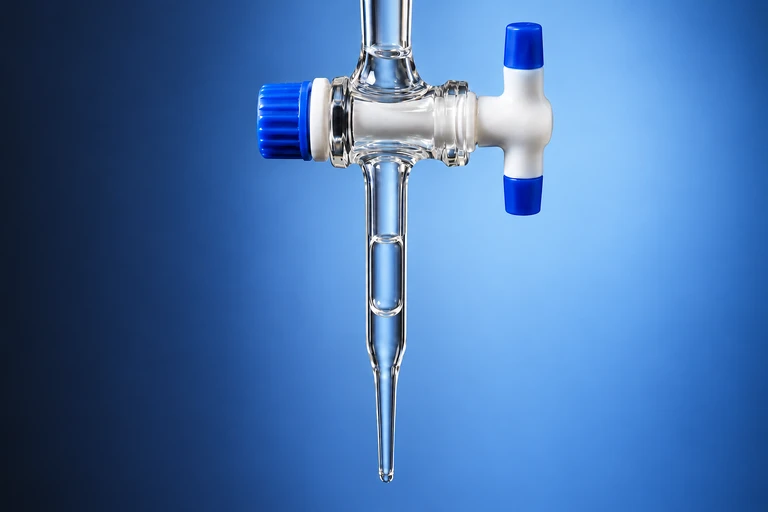 An air bubble in a buret tip can make the indicated delivery differ from the liquid volume that reaches the flask.
SECTION 8
Connection to Advanced Theory
The introductory titration calculations covered in this lesson assume ideal behavior and strong electrolytes whose reactions go to completion. In more advanced analytical chemistry courses—and in certain challenging AP free-response problems—you will need to account for the effects of weak acid/base equilibria, polyprotic species, and buffer capacity on the shape of the titration curve and the accuracy of the equivalence point determination.
| Concept in This Lesson | Advanced Extension |
|---|---|
| M₁V₁ = M₂V₂ (1:1 strong acid–strong base) | Henderson–Hasselbalch equation for pH at any point on a weak acid titration curve |
| Single equivalence point | Multiple equivalence points in polyprotic acid titrations (e.g., H₃PO₄) |
| Visual indicator end points | Potentiometric (pH electrode) and conductometric detection for greater precision |
| Aqueous solutions at 25 °C | Non-aqueous titrations in solvents like glacial acetic acid for very weak bases |
How basic titration concepts extend to advanced analytical chemistry
On the AP Chemistry exam specifically, the most common advanced titration scenario involves a weak acid–strong base system in which you must calculate the pH at several points along the curve: before any base is added (an equilibrium problem), at the half-equivalence point (where pH = pKa), at the equivalence point (hydrolysis of the conjugate base), and beyond the equivalence point (excess strong base determines pH). Mastering the introductory framework in this lesson gives you the scaffolding to tackle those more complex calculations with confidence.
SECTION 9
Practice Problems
Question 1: CONCEPTUAL
- A. Excess NaOH has been added beyond the equivalence point.
- B. The unknown acid is a weak acid, and its conjugate base hydrolyzes in water to produce OH⁻ ions.
- C. NaOH is a strong base, so all titrations using NaOH have equivalence points above pH 7.
- D. The indicator used has shifted the equilibrium of the reaction toward the products.
Show answer (B)
Question 2: BASIC CALCULATION
- A. 0.1214 M
- B. 0.2429 M
- C. 0.06071 M
- D. 0.4857 M
Show answer (A)
Question 3: INTERMEDIATE
- A. 2.87
- B. 4.74
- C. 7.00
- D. 9.26
Show answer (B)
Question 4: APPLIED
4 ptsShow answer
Question 5: CRITICAL THINKING
4 ptsShow answer
SUMMARY
Lesson Summary
Summary
Titration is a quantitative analytical technique in which a titrant of known concentration is added to an analyte of unknown concentration until the equivalence point is reached—the moment when moles of titrant satisfy the stoichiometric ratio from the balanced equation. The end point, detected by an indicator's color change or a pH probe, serves as the experimental approximation of the equivalence point.
The core calculation uses n = M × V to convert measured volume and known concentration into moles, which are then related through stoichiometry. Titration curves (pH vs. volume) reveal the nature of the acid and base, the location of the equivalence point, and the appropriate indicator to select. For strong acid–strong base titrations, the equivalence point falls at pH 7; for weak acid–strong base titrations, it lies above 7 due to conjugate-base hydrolysis. At the half-equivalence point, pH equals pKa—a relationship that connects titration data to acid-dissociation equilibria. Mastering these concepts prepares you for both the multiple-choice and free-response sections of the AP Chemistry exam.