
SECTION 1
Historical Context & Motivation
The concept of chemical equilibrium arose from a central puzzle of early chemistry: why do some reactions appear to stop before all reactants are consumed? By the late eighteenth century, chemists such as Claude-Louis Berthollet had observed that certain reactions seemed to proceed in both directions, a finding that contradicted the prevailing assumption that reactions were one-way affairs. Over the next century, thermodynamics and kinetics converged to explain that reactions do not truly stop—rather, the forward and reverse rates become equal, producing a macroscopically unchanging but microscopically dynamic system. This insight reshaped how chemists predict product yields, design industrial syntheses, and understand biological processes.
1799 • Berthollet's Reversible Reactions
1864 • Guldberg & Waage's Law of Mass Action
1884 • Le Châtelier's Principle
1901 • Van 't Hoff's Thermodynamic Integration
1913 • Haber Process Commercialized
The central question that equilibrium theory answers is deceptively simple: given a set of reactants and products, what mixture will a reaction naturally settle into, and how can we manipulate that mixture? Answering this question requires understanding kinetics, thermodynamics, and the mathematical formalism of the equilibrium constant—topics we develop throughout this lesson.
SECTION 2
Core Principles & Definitions
Chemical equilibrium is not a state of rest; it is a dynamic balance in which the forward reaction converts reactants to products at precisely the same rate that the reverse reaction converts products back to reactants. Because both processes occur simultaneously and at equal rates, the macroscopic concentrations of all species remain constant over time, even though individual molecules continue to react. This dynamic nature is essential to understand: equilibrium does not mean the system is inert, and it does not require that reactant and product concentrations be equal.
Reversibility
Dynamic Nature
Closed System Requirement
The Equilibrium Constant (K)
Independence of Path
KEY TAKEAWAY
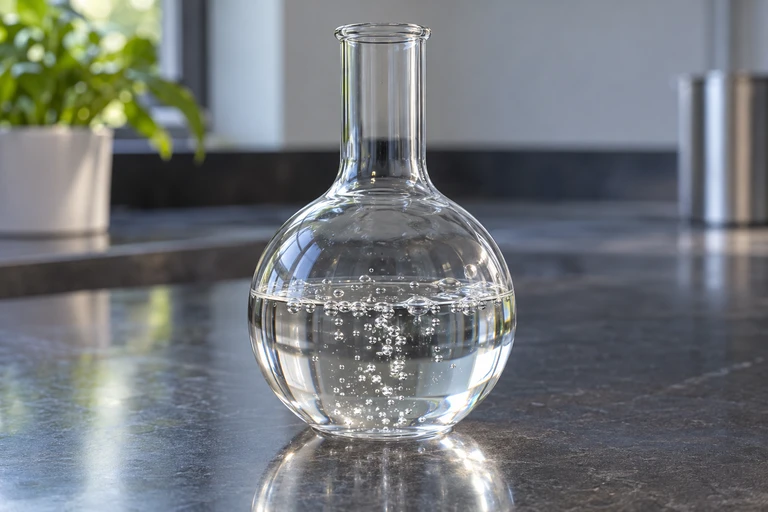 Gas escaping an open vessel removes material from the reacting system.
SECTION 3
Visualizing Equilibrium: Concentration vs. Time
The diagram above captures the essential behavior of a system approaching equilibrium from pure reactants. Initially, only the forward reaction has significant rate because reactant concentrations are high and product concentrations are zero. As products accumulate, the reverse reaction accelerates while the forward reaction slows. The two curves flatten once the forward and reverse rates equalize, and from that point onward, the concentrations remain constant. If you started from pure products instead, the curves would mirror—products would decrease and reactants would increase—but the system would converge to the same equilibrium concentrations, illustrating the path-independence of the equilibrium state.
SECTION 4
Mathematical Framework: The Equilibrium Constant
The quantitative heart of equilibrium is the equilibrium constant expression. For a generic reversible reaction aA + bB ⇌ cC + dD, the law of mass action gives a ratio of product and reactant concentrations at equilibrium that is constant at a given temperature. This ratio is denoted Kc (when written in terms of molar concentrations) or Kp (when written in terms of partial pressures for gaseous systems). On the AP Chemistry exam, you must be fluent with both forms and know when each is appropriate.
EQUILIBRIUM CONSTANT (CONCENTRATION)
Square brackets denote molar concentration (mol L⁻¹) at equilibrium. The exponents a, b, c, d are stoichiometric coefficients from the balanced equation. Pure solids and pure liquids are excluded from the expression because their activities are 1.
EQUILIBRIUM CONSTANT (PRESSURE)
P denotes partial pressure (atm). Kₚ is used for gas-phase equilibria. The relationship between Kₚ and K꜀ is Kₚ = K꜀(RT)^Δn, where Δn = (c + d) − (a + b) is the change in moles of gas, R = 0.08206 L·atm·mol⁻¹·K⁻¹, and T is in kelvin.
REACTION QUOTIENT
Q has the same mathematical form as K but uses instantaneous concentrations rather than equilibrium values. Comparing Q to K predicts the direction a reaction must shift: if Q < K the reaction proceeds forward; if Q > K the reaction proceeds in reverse; if Q = K the system is at equilibrium.
AP Exam Tip
SECTION 5
Predicting Reaction Direction: Q vs. K
One of the most powerful applications of the equilibrium constant is comparing it with the reaction quotient Q to determine which direction a reaction will shift. Because Q uses the same expression as K but with current (non-equilibrium) concentrations, the comparison of Q to K functions as a chemical GPS: it tells the system where it is relative to its equilibrium destination and which direction it must travel. This comparison is critical for predicting the outcome when conditions change—such as adding a reactant, removing a product, or mixing two solutions.
| Condition | Comparison | Direction of Shift | Net Effect |
|---|---|---|---|
| Excess reactants | Q < K | Forward (toward products) | [Products] ↑, [Reactants] ↓ |
| Excess products | Q > K | Reverse (toward reactants) | [Products] ↓, [Reactants] ↑ |
| Balanced | Q = K | No net shift | Concentrations remain constant |
Summary of Q vs. K predictions
SECTION 6
Worked Example: Calculating K and Predicting Direction
Consider the synthesis of hydrogen iodide: H₂(g) + I₂(g) ⇌ 2 HI(g). At 450 °C, an experiment finds the equilibrium concentrations to be [H₂] = 0.0220 M, [I₂] = 0.0220 M, and [HI] = 0.156 M. We will calculate K꜀ and then determine which way the reaction shifts if an additional experiment starts with [H₂] = 0.100 M, [I₂] = 0.100 M, and [HI] = 0.100 M.
Calculating K꜀ and Using Q to Predict Direction
- 1
Step 1 — Write the Equilibrium Expression
For H₂(g) + I₂(g) ⇌ 2 HI(g), the equilibrium expression is K꜀ = [HI]² / ([H₂][I₂]). All species are gases in solution, so all appear in the expression. - 2
Step 2 — Substitute Equilibrium Concentrations
K꜀ = (0.156)² / (0.0220 × 0.0220) = 0.024336 / 0.000484K꜀ = 50.3 - 3
Step 3 — Calculate Q for the New Conditions
With the new initial concentrations [H₂] = 0.100 M, [I₂] = 0.100 M, [HI] = 0.100 M: Q꜀ = (0.100)² / (0.100 × 0.100) = 0.0100 / 0.0100Q꜀ = 1.00 - 4
Step 4 — Compare Q to K
Since Q꜀ (1.00) < K꜀ (50.3), the reaction quotient is far below the equilibrium constant. The system has a deficiency of products relative to the equilibrium position. - 5
Step 5 — State the Conclusion
Because Q < K, the reaction will shift to the right (forward direction), consuming H₂ and I₂ while producing more HI, until Q increases to equal K at 50.3.The reaction shifts forward to produce more HI.
SECTION 7
Strengths & Limitations of the Equilibrium Constant
| Aspect | Strength | Limitation |
|---|---|---|
| Predictive power | K tells you the extent of a reaction—whether products or reactants dominate at equilibrium—without running the experiment. | K says nothing about how fast equilibrium is reached. A reaction may be thermodynamically favorable (large K) but kinetically slow without a catalyst. |
| Temperature dependence | The van 't Hoff equation connects K to ΔH°, enabling prediction of how K changes with temperature. | K is constant only at a fixed temperature. Any temperature change alters K, requiring recalculation for new conditions. |
| Universality | The equilibrium framework applies to all reversible reactions—acid-base, solubility, redox, gas-phase, and biochemical. | The expression assumes ideal behavior (dilute solutions, ideal gases). At high concentrations or pressures, activities must replace concentrations. |
| Q vs. K comparison | Provides a simple, quantitative method to predict direction of reaction shift under any set of initial conditions. | Predicts direction only—not the magnitude of change in concentration. An ICE table or numerical solver is needed for exact equilibrium concentrations. |
Strengths and limitations of using the equilibrium constant K
KEY TAKEAWAY
SECTION 8
Connection to Thermodynamics & Advanced Theory
The equilibrium constant is not merely an empirical ratio—it is rooted in Gibbs free energy. The standard free energy change ΔG° for a reaction is related to K by the equation ΔG° = −RT ln K, where R is the gas constant and T is the absolute temperature. When ΔG° is negative, K > 1 and the reaction favors products under standard conditions; when ΔG° is positive, K < 1 and reactants are favored. This relationship bridges kinetic observations (equilibrium concentrations) with the thermodynamic landscape of the reaction, providing a complete picture of spontaneity and equilibrium position.
GIBBS FREE ENERGY AND K
R = 8.314 J mol⁻¹ K⁻¹; T in kelvin; K is dimensionless (thermodynamic equilibrium constant). A large negative ΔG° corresponds to a very large K (products strongly favored).
| Concept | This Lesson (Introduction to Equilibrium) | Advanced Treatment |
|---|---|---|
| Equilibrium constant | Written in terms of concentrations (K꜀) or pressures (Kₚ) assuming ideal behavior | Thermodynamic K uses activities (effective concentrations corrected for non-ideal interactions) |
| Temperature effect | K changes with temperature; Le Châtelier's principle gives qualitative direction | Van 't Hoff equation quantitatively predicts K at any T from ΔH° and a reference K |
| Free energy | ΔG° = −RT ln K connects K to spontaneity | ΔG = ΔG° + RT ln Q gives free energy at any point, not just equilibrium |
| Multiple equilibria | Single equilibrium expression for one reaction | Coupled equilibria: K for combined reactions is the product of individual K values |
Introductory vs. advanced equilibrium concepts
As you progress through the AP Chemistry curriculum, you will apply equilibrium concepts to acid-base equilibria (Kₐ and ), solubility equilibria (Kₛₚ), buffer systems, and electrochemical cells. Each of these is a specialized application of the general equilibrium framework introduced here. Mastering K, Q, and their relationship to ΔG° provides the foundation for all of these downstream topics.
SECTION 9
Practice Problems
Question 1: CONCEPTUAL
- A. The concentrations of N₂O₄ and NO₂ are equal.
- B. Both the forward and reverse reactions have stopped.
- C. The rate of decomposition of N₂O₄ equals the rate of formation of N₂O₄.
- D. The total pressure in the flask is zero because the reactions cancel out.
Show answer (C)
Question 2: BASIC CALCULATION
- A. 2.0 × 10²
- B. 5.0 × 10⁻³
- C. 1.0 × 10²
- D. 4.0 × 10³
Show answer (A)
Question 3: INTERMEDIATE
- A. Forward, because Q < K
- B. Reverse, because Q > K
- C. Forward, because Q > K
- D. Reverse, because Q < K
Show answer (A)
Question 4: APPLIED
5 ptsShow answer
Question 5: CRITICAL THINKING
4 ptsShow answer
SUMMARY
Lesson Summary
Summary
Chemical equilibrium is a dynamic state in which the forward and reverse reaction rates are equal, producing constant macroscopic concentrations in a closed system. The equilibrium constant K quantifies the ratio of product to reactant concentrations (each raised to their stoichiometric coefficients) at equilibrium and depends only on temperature. A large K indicates the reaction favors products; a small K indicates it favors reactants. The expression can be written as K꜀ (concentration-based) or Kₚ (pressure-based) for gaseous systems, and pure solids and liquids are excluded from the expression.
The reaction quotient Q uses the same mathematical form as K but with current (not equilibrium) concentrations. Comparing Q to K predicts the direction of shift: Q < K means forward shift, Q > K means reverse shift, and Q = K means the system is at equilibrium. The thermodynamic foundation is provided by ΔG° = −RT ln K, which links spontaneity to the equilibrium constant. These principles form the basis for all subsequent equilibrium topics in AP Chemistry, including Le Châtelier's principle, ICE tables, acid-base equilibria, and solubility product calculations.