

SECTION 1
Historical Context & Motivation
The concept of entropy arose from a deceptively practical question: why can't a steam engine convert all of its heat into useful work? During the Industrial Revolution, engineers and physicists struggled to understand the fundamental limits of heat engines, and their investigations eventually revealed a profound truth about the natural world. The first law of thermodynamics established that energy is conserved—it can be transformed but never created or destroyed. Yet conservation alone could not explain why certain processes occur spontaneously in one direction but never in reverse: ice melts in a warm room, but a glass of water at room temperature never spontaneously forms ice cubes. This directional asymmetry demanded a new thermodynamic quantity, one that would quantify the irreversibility inherent in natural processes and set the stage for the second law of thermodynamics.
1824 • Carnot's Ideal Engine
1850 • Clausius Formalizes the Second Law
1865 • Entropy Named
1877 • Boltzmann's Statistical Interpretation
1920s–1960s • Entropy in Chemistry
The central question that entropy answers is deceptively simple: why do spontaneous processes have a preferred direction? Energy conservation alone permits a hot cup of coffee to spontaneously heat up from a cooler room—the total energy of the universe would still be conserved. Entropy is the quantity that forbids this scenario, providing the missing criterion for determining whether a process can proceed on its own. In the sections that follow, we will build a rigorous understanding of entropy from both the macroscopic (thermodynamic) and microscopic (statistical) perspectives, connect it to chemical applications on the AP Chemistry exam, and develop the mathematical tools needed to calculate entropy changes for reactions and phase transitions.
SECTION 2
Core Principles & Definitions
Entropy (S) is a thermodynamic state function that quantifies the dispersal of energy within a system at a given temperature. Unlike enthalpy or internal energy, entropy does not describe the amount of energy a system possesses; rather, it describes how many different ways that energy can be distributed among the particles. Because it is a state function, the entropy change (ΔS) between any two states depends only on the initial and final conditions, not on the path taken between them. This property is powerful: it allows us to calculate ΔS using any convenient reversible path, regardless of the actual (often irreversible) process that occurs. Below are the foundational ideas you need to internalize before tackling calculations.
Entropy as a State Function
Microstates (W)
Second Law of Thermodynamics
Third Law of Thermodynamics
Entropy and Spontaneity
KEY TAKEAWAY
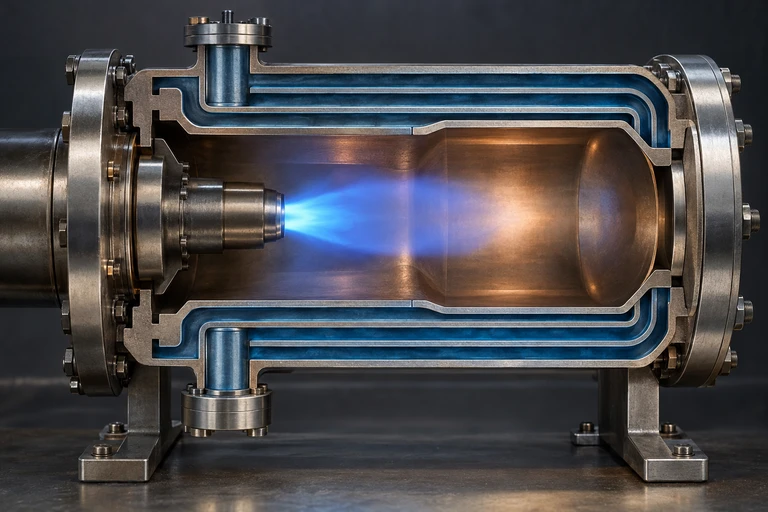 Combustion releases energy that can be transferred as heat to the surrounding enclosure.
SECTION 3
Visual Explanation — Microstates and Entropy
The diagram below illustrates the core statistical idea behind entropy. Consider a simple system of four gas particles confined to a box that is divided into two halves. We can enumerate every possible way the particles can be distributed between the left and right halves. Each distinct arrangement of individually labeled particles is a microstate, while the overall distribution (e.g., '3 particles left, 1 particle right') is a macrostate. The macrostate with the greatest number of microstates—the 2:2 even split—is the most probable and has the highest entropy. The system naturally evolves toward this most probable macrostate.
With just 4 particles, the most probable macrostate (2:2) accounts for 6 out of 16 total microstates, or 37.5%. This bias may seem modest, but it becomes overwhelming as particle numbers approach the 1023 scale of real chemical systems. For one mole of gas particles, the probability of finding all particles in one half of the container is so vanishingly small—roughly 2−6.02×10²³—that it would never be observed in the lifetime of the universe. This is precisely why gases expand spontaneously to fill their containers: the uniform distribution has overwhelmingly more microstates than any lopsided arrangement.
SECTION 4
Mathematical Framework
The mathematical description of entropy operates on two complementary levels. The Boltzmann equation provides the statistical (microscopic) foundation, while the Clausius definition gives the macroscopic, measurable form. For AP Chemistry, you will most frequently use the standard entropy change equation for reactions, but understanding both levels deepens your physical intuition and strengthens your ability to predict the sign of ΔS qualitatively.
BOLTZMANN EQUATION
S = entropy (J/K), kB = Boltzmann constant (1.381 × 10⁻²³ J/K), W = number of microstates. Higher W means higher entropy.
CLAUSIUS DEFINITION (MACROSCOPIC)
ΔS = entropy change (J/K), qrev = heat transferred along a reversible path (J), T = absolute temperature (K). For a phase change at constant T, this simplifies to ΔSphase = ΔHphase / T.
STANDARD ENTROPY CHANGE OF REACTION
n and m = stoichiometric coefficients, S° = standard molar entropy (J mol⁻¹ K⁻¹) from thermodynamic tables. This is the equation you will use most on the AP exam to compute ΔS° for balanced reactions.
GIBBS FREE ENERGY CONNECTION
ΔG° = standard free energy change (kJ/mol), ΔH° = standard enthalpy change (kJ/mol), T = temperature (K), ΔS° = standard entropy change (kJ mol⁻¹ K⁻¹). When ΔG° < 0, the reaction is spontaneous under standard conditions. Note: ensure ΔS° and ΔH° share the same energy unit (both kJ or both J) before substitution.
UNIT TRAP — AP EXAM ALERT
SECTION 5
Predicting the Sign of ΔS
One of the most valuable skills for the AP Chemistry exam is the ability to predict whether entropy increases or decreases for a given process without performing any calculation. Several reliable heuristics emerge from the microscopic definition of entropy: any change that increases the number of microstates available to the system's particles will produce a positive ΔS. The following table organizes these qualitative predictions by process type, and the diagram below provides a visual summary of the major factors.
| Process or Change | Effect on ΔS | Reasoning (Microstates) |
|---|---|---|
| Solid → Liquid → Gas | ΔS > 0 (increases) | Particles gain translational freedom; many more accessible positions and momenta. |
| Dissolving a solid solute | ΔS > 0 (usually) | Ions or molecules disperse throughout the solvent, increasing positional microstates. |
| Increase in temperature | ΔS > 0 | Higher T populates more energy levels, increasing the number of accessible microstates. |
| Increase in volume (gas expansion) | ΔS > 0 | More spatial positions available to each gas particle. |
| Fewer moles of gas produced | ΔS < 0 | Fewer gaseous molecules means fewer positional microstates; gas-phase entropy dominates. |
| More complex molecules formed | ΔS > 0 (per molecule) | More atoms per molecule → more vibrational, rotational modes → more ways to store energy. |
Qualitative rules for predicting the sign of ΔS
COMMON MISCONCEPTION
SECTION 6
Worked Example — Calculating ΔS°rxn
Consider the combustion of methane, one of the most important reactions in energy production. Using standard molar entropy values from a thermodynamic data table, we will compute the standard entropy change of reaction and verify our qualitative prediction.
Standard Entropy Change for Methane Combustion
- 1
Step 1 — Write the balanced equation
CH4(g) + 2 O2(g) → CO2(g) + 2 H2O(g). Note: we use the gaseous form of water to simplify the analysis. - 2
Step 2 — Gather S° values from the data table
S°[CH4(g)] = 186.3 J mol⁻¹ K⁻¹, S°[O2(g)] = 205.2 J mol⁻¹ K⁻¹, S°[CO2(g)] = 213.8 J mol⁻¹ K⁻¹, S°[H2O(g)] = 188.8 J mol⁻¹ K⁻¹. - 3
Step 3 — Apply the standard entropy change formula
ΔS°rxn = Σ nS°(products) − Σ mS°(reactants). Substituting: ΔS°rxn = [1(213.8) + 2(188.8)] − [1(186.3) + 2(205.2)]. - 4
Step 4 — Calculate
Products: 213.8 + 377.6 = 591.4 J mol⁻¹ K⁻¹. Reactants: 186.3 + 410.4 = 596.7 J mol⁻¹ K⁻¹. Therefore ΔS°rxn = 591.4 − 596.7 = −5.3 J mol⁻¹ K⁻¹.ΔS°rxn = −5.3 J mol⁻¹ K⁻¹ - 5
Step 5 — Interpret the result
The small negative ΔS° makes sense: the reaction goes from 3 moles of gas (1 CH₄ + 2 O₂) to 3 moles of gas (1 CO₂ + 2 H₂O), so the gas-mole count is unchanged and the entropy change is close to zero. The slight decrease reflects the fact that CO₂ and H₂O(g) are slightly less 'entropic' per mole than the weighted average of CH₄ and O₂. Despite the negative ΔS°sys, this reaction is highly spontaneous because ΔH° is very large and negative (−802.3 kJ/mol), making ΔG° strongly negative at all reasonable temperatures.
SECTION 7
Entropy vs. Enthalpy — Competing Driving Forces
A central theme in AP Chemistry thermodynamics is the interplay between enthalpy (ΔH) and entropy (ΔS) as competing or cooperating driving forces for spontaneity. Neither factor alone determines whether a reaction proceeds; the Gibbs free energy equation (ΔG = ΔH − TΔS) adjudicates the contest. The table below categorizes the four possible sign combinations and their implications for spontaneity, which is a framework the AP exam tests directly.
| ΔH | ΔS | ΔG | Spontaneity |
|---|---|---|---|
| − (exothermic) | + (entropy increases) | Always negative | Spontaneous at all T |
| + (endothermic) | − (entropy decreases) | Always positive | Non-spontaneous at all T |
| − (exothermic) | − (entropy decreases) | Depends on T | Spontaneous at low T |
| + (endothermic) | + (entropy increases) | Depends on T | Spontaneous at high T |
The four ΔH/ΔS sign combinations and their effect on spontaneity
The temperature-dependent cases (rows 3 and 4) are particularly important. The crossover temperature at which ΔG = 0 can be found by setting ΔH = TΔS and solving for T = ΔH/ΔS. Above this temperature, the TΔS term dominates; below it, ΔH dominates. This is precisely the temperature at which a phase transition occurs (for example, water's boiling point is where ΔHvap = TΔSvap), and the system is at equilibrium with ΔG = 0.
KEY TAKEAWAY
SECTION 8
Connection to Advanced Theory
The AP Chemistry treatment of entropy provides a powerful but simplified framework. In more advanced coursework—statistical mechanics, physical chemistry, and even information theory—entropy takes on deeper and more general meanings. The table below previews how the concepts you have learned connect to their more rigorous counterparts. Awareness of these connections can help you appreciate why entropy is considered one of the most important concepts in all of science.
| AP Chemistry Level | Advanced Level |
|---|---|
| ΔS°rxn from tabulated S° values | S° derived via integration of Cp/T from 0 K (Third Law); partition functions from quantum mechanics |
| Qualitative prediction of ΔS sign | Quantitative calculation of W using combinatorics and quantum-state counting |
| ΔG = ΔH − TΔS at constant T and P | Legendre transforms yield multiple free energy functions (Helmholtz A, Gibbs G) for different constraints |
| Entropy as 'disorder' | Entropy as missing information (Shannon/information entropy); connects to data compression, black hole thermodynamics |
| ΔSuniv > 0 for spontaneous processes | Entropy production rate and irreversible thermodynamics; fluctuation theorems at the nanoscale |
AP Chemistry entropy concepts and their advanced extensions
The statistical-mechanical framework, pioneered by Boltzmann and later formalized by Gibbs and others, reveals that the macroscopic laws of thermodynamics emerge naturally from the behavior of enormous collections of particles obeying quantum mechanics. This statistical viewpoint explains not only why entropy increases but also predicts the precise magnitude of equilibrium constants, the temperature dependence of reaction rates, and the thermodynamic properties of new materials. If you continue into physical chemistry or chemical engineering, entropy and its generalizations will remain a central organizing principle throughout your studies.
SECTION 9
Practice Problems
Question 1: CONCEPTUAL
- A. Evaporation of liquid ethanol at its boiling point
- B. Dissolving NaCl in water at 25 °C
- C. N₂(g) + 3 H₂(g) → 2 NH₃(g)
- D. Sublimation of dry ice (CO₂)
Show answer (C)
Question 2: BASIC CALCULATION
- A. +20.0 J mol⁻¹ K⁻¹
- B. −20.0 J mol⁻¹ K⁻¹
- C. +166.9 J mol⁻¹ K⁻¹
- D. −166.9 J mol⁻¹ K⁻¹
Show answer (A)
Question 3: INTERMEDIATE
- A. +109 J mol⁻¹ K⁻¹
- B. +40.7 J mol⁻¹ K⁻¹
- C. +0.109 J mol⁻¹ K⁻¹
- D. −109 J mol⁻¹ K⁻¹
Show answer (A)
Question 4: APPLIED
4 ptsShow answer
Question 5: CRITICAL THINKING
4 ptsShow answer
SUMMARY
Summary — Introduction to Entropy
Summary
Entropy (S) is a thermodynamic state function that measures the number of microstates (W) accessible to a system through the Boltzmann equation S = ln W. The second law of thermodynamics states that the total entropy of the universe increases for every spontaneous process (ΔSuniv > 0), while the third law establishes that a perfect crystal at 0 K has S = 0, providing the absolute reference for tabulated standard molar entropy values (S°).
To predict the sign of ΔS, focus on changes in phase (solid → liquid → gas increases S), moles of gas (more gas moles = higher S), temperature, volume, and molecular complexity. Calculate ΔS°rxn using ΔS° = Σ nS°(products) − Σ mS°(reactants), and connect entropy to spontaneity through the Gibbs free energy equation ΔG° = ΔH° − TΔS°. Always check unit consistency (J vs. kJ) before substitution—this is one of the most common AP exam pitfalls.