

AP Chemistry • Properties of Substances and Mixtures

Intramolecular and Interparticle Force

Understanding how forces within and between particles govern the physical and chemical behavior of all matter.

AP Chemistry illustration with a laboratory flask, atom, and microscope
Inside this lesson 9 sections 5 questions 8 figures

SECTION 1

Historical Context & Motivation

The question of what holds matter together — and why substances differ so dramatically in their melting points, solubilities, and reactivities — has driven chemical inquiry for centuries. Early atomists like Democritus imagined atoms hooking together mechanically, but a genuine understanding of intramolecular forces (bonding within molecules) and intermolecular forces (attractions between separate particles) required the development of electrostatics, quantum mechanics, and modern spectroscopy. Each breakthrough revealed a deeper layer of the electrostatic interactions that govern every phase transition and chemical reaction.

1916 • Lewis & Kossel — Chemical Bonding Theory

G. N. Lewis proposed the shared-electron-pair model of covalent bonding, while Walther Kossel described ionic bonding as complete electron transfer, establishing the two major categories of intramolecular force.

1930 • Debye — Polar Intermolecular Forces

Peter Debye formalized how permanent dipole moments in polar molecules create attractive forces between molecules, extending Coulomb's law to the molecular scale.

1930 • London — Dispersion Forces

Fritz London used quantum mechanics to explain the origin of instantaneous-dipole–induced-dipole attractions, showing that even nonpolar species experience attractive forces due to electron correlation.

1939 • Pauling — The Nature of the Chemical Bond

Linus Pauling published his landmark text unifying electronegativity, resonance, and orbital hybridization into a coherent framework that connected bond type to molecular properties.

The central question these scientists addressed remains at the heart of AP Chemistry: How do we distinguish forces that hold atoms together within a particle from the forces that hold particles together in bulk? Answering this question lets us predict boiling points, solubilities, vapor pressures, and much more.

SECTION 2

Core Principles & Definitions

All chemical forces are fundamentally electrostatic — they arise from the attraction between positive nuclei and negative electrons. The critical distinction is scale and strength. Intramolecular forces (ionic, covalent, and metallic bonds) hold atoms together within a formula unit, and breaking them constitutes a chemical change. Intermolecular forces (IMFs) (London dispersion, dipole–dipole, and hydrogen bonding) act between separate particles; overcoming them is a physical change such as boiling or dissolving.

1

Intramolecular Forces

Forces within a particle — ionic bonds (electrostatic lattice), covalent bonds (shared electron pairs), and metallic bonds (delocalized electron sea). Typical energies: 150–1000 kJ/mol.
2

Intermolecular Forces

Forces between discrete molecules — London dispersion forces (LDFs), dipole–dipole interactions, and hydrogen bonds. Typical energies: 0.5–40 kJ/mol, roughly 10–100× weaker than bonds.
3

London Dispersion Forces

Present in ALL substances. Arise from instantaneous dipoles caused by electron-cloud fluctuations. Strength scales with polarizability, which increases with molar mass and surface area.
4

Dipole–Dipole & Hydrogen Bonding

Dipole–dipole forces occur between polar molecules. Hydrogen bonding is an especially strong dipole–dipole case: H bonded to N, O, or F interacts with a lone pair on another N, O, or F.
5

Ion–Dipole Forces

The dominant force when ionic compounds dissolve in polar solvents. Ions attract the partial charges on solvent molecules, which is why NaCl dissolves readily in water.

SECTION 3

Visual Explanation — Force Hierarchy

Hierarchy of Chemical ForcesINTRAMOLECULAR (within particles)Ionic Bond400–4000 kJ/molCovalent Bond150–1000 kJ/molMetallic Bond100–800 kJ/molINTERMOLECULAR (between particles)Ion–Dipole50–600 kJ/molHydrogen Bond10–40 kJ/molDipole–Dipole5–25 kJ/molLondon Dispersion0.5–40 kJ/molIntramolecular forces are generally 10–100× stronger than intermolecular forces
The left panel lists the three major intramolecular bonding types with typical bond-energy ranges. The right panel lists intermolecular forces in descending order of strength. Note that ion–dipole interactions bridge the two regimes and are critical for dissolution of ionic solids.

The diagram above reveals a crucial pattern: intramolecular bonds are typically at least an order of magnitude stronger than intermolecular forces. This explains why a phase change (overcoming IMFs) requires far less energy than a chemical reaction (breaking bonds). When water boils at 100 °C, the O–H covalent bonds within each H2O molecule remain intact; only the hydrogen bonds between molecules are disrupted. Conversely, decomposing water into H2 and O2 via electrolysis requires breaking covalent bonds, demanding substantially more energy input.

Water boiling at the liquid-vapor interfaceDuring boiling, water molecules move from liquid into vapor while retaining their molecular identity.

SECTION 4

Mathematical Framework

Although the AP Chemistry exam rarely requires quantitative force calculations, understanding the mathematical relationships behind each force type deepens your ability to predict and rank physical properties. All interparticle forces trace back to Coulomb's law, which describes the electrostatic interaction between charged particles.

COULOMB'S LAW

F=k×(q1×q2)/r2F = k × (q₁ × q₂) / r²

F = electrostatic force; k = Coulomb constant (8.99 × 10⁹ N·m²/C²); q₁, q₂ = charges; r = distance between charge centers. The force is attractive when charges are opposite and repulsive when like.

For ionic bonding, Coulomb's law applies directly: the lattice energy of an ionic solid is proportional to the product of the ion charges and inversely proportional to the sum of the ionic radii. Larger charges and smaller ions produce stronger lattice energies — for example, MgO (2+/2− charges, small ions) has a much higher lattice energy than NaCl (1+/1− charges, larger ions).

LATTICE ENERGY PROPORTIONALITY

Elattice∝(q+×q−)/(r++r−)E_lattice ∝ (q⁺ × q⁻) / (r⁺ + r⁻)

q⁺ and q⁻ are the magnitudes of the cation and anion charges; r⁺ and r⁻ are the ionic radii. Greater charge magnitude and shorter interionic distance both increase lattice energy.

For London dispersion forces, the interaction energy varies as 1/r⁶, making them extremely short-range. Their strength depends on polarizability — the ease with which an electron cloud can be distorted. Polarizability generally increases with the number of electrons (molar mass) and molecular surface area. This is why long-chain hydrocarbons have higher boiling points than compact, branched isomers of the same molecular formula.

LONDON DISPERSION ENERGY

ELDF∝−α1×α2/r6E_LDF ∝ −α₁ × α₂ / r⁶

α₁ and α₂ are the polarizabilities of the two interacting species; r is the separation distance. The 1/r⁶ dependence means LDFs fall off extremely rapidly with distance.

SECTION 5

Detailed Classification of IMFs

To predict physical properties on the AP exam, you must identify which intermolecular forces are present in a given substance. The decision process begins with the type of particles involved and progresses through polarity and functional-group analysis.

IMF Identification FlowchartWhat type of particle?Ionic / metallicMolecularIonic / Metallic bonding(not IMFs — these are network forces)Is the molecule polar?NoYesLDF onlyDipole–Dipole + LDFH bonded to N, O, or F?NoYesDipole–Dipole + LDFH-Bond + DD+ LDFAll molecular substances exhibit LDF; additional forces depend on polarity and H-bonding capability.
Follow the flowchart from top to bottom. First, determine whether the substance is ionic/metallic or molecular. For molecular substances, assess polarity, then check for hydrogen-bonding capability (H bonded directly to N, O, or F). Every molecular substance has LDF; the question is whether additional, stronger IMFs are also present.
SubstanceParticle TypeIMFs PresentBP (°C)
NeNonpolar atomLDF only−246
CH₄Nonpolar moleculeLDF only−161
HClPolar moleculeDipole–dipole + LDF−85
H₂OPolar moleculeH-bond + DD + LDF100
NaClIonic compoundIonic bonding (not IMF)1413

Representative substances with their dominant interparticle forces and boiling points.
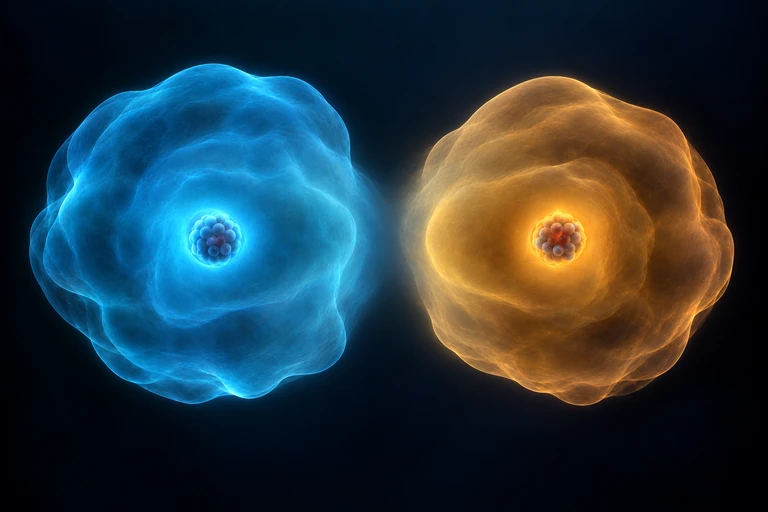
Interacting polarizable electron cloudsFluctuations in neighboring electron distributions create the temporary attractions responsible for London dispersion forces.
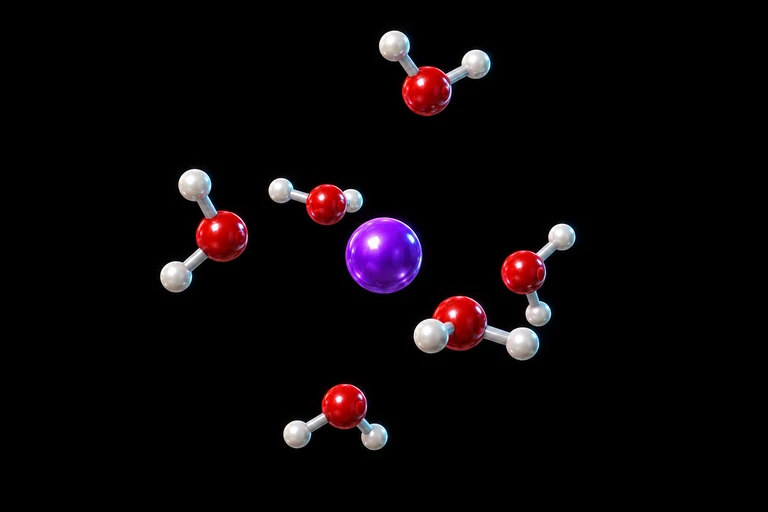
Water orientation around one sodium ionWater molecules orient their partially negative oxygen atoms toward a sodium ion.

SECTION 6

Worked Example — Ranking Boiling Points

One of the most common AP Chemistry tasks is ranking substances by boiling point based on their intermolecular forces. Let us work through a full example.

Worked example

  1. 1

    Step 1 — Draw Lewis Structures & Assess Polarity

    CH3CH2CH3 (propane) is nonpolar — symmetric C and H arrangement. CH3OCH3 (dimethyl ether) has a bent C–O–C geometry, making it polar but with no O–H bond. CH3CH2OH (ethanol) is polar and has an O–H bond.
  2. 2

    Step 2 — Identify IMFs for Each Substance

    Propane: LDF only. Dimethyl ether: dipole–dipole + LDF. Ethanol: hydrogen bonding + dipole–dipole + LDF.
    Ethanol has the strongest IMFs (H-bonding); propane has the weakest (LDF only).
  3. 3

    Step 3 — Consider Molar Mass as a Secondary Factor

    All three have similar molar masses (44–46 g/mol), so differences in LDF strength are minimal. The dominant factor is the type of IMF.
  4. 4

    Step 4 — Rank Boiling Points

    Stronger IMFs require more energy to overcome, producing higher boiling points.
    CH₃CH₂CH₃ (−42 °C) < CH₃OCH₃ (−24 °C) < CH₃CH₂OH (78 °C)
ℹ
Exam Tip

SECTION 7

Comparing Force Types — Strengths & Limitations

Force TypeOriginStrength RangeKey Property Effect
LDFInstantaneous dipole–induced dipole0.5–40 kJ/molExplains trends within homologous series (e.g., alkanes)
Dipole–DipolePermanent dipole alignment5–25 kJ/molRaises BP of polar vs. nonpolar molecules of similar mass
H-BondingH on N/O/F ↔ lone pair on N/O/F10–40 kJ/molAnomalously high BP of H₂O, NH₃, HF; biological structure
Ion–DipoleIon ↔ polar molecule50–600 kJ/molGoverns ionic compound solubility in water
Ionic BondFull charge attraction in lattice400–4000 kJ/molHigh melting points, brittleness, conductivity when dissolved
Covalent BondShared electron pair(s)150–1000 kJ/molDetermines molecular geometry, reactivity, and bond energy
Metallic BondDelocalized electron sea100–800 kJ/molMalleability, electrical/thermal conductivity, luster

Comparison of intramolecular and intermolecular forces.

★

Key takeaway

COMMON MISCONCEPTION

SECTION 8

Connections to Advanced Theory

The simple IMF classification taught at the AP level maps onto deeper physical-chemistry treatments. In advanced coursework, these forces are described quantitatively using the Lennard-Jones potential (which models the balance between short-range repulsion and long-range attraction) and van der Waals equations (which correct the ideal gas law for molecular volume and intermolecular attraction).

AP-Level ConceptAdvanced Extension
LDF strength ∝ polarizabilityQuantified by London's dispersion formula using ionization energies and polarizabilities
H-bonding is "strong dipole–dipole"Partial covalent character — overlap between H σ* orbital and lone pair
Lattice energy ∝ q⁺q⁻/(r⁺+r⁻)Born-Landé equation includes Madelung constant and Born exponent for precise crystal energy
Phase change = overcoming IMFsClausius-Clapeyron equation relates vapor pressure to ΔH_vap and temperature quantitatively

You do not need these advanced equations for the AP exam, but recognizing that the qualitative trends you learn — stronger IMFs lead to higher boiling points, lower vapor pressures, and greater viscosity — are grounded in rigorous thermodynamic and quantum-mechanical theory can deepen your confidence in applying the conceptual framework.

SECTION 9

Practice Problems

Question 1: CONCEPTUAL

When liquid ethanol (CH3CH2OH) evaporates, which of the following best describes the forces that are overcome?
  • A. Only the O–H covalent bonds within ethanol molecules are broken
  • B. Only London dispersion forces between ethanol molecules are overcome
  • C. Hydrogen bonds, dipole–dipole forces, and London dispersion forces between ethanol molecules are overcome
  • D. Covalent bonds within the molecules and hydrogen bonds between the molecules are both broken
Show answer (C)
C is correct. Evaporation is a physical change that overcomes all intermolecular forces between molecules — for ethanol, these include hydrogen bonds (O–H⋯O), dipole–dipole interactions (polar C–O and O–H bonds), and London dispersion forces. A is wrong because covalent bonds are intramolecular and are not broken during a phase change. B is wrong because it omits the hydrogen bonds and dipole–dipole forces that ethanol exhibits due to its –OH group. D is wrong because covalent bonds remain intact during evaporation; only intermolecular forces are overcome.

Question 2: BASIC CALCULATION

Which of the following correctly ranks the substances in order of increasing boiling point?
  • A. Ar < N₂ < CO < HF
  • B. N₂ < Ar < HF < CO
  • C. Ar < CO < N₂ < HF
  • D. N₂ < CO < Ar < HF
Show answer (D)
D is correct. The correct order of increasing boiling point is N₂ (−196 °C) < CO (−192 °C) < Ar (−186 °C) < HF (19.5 °C). N₂ is a nonpolar molecule that experiences only London dispersion forces (LDF). With 14 electrons, it has relatively low polarizability, giving it the weakest intermolecular forces and the lowest boiling point in this group. CO is isoelectronic with N₂ (14 electrons), so it has comparable LDF. However, CO also possesses a small permanent dipole moment, introducing weak dipole–dipole interactions that raise its boiling point slightly above that of N₂. Ar is a noble gas with only LDF, but it has 18 electrons — more than either N₂ or CO — giving it greater polarizability and therefore stronger London dispersion forces. This explains why Ar has a higher boiling point than both N₂ and CO despite lacking any dipole–dipole interactions. HF has the highest boiling point by a large margin because, in addition to LDF, it engages in strong hydrogen bonding (F is highly electronegative and has lone pairs that accept hydrogen bonds). These substantially stronger intermolecular attractions result in a boiling point far above the other three substances.

Question 3: INTERMEDIATE

Pentane (C₅H₁₂) and neopentane (C(CH₃)₄) have the same molecular formula but pentane boils at 36 °C while neopentane boils at 10 °C. Which explanation best accounts for this difference?
  • A. Pentane has stronger covalent bonds than neopentane
  • B. Neopentane is polar whereas pentane is nonpolar
  • C. Pentane's elongated shape provides greater surface area for London dispersion forces compared to neopentane's compact, spherical shape
  • D. Pentane has hydrogen bonding while neopentane does not
Show answer (C)
C is correct. Both are nonpolar isomers with identical molecular formulas and the same types of bonds, so they differ only in molecular shape. Pentane's linear chain provides a larger contact surface area between adjacent molecules, allowing more extensive London dispersion interactions and thus requiring more energy to vaporize. A is wrong because boiling involves overcoming intermolecular forces, not breaking covalent bonds, and both isomers contain the same types of C–C and C–H bonds. B is wrong because both molecules are nonpolar hydrocarbons. D is wrong because neither molecule contains N, O, or F bonded to H, so neither can form hydrogen bonds.

Question 4: APPLIED

A student performs an experiment measuring the vapor pressure of four liquids at 25 °C and obtains the following data: Substance | Molar Mass (g/mol) | Vapor Pressure (torr) Diethyl ether (CH₃CH₂OCH₂CH₃) | 74 | 534 1-Butanol (CH₃CH₂CH₂CH₂OH) | 74 | 6.7 Pentane (C₅H₁₂) | 72 | 511 Water (H₂O) | 18 | 23.8 (a) Identify all intermolecular forces present in 1-butanol. (b) Explain why 1-butanol has a much lower vapor pressure than diethyl ether, even though they have the same molar mass. (c) Explain why water has a lower vapor pressure than pentane, despite having a much lower molar mass. (d) Predict what would happen to the vapor pressure of each substance if the temperature were increased to 50 °C. Justify using kinetic molecular theory.
Show answer
(a) 1-Butanol exhibits London dispersion forces (present in all molecular substances), dipole–dipole forces (the C–O and O–H bonds create a net dipole), and hydrogen bonding (the –OH group has H bonded directly to O, which interacts with lone pairs on O atoms of neighboring molecules). [1 pt] (b) Although diethyl ether and 1-butanol have identical molar masses (74 g/mol) and thus similar LDF strengths, 1-butanol possesses an –OH group capable of hydrogen bonding, while diethyl ether has only lone pairs on oxygen with no H attached to O — it cannot act as a hydrogen-bond donor. The additional hydrogen bonds in 1-butanol create stronger net IMFs, meaning fewer molecules have sufficient kinetic energy to escape the liquid surface. This results in a dramatically lower vapor pressure (6.7 torr vs. 534 torr). [1 pt for identifying H-bonding capability difference; 1 pt for connecting to vapor pressure] (c) Water has a far lower molar mass than pentane (18 vs. 72 g/mol), which would suggest weaker LDFs and higher vapor pressure. However, water forms an extensive three-dimensional hydrogen-bonding network (each molecule can participate in up to four hydrogen bonds). These very strong IMFs far outweigh the LDF advantage of pentane, giving water a lower vapor pressure (23.8 vs. 511 torr). [1 pt] (d) All four vapor pressures would increase at 50 °C. According to kinetic molecular theory, raising the temperature increases the average kinetic energy of molecules and shifts the Maxwell-Boltzmann distribution to higher speeds. A greater fraction of molecules then possess enough energy to overcome the IMFs holding them in the liquid phase, so the rate of evaporation — and thus the equilibrium vapor pressure — increases for all four liquids. [1 pt for prediction; 1 pt for KMT justification]

Question 5: CRITICAL THINKING

The boiling points of the hydrogen halides are given below: HF: 19.5 °C HCl: −85.1 °C HBr: −66.8 °C HI: −35.4 °C (a) Explain the trend in boiling points from HCl to HI. (b) Explain why HF deviates dramatically from the trend observed for HCl → HBr → HI. (c) A student argues that because HF has the lowest molar mass in the series, it should have the lowest boiling point. Identify the flaw in this reasoning. (d) Using the data, estimate the boiling point HF would have if it followed the HCl–HBr–HI trend (i.e., if it relied only on dipole–dipole and LDF). Justify your estimate.
Show answer
(a) From HCl to HI, molar mass increases (36.5 → 127.9 g/mol), which increases polarizability and thus the strength of London dispersion forces. Since all three are polar and exhibit dipole–dipole forces as well, the increasing LDF dominates the trend, producing progressively higher boiling points: HCl (−85) < HBr (−67) < HI (−35). [1 pt] (b) HF deviates from this trend because fluorine is the most electronegative element and has a very small atomic radius, enabling exceptionally strong hydrogen bonds between HF molecules. These hydrogen bonds (H–F⋯H–F) are significantly stronger than the dipole–dipole and LDF interactions in HCl, HBr, and HI, raising HF's boiling point far above what molar mass alone would predict. [1 pt] (c) The student's reasoning is flawed because it assumes London dispersion forces are the only relevant IMF. While it is true that lower molar mass generally correlates with weaker LDFs, HF introduces hydrogen bonding — a much stronger intermolecular force that is absent in HCl, HBr, and HI (Cl, Br, and I are not electronegative enough to participate in traditional H-bonding). The hydrogen bonding in HF far outweighs the LDF disadvantage of its low molar mass. [1 pt] (d) Extrapolating the HCl–HBr–HI trend: the boiling points increase by roughly 18–31 °C per step as molar mass increases. Going in reverse from HCl (−85 °C) to a hypothetical non-hydrogen-bonding HF (molar mass 20 g/mol, even lower than HCl), one would expect a boiling point around −110 to −120 °C. The actual boiling point of 19.5 °C is therefore approximately 130–140 °C higher than predicted, and this entire elevation can be attributed to hydrogen bonding. [1 pt]

Varsity Tutors • AP Chemistry • Intramolecular and Interparticle Force