
SECTION 1
Historical Context & Motivation
The study of heat transfer has roots stretching back to the earliest human experiments with fire, but the scientific understanding of thermal energy only crystallized over the past three centuries. For much of the 18th century, scientists believed heat was a weightless, invisible fluid called caloric that flowed from hot objects to cold ones, much like water flowing downhill. While the caloric theory was eventually discarded, the intuition that heat moves spontaneously from higher to lower temperature proved correct and became formalized in the zeroth and second laws of thermodynamics. The quest to quantify this flow of energy gave birth to calorimetry, specific heat capacity, and ultimately the modern field of thermochemistry that is central to the AP Chemistry curriculum.
1760 • Black Defines Specific Heat
1798 • Rumford's Cannon-Boring Experiment
1843 • Joule's Mechanical Equivalent of Heat
1850 • Clausius Formalizes Thermodynamics
1872 • Boltzmann's Statistical Mechanics
The central question these pioneers collectively addressed remains the organizing principle for this lesson: How do we quantify the energy transferred as heat between substances, and what determines when that transfer stops? Answering this question is essential for predicting reaction enthalpies, interpreting calorimetry data, and solving the energy-balance problems that appear throughout the AP Chemistry exam.
SECTION 2
Core Principles & Definitions
Before diving into calculations, it is important to establish precise definitions for the core quantities involved in heat transfer. In everyday language, "heat" and "temperature" are often used interchangeably, but in chemistry they refer to fundamentally different physical quantities. Temperature measures the average kinetic energy of the particles in a substance, while heat (symbol q) is the energy transferred between two objects because of a temperature difference between them. Recognizing this distinction is the first step toward mastering thermochemistry.
Heat (q)
Temperature (T)
Specific Heat Capacity (c)
Thermal Equilibrium
System vs. Surroundings
KEY TAKEAWAY
SECTION 3
Visual Explanation — Energy Flow Toward Equilibrium
The diagram above captures the central physical picture of heat transfer in a coffee-cup calorimeter. When a hot metal sample is dropped into cooler water, energy flows from the metal to the water via conduction—molecular collisions at the metal-water interface transfer kinetic energy from faster-moving metal atoms to slower-moving water molecules. The metal's temperature decreases while the water's temperature increases. The process continues until both substances reach the same final temperature, at which point the net heat transfer is zero. The key quantitative constraint is conservation of energy within the insulated system: the heat lost by the metal equals the heat gained by the water, expressed as qlost + qgained = 0. This equation is the mathematical backbone of every calorimetry problem on the AP Chemistry exam.
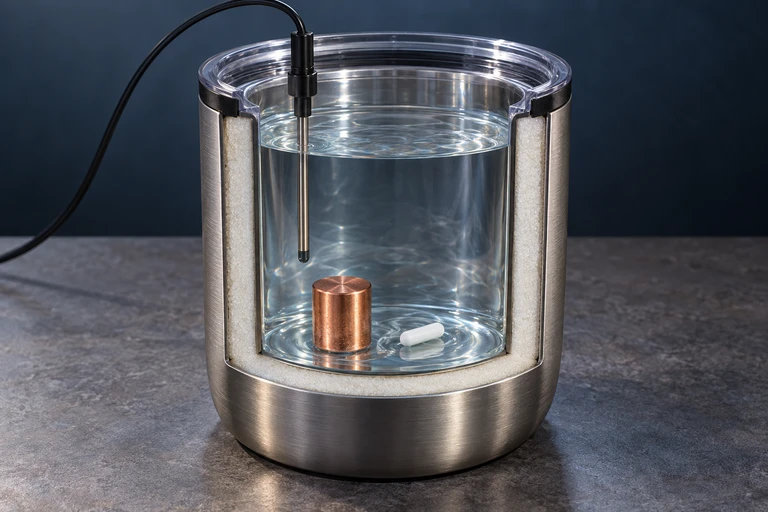 A metal sample and water exchange energy until they approach a shared temperature.
SECTION 4
Mathematical Framework
Three equations form the mathematical core of heat transfer problems in AP Chemistry. The first relates heat to temperature change, the second enforces conservation of energy at thermal equilibrium, and the third connects measurable heat flow to molar enthalpy changes in chemical reactions.
HEAT-TEMPERATURE RELATIONSHIP
where q = heat absorbed or released (J), m = mass of the substance (g), c = specific heat capacity (J·g⁻¹·°C⁻¹), and ΔT = Tfinal − Tinitial. A positive q means the substance absorbed heat (endothermic); a negative q means it released heat (exothermic).
THERMAL EQUILIBRIUM CONDITION
This equation expresses conservation of energy in an isolated system. The heat lost by the hotter substance is equal in magnitude and opposite in sign to the heat gained by the colder substance. Both ΔT terms are computed as Tfinal − Tinitial for each respective substance.
CALORIMETRY AND ENTHALPY OF REACTION
In a coffee-cup calorimeter at constant pressure, the heat of reaction equals the negative of the heat absorbed by the solution. Dividing qrxn by the moles of limiting reactant gives the molar enthalpy of reaction (ΔHrxn).
Sign Convention Tip
SECTION 5
Modes of Heat Transfer & Specific Heat Comparisons
Heat transfer occurs through three fundamental mechanisms: conduction, convection, and radiation. In the context of AP Chemistry calorimetry, conduction at the molecular interface between reacting substances and the solution is the dominant mode. Convection currents within the solution help distribute the transferred energy uniformly, while radiation losses are minimized by insulation. The specific heat capacity of a substance dictates how much its temperature changes for a given amount of absorbed heat. The following diagram and table compare specific heat capacities for substances frequently encountered on the AP exam.
| Substance | c (J·g⁻¹·°C⁻¹) | Molar Heat Capacity (J·mol⁻¹·°C⁻¹) | Molecular Explanation |
|---|---|---|---|
| Water (l) | 4.184 | 75.3 | Extensive hydrogen bonding network absorbs energy into intermolecular vibrations and rotations. |
| Aluminum (s) | 0.897 | 24.2 | Metallic bonding with light atoms; moderate lattice vibrational modes. |
| Copper (s) | 0.385 | 24.5 | Heavier atoms than Al; molar heat capacity nearly identical (Dulong-Petit law ≈ 25 J·mol⁻¹·°C⁻¹). |
| Lead (s) | 0.129 | 26.7 | Very heavy atoms yield low c per gram, but molar value again ≈ 25 J·mol⁻¹·°C⁻¹. |
Notice that the molar heat capacities of monatomic metallic solids cluster near 25 J·mol⁻¹·°C⁻¹ (the Dulong-Petit limit), while per-gram values differ dramatically because of atomic mass differences.
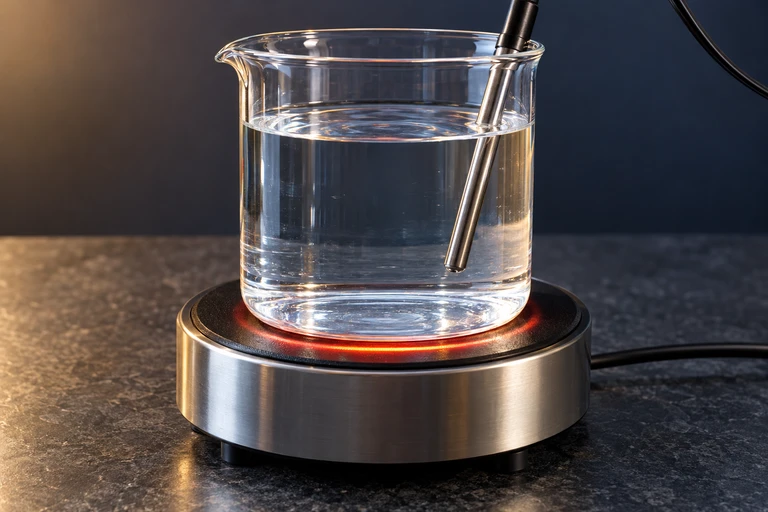 Heating a vessel involves energy transfer through the vessel and within the fluid.
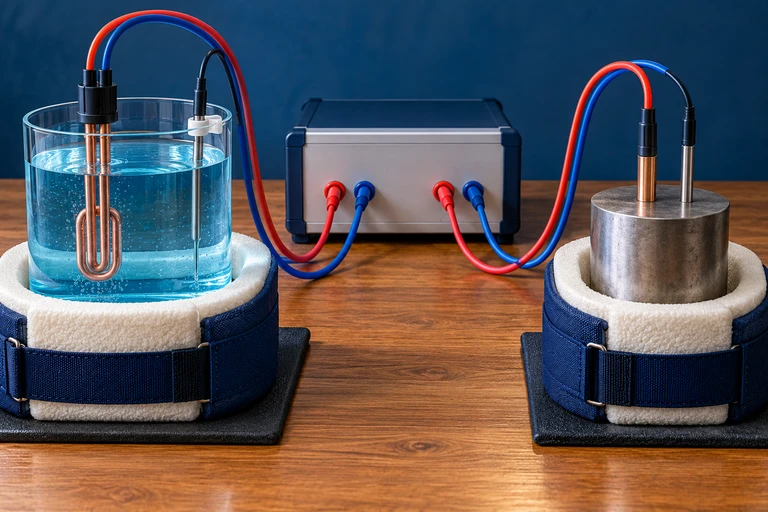 Suppose equal 100 g samples each receive 418.4 J with negligible heat loss and no phase change. Water warms by 1.00 °C and iron by about 9.32 °C because their specific heat capacities differ.
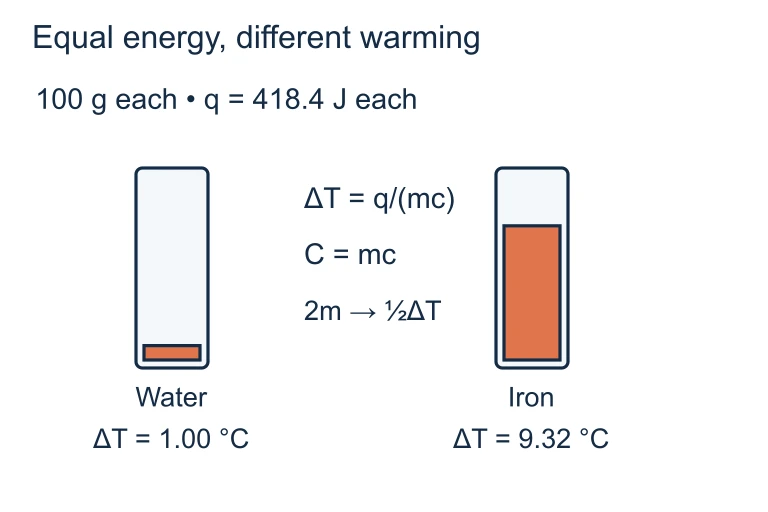 Suppose equal 100 g samples each receive 418.4 J with negligible heat loss and no phase change. Water warms by 1.00 °C and iron by about 9.32 °C because their specific heat capacities differ.
SECTION 6
Worked Example — Coffee-Cup Calorimetry
A 45.0-g piece of an unknown metal, initially at 98.0 °C, is dropped into an insulated coffee-cup calorimeter containing 150.0 g of water at 21.0 °C. The final equilibrium temperature of the system is 24.5 °C. Determine the specific heat capacity of the unknown metal and suggest its identity.
Finding the Specific Heat of an Unknown Metal
- 1
Step 1 — List Given Information
Mass of metal (mmetal) = 45.0 g; Ti,metal = 98.0 °C. Mass of water (mwater) = 150.0 g; Ti,water = 21.0 °C; cwater = 4.184 J·g⁻¹·°C⁻¹. Tfinal = 24.5 °C. - 2
Step 2 — Apply Conservation of Energy
In an insulated calorimeter, qmetal + qwater = 0. This means: mmetal × cmetal × (Tf − Ti,metal) + mwater × cwater × (Tf − Ti,water) = 0. - 3
Step 3 — Calculate Heat Gained by Water
qwater = 150.0 g × 4.184 J·g⁻¹·°C⁻¹ × (24.5 − 21.0) °C = 150.0 × 4.184 × 3.5 = 2196.6 J.q_water = +2196.6 J (water gains heat) - 4
Step 4 — Determine Heat Lost by Metal
By conservation of energy, qmetal = −qwater = −2196.6 J. The metal released this energy.q_metal = −2196.6 J (metal loses heat) - 5
Step 5 — Solve for c_metal
cmetal = qmetal / (mmetal × ΔTmetal) = −2196.6 J / [45.0 g × (24.5 − 98.0) °C] = −2196.6 / (45.0 × (−73.5)) = −2196.6 / (−3307.5) = 0.664 J·g⁻¹·°C⁻¹.c_metal ≈ 0.664 J·g⁻¹·°C⁻¹ — consistent with granite or a glass, but no common pure metal matches exactly. However, this value is close to aluminum's value if experimental uncertainties exist. - 6
Step 6 — Identify the Metal
Comparing 0.664 J·g⁻¹·°C⁻¹ to known values: aluminum is 0.897, iron is 0.449, and this value falls between them. In a real experiment, you would repeat the trial, check for heat loss to the calorimeter, and refine. If the measured value were slightly lower—around 0.449—the metal would likely be iron. Discrepancies on the AP exam often test whether students understand that heat loss to the environment shifts the calculated specific heat upward.
SECTION 7
Strengths & Limitations of Calorimetry Assumptions
The idealized equations presented in Section 4 rest on several assumptions that may or may not hold in real laboratory conditions. Understanding where these assumptions break down is critical for interpreting experimental data and for answering free-response questions on the AP exam that ask students to identify sources of error.
| Assumption | When It Holds | When It Fails |
|---|---|---|
| No heat lost to surroundings | Well-insulated calorimeters (Styrofoam cups, bomb calorimeters with known heat capacity) | Open beakers, long experiments, large temperature gradients with room temperature |
| Solution has properties of pure water | Dilute aqueous solutions (< 1 M) where solute contributes minimally to mass and c | Concentrated solutions, organic solvents, or mixtures where density and c differ substantially from water |
| Constant pressure | Open coffee-cup calorimeter at atmospheric pressure (measures ΔH directly) | Sealed-container experiments at constant volume (bomb calorimeter measures ΔE, not ΔH directly) |
| No phase change | Temperature stays between 0 °C and 100 °C for aqueous systems | Ice melts or water boils during experiment; requires enthalpy of fusion/vaporization terms |
Common assumptions in calorimetry and the conditions under which they hold or fail.
KEY TAKEAWAY
SECTION 8
Connection to Advanced Thermodynamic Theory
The heat transfer and thermal equilibrium concepts you have learned form the experimental foundation for broader thermodynamic principles that span general chemistry and extend into physical chemistry. Specifically, the calorimetric measurement of q at constant pressure gives you ΔH, which connects directly to Hess's Law and standard enthalpies of formation. Looking ahead, the spontaneity of heat flow—always from hot to cold in an isolated system—is a macroscopic manifestation of the second law of thermodynamics and the concept of entropy. Heat flows from hot to cold because doing so increases the total entropy of the universe.
| Concept in This Lesson | Advanced Extension | Where It Appears |
|---|---|---|
| q = mcΔT | ΔH = q at constant pressure; relates to bond enthalpies and Hess's Law | AP Chemistry Units 5–6 |
| Thermal equilibrium (T₁ = T₂) | Zeroth law; foundation for temperature scales and thermometry | Physical Chemistry (Thermodynamics) |
| Heat always flows hot → cold | Second law of thermodynamics; ΔSuniv > 0 for spontaneous processes | AP Chemistry Unit 9; Physical Chemistry |
| Coffee-cup calorimetry (constant P) | Bomb calorimetry (constant V); ΔE = qv; relationship ΔH = ΔE + PΔV | AP Chemistry Unit 5; General Chemistry II |
| Specific heat capacity (intensive property) | Statistical thermodynamics: equipartition theorem, degrees of freedom determine heat capacity | Physical Chemistry; Statistical Mechanics |
How this lesson's core concepts connect to more advanced thermodynamic theory.
As you continue through the AP Chemistry curriculum, you will find that Hess's Law problems, bond enthalpy calculations, and Gibbs free energy analyses all rely on the same energy-conservation logic you have practiced here. The ability to set up the equation qsystem + qsurroundings = 0 and solve for an unknown is a transferable skill that reappears in equilibrium, electrochemistry, and kinetics contexts.
SECTION 9
Practice Problems
Question 1: CONCEPTUAL
- A. Exactly 50.0 °C, because the masses are equal
- B. Closer to 20.0 °C than to 80.0 °C
- C. Closer to 80.0 °C than to 20.0 °C
- D. Exactly 80.0 °C, because the metal releases all of its thermal energy
Show answer (B)
Question 2: BASIC CALCULATION
- A. 5.27 × 10⁴ J
- B. 1.84 × 10⁴ J
- C. 7.11 × 10⁴ J
- D. 5.27 × 10³ J
Show answer (A)
Question 3: INTERMEDIATE
- A. 22.1 °C
- B. 25.7 °C
- C. 30.0 °C
- D. 60.0 °C
Show answer (A)
Question 4: APPLIED
5 ptsShow answer
Question 5: CRITICAL THINKING
4 ptsShow answer
SUMMARY
Summary — Heat Transfer and Thermal Equilibrium
Summary
Heat (q) is the energy transferred between objects due to a temperature difference, and it always flows spontaneously from a hotter body to a cooler one. The fundamental equation q = mcΔT relates the heat absorbed or released by a substance to its mass, specific heat capacity, and change in temperature. In an insulated calorimeter, conservation of energy requires that qhot + qcold = 0, and the system reaches thermal equilibrium when both objects share a common final temperature and net heat flow ceases.
In AP Chemistry, these principles underpin coffee-cup calorimetry, where measured temperature changes are used to calculate molar enthalpies of reaction via qrxn = −qsoln. Remember that water's high specific heat capacity (4.184 J·g⁻¹·°C⁻¹) makes it an excellent calorimeter solvent, and that the most common experimental error—heat loss to the surroundings—causes measured |ΔH| values to be smaller in magnitude than accepted literature values. Mastering these relationships prepares you for Hess's Law, bond enthalpies, and Gibbs free energy in later units.