

SECTION 1
Historical Context & Motivation
Long before modern thermodynamics existed as a formal discipline, practical questions about heat drove scientific inquiry: How much fuel does it take to boil a pot of water? Why do metals feel colder to the touch than wood at the same temperature? These everyday observations hinted at a deeper truth — that different substances absorb and release thermal energy at fundamentally different rates. The development of heat capacity as a quantitative concept, alongside the experimental technique of calorimetry, transformed these qualitative observations into the precise science that underpins everything from chemical engineering to climate modeling.
1760 • Black Distinguishes Heat from Temperature
1780 • Lavoisier & Laplace Build the Ice Calorimeter
1842 • Hess's Law of Constant Heat Summation
1848 • Joule Establishes the Mechanical Equivalent of Heat
1881 • Berthelot's Bomb Calorimeter
The central question that drove all of these developments remains the same question you encounter on the AP Chemistry exam: How can we quantitatively measure and predict the thermal energy exchanged during physical and chemical processes? Answering this question requires both a theoretical understanding of how substances store thermal energy and a mastery of the experimental methods used to measure heat flow.
SECTION 2
Core Principles & Definitions
Before tackling calculations, it is essential to distinguish several related but distinct quantities. Heat (q) is the transfer of thermal energy between a system and its surroundings, driven by a temperature difference. Temperature is a measure of the average kinetic energy of the particles in a sample, whereas heat capacity describes how much energy is needed to change that temperature. These foundational ideas connect through a small set of principles that form the backbone of calorimetry.
Specific Heat Capacity (c)
Molar Heat Capacity (Cₘ)
Calorimeter Constant (Ccal)
Conservation of Energy in Calorimetry
KEY TAKEAWAY
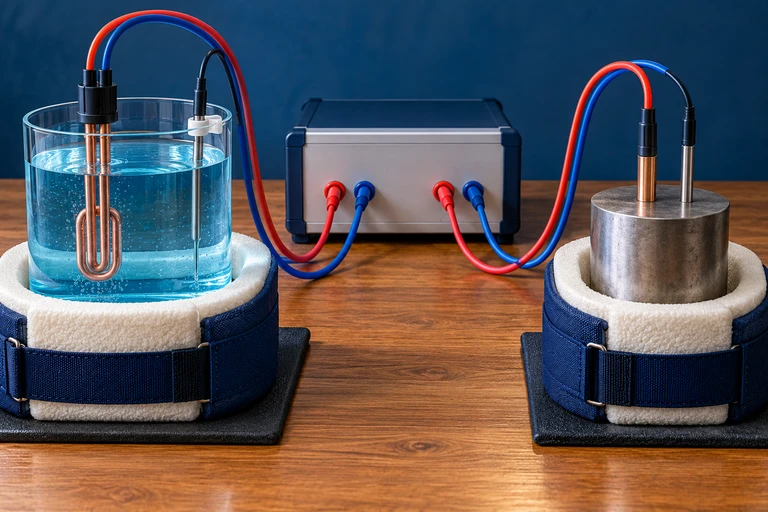 Suppose equal 100 g samples each receive 418.4 J with negligible heat loss and no phase change. Water warms by 1.00 °C and iron by about 9.32 °C because their specific heat capacities differ.
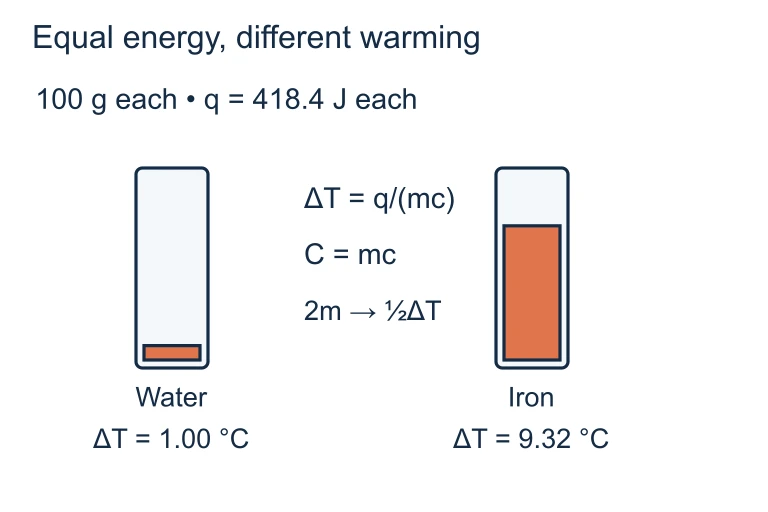 Suppose equal 100 g samples each receive 418.4 J with negligible heat loss and no phase change. Water warms by 1.00 °C and iron by about 9.32 °C because their specific heat capacities differ.
SECTION 3
Visual Explanation — Coffee-Cup Calorimeter
In practice, the coffee-cup calorimeter is the workhorse of introductory thermochemistry labs. The solution inside — typically water or a dilute aqueous mixture — serves as both the reaction medium and the heat-absorbing (or heat-releasing) body. When two reactants are mixed in the solution, any exothermic reaction raises the solution's temperature, and any endothermic reaction lowers it. By measuring the mass of the solution, its specific heat capacity, and the observed temperature change, we can calculate q directly. The critical assumption is that heat exchange with the environment is negligible, which the foam insulation helps ensure. On the AP exam, you should be comfortable recognizing that this constant-pressure setup means qrxn = ΔH.
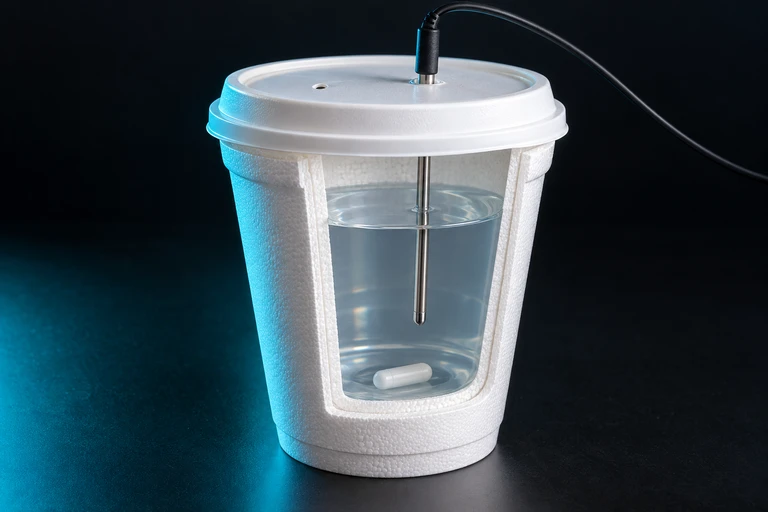 A coffee-cup calorimeter reduces heat exchange with the room while the solution’s temperature is measured.
SECTION 4
Mathematical Framework
The quantitative treatment of calorimetry rests on a handful of equations that connect heat flow to measurable quantities. Mastery of these equations — and knowing when to apply each one — is essential for AP Chemistry success. Pay close attention to sign conventions: a positive q means the system absorbs heat (endothermic process), while a negative q means the system releases heat (exothermic process).
HEAT TRANSFER (SPECIFIC HEAT)
where q = heat (J), m = mass (g), c = specific heat capacity (J·g⁻¹·°C⁻¹), ΔT = T_final − T_initial (°C or K). This is the most frequently tested equation in AP calorimetry.
HEAT TRANSFER (MOLAR HEAT CAPACITY)
where n = moles and Cₘ = molar heat capacity (J·mol⁻¹·°C⁻¹). This form is used when working with pure substances on a per-mole basis.
BOMB CALORIMETER
where C_cal = calorimeter constant (J·°C⁻¹) and ΔT = measured temperature change. The negative sign ensures q_rxn is negative for exothermic reactions (which raise the calorimeter temperature). In a bomb calorimeter, volume is constant, so q = ΔE (internal energy), not ΔH.
CONSERVATION OF ENERGY (MIXING)
When two substances at different temperatures are mixed in an isolated calorimeter, the heat lost by the hotter substance (q_hot < 0) equals in magnitude the heat gained by the cooler substance (q_cold > 0). This is a direct application of the first law of thermodynamics for an isolated system.
Sign Convention Alert
SECTION 5
Calorimeter Types & Detailed Comparison
The AP Chemistry curriculum emphasizes two primary calorimeter designs, each suited to different experimental conditions. Understanding their differences is not merely academic — the type of calorimeter determines whether you measure ΔH or ΔE, and it dictates which equation you use. The following diagram and table lay out the key distinctions.
| Feature | Coffee-Cup Calorimeter | Bomb Calorimeter |
|---|---|---|
| Condition | Constant pressure (open to atmosphere) | Constant volume (sealed steel vessel) |
| Measures | qp = ΔH | qv = ΔE |
| Equation | q = m × c × ΔT | q = Ccal × ΔT |
| Typical use | Dissolving salts, neutralization reactions, mixing at room pressure | Combustion reactions, determining caloric content of food |
| Precision | Moderate — some heat escapes to environment | High — well-insulated, calibrated |
| AP exam frequency | Very high — appears in FRQ and MCQ regularly | Moderate — conceptual understanding tested |
Comparison of the two primary calorimeter types tested on the AP Chemistry exam
SECTION 6
Worked Example — Neutralization Calorimetry
Let us work through a complete coffee-cup calorimetry problem of the type frequently seen on the AP exam. When 50.0 mL of 1.00 M HCl is mixed with 50.0 mL of 1.00 M NaOH in a coffee-cup calorimeter, the temperature rises from 22.5 °C to 29.3 °C. Assume the density and specific heat of the combined solution are the same as water (1.00 g/mL and 4.184 J·g⁻¹·°C⁻¹). Calculate the enthalpy of neutralization per mole of water formed.
Coffee-Cup Calorimetry: HCl + NaOH Neutralization
- 1
Step 1 — Identify Given Values
Volume of HCl = 50.0 mL, Volume of NaOH = 50.0 mL, so total volume = 100.0 mL. With density = 1.00 g/mL, mass = 100.0 g. Specific heat c = 4.184 J·g⁻¹·°C⁻¹. Ti = 22.5 °C, Tf = 29.3 °C, so ΔT = 29.3 − 22.5 = 6.8 °C. - 2
Step 2 — Calculate Heat Absorbed by Solution
Using q = m × c × ΔT: qsoln = 100.0 g × 4.184 J·g⁻¹·°C⁻¹ × 6.8 °C = 2,845 J = 2.845 kJ. The solution absorbs heat, so qsoln > 0.qsoln = +2,845 J - 3
Step 3 — Determine qᵣₓₙ
By conservation of energy: qrxn = −qsoln = −2,845 J = −2.845 kJ. The negative sign confirms the reaction is exothermic, which makes sense — the temperature of the solution rose.qrxn = −2.845 kJ - 4
Step 4 — Calculate Moles of Reaction
Moles of HCl = 0.0500 L × 1.00 mol/L = 0.0500 mol. Moles of NaOH = 0.0500 mol. The balanced equation is HCl(aq) + NaOH(aq) → NaCl(aq) + H₂O(l), so 0.0500 mol of water is formed in a 1:1 stoichiometry. - 5
Step 5 — Calculate ΔH per Mole
ΔH = qrxn / moles = −2.845 kJ / 0.0500 mol = −56.9 kJ/mol. This value is close to the accepted value of −57.1 kJ/mol for strong acid–strong base neutralization, which confirms the validity of the measurement.ΔH_neutralization = −56.9 kJ/mol
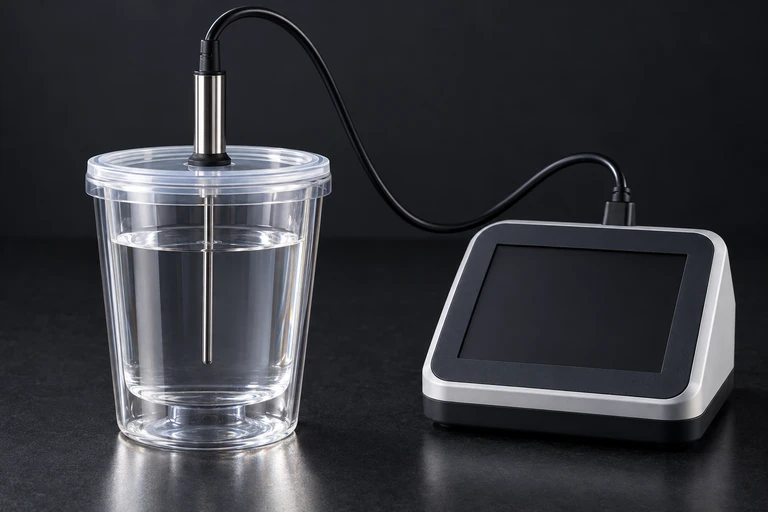 A temperature probe tracks the surroundings’ temperature during a reaction in a calorimeter.
SECTION 7
Sources of Error & Practical Limitations
No calorimeter is perfectly isolated, and AP Chemistry free-response questions frequently ask students to identify and explain sources of experimental error. Understanding these limitations is essential not only for earning full credit on the exam but also for developing sound experimental reasoning. The table below organizes common error sources and their effects on calculated values.
| Source of Error | Effect on ΔT | Effect on Calculated |ΔH| |
|---|---|---|
| Heat loss to surroundings | Measured ΔT is smaller than true ΔT | Underestimated (smaller magnitude) |
| Heat absorbed by calorimeter walls | Measured ΔT is smaller (energy goes into walls, not solution) | Underestimated |
| Assuming c = 4.184 J·g⁻¹·°C⁻¹ for a non-dilute solution | ΔT is measured correctly, but c is incorrect | Could be over- or underestimated depending on true c |
| Incomplete reaction | Measured ΔT is smaller (less heat released) | Underestimated per mole (if moles assumed theoretical) |
| Evaporation of solvent | Reduces measured ΔT (evaporation is endothermic, cools solution) | Underestimated |
Common sources of error in calorimetry and their directional effects
KEY TAKEAWAY
SECTION 8
Connection to Enthalpy, Hess's Law & Beyond
Calorimetry does not exist in isolation within the AP Chemistry curriculum; it connects directly to several more advanced thermochemical concepts. The enthalpy values you measure experimentally in a calorimeter are the same values used in Hess's law calculations, standard enthalpies of formation (ΔH°f), and bond enthalpy analyses. Understanding how calorimetric data feeds into these broader frameworks strengthens your ability to navigate multi-step thermochemistry problems.
| Concept | Calorimetry Connection | Advanced Extension |
|---|---|---|
| Hess's Law | Calorimetric ΔH values for individual reactions are summed to find ΔH for a reaction that is difficult to measure directly. | Hess's law is a consequence of enthalpy being a state function — only initial and final states matter. |
| Standard Enthalpy of Formation | ΔH°f values are determined from calorimetric measurements of combustion or synthesis reactions. | ΔH°rxn = Σ ΔH°f(products) − Σ ΔH°f(reactants) provides a tabulated shortcut. |
| Bond Enthalpies | Calorimetric data validates average bond dissociation energies used in gas-phase estimates. | ΔH ≈ Σ(bonds broken) − Σ(bonds formed). Less precise than Hess's law but useful for estimation. |
| Entropy & Gibbs Free Energy | Calorimetry provides the ΔH term in ΔG = ΔH − TΔS, which predicts reaction spontaneity. | Advanced calorimetry (differential scanning calorimetry) can measure both ΔH and heat capacity changes to derive ΔS. |
How calorimetry connects to advanced thermochemistry topics on the AP exam
Looking beyond the AP exam, calorimetry remains indispensable in modern research. Isothermal titration calorimetry (ITC) is a gold-standard technique in biochemistry for measuring binding affinities of drugs to proteins. Differential scanning calorimetry (DSC) characterizes phase transitions in polymers and pharmaceuticals. The principles you learn here — conservation of energy, careful measurement of temperature changes, and accounting for heat capacities — form the intellectual foundation for these sophisticated techniques.
SECTION 9
Practice Problems
Question 1: CONCEPTUAL
- A. q_rxn > 0 and q_soln > 0
- B. q_rxn < 0 and q_soln < 0
- C. q_rxn < 0 and q_soln > 0
- D. q_rxn > 0 and q_soln < 0
Show answer (C)
Question 2: BASIC CALCULATION
- A. 6.3 °C
- B. 15.0 °C
- C. 22.4 °C
- D. 62.7 °C
Show answer (B)
Question 3: INTERMEDIATE
- A. 0.129 J·g⁻¹·°C⁻¹
- B. 0.230 J·g⁻¹·°C⁻¹
- C. 0.457 J·g⁻¹·°C⁻¹
- D. 0.897 J·g⁻¹·°C⁻¹
Show answer (C)
Question 4: APPLIED
5 ptsShow answer
Question 5: CRITICAL THINKING
5 ptsShow answer
SUMMARY
Summary
Summary
Heat capacity quantifies a substance's resistance to temperature change, expressed as specific heat capacity (c, per gram) or molar heat capacity (Cₘ, per mole). The foundational equation q = mcΔT relates heat transfer to mass, specific heat, and temperature change. Calorimetry is the experimental technique for measuring heat flow, relying on the principle that q_lost + q_gained = 0 in an isolated system.
A coffee-cup calorimeter operates at constant pressure and measures ΔH, while a bomb calorimeter operates at constant volume and measures ΔE. Most experimental errors — heat loss, absorption by calorimeter walls, evaporation — lead to an underestimate of |ΔH|. Always watch your sign conventions: q_rxn = −q_soln, and ΔT = T_final − T_initial. Calorimetric data connects directly to Hess's law, standard enthalpies of formation, and Gibbs free energy calculations, making it a cornerstone of the AP Chemistry thermochemistry unit.