

SECTION 1
Historical Context & Motivation
For centuries, chemists observed that certain salts dissolve readily in water while others remain virtually insoluble, yet no satisfying quantitative framework existed to predict or explain these observations. Early alchemists categorized substances simply as "soluble" or "insoluble," and even the advent of careful stoichiometric methods in the eighteenth century did little to explain why dissolution occurred at the molecular level. The missing ingredient was a rigorous thermodynamic treatment that could unify enthalpy changes, entropy changes, and temperature into a single predictive quantity—the Gibbs free energy of dissolution.
1824 • Carnot's Heat Engine Work
1876 • Gibbs Free Energy Defined
1889 • Van 't Hoff Equation
1923 • Debye–Hückel Theory
Modern Era • Computational Thermodynamics
The central question that the free energy of dissolution addresses is deceptively simple: given a particular ionic compound and a solvent, will the solute dissolve spontaneously under standard conditions, and if so, to what extent? Answering this question requires us to dissect the dissolution process into its enthalpic and entropic components, weigh them against each other through the Gibbs equation, and connect the resulting ΔG° to the solubility-product constant Ksp. This framework not only explains familiar solubility rules but also reveals surprising cases—like certain endothermic salts that dissolve spontaneously because entropy drives the process—that no simpler model can account for.
SECTION 2
Core Principles & Definitions
To understand the free energy of dissolution, we must first establish the thermodynamic quantities that govern whether a solute enters solution. The dissolution of an ionic compound can be conceptually decomposed into two hypothetical steps: breaking the crystal lattice apart into gaseous ions (requiring the lattice energy) and then hydrating those gaseous ions (releasing the hydration energy). The net enthalpy change, ΔHdiss, depends on the relative magnitudes of these two steps. However, enthalpy alone does not determine spontaneity—the entropy change associated with dispersing ions throughout the solvent must also be considered.
Gibbs Free Energy (ΔG°)
Enthalpy of Dissolution (ΔH°diss)
Entropy of Dissolution (ΔS°diss)
Lattice Energy
Solubility Product (Ksp)
KEY TAKEAWAY
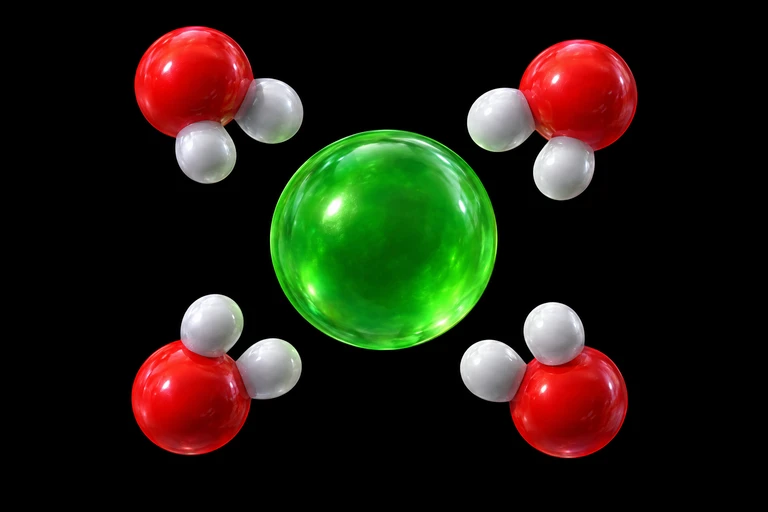 Water molecules orient their partially positive hydrogen atoms toward a chloride ion.
SECTION 3
Visual Explanation — The Dissolution Energy Landscape
The energy diagram above illustrates the conceptual framework underpinning ΔH°diss using a Born–Haber-type cycle adapted for dissolution. Notice that this diagram captures only the enthalpy component of the free energy equation. A salt like ammonium nitrate (NH4NO3) has a positive ΔH°diss (the solution cools when it dissolves), yet it dissolves readily at room temperature because the favorable TΔS° term more than compensates. This is the hallmark of an entropy-driven dissolution. Conversely, a compound with a very large lattice energy—such as MgO—has such a strongly endothermic ΔH°diss that no reasonable entropy gain at standard temperatures can overcome it, resulting in effective insolubility.
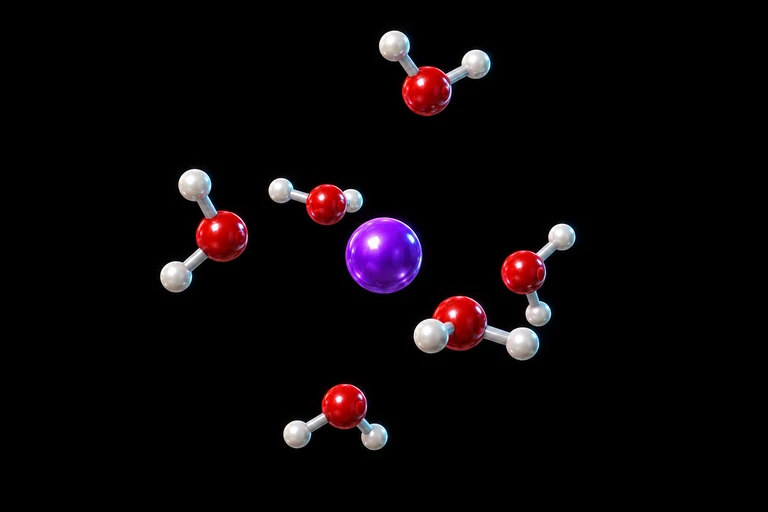 Water molecules orient their partially negative oxygen atoms toward a sodium ion.
SECTION 4
Mathematical Framework
The quantitative treatment of dissolution spontaneity rests on the Gibbs free energy equation and its connection to the equilibrium constant. These relationships allow us to predict whether a salt will dissolve, compute the extent of dissolution, and determine how temperature shifts solubility.
GIBBS FREE ENERGY OF DISSOLUTION
ΔG°diss = standard free energy of dissolution (kJ mol⁻¹); ΔH°diss = standard enthalpy of dissolution (kJ mol⁻¹); T = temperature in kelvins; ΔS°diss = standard entropy of dissolution (kJ mol⁻¹ K⁻¹).
RELATIONSHIP TO SOLUBILITY PRODUCT
R = 8.314 J mol⁻¹ K⁻¹ (gas constant); T = temperature (K); Ksp = solubility product constant. When Ksp > 1, ΔG° is negative and dissolution is strongly favored.
VAN 'T HOFF EQUATION
Relates the solubility product at two temperatures. For endothermic dissolution (ΔH° > 0), Ksp increases with temperature; for exothermic dissolution (ΔH° < 0), Ksp decreases with temperature.
A crucial detail for AP Chemistry is the sign convention and unit consistency. Because ΔH° is typically reported in kJ mol⁻¹ while R is 8.314 J mol⁻¹ K⁻¹, you must convert ΔH° to joules (or R to kJ) before substituting into the van 't Hoff equation. Additionally, combining the first two equations yields −RT ln Ksp = ΔH°diss − TΔS°diss, which can be rearranged to solve for Ksp at any temperature if ΔH° and ΔS° are assumed temperature-independent—an approximation that holds well over moderate temperature ranges.
SIGN CONVENTION REMINDER
SECTION 5
Classifying Dissolution by Thermodynamic Driving Force
Not all spontaneous dissolutions are alike. By examining the signs and relative magnitudes of ΔH° and ΔS°, we can classify dissolution processes into four thermodynamic categories. This classification illuminates why certain solubility trends exist and how temperature modulates them.
The most commonly tested scenario on the AP exam is the entropy-driven dissolution case, where ΔH° > 0 and ΔS° > 0. The crossover temperature at which ΔG° changes sign is T = ΔH°/ΔS°. Below this temperature, the positive enthalpy dominates and the salt remains sparingly soluble. Above it, the TΔS° term wins and dissolution becomes favorable. This is precisely why KNO3 is only moderately soluble at 20 °C but extremely soluble at 70 °C. It is also the principle behind instant cold packs: when NH4NO3 dissolves endothermically, the solution absorbs heat from the surroundings, providing the cooling effect.
| Compound | ΔH°diss (kJ/mol) | ΔS°diss (J/mol·K) | ΔG°298 (kJ/mol) | Category |
|---|---|---|---|---|
| NaCl | +3.9 | +43.2 | −8.9 | Entropy-driven |
| NaOH | −44.5 | +38.6 | −56.0 | Always spontaneous |
| NH₄NO₃ | +25.7 | +108.7 | −6.7 | Entropy-driven |
| AgCl | +65.5 | +33.0 | +55.7 | Non-spontaneous |
| Ca(OH)₂ | −16.7 | −30.1 | −7.7 | Enthalpy-driven |
Thermodynamic dissolution data for selected ionic compounds at 298 K
 Dissolution inside an activated cold pack absorbs heat from the surroundings.
SECTION 6
Worked Example
Calculating ΔG°diss and Ksp for Silver Chloride at 298 K
- 1
Step 1 — Identify Given Values
For the dissolution AgCl(s) → Ag⁺(aq) + Cl⁻(aq), we are given: ΔH°diss = +65.5 kJ mol⁻¹ and ΔS°diss = +33.0 J mol⁻¹ K⁻¹. The temperature is T = 298 K. - 2
Step 2 — Ensure Consistent Units
Convert ΔS° to kJ: ΔS° = 33.0 J mol⁻¹ K⁻¹ × (1 kJ / 1000 J) = 0.0330 kJ mol⁻¹ K⁻¹. Alternatively, convert ΔH° to J: 65,500 J mol⁻¹. We will use the kJ route here. - 3
Step 3 — Apply the Gibbs Equation
ΔG°diss = ΔH° − TΔS° = 65.5 kJ mol⁻¹ − (298 K)(0.0330 kJ mol⁻¹ K⁻¹) = 65.5 − 9.83 = +55.7 kJ mol⁻¹.ΔG°diss = +55.7 kJ mol⁻¹ — dissolution is non-spontaneous (product-disfavored) at 298 K. - 4
Step 4 — Calculate Ksp from ΔG°
Using ΔG° = −RT ln Ksp, rearrange: ln Ksp = −ΔG° / RT = −55,700 J mol⁻¹ / (8.314 J mol⁻¹ K⁻¹ × 298 K) = −55,700 / 2477.6 = −22.48. - 5
Step 5 — Evaluate Ksp
Ksp = e−22.48 ≈ 1.7 × 10⁻¹⁰. This very small Ksp confirms that AgCl is sparingly soluble, consistent with the well-known literature value of 1.77 × 10⁻¹⁰.Ksp ≈ 1.7 × 10⁻¹⁰ - 6
Step 6 — Interpret the Result
The positive ΔG° and extremely small Ksp both indicate that the equilibrium lies far to the left—AgCl remains predominantly as a solid precipitate. Although the entropy of dissolution is positive (favorable), it is nowhere near large enough to compensate for the substantial lattice energy that must be overcome. This example illustrates how ΔG° bridges macroscopic solubility behavior with molecular-level energetics.
SECTION 7
Strengths & Limitations of the Thermodynamic Model
| Aspect | Strength | Limitation |
|---|---|---|
| Predictive Power | ΔG° accurately predicts whether dissolution is spontaneous and yields quantitative Ksp values from tabulated thermodynamic data. | Assumes ideal behavior; real solutions with high ionic strength require activity coefficient corrections (Debye–Hückel). |
| Temperature Dependence | The van 't Hoff equation predicts how solubility changes with temperature, explaining anomalous solubility curves. | Assumes ΔH° and ΔS° are temperature-independent, which breaks down over large temperature ranges. |
| Kinetic Insight | Thermodynamic spontaneity tells us the direction of net change. | Says nothing about the rate of dissolution. A thermodynamically favorable process can be kinetically slow (e.g., BaSO₄ formation). |
| Scope | Applicable to any solute–solvent combination, not just ionic compounds in water. | Tabulated ΔH° and ΔS° values may not be available for all solute–solvent pairs, especially nonaqueous solvents. |
Strengths and limitations of using ΔG° to analyze dissolution
KEY TAKEAWAY
SECTION 8
Connections to Advanced Theory
The free energy of dissolution connects to several advanced topics that appear in college-level physical chemistry and are sometimes probed in the more challenging AP free-response questions. Understanding these connections deepens your conceptual toolkit and prepares you for more rigorous treatments of solution thermodynamics.
| AP Chemistry Level | Advanced / Physical Chemistry Level |
|---|---|
| ΔG° = ΔH° − TΔS° with constant ΔH° and ΔS° | ΔG° computed from temperature-dependent heat capacities: ΔH°(T) = ΔH°(T₀) + ∫Cp dT and similar for ΔS°(T) |
| Ksp as an equilibrium constant for dissolution | Thermodynamic Ksp expressed in terms of activities (a = γ·m), requiring Debye–Hückel or Pitzer models for activity coefficients |
| ΔG° = −RT ln Ksp | ΔG = ΔG° + RT ln Q (non-standard conditions), yielding the ion activity product Q vs. Ksp criterion for precipitation |
| Dissolution classified as enthalpy- or entropy-driven | Entropy–enthalpy compensation analyzed using Born solvation model: ΔG°solv = −(z²e²/8πε₀r)(1 − 1/εr) |
Progression from AP-level to advanced dissolution thermodynamics
One particularly important extension for AP Chemistry involves the relationship between ΔG and the reaction quotient Q. When a solution is unsaturated, Q < Ksp, and ΔG < 0, so more solute will dissolve. When the solution is supersaturated, Q > Ksp and ΔG > 0, favoring precipitation. This non-standard free energy analysis bridges the dissolution equilibrium framework with the broader concept of Le Châtelier's principle and is central to understanding common-ion effects, selective precipitation, and qualitative analysis schemes.
AP EXAM CONNECTION
SECTION 9
Practice Problems
Question 1: CONCEPTUAL
- A. ΔH° < 0 and ΔS° > 0; the process is both enthalpy- and entropy-driven.
- B. ΔH° > 0 and ΔS° > 0; the favorable entropy change overcomes the unfavorable enthalpy change at 298 K.
- C. ΔH° > 0 and ΔS° < 0; the process is kinetically favorable despite being thermodynamically non-spontaneous.
- D. ΔH° < 0 and ΔS° < 0; the large exothermic hydration energy drives dissolution.
Show answer (B)
Question 2: BASIC CALCULATION
- A. −27.2 kJ mol⁻¹
- B. +27.2 kJ mol⁻¹
- C. −11.0 kJ mol⁻¹
- D. +11.0 kJ mol⁻¹
Show answer (B)
Question 3: INTERMEDIATE
- A. 77 K
- B. 298 K
- C. 350 K
- D. 500 K
Show answer (C)
Question 4: APPLIED
4 ptsShow answer
Question 5: CRITICAL THINKING
4 ptsShow answer
SUMMARY
Summary — Free Energy of Dissolution
Summary
The free energy of dissolution determines whether a solute dissolves spontaneously by combining the enthalpy of dissolution (net result of lattice energy and hydration energy) with the entropy of dissolution via the Gibbs equation: ΔG° = ΔH° − TΔS°. A negative ΔG° signals spontaneous dissolution; a positive ΔG° favors the solid remaining intact.
The connection ΔG° = −RT ln Ksp links thermodynamics directly to the solubility product, enabling quantitative predictions of solubility. Dissolution processes are classified as entropy-driven (endothermic, positive ΔS°), enthalpy-driven (exothermic, negative ΔS°), or always/never spontaneous. The van 't Hoff equation predicts temperature effects: endothermic dissolutions become more favorable at higher T, while exothermic dissolutions become less favorable. Mastery of these relationships is essential for AP Chemistry free-response success.