
AP Chemistry • Thermochemistry

Enthalpy of Formation

A thermodynamic bookkeeping system that lets you predict the heat of any reaction from tabulated values.

AP Chemistry illustration with a laboratory flask, atom, and microscope
Inside this lesson 10 sections 5 questions 8 figures

SECTION 1

Historical Context & Motivation

The quest to quantify the energy released or absorbed by chemical reactions stretches back to the late eighteenth century, when scientists first attempted to measure heat with precision. Early calorimetric experiments were crude, but they revealed a tantalizing regularity: the heat associated with a chemical transformation appeared to depend only on the initial and final states of the system, not on the pathway connecting them. This observation eventually crystallized into one of thermochemistry's most powerful tools—the standard enthalpy of formation, ΔH°f. By assigning an enthalpy "cost" to building each compound from its elements in their standard states, chemists created a universal reference system that could predict the enthalpy change of virtually any reaction without performing a new calorimetry experiment.

1780 • Lavoisier & Laplace's Ice Calorimeter

Antoine Lavoisier and Pierre-Simon Laplace designed an ice calorimeter to measure the heat evolved by chemical reactions, establishing quantitative calorimetry as a discipline and demonstrating that heat changes could be measured reproducibly.

1840 • Hess's Law of Constant Heat Summation

Germain Hess published his landmark finding that the total enthalpy change for a reaction is independent of the route taken—effectively a restatement of energy conservation applied to chemistry. This law is the theoretical backbone of formation-enthalpy calculations.

1854 • Thomsen & Berthelot's Thermochemical Measurements

Julius Thomsen and Marcellin Berthelot independently compiled extensive tables of heats of reaction, foreshadowing the modern approach of cataloguing ΔH°f values for rapid thermochemical computation.

1920s • IUPAC Standardization of Reference States

The International Union of Pure and Applied Chemistry formalized the concept of standard states (1 bar, specified temperature, most stable allotrope) and the convention that ΔH°f for any element in its standard state is exactly zero, providing a consistent baseline for all tabulated values.

Present • NIST Thermochemical Databases

Modern reference databases, such as the NIST WebBook, compile critically evaluated ΔH°f data for thousands of substances, enabling chemists and engineers to predict reaction energetics computationally without resorting to laborious bench experiments.

The central question that enthalpy of formation answers is deceptively simple: How much energy does it take to assemble one mole of a compound from the most stable forms of its constituent elements? By treating this assembly energy as a characteristic property of each substance, we gain the ability to compute the enthalpy change for any balanced equation through a simple algebraic combination—products minus reactants—without ever measuring that specific reaction directly.

SECTION 2

Core Principles & Definitions

To use enthalpy-of-formation data effectively, you must internalize several foundational ideas that define what ΔH°f means, how the reference state is chosen, and why the entire framework is self-consistent. These principles are not arbitrary conventions; each one follows logically from the path-independence of enthalpy (Hess's law) and the need for a single, universal zero point.

1

Definition of ΔH°f

The standard enthalpy of formation is the enthalpy change when one mole of a compound is synthesized from its constituent elements, each in their most thermodynamically stable form (standard state) at 1 bar and a specified temperature (usually 298.15 K).
2

Elements Have ΔH°f = 0

By convention, the standard enthalpy of formation of any element in its reference form is exactly zero. This includes O₂(g), N₂(g), C(graphite), Fe(s), and Br₂(l). This convention establishes the common baseline from which all other ΔH°f values are measured.
3

Standard State Matters

Standard state refers to the most stable allotrope or phase at 1 bar: graphite (not diamond) for carbon, O₂ (not O₃) for oxygen, and liquid for bromine at 298 K. Choosing the wrong reference form will yield an incorrect ΔH°f value.
4

Hess's Law Underpins Everything

Because enthalpy is a state function, the enthalpy change for any reaction depends only on the initial and final states. We can therefore decompose any reaction into formation reactions—one per substance—and sum their contributions algebraically.
5

Sign Convention

A negative ΔH°f means the compound is more stable than its separated elements (exothermic formation). A positive ΔH°f means energy must be input to form the compound (endothermic formation), suggesting it is thermodynamically unstable relative to its elements.
✦

KEY TAKEAWAY

Think of ΔH°f values as the "price tags" on chemical compounds. Just as you can calculate the total cost of a shopping trip by adding up the prices of items you buy and subtracting the value of items you return, you can calculate the enthalpy change of a reaction by summing the formation enthalpies of the products and subtracting those of the reactants. The "store" sells everything starting from elements in their standard states—those items are free (ΔH°f = 0), and every compound's price tag tells you how much energy was spent or released to build it.

A layered dark graphite specimen and rough clear diamond sit beside sealed colorless-gas and reddish-brown-liquid containers.At 298.15 K and 1 bar, graphite, O₂(g) and Br₂(l) are elemental reference forms with standard formation enthalpy zero. Diamond is a different allotrope; a formation equation produces exactly one mole of the specified product.
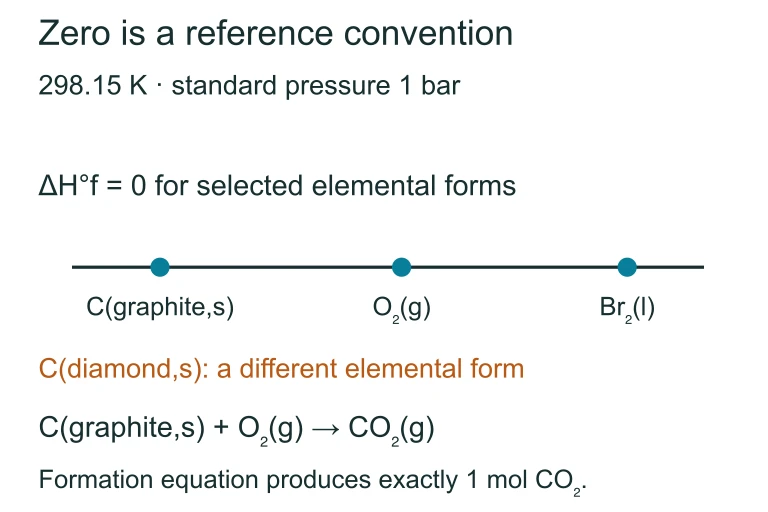
Zero is a reference convention. At 298.15 K and 1 bar, graphite, O₂(g) and Br₂(l) are elemental reference forms with standard formation enthalpy zero. Diamond is a different allotrope; a formation equation produces exactly one mole of the specified product.At 298.15 K and 1 bar, graphite, O₂(g) and Br₂(l) are elemental reference forms with standard formation enthalpy zero. Diamond is a different allotrope; a formation equation produces exactly one mole of the specified product.

SECTION 3

Visual Explanation — The Enthalpy Cycle

The power of formation enthalpies becomes transparent when you visualize the underlying enthalpy cycle. Every chemical reaction can be imagined as a two-step detour: first, mentally decompose all reactants back into their constituent elements in standard states (the reverse of their formation reactions), and second, reassemble those same elements into the products. Because enthalpy is a state function, the total enthalpy change around this cycle equals the enthalpy change of the direct reaction. The following diagram illustrates this cycle for the combustion of methane.

Enthalpy Cycle for CH₄ CombustionReactantsCH₄(g) + 2 O₂(g)ProductsCO₂(g) + 2 H₂O(l)ΔH°rxn = ?Elements in Standard StatesC(graphite) + 2 H₂(g) + 2 O₂(g)−ΔH°f [reactants]−(−74.8) = +74.8 kJ+ΔH°f [products](−393.5) + 2(−285.8)ΔH°rxn = Σ ΔH°f(products) − Σ ΔH°f(reactants)= (−393.5 + 2(−285.8)) − (−74.8 + 0) = −890.3 kJ/mol
The enthalpy cycle for the combustion of methane. The upper horizontal arrow represents the direct reaction pathway, while the two diagonal arrows show the indirect route through the elements in their standard states. Because enthalpy is a state function, the sum of the indirect arrows must equal the direct arrow. Note that the ΔH°f of O₂(g) is zero since it is already in its standard state.

The diagram makes the logic of the calculation almost self-evident. Traveling from reactants down to elements reverses the formation reactions of CH₄ and O₂, so we negate their ΔH°f values (O₂ contributes zero because it is already an element in its standard state). Traveling upward from elements to products uses the formation reactions of CO₂ and H₂O directly. The net result is the familiar products-minus-reactants formula. This visual decomposition is essentially Hess's law in action, confirming that we can treat formation enthalpies as energetic "coordinates" on an enthalpy axis.

SECTION 4

Mathematical Framework

The algebraic expression that links formation enthalpies to any reaction enthalpy is a direct consequence of Hess's law. Because we can write any balanced equation as a linear combination of formation reactions—products formed, reactants un-formed—the enthalpy change of the overall reaction reduces to a stoichiometric sum over tabulated ΔH°f values.

STANDARD REACTION ENTHALPY

ΔH°rxn=Σn⋅ΔH°f(products)−Σm⋅ΔH°f(reactants)ΔH°rxn = Σ n·ΔH°f(products) − Σ m·ΔH°f(reactants)

Where n and m are the stoichiometric coefficients of the products and reactants respectively, ΔH°f is the standard enthalpy of formation in kJ/mol, and all species are in their standard states at 298 K and 1 bar.

FORMATION REACTION (GENERAL FORM)

elements(standardstates)→1molcompoundΔH=ΔH°felements (standard states) → 1 mol compound ΔH = ΔH°f

The formation reaction must produce exactly one mole of product. Fractional coefficients on the element side are permitted and often necessary. For example, the formation reaction of H₂O(l) is: H₂(g) + ½ O₂(g) → H₂O(l).

ELEMENT CONVENTION

ΔH°f[elementinstandardstate]=0kJ/molΔH°f [element in standard state] = 0 kJ/mol

This convention sets the energetic baseline. Standard states include O₂(g), N₂(g), H₂(g), C(graphite), S₈(rhombic), P₄(white), and metals in their crystalline form at 298 K.

💡

AP Exam Tip

The College Board's AP Chemistry equation sheet provides the formula ΔH°rxn = Σ ΔH°f(products) − Σ ΔH°f(reactants), but you must remember to multiply each ΔH°f by its stoichiometric coefficient. Forgetting this multiplier is one of the most common errors on FRQ problems.

SECTION 5

Key Formation Enthalpies & Energy Landscape

Familiarity with commonly encountered ΔH°f values accelerates problem-solving and deepens your intuition about chemical stability. The table below lists substances that appear frequently on the AP Chemistry exam. Notice that highly negative values correspond to compounds that are energetically very stable relative to their elements (strong bonds formed), while positive values indicate compounds that are endothermic to form and are thus less thermodynamically stable than their elemental starting materials.

SubstanceFormulaΔH°f (kJ/mol)Notes
Water (liquid)H₂O(l)−285.8Most commonly tested value
Water (gas)H₂O(g)−241.8Phase matters! Difference = ΔH vaporization
Carbon dioxideCO₂(g)−393.5Combustion product; very stable
MethaneCH₄(g)−74.8Simplest hydrocarbon
EthanolC₂H₅OH(l)−277.7Common biofuel
AmmoniaNH₃(g)−45.9Haber process product
Nitrogen dioxideNO₂(g)+33.2Endothermic formation
OzoneO₃(g)+142.7Less stable than O₂

Selected standard enthalpies of formation at 298 K

Energy Landscape: ΔH°f of Selected Compounds0+150+100+50−50−150−300−400ΔH°f (kJ/mol)+142.7O₃(g)+33.2NO₂(g)−45.9NH₃(g)−74.8CH₄(g)−285.8H₂O(l)−277.7C₂H₅OH−393.5CO₂(g)Dashed line = ΔH°f = 0 (elements in standard states)
Bar chart showing the ΔH°f values for selected compounds. Bars extending below the dashed zero line represent compounds with negative (exothermic) formation enthalpies, indicating greater thermodynamic stability relative to their constituent elements. Bars above the line—ozone and nitrogen dioxide—require energy input to form and are less stable.

Examining the bar chart reveals a clear trend: the more bonds that are formed (and the stronger those bonds are) when assembling the compound from its elements, the more negative ΔH°f becomes. Carbon dioxide, with two very strong C=O double bonds, sits near the bottom of the chart. Meanwhile, ozone (O₃) is a high-energy allotrope of oxygen; its formation from O₂ is substantially endothermic because the resonance-stabilized O₃ molecule is inherently less stable than the O=O double bond in diatomic oxygen.

SECTION 6

Worked Example — Combustion of Ethanol

Let us calculate the standard enthalpy of combustion of ethanol, C₂H₅OH(l), using formation enthalpies. This is a classic AP Chemistry problem that integrates stoichiometry with thermochemical reasoning.

Standard Enthalpy of Combustion of Ethanol

  1. 1

    Step 1 — Write the balanced equation

    The complete combustion of ethanol in oxygen produces carbon dioxide and liquid water. The balanced equation is: C₂H₅OH(l) + 3 O₂(g) → 2 CO₂(g) + 3 H₂O(l). Confirm that atoms balance: 2 C, 6 H, and 7 O on each side.
  2. 2

    Step 2 — List ΔH°f values from the data table

    Gather the required formation enthalpies. ΔH°f[C₂H₅OH(l)] = −277.7 kJ/mol; ΔH°f[O₂(g)] = 0 kJ/mol (element in standard state); ΔH°f[CO₂(g)] = −393.5 kJ/mol; ΔH°f[H₂O(l)] = −285.8 kJ/mol.
  3. 3

    Step 3 — Apply the formation enthalpy equation

    Using ΔH°rxn = Σ n·ΔH°f(products) − Σ m·ΔH°f(reactants), we substitute: Products = [2(−393.5) + 3(−285.8)] = [−787.0 + (−857.4)] = −1644.4 kJ. Reactants = [(−277.7) + 3(0)] = −277.7 kJ.
  4. 4

    Step 4 — Compute the final answer

    ΔH°rxn = −1644.4 − (−277.7) = −1644.4 + 277.7 = −1366.7 kJ/mol. The large negative value confirms that ethanol combustion is highly exothermic, consistent with its use as a fuel.
    ΔH°comb = −1366.7 kJ/mol
  5. 5

    Step 5 — Verify the sign and magnitude

    Combustion reactions are always exothermic, so a negative ΔH° is expected. The magnitude (≈1367 kJ per mole of ethanol) is comparable to other alcohol fuels and about 60% of the heat released by one mole of octane, which is consistent with ethanol's lower energy density.

SECTION 7

Strengths & Limitations of the ΔH°f Approach

The formation-enthalpy method is remarkably versatile, but like every thermodynamic tool it has boundaries. Understanding both its power and its constraints will help you decide when to reach for a ΔH°f table versus when another approach—bond enthalpies, calorimetry, or computational chemistry—might be more appropriate.

StrengthsLimitations
Allows calculation of ΔH° for any reaction without performing the experiment, as long as ΔH°f values are available for every species.Only applies at standard conditions (1 bar, specified T). Real-world reactions may occur at different pressures and temperatures, requiring corrections.
Exact and additive—because it relies on a state function, errors from intermediate pathways are eliminated.ΔH°f data may not exist for uncommon, newly synthesized, or short-lived compounds.
Applicable to any phase—gas, liquid, solid, or aqueous—as long as the correct phase-specific ΔH°f is used.Says nothing about reaction rate or kinetic feasibility—a reaction may have a large negative ΔH° but still be extremely slow without a catalyst.
Provides a consistent thermodynamic reference framework that connects to Gibbs free energy calculations (ΔG° = ΔH° − TΔS°).Does not directly reveal entropy contributions; a negative ΔH° does not guarantee spontaneity.

Comparative strengths and limitations of the ΔH°f approach

✦

KEY TAKEAWAY

The ΔH°f method is analogous to using GPS elevation data to calculate altitude changes on a hiking trip. Just as you can determine the total elevation gain between two points by subtracting their absolute elevations—without tracing every twist of the trail—you can determine the enthalpy change of a reaction by comparing the thermodynamic 'elevations' (ΔH°f values) of products and reactants. However, the GPS tells you nothing about how strenuous the hike is (kinetics) or whether the weather favors the trip (entropy and spontaneity).

SECTION 8

Connection to Gibbs Free Energy & Beyond

The enthalpy of formation is one pillar of a broader thermodynamic framework. On the AP Chemistry exam—and in subsequent coursework—you will encounter the Gibbs free energy, ΔG°, which combines enthalpy and entropy to predict reaction spontaneity. Just as ΔH°rxn can be computed from ΔH°f values, the standard Gibbs free energy of reaction can be computed from tabulated ΔG°f values using the identical products-minus-reactants formula. The parallel structure is not coincidental: both G and H are state functions, and both obey Hess's law.

FeatureΔH°f (This Lesson)ΔG°f (Advanced)
What it measuresHeat exchanged at constant pressure during formation from elementsMaximum non-expansion work available during formation from elements
Elements conventionΔH°f = 0 for elements in standard stateΔG°f = 0 for elements in standard state
Reaction formulaΔH°rxn = Σ nΔH°f(prod) − Σ mΔH°f(react)ΔG°rxn = Σ nΔG°f(prod) − Σ mΔG°f(react)
Predicts spontaneity?No—enthalpy alone is insufficientYes—ΔG° < 0 indicates a spontaneous process at standard conditions
RelationshipComponent of ΔG via: ΔG° = ΔH° − TΔS°Integrates both enthalpy and entropy

Comparison of formation enthalpy and formation free energy

In more advanced courses, you will also encounter bond dissociation enthalpies as an alternative estimation method. While bond enthalpies are approximate (because they represent average values over many molecular environments), formation enthalpies are exact for the specific compound in its specified phase. For gas-phase reactions where ΔH°f data is unavailable, bond enthalpies provide a useful fallback. The AP Chemistry exam expects you to understand both approaches and to recognize which one is more reliable in a given context.

SECTION 9

Practice Problems

Question 1: CONCEPTUAL

Which of the following correctly describes the standard enthalpy of formation, ΔH°f, of a compound?
  • A. The enthalpy change when one gram of the compound is formed from its elements in their standard states.
  • B. The enthalpy change when one mole of the compound is decomposed into its elements in their standard states.
  • C. The enthalpy change when one mole of the compound is formed from its elements, each in their most stable form at standard conditions.
  • D. The enthalpy change when one mole of the compound is formed from its elements in their atomic (gaseous) states.
Show answer (C)
C is correct. The standard enthalpy of formation is defined as the enthalpy change when exactly one mole of a compound is synthesized from its constituent elements, each in their most thermodynamically stable form (standard state) at 1 bar and 298 K. A is wrong because ΔH°f is defined per mole, not per gram. B is wrong because it describes the reverse process (decomposition), which would have the opposite sign. D is wrong because atomization enthalpies use gaseous atoms, not elements in their standard states; this distinction changes the numerical value significantly.

Question 2: BASIC CALCULATION

Given ΔH°f[NH₃(g)] = −45.9 kJ/mol, ΔH°f[NO(g)] = +90.3 kJ/mol, and ΔH°f[H₂O(g)] = −241.8 kJ/mol, what is ΔH°rxn for the reaction 4 NH₃(g) + 5 O₂(g) → 4 NO(g) + 6 H₂O(g)?
  • A. −906.0 kJ
  • B. −1273.2 kJ
  • C. −722.4 kJ
  • D. −907.2 kJ
Show answer (A)
A is correct. Using Hess's law: ΔH°rxn = ΣΔH°f(products) − ΣΔH°f(reactants). Products: 4(+90.3) + 6(−241.8) = +361.2 + (−1450.8) = −1089.6 kJ. Reactants: 4(−45.9) + 5(0) = −183.6 + 0 = −183.6 kJ. ΔH°rxn = −1089.6 − (−183.6) = −1089.6 + 183.6 = −906.0 kJ. Remember that O₂(g) is an element in its standard state, so ΔH°f = 0. B is wrong because it results from using an incorrect stoichiometric coefficient for H₂O (e.g., using 8 instead of 6), giving 8(−241.8) + 361.2 − (−183.6) = −1273.2 kJ. C is wrong because it reverses the sign on the NH₃ term, subtracting the reactant enthalpies in the wrong direction: −1089.6 − 183.6 = −1273.2 would be too negative, but using a smaller coefficient error or partial sign reversal yields −722.4 kJ. D is wrong because it results from using an incorrect ΔH°f value for NH₃ (such as −46.2 kJ/mol instead of the given −45.9 kJ/mol), which would give −907.2 kJ.

Question 3: INTERMEDIATE

The standard enthalpy of combustion of propane, C₃H₈(g), is −2220 kJ/mol. Given that ΔH°f[CO₂(g)] = −393.5 kJ/mol and ΔH°f[H₂O(l)] = −285.8 kJ/mol, what is ΔH°f for C₃H₈(g)? The balanced combustion equation is: C₃H₈(g) + 5 O₂(g) → 3 CO₂(g) + 4 H₂O(l).
  • A. −103.7 kJ/mol
  • B. +103.7 kJ/mol
  • C. −2323.7 kJ/mol
  • D. −46.4 kJ/mol
Show answer (A)
A is correct. First compute Σ ΔH°f(products): 3(−393.5) + 4(−285.8) = −1180.5 + (−1143.2) = −2323.7 kJ. Then use ΔH°rxn = Σ ΔH°f(products) − Σ ΔH°f(reactants): −2220 = −2323.7 − [ΔH°f(C₃H₈) + 5(0)]. Solving: ΔH°f(C₃H₈) = −2323.7 − (−2220) = −2323.7 + 2220 = −103.7 kJ/mol. B is wrong because it has the correct magnitude but the wrong sign, resulting from an algebraic error when rearranging. C is wrong because −2323.7 is the sum of formation enthalpies of the products, not the formation enthalpy of propane. D is wrong and does not correspond to any correct step in the calculation.

Question 4: APPLIED

4 pts
A student wants to determine the standard enthalpy of formation of sucrose, C₁₂H₂₂O₁₁(s), which cannot easily be synthesized directly from its elements. The student measures the enthalpy of combustion of sucrose in a bomb calorimeter and obtains ΔH°comb = −5645 kJ/mol. The balanced combustion reaction is: C₁₂H₂₂O₁₁(s) + 12 O₂(g) → 12 CO₂(g) + 11 H₂O(l). Given: ΔH°f[CO₂(g)] = −393.5 kJ/mol; ΔH°f[H₂O(l)] = −285.8 kJ/mol. (a) Write the formation reaction for sucrose. (b) Using Hess's law and the data above, calculate ΔH°f[C₁₂H₂₂O₁₁(s)]. (c) Explain why the enthalpy of formation of sucrose cannot be measured directly. (d) Is sucrose thermodynamically stable or unstable relative to its elements? Justify your answer using the sign of ΔH°f.
Show answer
Rubric (4 points): Part (a) — 1 point: The formation reaction must produce exactly 1 mol of sucrose from elements in their standard states: 12 C(graphite) + 11 H₂(g) + 11/2 O₂(g) → C₁₂H₂₂O₁₁(s). Award 1 point for the correct balanced equation with proper standard-state forms (graphite for C, diatomic gases for H₂ and O₂) and one mole of product. Part (b) — 1 point: Apply ΔH°rxn = Σ ΔH°f(products) − Σ ΔH°f(reactants). Products of combustion: 12(−393.5) + 11(−285.8) = −4722.0 + (−3143.8) = −7865.8 kJ. Reactants: ΔH°f[sucrose] + 12(0) = ΔH°f[sucrose]. So −5645 = −7865.8 − ΔH°f[sucrose]. Solving: ΔH°f[sucrose] = −7865.8 − (−5645) = −7865.8 + 5645 = −2220.8 kJ/mol. Award 1 point for the correct setup and arithmetic yielding approximately −2221 kJ/mol. Part (c) — 1 point: Sucrose cannot be directly synthesized from graphite, hydrogen gas, and oxygen gas in a single reaction under standard conditions because the reaction is not thermodynamically or kinetically feasible as written—carbon and hydrogen would form many other products. Therefore, Hess's law must be used with measurable reactions (like combustion) to determine ΔH°f indirectly. Award 1 point for a clear explanation referencing the impracticality of direct synthesis. Part (d) — 1 point: Since ΔH°f is negative (≈ −2221 kJ/mol), the formation of sucrose from its elements is exothermic. This means sucrose is at a lower enthalpy than its constituent elements, indicating that it is thermodynamically stable with respect to decomposition into its elements (from an enthalpy perspective). Award 1 point for correctly identifying the negative sign as indicating stability relative to elements and providing a clear justification.

Question 5: CRITICAL THINKING

4 pts
A research team measured the enthalpy of combustion of three hydrocarbons. The data are shown below. | Hydrocarbon | Formula | ΔH°comb (kJ/mol) | |---|---|---| | Methane | CH₄(g) | −890.3 | | Ethane | C₂H₆(g) | −1560.7 | | Propane | C₃H₈(g) | −2220.0 | Additional data: ΔH°f[CO₂(g)] = −393.5 kJ/mol; ΔH°f[H₂O(l)] = −285.8 kJ/mol. (a) Calculate ΔH°f for each of the three hydrocarbons. (b) Describe the trend in ΔH°f as the chain length increases. Is this trend consistent with the idea that each additional CH₂ unit contributes roughly the same increment to the enthalpy of formation? Support your answer with a numerical comparison. (c) Predict ΔH°f for butane (C₄H₁₀) using the trend identified in part (b). (d) Explain one limitation of this extrapolation method compared to using experimentally measured ΔH°f values.
Show answer
Rubric (4 points): Part (a) — 1 point: For each hydrocarbon CₙH₂ₙ₊₂, use: ΔH°comb = [n(−393.5) + (n+1)(−285.8)] − [ΔH°f(CₙH₂ₙ₊₂) + (3n+1)/2 × 0]. Rearranging: ΔH°f = [n(−393.5) + (n+1)(−285.8)] − ΔH°comb. • Methane (n=1): ΔH°f = [(−393.5) + 2(−285.8)] − (−890.3) = [−393.5 − 571.6] − (−890.3) = −965.1 + 890.3 = −74.8 kJ/mol. • Ethane (n=2): ΔH°f = [2(−393.5) + 3(−285.8)] − (−1560.7) = [−787.0 − 857.4] − (−1560.7) = −1644.4 + 1560.7 = −83.7 kJ/mol. • Propane (n=3): ΔH°f = [3(−393.5) + 4(−285.8)] − (−2220.0) = [−1180.5 − 1143.2] − (−2220.0) = −2323.7 + 2220.0 = −103.7 kJ/mol. Award 1 point for correct calculation of all three values. Part (b) — 1 point: ΔH°f becomes more negative as chain length increases: −74.8 → −83.7 → −103.7 kJ/mol. The increments are: from methane to ethane, Δ = −83.7 − (−74.8) = −8.9 kJ/mol; from ethane to propane, Δ = −103.7 − (−83.7) = −20.0 kJ/mol. The increments are NOT exactly equal (−8.9 vs. −20.0 kJ per additional CH₂), so the 'constant increment' approximation is rough at best for these small hydrocarbons, though for longer-chain alkanes the increment per CH₂ converges to approximately −20 to −21 kJ/mol. Award 1 point for identifying the trend (more negative with longer chain), calculating increments, and commenting on their consistency. Part (c) — 1 point: Using the ethane-to-propane increment of approximately −20.0 kJ/mol per CH₂: ΔH°f[C₄H₁₀] ≈ −103.7 + (−20.0) = −123.7 kJ/mol. (The literature value is approximately −125.6 kJ/mol, showing reasonable agreement.) Award 1 point for a reasonable extrapolation that uses the trend from part (b) and arrives at a value in the range of −120 to −130 kJ/mol. Part (d) — 1 point: The extrapolation assumes a constant enthalpy contribution per CH₂ group, but this approximation neglects structural effects such as branching, conformational strain, and the non-additive nature of intermolecular forces in different phases. Additionally, the increment is derived from only two data points (ethane to propane), introducing significant uncertainty. Experimentally measured ΔH°f values account for all of these effects implicitly and are therefore more accurate. Award 1 point for identifying at least one valid limitation (e.g., assumption of constant group contribution, small data set, ignoring structural effects).

SUMMARY

Lesson Summary

Summary

The standard enthalpy of formation (ΔH°f) is defined as the enthalpy change when one mole of a compound is formed from its constituent elements in their standard states (most stable allotrope at 1 bar). By convention, ΔH°f = 0 for all elements in their reference forms, establishing a universal thermodynamic baseline. This convention, combined with Hess's law (the path-independence of enthalpy), allows you to calculate the enthalpy change for any balanced reaction using the master equation: ΔH°rxn = Σ nΔH°f(products) − Σ mΔH°f(reactants).

Key reminders for the AP exam: always multiply each ΔH°f by its stoichiometric coefficient; use the correct phase-specific ΔH°f (e.g., H₂O(l) ≠ H₂O(g)); and remember that a negative ΔH°f indicates the compound is enthalpically more stable than its elements. This framework connects forward to Gibbs free energy calculations, where an analogous products-minus-reactants approach using ΔG°f values determines reaction spontaneity.

Varsity Tutors • AP Chemistry • Enthalpy of Formation