
SECTION 1
Historical Context & Motivation
The study of heat and its relationship to phase transitions stretches back centuries, rooted in early attempts to understand why ice melts at a predictable temperature and why boiling water remains at 100 °C despite continuous heating. These observations puzzled natural philosophers who lacked a quantitative framework for distinguishing temperature from heat. The realization that energy could be absorbed or released without changing a substance's temperature was one of the most profound insights in the history of thermochemistry, eventually leading to the modern concepts of latent heat and enthalpy of phase transitions.
1761 • Black's Latent Heat
1780 • Lavoisier & Laplace's Ice Calorimeter
1840 • Hess's Law
1882 • Gibbs Free Energy
1930s • Modern Calorimetry
The central question that drove these developments remains at the heart of AP Chemistry: when a substance changes phase, how much energy is transferred, and where does that energy go if the temperature does not change? Answering this question requires understanding intermolecular forces, the distinction between kinetic and potential energy at the molecular level, and the quantitative tools of calorimetry.
SECTION 2
Core Principles & Definitions
Phase changes occur when a substance transitions between solid, liquid, and gas states. During these transitions, energy is absorbed or released to overcome or establish intermolecular forces (IMFs) rather than to increase molecular kinetic energy. This is why temperature remains constant during a phase change at constant pressure—the added or removed energy alters the potential energy of the system, not the average kinetic energy of the particles. Understanding this distinction is essential for mastering thermochemistry on the AP Chemistry exam.
Enthalpy of Fusion (ΔH_fus)
Enthalpy of Vaporization (ΔH_vap)
Enthalpy of Sublimation (ΔH_sub)
Endothermic vs. Exothermic
Temperature Plateau
SECTION 3
The Heating Curve: A Visual Explanation
A heating curve is the signature diagram of phase-change energetics. It plots temperature on the vertical axis against heat added (or time at constant heating rate) on the horizontal axis. The curve for water, the most commonly tested substance on the AP exam, reveals five distinct regions: three sloped segments where a single phase is warming and two flat plateaus where phase changes occur. The relative lengths of the plateaus directly reflect the magnitudes of ΔHfus and ΔHvap.
Each sloped region in the diagram above corresponds to heating a single phase, where the heat added is calculated using q = mcΔT. The slope of each segment depends on the specific heat capacity of that phase: ice (cs = 2.09 J/(g·°C)), liquid water (cl = 4.18 J/(g·°C)), and steam (cg = 2.01 J/(g·°C)). A steeper slope means less heat is needed per degree of temperature change, corresponding to a smaller specific heat capacity. The flat plateaus, by contrast, represent regions where all added energy goes into overcoming intermolecular forces rather than raising the temperature.
SECTION 4
Mathematical Framework
Quantitative problems involving phase changes require two distinct equations, applied to different regions of the heating curve. The key is recognizing which equation applies: within a single phase, use q = mcΔT; during a phase change, use q = nΔH. For a process that spans multiple regions (e.g., heating ice from −20 °C to steam at 120 °C), the total heat is the sum of the heat for each individual segment.
SINGLE-PHASE HEATING
q = heat absorbed or released (J or kJ), m = mass (g), c = specific heat capacity (J/(g·°C)), ΔT = Tfinal − Tinitial (°C). A positive q indicates endothermic heating; a negative q indicates exothermic cooling.
PHASE CHANGE
n = number of moles, ΔH = molar enthalpy of the phase change (kJ/mol). For fusion: ΔHfus; for vaporization: ΔHvap. Alternatively, q = m × ΔH (using mass-based enthalpy in kJ/g).
TOTAL HEAT (MULTI-SEGMENT)
For a complete heating curve with five segments: q₁ = warming solid, q₂ = melting, q₃ = warming liquid, q₄ = boiling, q₅ = warming gas. Each q is calculated with the appropriate formula for its region.
HESS'S LAW FOR SUBLIMATION
Because enthalpy is a state function, the energy to convert a solid directly to a gas equals the sum of the energies for melting and then vaporizing. This is a direct application of Hess's law to phase transitions.
SECTION 5
Intermolecular Forces & Enthalpy Magnitudes
The magnitude of a substance's enthalpy of phase change is directly related to the strength and type of its intermolecular forces. Substances with strong IMFs—such as hydrogen bonds, strong dipole-dipole interactions, or ionic interactions—require more energy to undergo phase transitions. This explains why water, with its extensive hydrogen-bonding network, has an unusually high ΔHvap compared to similarly sized nonpolar molecules. Conversely, substances held together only by weak London dispersion forces (such as noble gases or small nonpolar molecules) have very low enthalpies of vaporization and boil at low temperatures.
| Substance | Dominant IMF | ΔH_fus (kJ/mol) | ΔH_vap (kJ/mol) | Boiling Point (°C) |
|---|---|---|---|---|
| He | London dispersion | 0.02 | 0.08 | −269 |
| N₂ | London dispersion | 0.72 | 5.6 | −196 |
| CH₃OH | Hydrogen bonding | 3.18 | 35.2 | 64.7 |
| H₂O | Hydrogen bonding | 6.01 | 40.7 | 100 |
| NaCl | Ionic bonding | 28.0 | ≈171 | 1413 |
Selected enthalpies of phase change and dominant intermolecular forces
Two important trends emerge from these data. First, for every substance, ΔHvap is always substantially larger than ΔHfus. This makes physical sense: melting merely loosens the rigid structure of a solid while preserving most intermolecular contacts, whereas vaporization requires completely separating molecules from one another. Second, within each IMF category, larger or more polarizable molecules tend to have higher enthalpies of phase change due to stronger London dispersion forces contributing alongside other IMF types.
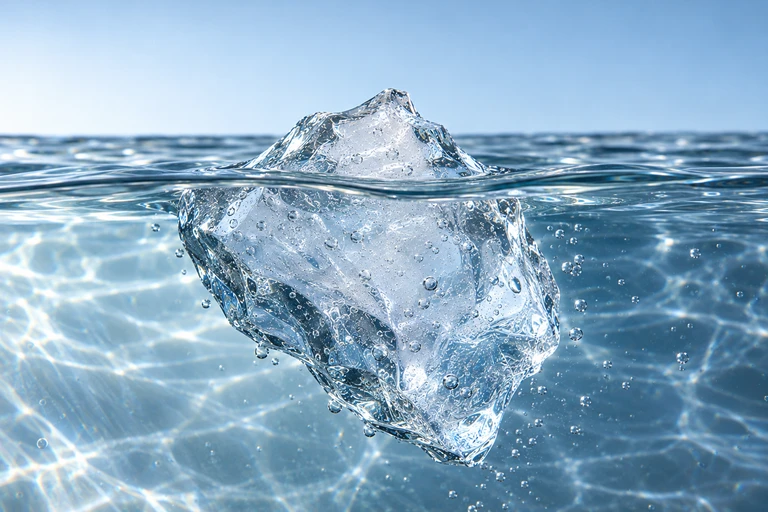 At an ice–water interface, melting changes molecular organization while preserving water molecules.
SECTION 6
Worked Example: Full Heating Curve Calculation
Calculate the total energy required to convert 36.0 g of ice at −15.0 °C to steam at 125.0 °C at 1 atm pressure. Use the following data: cice = 2.09 J/(g·°C), cwater = 4.18 J/(g·°C), csteam = 2.01 J/(g·°C), ΔHfus = 6.01 kJ/mol, ΔHvap = 40.7 kJ/mol, MH₂O = 18.02 g/mol.
Worked example
- 1
Step 1 — Find moles of water
n = m / M = 36.0 g ÷ 18.02 g/mol = 2.00 mol. This value will be needed for the phase-change calculations in Steps 3 and 5.n = 2.00 mol - 2
Step 2 — Heat ice from −15.0 °C to 0 °C
q₁ = m × cice × ΔT = 36.0 g × 2.09 J/(g·°C) × (0 − (−15.0)) °C = 36.0 × 2.09 × 15.0 = 1,129 J = 1.13 kJ.q₁ = 1.13 kJ - 3
Step 3 — Melt ice at 0 °C
q₂ = n × ΔHfus = 2.00 mol × 6.01 kJ/mol = 12.02 kJ. Temperature remains at 0 °C throughout this step.q₂ = 12.02 kJ - 4
Step 4 — Heat liquid water from 0 °C to 100 °C
q₃ = m × cwater × ΔT = 36.0 g × 4.18 J/(g·°C) × 100.0 °C = 15,048 J = 15.05 kJ.q₃ = 15.05 kJ - 5
Step 5 — Boil water at 100 °C
q₄ = n × ΔHvap = 2.00 mol × 40.7 kJ/mol = 81.4 kJ. This is by far the largest contribution—note that boiling requires nearly six times the energy of all other steps combined.q₄ = 81.4 kJ - 6
Step 6 — Heat steam from 100 °C to 125 °C
q₅ = m × csteam × ΔT = 36.0 g × 2.01 J/(g·°C) × 25.0 °C = 1,809 J = 1.81 kJ.q₅ = 1.81 kJ - 7
Step 7 — Sum all segments
qtotal = 1.13 + 12.02 + 15.05 + 81.4 + 1.81 = 111.4 kJ. To three significant figures, the total energy required is approximately 111 kJ.q_total ≈ 111 kJ
SECTION 7
Common Pitfalls & Exam Strategies
Students frequently lose points on AP Chemistry free-response questions involving phase changes due to a handful of recurring errors. Awareness of these pitfalls can make the difference between a 4 and a 5 on the exam. The table below contrasts correct reasoning with common mistakes.
| Common Mistake | Correct Approach | Why It Matters |
|---|---|---|
| Using q = mcΔT during a phase change | Use q = nΔH (or q = mΔH in g-based units) when temperature is constant | ΔT = 0 during a phase change, so q = mcΔT gives q = 0, which is incorrect |
| Mixing J and kJ in multi-step calculations | Convert all values to the same unit (typically kJ) before summing | A factor-of-1000 error will make the final answer wildly incorrect |
| Using mass (g) with molar ΔH (kJ/mol) | Convert mass to moles first: n = m/M, then q = nΔH | Dimensional analysis fails; answer has wrong magnitude |
| Forgetting to use the correct specific heat for each phase | Use c_ice for solid, c_water for liquid, c_steam for gas | Specific heats differ significantly; using c_water for ice gives ≈2× error |
| Ignoring sign conventions for exothermic processes | Freezing/condensation release heat: q < 0. Use −ΔH for reverse transitions | Sign errors affect calorimetry problems and Hess's law applications |
Common errors in phase change calculations and their corrections
Key takeaway
SECTION 8
Connections to Gibbs Free Energy & Phase Diagrams
The energetics of phase changes connect to deeper thermodynamic principles that extend beyond the AP Chemistry curriculum but are worth understanding conceptually. At a phase transition, the system is at equilibrium between two phases, which means ΔG = 0. Since ΔG = ΔH − TΔS, this condition gives us ΔH = TΔS at the transition temperature, or equivalently, Ttransition = ΔH/ΔS. This elegant relationship explains why each substance has a characteristic melting point and boiling point: these are the temperatures at which the enthalpy cost of disrupting intermolecular forces is exactly compensated by the entropy gain of increased molecular disorder.
| Concept | AP Chemistry Level | Advanced / College Level |
|---|---|---|
| Why do phase changes occur? | Energy input overcomes IMFs; energy output establishes IMFs | ΔG = 0 at the transition temperature; competing ΔH and TΔS terms drive spontaneity |
| Effect of pressure | Qualitative: higher pressure raises boiling point | Clausius-Clapeyron equation: ln(P₂/P₁) = (ΔH_vap/R)(1/T₁ − 1/T₂) |
| Phase diagrams | Identify regions (solid, liquid, gas), triple point, critical point | Phase boundaries derived from dP/dT = ΔS/ΔV (Clapeyron equation); supercritical fluids |
| Enthalpy calculations | q = nΔH and q = mcΔT for each segment | Temperature-dependent ΔH using Kirchhoff's equation: ΔH(T₂) = ΔH(T₁) + ∫Δ dT |
Phase change concepts at AP vs. advanced levels
For the AP exam, you are expected to perform multi-step heating curve calculations, interpret heating/cooling curves qualitatively, and connect the magnitude of phase-change enthalpies to the strength of intermolecular forces. The Clausius-Clapeyron equation and Gibbs free energy derivations are beyond the scope of the AP curriculum, but understanding the conceptual relationship between ΔH, ΔS, and the transition temperature provides valuable insight when answering qualitative free-response questions about why certain substances have higher or lower melting/boiling points.
SECTION 9
Practice Problems
Question 1: CONCEPTUAL
- A. The water molecules reach their maximum kinetic energy at 100 °C and cannot move faster.
- B. The heat being added is used entirely to overcome intermolecular forces rather than to increase the average kinetic energy of the molecules.
- C. The heat capacity of water becomes infinitely large at the boiling point, so temperature cannot change.
- D. Heat is being lost to the surroundings at exactly the same rate it is being supplied, so the net heat absorbed is zero.
Show answer (B)
Question 2: BASIC CALCULATION
- A. 6.01 kJ
- B. 12.0 kJ
- C. 30.0 kJ
- D. 541 kJ
Show answer (C)
Question 3: INTERMEDIATE
- A. Heating the liquid requires approximately 15.7 kJ; vaporizing requires approximately 113 kJ; total ≈ 129 kJ
- B. Heating the liquid requires approximately 113 kJ; vaporizing requires approximately 15.7 kJ; total ≈ 129 kJ
- C. Heating the liquid requires approximately 15.7 kJ; vaporizing requires approximately 40.7 kJ; total ≈ 56.4 kJ
- D. Heating the liquid requires approximately 15.7 kJ; vaporizing requires approximately 2,035 kJ; total ≈ 2,051 kJ
Show answer (A)
Question 4: APPLIED
5 ptsShow answer
Question 5: CRITICAL THINKING
5 ptsShow answer
 In an insulated mixture, 400 g of water at 60 °C can release 100.320 kJ before reaching 0 °C. Warming and melting 150 g of ice initially at −10 °C requires 53.235 kJ; the remaining energy warms 550 g of liquid to about 20.5 °C.
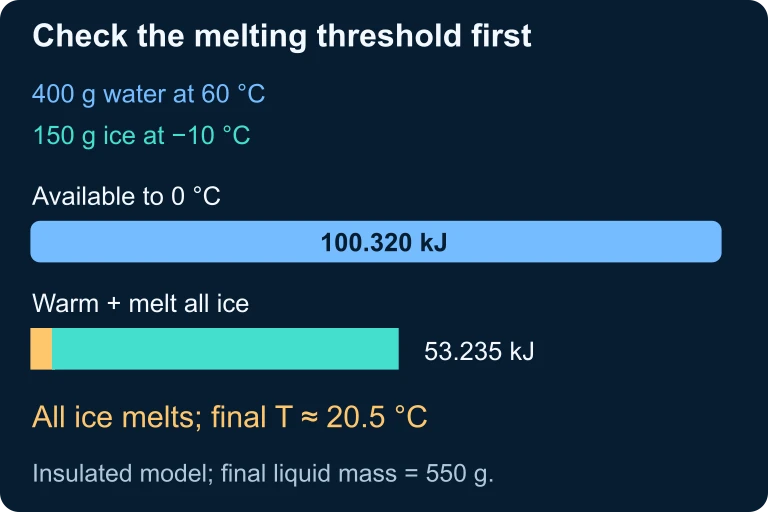 In an insulated mixture, 400 g of water at 60 °C can release 100.320 kJ before reaching 0 °C. Warming and melting 150 g of ice initially at −10 °C requires 53.235 kJ; the remaining energy warms 550 g of liquid to about 20.5 °C.
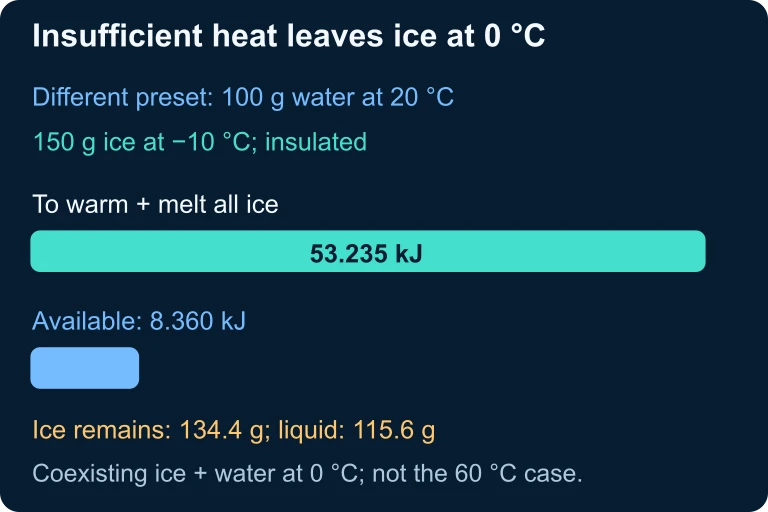 In a separate insulated mixture, 100 g of water at 20 °C cannot melt 150 g of ice initially at −10 °C. About 134.4 g of ice remains with 115.6 g of liquid at 0 °C.