
SECTION 1
Historical Context & Motivation
While galvanic cells convert chemical energy into electrical energy spontaneously, chemists in the early nineteenth century realized that the reverse process—forcing a non-spontaneous reaction to proceed by supplying electrical energy—could unlock extraordinary synthetic and industrial capabilities. Electrolysis, from the Greek elektron (amber) and lysis (loosening), became the foundational technique for decomposing compounds that no purely chemical reagent could break apart. The quest to understand the precise relationship between electricity and matter transformed both physics and chemistry, ultimately yielding a quantitative law that remains indispensable in modern electrochemistry.
1800 • The Voltaic Pile
1807 • Isolation of Alkali Metals
1834 • Faraday's Laws Published
1886 • Hall–Héroult Process
Modern • Industrial Electrochemistry Today
The central question that Faraday answered, and that we will explore in this lesson, is deceptively simple: exactly how much substance is produced when a known quantity of electric charge flows through an electrolytic cell? Answering this question requires connecting the macroscopic measurement of current and time to the microscopic transfer of electrons at each electrode, bridging electrical engineering and stoichiometry in a single elegant framework.
SECTION 2
Core Principles & Definitions
Before diving into calculations, it is essential to establish a clear conceptual vocabulary. Electrolysis is the process of using an external electrical power source to drive a non-spontaneous redox reaction (one with a positive ΔG or, equivalently, a negative E°cell). The electrolytic cell contains an electrolyte (a molten salt or aqueous solution containing mobile ions), two electrodes connected to the power source, and a circuit through which electrons travel. Unlike a galvanic cell, where the cell itself is the source of emf, in electrolysis the external power supply must overcome the thermodynamic voltage barrier and any kinetic overpotentials.
Electrolytic Cell
Cathode (Reduction)
Anode (Oxidation)
Faraday's Constant (F)
Coulombs of Charge (q)
KEY TAKEAWAY
SECTION 3
Visual Explanation — The Electrolytic Cell
The diagram above illustrates the essential architecture of an electrolytic cell. Notice that the sign conventions are opposite to those in a galvanic cell: here the anode is positive and the cathode is negative because the external power supply dictates the electron flow direction. The applied voltage must exceed the magnitude of E°cell (which is negative for a non-spontaneous reaction) plus any overpotential—additional voltage required to overcome kinetic barriers such as activation energy at the electrode surfaces and resistance in the solution. In the electrolyte, ionic migration completes the circuit: cations (positive ions) drift toward the cathode to accept electrons, while anions (negative ions) drift toward the anode to surrender electrons. This continuous flow of charge through both the external wire and the internal solution sustains the electrolysis process.
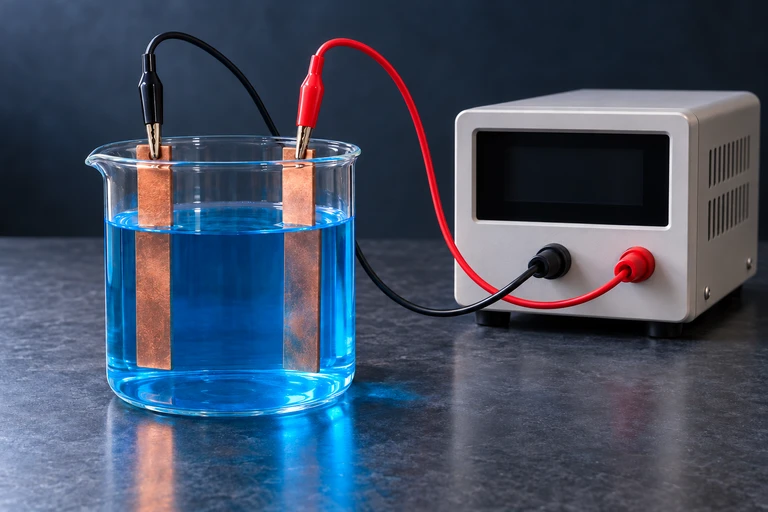 An external power supply drives electrode reactions in an electrolytic cell.
SECTION 4
Mathematical Framework — Faraday's Laws
Faraday's experimental observations led to two laws that, when expressed in modern notation, merge into a single quantitative relationship. Faraday's First Law states that the mass of substance deposited or dissolved at an electrode is directly proportional to the quantity of electric charge passed through the electrolyte. Faraday's Second Law states that for the same quantity of charge, the masses of different substances deposited are proportional to their equivalent weights (molar mass divided by the number of electrons transferred per formula unit). These two laws combine into one master equation that connects current, time, molar mass, electron stoichiometry, and Faraday's constant.
TOTAL CHARGE
q = total charge in coulombs (C); I = current in amperes (A); t = time in seconds (s). Since 1 A = 1 C/s, this is a straightforward dimensional identity.
MOLES OF ELECTRONS
n(e⁻) = moles of electrons transferred; F = Faraday's constant = 96,485 C/mol e⁻. Dividing total charge by F converts coulombs into moles of electrons.
FARADAY'S LAW (COMBINED)
m = mass deposited or dissolved (g); M = molar mass of the substance (g/mol); I = current (A); t = time (s); n = number of electrons transferred per formula unit in the balanced half-reaction; F = 96,485 C/mol e⁻.
Stoichiometric Bridge
VOLUME OF GAS PRODUCED
When electrolysis produces a gas (e.g., H₂ or O₂ from water electrolysis), first calculate moles of gas from Faraday's law, then use the ideal gas law to find volume. At STP (0 °C, 1 atm), one mole of ideal gas occupies 22.4 L.
SECTION 5
The Electrolysis Stoichiometry Roadmap
The roadmap above encapsulates the entire problem-solving strategy for any Faraday's law question. Each arrow represents a single conversion factor, making the process entirely analogous to the stoichiometric map you already use for mass-to-mass calculations in chemical equations. The key difference is that the "reagent" here is electric charge rather than a chemical substance. When confronted with an electrolysis problem on the AP exam, identify which box you start in (usually current and time) and which box you need to reach (usually mass or volume), then follow the arrows, applying the appropriate conversion at each step.
| Half-Reaction | n (mol e⁻ per mol product) | M (g/mol) |
|---|---|---|
| Cu²⁺ + 2e⁻ → Cu | 2 | 63.55 |
| Ag⁺ + e⁻ → Ag | 1 | 107.87 |
| Al³⁺ + 3e⁻ → Al | 3 | 26.98 |
| 2H⁺ + 2e⁻ → H₂ | 2 | 2.016 |
| 2Cl⁻ → Cl₂ + 2e⁻ | 2 | 70.90 |
Common electrolysis half-reactions with their electron stoichiometry and molar masses
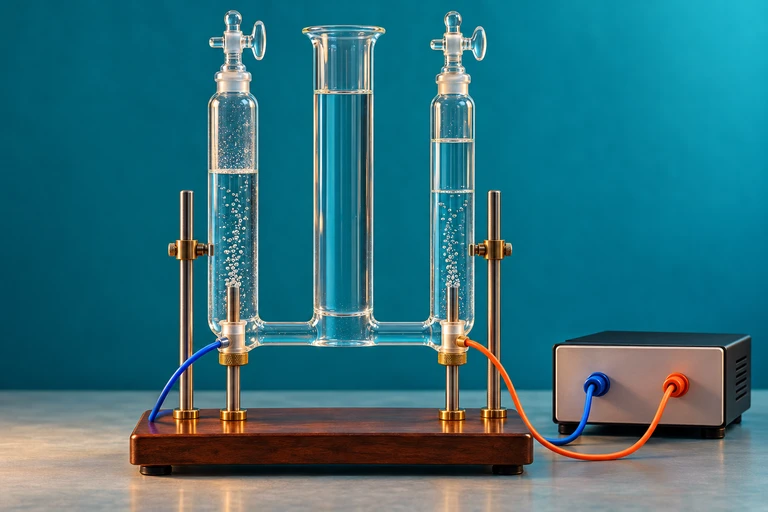 In dilute sulfuric acid with inert electrodes, the negative cathode produces hydrogen and the positive anode produces oxygen. Equal charge at both electrodes gives a 2:1 mole ratio; comparing dry-gas volumes requires matched temperature and pressure.
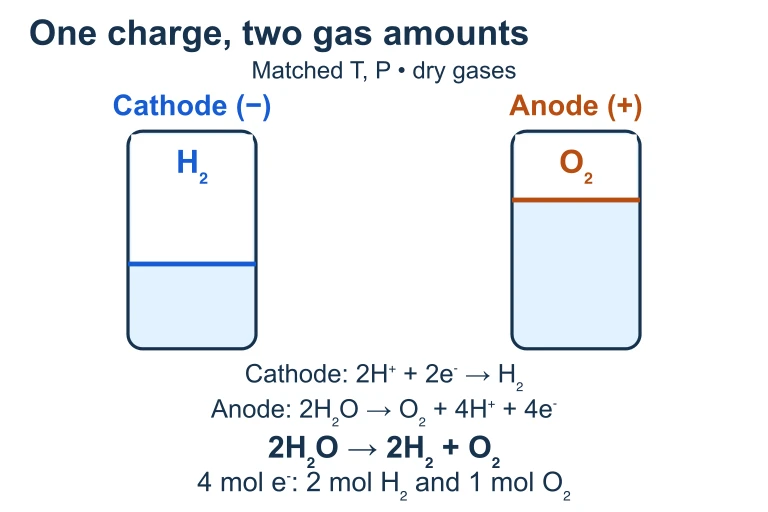 In dilute sulfuric acid with inert electrodes, the negative cathode produces hydrogen and the positive anode produces oxygen. Equal charge at both electrodes gives a 2:1 mole ratio; comparing dry-gas volumes requires matched temperature and pressure.
SECTION 6
Worked Example — Copper Electroplating
A copper electroplating bath uses a solution of CuSO₄(aq). A current of 2.50 A is passed through the cell for exactly 1.00 hour. Calculate the mass of copper deposited at the cathode.
Mass of Copper Deposited
- 1
Step 1 — Write the Cathode Half-Reaction
Copper(II) ions are reduced at the cathode: Cu²⁺(aq) + 2e⁻ → Cu(s). This tells us that n = 2 moles of electrons are required to deposit 1 mole of Cu.n = 2 mol e⁻ per mol Cu - 2
Step 2 — Calculate Total Charge
Convert the time to seconds: 1.00 hr × 3600 s/hr = 3600 s. Then apply q = I × t: q = 2.50 A × 3600 s = 9000 C.q = 9000 C - 3
Step 3 — Calculate Moles of Electrons
Divide total charge by Faraday's constant: n(e⁻) = 9000 C ÷ 96,485 C/mol = 0.09328 mol e⁻.n(e⁻) = 0.09328 mol - 4
Step 4 — Convert to Moles of Copper
From the half-reaction, 2 mol e⁻ deposit 1 mol Cu: mol Cu = 0.09328 mol e⁻ × (1 mol Cu / 2 mol e⁻) = 0.04664 mol Cu.mol Cu = 0.04664 mol - 5
Step 5 — Convert to Mass
Multiply by the molar mass of Cu (63.55 g/mol): m = 0.04664 mol × 63.55 g/mol = 2.96 g.m = 2.96 g Cu deposited
One-Line Formula Check
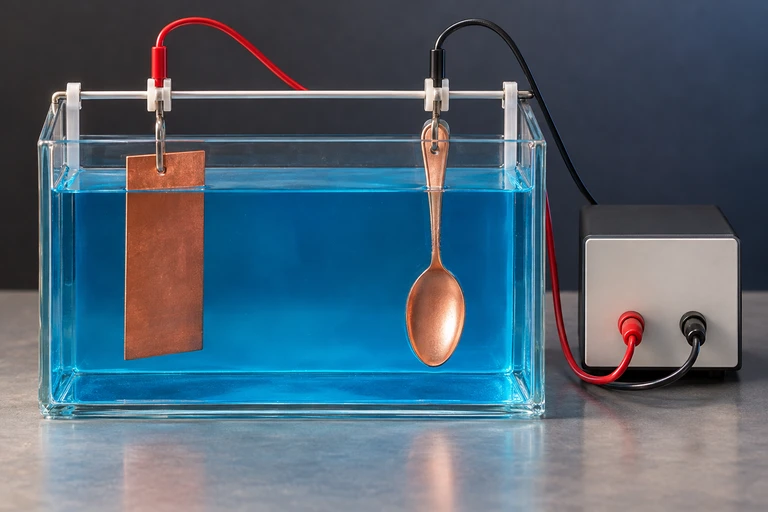 During copper electroplating, copper ions are reduced onto the object connected as the cathode.
SECTION 7
Galvanic vs. Electrolytic Cells — Key Comparisons
A recurring source of confusion on the AP exam is distinguishing between galvanic (voltaic) cells and electrolytic cells. Both rely on redox chemistry and both have an anode, a cathode, and an electrolyte. The differences lie in the thermodynamic spontaneity of the overall reaction and, consequently, in which component supplies the driving force for electron flow. The table below systematically contrasts the two cell types across every key parameter.
| Feature | Galvanic Cell | Electrolytic Cell |
|---|---|---|
| Spontaneity | Spontaneous (ΔG < 0) | Non-spontaneous (ΔG > 0) |
| E°(cell) | Positive | Negative (applied V must exceed |E°|) |
| Energy conversion | Chemical → Electrical | Electrical → Chemical |
| Anode sign | Negative (−) | Positive (+) |
| Cathode sign | Positive (+) | Negative (−) |
| Reaction at anode | Oxidation | Oxidation |
| Reaction at cathode | Reduction | Reduction |
| Salt bridge / separator | Required (separates half-cells) | Not required (single solution is common) |
Comparison of galvanic and electrolytic cells
KEY TAKEAWAY
SECTION 8
Industrial Applications & Beyond the AP Scope
Faraday's law is not merely an exam topic; it is the quantitative backbone of several multi-billion-dollar industries. Understanding how the simple relationship m = (MIt)/(nF) scales from the laboratory to industrial reactors provides valuable context and occasionally surfaces in AP free-response questions that reference real-world electrochemistry.
| AP-Level Concept | Advanced Extension |
|---|---|
| Faraday's law: m = (MIt)/(nF) | Current efficiency: in practice, not 100% of charge goes to the desired product; side reactions (e.g., H₂ evolution) reduce Faradaic efficiency |
| Applied voltage > |E°(cell)| | Overpotential (η): additional voltage needed to overcome activation barriers at each electrode, described by the Butler–Volmer equation in electrochemical kinetics |
| Water electrolysis: 2H₂O → 2H₂ + O₂ | Proton-exchange membrane (PEM) electrolyzers for green hydrogen production; thermodynamic minimum of 1.23 V plus large O₂ overpotential |
| Electroplating of metals (Cu, Ag, Au) | Pulse plating, nucleation theory, and surface roughness control in semiconductor and PCB manufacturing |
| Chlor-alkali process: 2NaCl(aq) → Cl₂ + 2NaOH + H₂ | Membrane cell technology using Nafion® ion-exchange membranes; energy consumption ≈ 2,200 kWh per tonne of NaOH |
How AP-level electrolysis concepts connect to advanced industrial and research applications
While the AP exam will not ask you to derive the Butler–Volmer equation or calculate Faradaic efficiency, it may present data in which the actual mass deposited is less than the theoretical prediction. In such cases, you should recognize that side reactions or less-than-100% current efficiency is the explanation. Additionally, qualitative questions about choosing between competing reduction reactions at the cathode—such as whether Cu²⁺ or H⁺ is reduced from an aqueous CuSO₄ solution—rely on comparing standard reduction potentials and recognizing that the species with the more positive (less negative) E° is preferentially reduced, assuming overpotentials are not dramatically different.
SECTION 9
Practice Problems
Question 1: CONCEPTUAL
- A. It is the positive electrode where oxidation occurs.
- B. It is the negative electrode where reduction occurs.
- C. It is the negative electrode where oxidation occurs.
- D. It is the positive electrode where reduction occurs.
Show answer (B)
Question 2: BASIC CALCULATION
- A. 1.15 g
- B. 2.30 g
- C. 4.60 g
- D. 0.575 g
Show answer (B)
Question 3: INTERMEDIATE
- A. 72.5%
- B. 84.5%
- C. 88.5%
- D. 95.2%
Show answer (C)
Question 4: APPLIED
5 ptsShow answer
Question 5: CRITICAL THINKING
4 ptsShow answer
SUMMARY
Lesson Summary
Summary
Electrolysis uses an external DC power source to drive non-spontaneous redox reactions. In the electrolytic cell, reduction occurs at the cathode (negative electrode) and oxidation occurs at the anode (positive electrode). Faraday's law quantifies the relationship between electric charge and the amount of substance transformed: m = (M × I × t) / (n × F), where M is molar mass, I is current, t is time, n is the number of electrons in the half-reaction, and F = 96,485 C/mol e⁻.
The problem-solving strategy follows a linear conversion path: current × time → charge → moles of electrons → moles of substance → mass or volume. Always begin by writing the balanced half-reaction to determine n. Remember that while the sign conventions for electrodes differ between galvanic and electrolytic cells, the anode is always oxidation and the cathode is always reduction. On the AP exam, expect questions requiring multi-step Faraday's law calculations, comparisons between cell types, and interpretation of experimental electrolysis data.