
SECTION 1
Historical Context & Motivation
One of the central questions in thermodynamics has always been deceptively simple: why do certain reactions happen spontaneously while others do not? By the mid-nineteenth century, scientists understood that heat flow alone could not explain chemical spontaneity—some endothermic reactions proceed on their own, and some exothermic reactions require constant driving. The concept of coupled reactions arose from the recognition that nature frequently links a thermodynamically unfavorable process with a favorable one, allowing the overall transformation to proceed spontaneously. This principle governs processes from industrial metallurgy to the biochemistry of every living cell, and it represents one of the most powerful applications of Gibbs free energy in all of chemistry.
1824 • Carnot and Heat Engines
1876 • Gibbs Free Energy Formulated
1897 • Thermite Process Patented
1929 • ATP Identified as Energy Currency
1941 • Lipmann's 'High-Energy Phosphate Bond'
The thread connecting Carnot's engines, Gibbs's thermodynamics, Goldschmidt's thermite, and Lipmann's ATP is a single powerful idea: reactions that cannot occur alone can be made to occur when they share a common intermediate with a reaction whose free energy change is sufficiently negative. Understanding how to add reactions together and sum their ΔG° values is an essential AP Chemistry skill, appearing in both free-response and multiple-choice questions on the exam.
SECTION 2
Core Principles & Definitions
At the heart of coupled reactions lies the state-function nature of Gibbs free energy. Because G is a state function, the free energy change for any overall process depends only on the initial and final states, not the path. This means we can algebraically combine two or more reactions—provided they share common species that cancel—and simply sum their ΔG° values to obtain the ΔG° of the net process. If the net ΔG° is negative, the coupled process is spontaneous under standard conditions, even if one of the constituent steps has a positive ΔG° on its own.
Gibbs Free Energy & Spontaneity
Hess's Law Applied to ΔG°
Common Intermediate
Thermodynamic Driving Force
KEY TAKEAWAY
SECTION 3
Visual Explanation — Energy Diagram of Coupled Reactions
The diagram above illustrates the essential logic of coupled reactions. Reaction 1, shown in violet on the left, is thermodynamically unfavorable on its own—its products sit at a higher Gibbs free energy than its reactants. Reaction 2, shown in amber at center, releases a large amount of free energy. When the two reactions share a common intermediate and are added together, their ΔG° values sum algebraically. Because the magnitude of the negative ΔG° from Reaction 2 exceeds the positive ΔG° from Reaction 1, the net free energy change is negative, and the coupled process proceeds spontaneously. This is the thermodynamic rationale behind every coupled reaction you will encounter on the AP exam.
SECTION 4
Mathematical Framework
The mathematical treatment of coupled reactions follows directly from the state-function properties of enthalpy, entropy, and Gibbs free energy. Because these are all state functions, Hess's law applies to each of them, and we can sum ΔH°, ΔS°, or ΔG° values for individual steps to obtain the corresponding value for the overall process. The key equations are presented below.
GIBBS FREE ENERGY OF REACTION
ΔG° = standard Gibbs free energy change (kJ/mol); ΔH° = standard enthalpy change (kJ/mol); T = absolute temperature (K); ΔS° = standard entropy change (kJ/(mol·K)). A negative ΔG° indicates a thermodynamically spontaneous process under standard conditions.
ADDITIVITY (HESS'S LAW FOR ΔG°)
When n reactions are added to give a net equation, their standard free energy changes sum algebraically. If any reaction is reversed, the sign of its ΔG° is inverted; if multiplied by a coefficient, ΔG° is scaled by the same factor.
SPONTANEITY CRITERION FOR COUPLING
The coupled process is spontaneous only if the magnitude of the negative ΔG° from the driving reaction exceeds the magnitude of the positive ΔG° from the driven reaction.
RELATIONSHIP TO EQUILIBRIUM CONSTANT
R = 8.314 J/(mol·K); T = temperature in kelvins; K = equilibrium constant. When two reactions are added, K_net = K₁ × K₂, consistent with ΔG° values being additive: −RT ln(K₁K₂) = −RT ln K₁ + (−RT ln K₂).
The relationship between ΔG° and K is particularly illuminating for coupled reactions. Consider that a reaction with ΔG° = +171 kJ at 298 K has K₁ ≈ 3.2 × 10⁻³⁰—essentially no product at equilibrium. A favorable reaction with ΔG° = −334 kJ has K₂ ≈ 2.3 × 10⁵⁸. When coupled, K_net = K₁ × K₂ ≈ 7.4 × 10²⁸, an overwhelmingly product-favored equilibrium. This multiplicative property of equilibrium constants is the equilibrium-constant equivalent of Hess's-law additivity for ΔG°.
SECTION 5
Applications & Classification of Coupled Reactions
Coupled reactions appear throughout both industrial chemistry and biochemistry. On the AP Chemistry exam, you are most likely to encounter inorganic examples involving metal oxide reduction or the decomposition of minerals, but awareness of biological coupling—particularly ATP hydrolysis—provides valuable context. The table below classifies the major categories of coupled reactions you should know.
| Category | Unfavorable Reaction (ΔG° > 0) | Driving Reaction (ΔG° < 0) | Net Result |
|---|---|---|---|
| Metal oxide reduction | Fe₂O₃ → 2 Fe + 3/2 O₂ (ΔG° = +742 kJ) | 2 Al + 3/2 O₂ → Al₂O₃ (ΔG° = −1582 kJ) | Fe₂O₃ + 2 Al → Al₂O₃ + 2 Fe; ΔG° = −840 kJ |
| Mineral decomposition | TiO₂ → Ti + O₂ (ΔG° = +889 kJ) | 2 C + O₂ → 2 CO (ΔG° ≈ −274 kJ × 2) | TiO₂ + 2 C → Ti + 2 CO at high T |
| Biological (ATP) | Glutamate + NH₃ → Glutamine + H₂O (ΔG° = +14 kJ) | ATP + H₂O → ADP + Pᵢ (ΔG° = −30.5 kJ) | Glutamate + NH₃ + ATP → Glutamine + ADP + Pᵢ; ΔG° = −16.5 kJ |
| Electrochemical | Reduction of an unfavorable half-reaction (E° < 0) | Oxidation of a strong reducing agent (E° > 0 for cell) | E°_cell > 0 ⟹ ΔG° < 0 |
Common categories of coupled reactions encountered in AP Chemistry
Notice in the diagram that 3/2 O₂ is produced in Step 1 and consumed in Step 2. This shared species is the common intermediate that enables coupling. When you add the two equations, the O₂ cancels algebraically, just as a variable cancels in a system of equations. The net equation shows only the species that actually change: Fe₂O₃ and Al are consumed, while Al₂O₃ and Fe are formed. On the AP exam, always verify that your common intermediate cancels completely—if it does not, you may need to multiply one or both reactions by appropriate coefficients before adding.
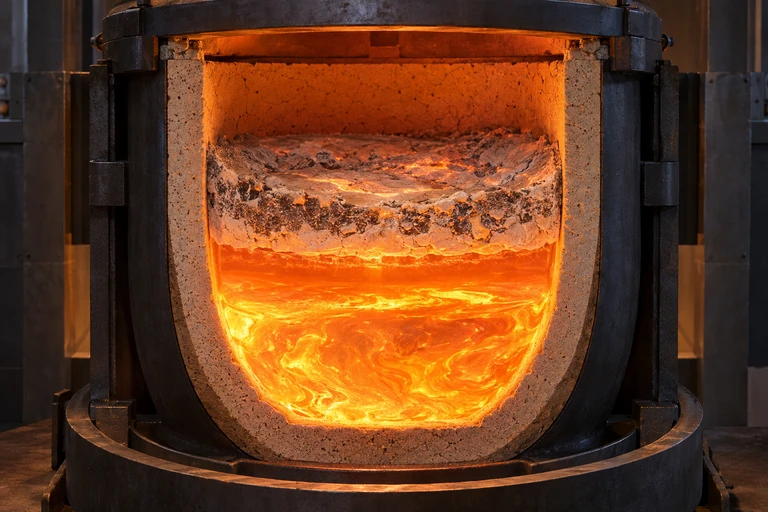 The thermite reaction produces iron and aluminum oxide while releasing enough heat to generate very hot products.
SECTION 6
Worked Example — Coupling the Extraction of Copper
Copper is extracted from its oxide ore by heating with carbon (coke). The overall process couples the non-spontaneous decomposition of Cu₂O with the exergonic oxidation of carbon. Let us work through this quantitatively.
Coupling Cu₂O Decomposition with Carbon Oxidation
- 1
Step 1 — Identify the Unfavorable Reaction
The target is to obtain metallic copper from its oxide. The decomposition reaction is Cu₂O(s) → 2 Cu(s) + ½ O₂(g), with ΔG° = +146 kJ. This reaction is non-spontaneous (ΔG° > 0) at standard conditions.Reaction 1: Cu₂O(s) → 2 Cu(s) + ½ O₂(g); ΔG°₁ = +146 kJ - 2
Step 2 — Identify the Driving Reaction
Carbon reacts readily with oxygen to form CO. The relevant reaction is C(s) + ½ O₂(g) → CO(g), with ΔG° = −137 kJ. The ½ O₂ produced in Step 1 is consumed here—this is the common intermediate.Reaction 2: C(s) + ½ O₂(g) → CO(g); ΔG°₂ = −137 kJ - 3
Step 3 — Verify the Common Intermediate Cancels
Reaction 1 produces ½ O₂ and Reaction 2 consumes ½ O₂. The stoichiometric coefficients match, so ½ O₂ cancels when the reactions are added. No coefficient adjustment is needed.Common intermediate ½ O₂ cancels ✓ - 4
Step 4 — Add Reactions and Sum ΔG° Values
Adding Reactions 1 and 2: Cu₂O(s) + C(s) → 2 Cu(s) + CO(g). The net standard free energy change is ΔG°_net = ΔG°₁ + ΔG°₂ = (+146) + (−137) = +9 kJ.ΔG°_net = +9 kJ at 298 K - 5
Step 5 — Interpret the Result
At 298 K, ΔG°_net is slightly positive (+9 kJ), meaning the coupled reaction is barely non-spontaneous under standard conditions. However, smelting occurs at elevated temperatures (> 1000 K). Because ΔS° for this reaction is positive (a gas is produced from solids), increasing T makes the −TΔS° term more negative, which decreases ΔG and eventually makes ΔG < 0. This illustrates why metallurgical coupling often requires high temperatures.At high T, ΔG < 0 and the smelting reaction becomes spontaneous
AP Exam Tip
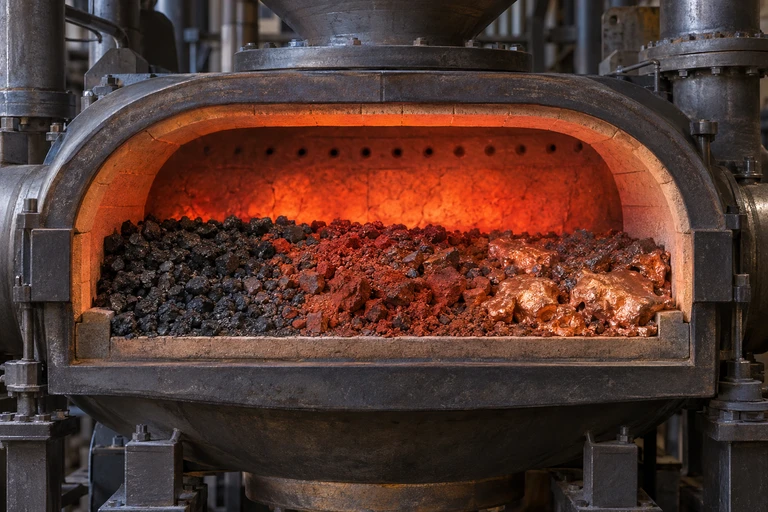 In a furnace, an oxide can be reduced through coupling to a reaction that removes oxygen and forms gaseous products.
SECTION 7
Strengths and Limitations of Coupled Reactions
Coupled reactions are among the most versatile tools in chemistry, but they carry both advantages and constraints that are important to understand. The table below summarizes the key strengths and limitations of the coupling approach.
| Strengths | Limitations |
|---|---|
| Enables reactions that are thermodynamically impossible in isolation to proceed when paired with sufficiently exergonic processes. | Thermodynamic feasibility (ΔG° < 0) does not guarantee a useful reaction rate; kinetic barriers may still require catalysts or elevated temperatures. |
| The Hess's law framework makes calculations straightforward: sum ΔG° values of individual steps to predict spontaneity of the net process. | A suitable common intermediate must exist; not every pair of reactions can be physically coupled in a single reaction vessel. |
| Applies universally—from metallurgy (thermite) to biochemistry (ATP-driven synthesis) to electrochemistry (galvanic cells). | Calculated ΔG° values apply only at standard conditions; non-standard concentrations, pressures, or temperatures require adjustment using ΔG = ΔG° + RT ln Q. |
| Temperature can be used as a lever: reactions with positive ΔS° become more favorable at higher T, broadening the scope of practical coupling. | Side reactions may consume the common intermediate, reducing yield and complicating the idealized thermodynamic picture. |
Strengths and limitations of using coupled reactions
KEY TAKEAWAY
SECTION 8
Connection to Electrochemistry and Advanced Topics
The logic of coupled reactions extends naturally into electrochemistry. In a galvanic (voltaic) cell, two half-reactions are physically separated into half-cells connected by a salt bridge. One half-reaction (the anode) is thermodynamically favorable as an oxidation, while the other (the cathode) is favorable as a reduction. Neither half-reaction can proceed independently without the electron-transfer circuit that connects them, so the overall cell reaction is, in essence, a coupled reaction in which electrons serve as the common intermediate. The standard cell potential E°_cell is positive when ΔG° is negative, via the relationship ΔG° = −nFE°_cell.
| Feature | Chemical Coupling (Hess's Law) | Electrochemical Coupling (Cell Reactions) |
|---|---|---|
| Common intermediate | A chemical species (e.g., O₂, H₂O) that cancels | Electrons transferred through an external circuit |
| Spontaneity criterion | ΔG°_net < 0 | E°_cell > 0 (equivalent to ΔG° < 0) |
| Additivity rule | ΔG° values add directly | E° values of half-reactions are NOT directly additive unless n is the same; ΔG° values must be summed instead |
| Key equation | ΔG°_net = ΣΔG°ᵢ | ΔG° = −nFE°_cell |
| Non-standard conditions | ΔG = ΔG° + RT ln Q | Nernst equation: E = E° − (RT/nF) ln Q |
Comparing chemical coupling (Hess's law approach) with electrochemical coupling
A critical nuance for the AP exam concerns the additivity of standard reduction potentials. Unlike ΔG°, standard electrode potentials are intensive properties—they do not scale with the stoichiometric coefficient. When combining two half-reactions with different numbers of electrons transferred, you cannot simply add their E° values. Instead, convert each to ΔG° using ΔG° = −nFE°, sum the ΔG° values, and then back-calculate E°_cell for the net reaction. Coupled-reaction problems that cross the boundary between thermochemistry and electrochemistry are among the most challenging—and most rewarding—on the exam.
Looking Ahead
SECTION 9
Practice Problems
Question 1: CONCEPTUAL
- A. The activation energy of the coupled process is lower than that of either individual reaction.
- B. Gibbs free energy is a state function, so the ΔG° values of the individual reactions sum to give a net ΔG° = −30 kJ, which is negative.
- C. The entropy of the universe always increases in a coupled reaction, regardless of the individual ΔG° values.
- D. The enthalpy change of the coupled process must be negative because the system releases heat.
Show answer (B)
Question 2: BASIC CALCULATION
- A. −455 kJ
- B. +455 kJ
- C. +181 kJ
- D. −181 kJ
Show answer (C)
Question 3: INTERMEDIATE
- A. The coupled reaction is spontaneous at 298 K with ΔG°_net = −74 kJ.
- B. The coupled reaction is non-spontaneous at 298 K with ΔG°_net = +74 kJ, but may become spontaneous at higher T because ΔS°_net > 0.
- C. The coupled reaction is non-spontaneous at all temperatures because ΔH°_net > 0.
- D. The coupled reaction is spontaneous at 298 K because the formation of Ca(OH)₂ releases enough energy to decompose CaCO₃.
Show answer (B)
Question 4: APPLIED
5 ptsShow answer
Question 5: CRITICAL THINKING
5 ptsShow answer
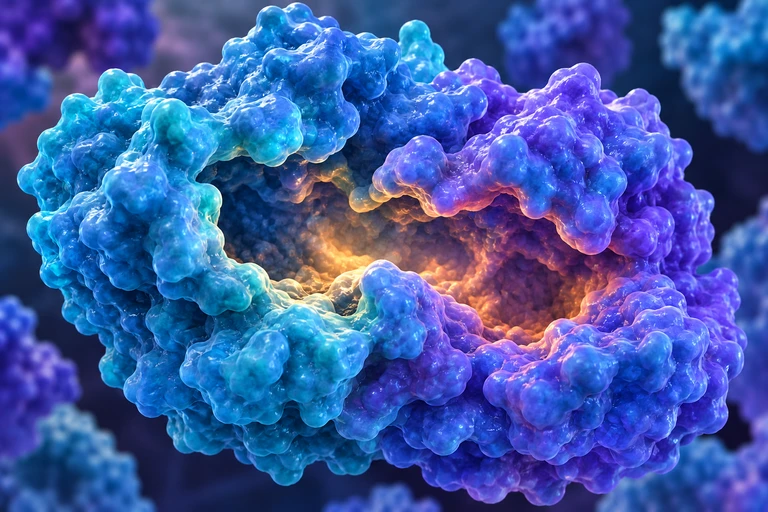 An enzyme links ATP-dependent phosphoryl transfer to glucose phosphorylation. Using +14.0 kJ/mol for glucose phosphorylation and −30.5 kJ/mol for ATP hydrolysis under the stated biochemical convention gives a net −16.5 kJ/mol.
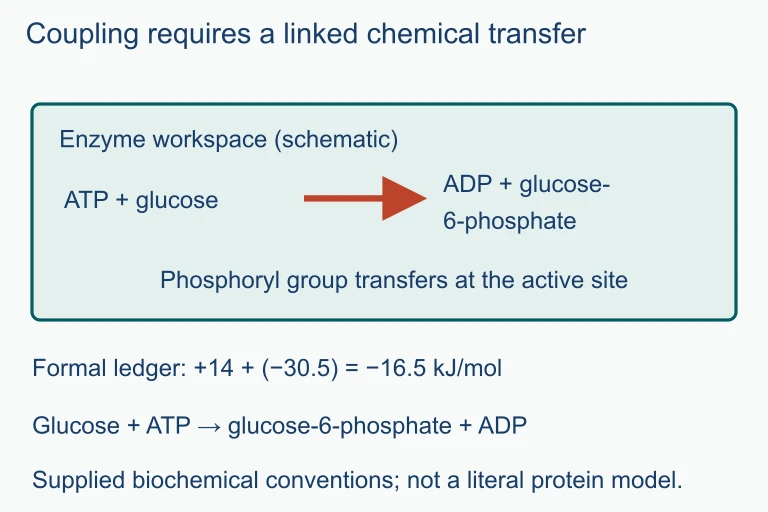 An enzyme links ATP-dependent phosphoryl transfer to glucose phosphorylation. Using +14.0 kJ/mol for glucose phosphorylation and −30.5 kJ/mol for ATP hydrolysis under the stated biochemical convention gives a net −16.5 kJ/mol.
SUMMARY
Summary — Coupled Reactions
Summary
Coupled reactions allow a thermodynamically non-spontaneous reaction (ΔG° > 0) to proceed by pairing it with a sufficiently exergonic reaction (ΔG° < 0) that shares a common intermediate. Because Gibbs free energy is a state function, Hess's law applies: the ΔG° values of the individual steps sum to give ΔG°_net. If ΔG°_net < 0, the coupled process is spontaneous under standard conditions.
Key applications include the thermite reaction (coupling Fe₂O₃ decomposition with Al oxidation), metallurgical smelting (coupling metal oxide decomposition with carbon oxidation at high temperature), and ATP-driven biosynthesis. In electrochemistry, electrons serve as the common intermediate connecting two half-reactions, and ΔG° = −nFE°_cell links coupling to cell potential. Remember that a negative ΔG° confirms thermodynamic feasibility but says nothing about reaction rate; kinetics and catalysis remain separate considerations.