AP Chemistry • Atomic Structure and Properties

Composition of Mixtures

Quantifying the elemental and molecular makeup of mixtures through mass percent, mole fraction, and molarity.

AP Chemistry illustration with a laboratory flask, atom, and microscope
Inside this lesson 10 sections 5 questions 9 figures

SECTION 1

Historical Context & Motivation

The ability to describe the exact composition of a mixture is one of the foundational skills in chemistry, yet the path to rigorous compositional analysis was neither quick nor straightforward. For centuries, alchemists and early chemists worked with impure substances, unable to distinguish between a compound and a mixture or to quantify how much of each component was present. The emergence of analytical chemistry in the eighteenth and nineteenth centuries transformed this situation, giving rise to systematic methods for measuring mass percent, mole fraction, and concentration—quantities that remain indispensable in modern laboratories and industrial processes.

1661 • Boyle's The Sceptical Chymist

Robert Boyle challenged Aristotelian elements and argued that matter should be defined by experimental composition, setting the stage for distinguishing pure substances from mixtures.

1789 • Lavoisier's Traité Élémentaire

Antoine Lavoisier introduced precise gravimetric methods and the law of conservation of mass, enabling chemists to determine mass percentages of elements in compounds and mixtures with quantitative rigor.

1811 • Avogadro's Hypothesis

Amedeo Avogadro proposed that equal volumes of gases at the same temperature and pressure contain equal numbers of molecules, providing the conceptual foundation for mole-based composition measures.

1887 • Arrhenius and Electrolyte Solutions

Svante Arrhenius described the dissociation of electrolytes in solution, deepening the understanding of how solute composition affects properties like conductivity and colligative behavior.

1960s • Modern Instrumental Analysis

Techniques such as mass spectrometry, gas chromatography, and atomic absorption spectroscopy enabled rapid, high-precision compositional analysis of complex mixtures.

Throughout these developments, a central question persisted: how do we express exactly how much of each substance is present in a given mixture? The answer depends on context—sometimes mass-based measures are most practical, other times mole-based or volume-based concentrations are preferred. The AP Chemistry curriculum expects you to convert fluently among these representations and to apply them in stoichiometric, colligative, and equilibrium calculations.

SECTION 2

Core Principles & Definitions

Before performing any composition calculation, you must internalize a few foundational distinctions. A pure substance has a fixed, definite composition at the atomic level—every sample of water is 11.19% hydrogen and 88.81% oxygen by mass. A mixture, on the other hand, combines two or more pure substances in variable proportions, meaning the composition must be explicitly specified for each sample. Mixtures may be homogeneous (uniform throughout, such as a NaCl solution) or heterogeneous (nonuniform, such as sand in water). For AP Chemistry, most composition problems involve homogeneous solutions.

1

Mass Percent (w/w%)

The ratio of the mass of a component to the total mass of the mixture, multiplied by 100. Temperature-independent and commonly reported on reagent bottle labels.
2

Mole Fraction (χ)

The ratio of the moles of one component to the total moles of all components. Dimensionless and particularly useful for Raoult's law and gas-phase equilibria.
3

Molarity (M)

Moles of solute per liter of solution. The most common concentration unit in aqueous chemistry; temperature-dependent because solution volume changes with temperature.
4

Molality (m)

Moles of solute per kilogram of solvent. Temperature-independent and preferred for colligative property calculations such as boiling-point elevation and freezing-point depression.
5

Parts per Million (ppm)

Milligrams of solute per liter (or per kilogram) of solution for dilute aqueous systems. Used for trace-level analysis such as water quality testing.
✦

KEY TAKEAWAY

Think of describing a mixture's composition like a recipe that can be written in different units. You could say a dough uses '200 g flour and 100 g water' (mass percent), or '3 cups flour to 0.5 cups water' (volume-based), or '3.5 mol flour per mol water' (mole fraction). Each representation encodes the same reality; the skill lies in converting fluently between them depending on the calculation you need to perform.

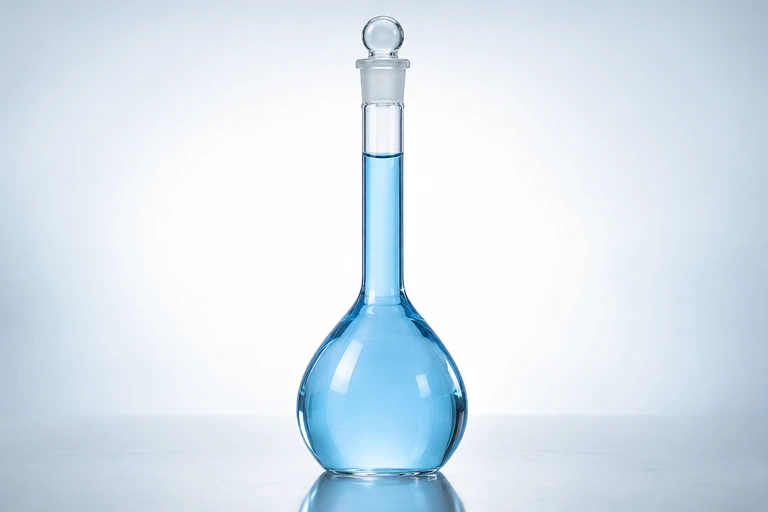
One volumetric flask at final dilutionA volumetric flask is filled to its calibration mark to establish the final solution volume.

SECTION 3

Visualizing Mixture Composition

The diagram below illustrates a solution of sodium chloride dissolved in water, depicting the relationship between the macroscopic quantities you measure in the lab (mass, volume) and the particulate-level reality (individual ions and molecules). Understanding this connection is essential: composition measures like molarity and mass percent bridge the gap between the submicroscopic and macroscopic scales. Notice how the mole concept serves as the translator between counting particles and weighing them on a balance.

Macroscopic ↔ Particulate View of a NaCl SolutionMACROSCOPICSolutionV = 1.000 Lm_total = 1023.4 gm_NaCl = 29.22 gm_H₂O = 994.2 gmass % = (29.22/1023.4)×100= 2.856%n_NaCl = 0.500 molMolarity = 0.500 Mn_H₂O = 55.18 molχ_NaCl = 0.00898PARTICULATENa⁺Cl⁻Na⁺Cl⁻Cl⁻Na⁺Na⁺Cl⁻H₂Omole concept
The left panel shows macroscopic lab measurements—total mass, component masses, and derived quantities (mass percent, molarity, mole fraction). The right panel depicts the corresponding particulate view where Na+ and Cl− ions are dispersed among H₂O molecules. The mole concept links these two representations.

In the particulate panel, the ratio of solute ions to solvent molecules is deliberately exaggerated for visual clarity. In reality, a 0.500 M NaCl solution has roughly 110 water molecules for every NaCl formula unit. This enormous excess of solvent is precisely why the mole fraction of a typical solute is very small even when the molarity seems appreciable. Developing intuition for the relative magnitudes of different composition measures prevents common errors in problems that require conversions between mass percent, mole fraction, and molarity.
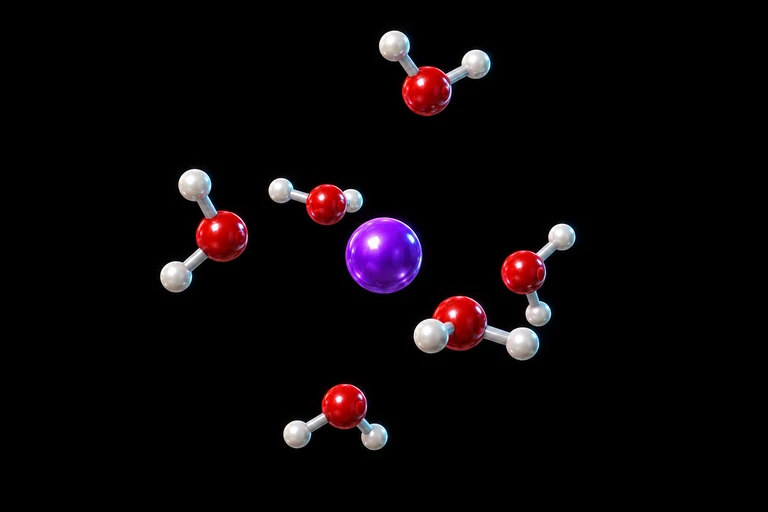
Water orientation around one sodium ionWater molecules orient their partially negative oxygen atoms toward a sodium ion.

SECTION 4

Mathematical Framework

Every composition measure is fundamentally a ratio: an amount of one component divided by a reference amount. The differences among them lie in what quantity sits in the numerator (mass or moles of component) and what quantity sits in the denominator (total mass, total moles, or volume of solution). Mastering the equations below and the conversions between them is essential for the AP Chemistry exam.

MASS PERCENT

massmass % = (mass of component / mass of mixture) × 100

Mass of component and mass of mixture must be in the same units (typically grams). Mass percent is dimensionless and temperature-independent.

MOLE FRACTION

χA=nA/(nA+nB+nC+…)=nA/ntotalχ_A = n_A / (n_A + n_B + n_C + …) = n_A / n_total

χA is the mole fraction of component A; nA is the moles of A. The sum of all mole fractions in a mixture equals exactly 1. This quantity is dimensionless and temperature-independent.

MOLARITY

M=nsolute/Vsolution(mol/L)M = n_solute / V_solution (mol / L)

Vsolution is the volume of the entire solution (not just the solvent) in liters. Because volume changes with temperature, molarity is temperature-dependent.

MOLALITY

m=nsolute/msolvent(mol/kg)m = n_solute / m_solvent (mol / kg)

msolvent is the mass of the solvent in kilograms (not the total solution mass). Molality is temperature-independent and used extensively in colligative property calculations.

💡

CONVERSION STRATEGY

When converting between composition units, always start with a convenient basis—typically 1 L of solution for molarity-based problems or 100 g of solution for mass-percent problems. Convert masses to moles using molar masses, then assemble the desired ratio. This 'assume-a-basis' technique eliminates the need for simultaneous equations in most AP-level problems.

SECTION 5

Interconverting Composition Measures

AP Chemistry problems frequently require you to convert from one concentration unit to another. The flowchart below maps the key pathways. Notice that every conversion passes through the mole as an intermediary—moles are the universal currency of chemistry. The density of the solution is often the critical piece of data that links mass-based and volume-based measures, so always look for density information when a conversion between mass percent and molarity is requested.

Concentration Conversion FlowchartMOLES (n)Mass Percent (%)Molarity (M)Mole Fraction (χ)Molality (m)ppm / ppb÷ molar mass÷ V (L)÷ n_total÷ kg solventdensityn_total× 10⁶ (dilute)Dashed lines require solution density or other auxiliary data.
All interconversions pass through moles as the central node. Solid arrows represent straightforward divisions or multiplications, while dashed arrows indicate that additional data (typically solution density) is required.
ConversionData NeededKey Step
mass % → molaritydensity of solution, molar mass of soluteAssume 100 g of solution; convert component mass to moles; convert total mass to volume using density.
molarity → mole fractiondensity of solution, molar mass of solute and solventAssume 1 L of solution; compute mass of solution from density; subtract solute mass to get solvent mass; convert solvent mass to moles.
mass % → molalitymolar mass of soluteAssume 100 g of solution; solvent mass = 100 − solute mass (in g); convert solute mass to moles; divide by solvent mass in kg.
molarity → molalitydensity of solution, molar mass of soluteAssume 1 L; total mass = density × 1000 mL; solvent mass = total − solute mass; divide moles solute by kg solvent.

Common composition conversions and the auxiliary data required for each.

SECTION 6

Worked Example: Converting Mass Percent to Molarity

A common exam scenario provides a mass percent and solution density and asks for molarity. The worked example below walks through this conversion for a sulfuric acid solution, illustrating the 'assume-a-basis' strategy described earlier.

What is the molarity of a 36.0% H₂SO₄ solution with a density of 1.27 g/mL?

  1. 1

    Step 1 — Choose a convenient basis

    Assume you have exactly 100.0 g of solution. In a 36.0% solution, this means 36.0 g of H₂SO₄ and 64.0 g of H₂O.
  2. 2

    Step 2 — Convert mass of solute to moles

    Molar mass of H₂SO₄ = 2(1.008) + 32.07 + 4(16.00) = 98.09 g/mol. Therefore n = 36.0 g ÷ 98.09 g/mol = 0.367 mol.
    nH₂SO₄ = 0.367 mol
  3. 3

    Step 3 — Convert mass of solution to volume

    V = mass / density = 100.0 g ÷ 1.27 g/mL = 78.7 mL = 0.0787 L.
    V = 0.0787 L
  4. 4

    Step 4 — Calculate molarity

    M = n / V = 0.367 mol ÷ 0.0787 L = 4.66 M. Always report to three significant figures when the given data supports it.
    Molarity = 4.66 M
⚠

COMMON MISTAKE

Do not confuse the mass of the solvent with the mass of the solution. Mass percent uses the total solution mass in the denominator, whereas molality uses only the solvent mass. Mixing these up is one of the most frequent errors on AP Chemistry free-response questions.

SECTION 7

Comparing Concentration Units

Each concentration unit has specific advantages and limitations that make it more or less suitable for particular applications. The table below summarizes these trade-offs. On the AP exam, choosing the right unit for a given calculation—without being told which to use—can be the difference between a correct and incorrect approach.

UnitStrengthsLimitations
Mass %Temperature-independent; easy to measure with a balance; directly relates to laboratory preparation.Not directly usable in stoichiometric calculations without converting to moles first.
Mole fraction (χ)Dimensionless; used in Raoult's law, Dalton's law, and thermodynamic expressions; temperature-independent.Requires molar masses of all components; values for solutes are often very small, making them less intuitive.
Molarity (M)Easiest for stoichiometric calculations in solution (n = M × V); standard unit for reaction equilibria.Temperature-dependent (volume changes with T); requires volumetric glassware to prepare accurately.
Molality (m)Temperature-independent; ideal for colligative property calculations (ΔTbT_b, ΔTfT_f, π).Less convenient for volumetric laboratory work; less commonly encountered in equilibrium expressions.
ppmConvenient for trace concentrations; used in environmental chemistry and pharmacology.Only intuitive for very dilute solutions; definition can vary (mg/L vs. mg/kg).

Strengths and limitations of common concentration measures.

✦

KEY TAKEAWAY

Think of concentration units like different map projections: each distorts reality in a different way but is optimized for a specific task. Mercator projections preserve angles (useful for navigation), just as molarity preserves the stoichiometric convenience of n = M × V. Peters projections preserve area (useful for comparing countries), just as mole fraction preserves the thermodynamic simplicity of partial pressure = χ × P_total. No single unit is universally best.

SECTION 8

Connections to Advanced Topics

The composition of mixtures is not an isolated skill—it underpins virtually every quantitative topic in AP Chemistry. When you reach colligative properties, you will need molality and the van 't Hoff factor to predict boiling-point elevation and freezing-point depression. In chemical equilibrium, equilibrium constants are expressed in molarity (KcK_c) or partial pressure (KpK_p, which relates to mole fraction via Dalton's law). For solution stoichiometry, the relationship n = M × V is the workhorse equation for titration calculations. The concept extends further into thermodynamics, electrochemistry, and kinetics, where solution concentrations appear in rate laws and the Nernst equation.

AP TopicComposition Unit UsedKey Equation
Stoichiometry in solutionMolarity (M)n = M × V; used in dilution (M₁V₁ = M₂V₂) and titrations
Gas-phase equilibriaMole fraction (χ)PAP_A = χ_A × P_total (Dalton's law)
Colligative propertiesMolality (m)ΔTbT_b = i × KbK_b × m
Vapor pressure loweringMole fraction (χ)P_solution = χ_solvent × P°_solvent (Raoult's law)
Kinetics (rate laws)Molarity (M)rate = k[A]^m[B]^n

How composition measures feed into major AP Chemistry topics.

Looking ahead, university-level physical chemistry extends mole fraction into the concept of chemical activity, which corrects for non-ideal behavior in concentrated solutions. The activity coefficient γ multiplies the mole fraction (or molality) so that thermodynamic equations remain valid even when intermolecular forces cause deviations from ideal mixing. Understanding composition at the AP level provides the scaffolding for this more nuanced treatment.

SECTION 9

Practice Problems

Question 1: CONCEPTUAL

A student prepares two NaCl solutions. Solution A has a molarity of 1.00 M, and Solution B has a molality of 1.00 m. Both solutions are at 25 °C and use the same solute. Which of the following statements is correct?
  • A. Solutions A and B contain identical amounts of NaCl per unit mass of water.
  • B. The mole fraction of NaCl is necessarily higher in Solution A than in Solution B.
  • C. The molarity of Solution B depends on the density of the solution, whereas the molality of Solution A does not.
  • D. If both solutions are heated, the molality of Solution A will decrease while the molarity of Solution B remains constant.
Show answer (C)
C is correct. Molality is defined as moles of solute per kilogram of solvent, which is independent of volume and temperature. To express the concentration of Solution B in molarity, you would need its density to convert mass to volume. A is incorrect because 1.00 M means 1 mol NaCl per liter of solution (not per kg of water), while 1.00 m means 1 mol NaCl per kg of water—these are different reference quantities. B is incorrect because the mole fraction depends on the total moles in each solution, and without density data we cannot determine which is larger. D reverses the temperature dependence: molarity (Solution A) changes with temperature because volume expands, while molality (Solution B) remains constant.

Question 2: BASIC CALCULATION

A solution is prepared by dissolving 12.0 g of NaOH (molar mass = 40.00 g/mol) in enough water to produce 500.0 mL of solution. What is the molarity of the solution?
  • A. 0.240 M
  • B. 0.300 M
  • C. 0.600 M
  • D. 24.0 M
Show answer (C)
C is correct. First, convert mass to moles: 12.0 g ÷ 40.00 g/mol = 0.300 mol NaOH. Then convert volume to liters: 500.0 mL = 0.5000 L. Molarity = 0.300 mol ÷ 0.5000 L = 0.600 M. A (0.240 M) results from incorrectly using 1250 mL or a similar arithmetic error. B (0.300 M) is the number of moles, not the molarity—this error arises from forgetting to divide by the volume. D (24.0 M) would result from dividing grams by liters without first converting to moles, yielding g/L instead of mol/L.

Question 3: INTERMEDIATE

An aqueous solution of ethanol (C₂H₅OH, molar mass = 46.07 g/mol) is 20.0% ethanol by mass and has a density of 0.969 g/mL. What is the mole fraction of ethanol in this solution?
  • A. 0.0891
  • B. 0.200
  • C. 0.108
  • D. 0.0434
Show answer (A)
A is correct. Assume 100.0 g of solution: 20.0 g ethanol and 80.0 g water. Moles of ethanol = 20.0 g ÷ 46.07 g/mol = 0.4341 mol. Moles of water = 80.0 g ÷ 18.02 g/mol = 4.439 mol. Total moles = 0.4341 + 4.439 = 4.873 mol. Mole fraction of ethanol = 0.4341 / 4.873 = 0.0891. B (0.200) is the mass fraction expressed as a decimal, not the mole fraction—this error conflates mass ratio with mole ratio. C (0.108) could result from dividing moles of ethanol by moles of water only (0.4341/4.439) rather than by total moles. D (0.0434) could result from using an incorrect molar mass for ethanol or water. Note that the density is extraneous information for this calculation since mole fraction depends only on masses and molar masses, not volume.

Question 4: APPLIED

5 pts
A commercial hydrochloric acid solution is labeled as 37.0% HCl by mass and has a density of 1.19 g/mL. (Molar mass of HCl = 36.46 g/mol; molar mass of H₂O = 18.02 g/mol.) (a) Calculate the molarity of this solution. (b) Calculate the molality of this solution. (c) Calculate the mole fraction of HCl. (d) A chemist needs 250.0 mL of 2.00 M HCl. Calculate the volume of the concentrated acid required. (e) Explain why the molarity and molality of this solution differ significantly in numerical value.
Show answer
Rubric (5 points): Part (a) — 1 point: Assume 100.0 g of solution: 37.0 g HCl and 63.0 g H₂O. Moles HCl = 37.0 / 36.46 = 1.015 mol. Volume = 100.0 g / 1.19 g/mL = 84.03 mL = 0.08403 L. Molarity = 1.015 / 0.08403 = 12.1 M. Award 1 point for correct molarity with supporting work. Part (b) — 1 point: Molality = moles HCl / kg solvent = 1.015 mol / 0.0630 kg = 16.1 m. Award 1 point for correct molality. Part (c) — 1 point: Moles H₂O = 63.0 / 18.02 = 3.496 mol. Total moles = 1.015 + 3.496 = 4.511 mol. χ_HCl = 1.015 / 4.511 = 0.225. Award 1 point for correct mole fraction. Part (d) — 1 point: M₁V₁ = M₂V₂ → 12.1 × V₁ = 2.00 × 0.2500 → V₁ = 0.500 / 12.1 = 0.0413 L = 41.3 mL. Award 1 point for correct volume. Part (e) — 1 point: Molarity uses volume of the entire solution in the denominator, while molality uses only the mass of solvent. In a concentrated solution like 37% HCl, the solute constitutes a large fraction of the total mass, so the mass of solvent (63.0 g) is substantially less than the total solution mass (100.0 g). Since the denominators differ, the numerical values diverge. In dilute solutions the values would converge because the solution is mostly solvent. Award 1 point for a correct explanation that identifies the different denominators and the effect of high solute concentration.

Question 5: CRITICAL THINKING

5 pts
A student prepares four aqueous glucose (C₆H₁₂O₆, molar mass = 180.16 g/mol) solutions and records the following data: | Solution | Mass of glucose (g) | Mass of water (g) | Solution volume (mL) | Density (g/mL) | |----------|--------------------|--------------------|---------------------|----------------| | I | 9.01 | 241.0 | 248.5 | 1.006 | | II | 18.02 | 232.0 | 247.3 | 1.012 | | III | 36.03 | 214.0 | 244.8 | 1.022 | | IV | 54.05 | 196.0 | 242.4 | 1.032 | (a) Calculate the molarity and molality of Solution III. (b) For Solutions I through IV, the molality and molarity have increasingly different numerical values. Explain this trend using the data. (c) A fifth solution (Solution V) is prepared with 90.08 g of glucose in 160.0 g of water. Predict whether the mass percent of glucose in Solution V is greater than, less than, or equal to 30%. Justify your prediction with a calculation. (d) The student claims that the mole fraction of glucose in Solution II equals 0.00777. Evaluate this claim.
Show answer
Rubric (5 points): Part (a) — 1 point: Moles glucose in III = 36.03 / 180.16 = 0.2000 mol. Molarity = 0.2000 mol / 0.2448 L = 0.817 M. Molality = 0.2000 mol / 0.2140 kg = 0.935 m. Award 1 point for both correct values with work shown. Part (b) — 2 points: Award 1 point for identifying that molarity divides by solution volume while molality divides by solvent mass. Award 1 point for explaining that as more glucose is added, the volume of solution increases more slowly than the decrease in solvent mass (because glucose has a higher density than water and occupies relatively little extra volume), causing the denominators in the molarity and molality expressions to diverge. As the solution becomes more concentrated, the solute mass becomes a larger fraction of the total, so the solvent mass (denominator for molality) shrinks relative to the solution volume (denominator for molarity), and the two values diverge. Part (c) — 1 point: Mass percent = 90.08 / (90.08 + 160.0) × 100 = 90.08 / 250.08 × 100 = 36.0%. This is greater than 30%. Award 1 point for a correct calculation and correct comparison. Part (d) — 1 point: Moles glucose in II = 18.02 / 180.16 = 0.1000 mol. Moles water = 232.0 / 18.02 = 12.875 mol. Total moles = 0.1000 + 12.875 = 12.975 mol. χ_glucose = 0.1000 / 12.975 = 0.007710 ≈ 0.00771. The student's claim of 0.00777 is slightly too high, possibly due to a rounding error in the moles of water (e.g., using 18.00 instead of 18.02 g/mol). Award 1 point for computing the correct mole fraction and identifying the claim as slightly inaccurate with a plausible explanation for the discrepancy.

SUMMARY

Lesson Summary

Summary

The composition of a mixture can be expressed using several complementary measures. Mass percent relates the mass of a component to the total mass of the mixture. Mole fraction expresses the ratio of moles of one component to total moles, making it essential for Raoult's law and Dalton's law. Molarity (mol/L) is the workhorse unit for stoichiometric calculations in solution, while molality (mol/kg solvent) is temperature-independent and preferred for colligative property calculations.

All interconversions between these units pass through the mole as the central quantity. The 'assume-a-basis' strategy—choosing 100 g of solution for mass percent problems or 1 L of solution for molarity problems—simplifies conversions enormously. Remember that converting between mass-based and volume-based units requires solution density as an essential bridge. Mastering these conversions equips you for nearly every quantitative problem in AP Chemistry.

Varsity Tutors • AP Chemistry • Composition of Mixtures