
AP Chemistry • Kinetics

Catalysts

How substances accelerate reactions by lowering activation energy without being consumed in the process.

AP Chemistry illustration with a laboratory flask, atom, and microscope
Inside this lesson 10 sections 5 questions 8 figures

SECTION 1

Historical Context & Motivation

Long before chemists understood reaction mechanisms, they observed a puzzling phenomenon: certain substances dramatically accelerated chemical reactions yet remained unchanged at the end of the process. These observations defied the prevailing stoichiometric worldview, in which every reactant was expected to be consumed in proportion to the products formed. The concept of catalysis emerged precisely to account for this gap—substances that participate in reactions mechanistically but are regenerated by the final step, making them available to facilitate the transformation of additional reactant molecules.

1812 • Kirchhoff's Starch Hydrolysis

Gottlieb Kirchhoff demonstrated that dilute sulfuric acid converts starch into glucose without itself being consumed, providing one of the earliest documented examples of catalytic action in organic chemistry.

1835 • Berzelius Coins 'Catalysis'

Jöns Jacob Berzelius introduced the term 'catalysis' from the Greek kata (down) and lyein (loosen), proposing that certain substances possess a 'catalytic force' that triggers chemical change without being altered themselves.

1909 • Haber–Bosch Process

Fritz Haber demonstrated that an iron catalyst enables the synthesis of ammonia from N₂ and H₂ at practical rates—a breakthrough later scaled industrially by Carl Bosch. This single catalytic process now sustains roughly half of global food production through fertilizer manufacture.

1926 • Enzyme Crystallization

James Sumner crystallized urease, proving that enzymes are proteins. This milestone established the molecular basis of biological catalysis and earned Sumner the 1946 Nobel Prize in Chemistry.

1970s • Catalytic Converters in Automobiles

Platinum-group metal catalysts were deployed in automotive exhaust systems, converting toxic CO, NOₓ, and unburned hydrocarbons into CO₂, N₂, and H₂O—demonstrating how heterogeneous catalysis can address environmental challenges at scale.

The central question driving the study of catalysis is deceptively simple: how can a substance speed up a reaction without being consumed? Answering this question requires a kinetic and thermodynamic framework that distinguishes between the rate of a reaction (a kinetic property) and the thermodynamic favorability of a reaction—an essential distinction that pervades the AP Chemistry curriculum.

SECTION 2

Core Principles & Definitions

A catalyst is a substance that increases the rate of a chemical reaction by providing an alternative reaction pathway with a lower activation energy (Ea). Crucially, a catalyst is not consumed in the overall reaction; it appears in the mechanism as an intermediate participant but is regenerated before the final products form. The catalyst does not alter the equilibrium position of a reversible reaction—it accelerates both the forward and reverse reactions equally, allowing the system to reach equilibrium faster without changing the value of the equilibrium constant K.

1

Lower Activation Energy

A catalyst provides a new mechanistic pathway whose highest-energy transition state is lower than that of the uncatalyzed path. This means a greater fraction of molecular collisions possess sufficient energy to react, according to the Boltzmann distribution.
2

Not Consumed Overall

Although the catalyst may be consumed in an early elementary step, it is regenerated in a subsequent step. Its net stoichiometric coefficient in the balanced overall equation is zero, distinguishing it from a traditional reactant.
3

No Effect on Thermodynamics

Catalysts do not change ΔG, ΔH, or ΔS for the overall reaction. They do not shift equilibrium position—they only affect how quickly equilibrium is reached. The equilibrium constant K remains unchanged.
4

Homogeneous vs. Heterogeneous

A homogeneous catalyst exists in the same phase as the reactants (e.g., an acid catalyst in an aqueous solution). A heterogeneous catalyst is in a different phase, typically a solid catalyst with gaseous or liquid reactants adsorbing onto its surface.
5

Enzymes as Biological Catalysts

Enzymes are protein-based catalysts of extraordinary specificity. They bind substrates at active sites, stabilizing the transition state through complementary electrostatic, hydrogen-bonding, and van der Waals interactions, often accelerating reactions by factors of 10⁶ to 10¹².
✦

KEY TAKEAWAY

Think of a catalyst as a tunnel through a mountain rather than a road over the summit. Both paths connect the same starting and ending points (same ΔG), but the tunnel route requires far less climbing (lower Ea). The mountain itself is unchanged—it doesn't become smaller—and the tunnel doesn't move your destination closer; it simply lets you get there faster.

SECTION 3

Energy Diagram: Catalyzed vs. Uncatalyzed Pathways

Reaction Energy Diagram: Catalyzed vs. UncatalyzedPotential EnergyReaction ProgressUncatalyzed EₐCatalyzed EₐEₐ (uncat.)Eₐ (cat.)ΔH (same)ReactantsProductsUncatalyzed pathCatalyzed pathΔH unchanged by catalyst
The violet curve represents the uncatalyzed pathway with a large activation energy barrier. The cyan curve shows the catalyzed pathway, which reaches a lower transition state (sometimes through two smaller humps representing a two-step mechanism). Notice that both pathways share the same reactant and product energy levels: ΔH is unchanged by the presence of a catalyst.

The diagram above captures the single most testable idea about catalysts on the AP Chemistry exam: a catalyst lowers Ea by providing an alternative mechanism—often one with multiple elementary steps, each having a smaller energy barrier than the single large barrier of the uncatalyzed route. When the catalyzed pathway involves two elementary steps, the energy diagram shows two humps with an intermediate valley between them. This valley corresponds to the reaction intermediate, a transient species that is produced in one step and consumed in the next. The catalyst itself, by contrast, is consumed in an early step and regenerated in a later step—so it appears on both sides of the mechanism but cancels out of the net equation.

SECTION 4

Mathematical Framework: Arrhenius Equation & Catalysis

The quantitative effect of a catalyst on reaction rate is captured through the Arrhenius equation, which relates the rate constant k to the activation energy Ea and temperature T. Because a catalyst lowers Ea, the exponential term in the Arrhenius equation increases, producing a larger rate constant and therefore a faster reaction at the same temperature.

ARRHENIUS EQUATION

k=A×e(−Ea/RT)k = A × e^(−Eₐ / RT)

k = rate constant; A = frequency (pre-exponential) factor; Ea = activation energy (J·mol⁻¹); R = 8.314 J·mol⁻¹·K⁻¹; T = absolute temperature (K). A catalyst reduces Ea, which increases the magnitude of the negative exponent, thus increasing k.

LINEARIZED ARRHENIUS (TWO-POINT FORM)

ln(k2/k1)=(Ea/R)×(1/T1−1/T2)ln(k₂/k₁) = (Eₐ/R) × (1/T₁ − 1/T₂)

This form compares rate constants at two different temperatures (or, equivalently, the catalyzed vs. uncatalyzed rate constants at the same temperature when different Ea values are used). It is particularly useful for AP exam free-response calculations.

RATIO OF CATALYZED TO UNCATALYZED RATE CONSTANTS

kcat/kuncat=e[(Ea,uncat−Ea,cat)/RT]k_cat / k_uncat = e^[(Eₐ,uncat − Eₐ,cat) / RT]

At a fixed temperature, the ratio of the catalyzed rate constant to the uncatalyzed rate constant depends exponentially on the difference in activation energies. Even a modest 20 kJ·mol⁻¹ reduction in Ea at 298 K yields a rate increase of roughly 3,000-fold.

💡

AP Exam Tip

On the AP Chemistry exam, you will not be asked to derive the Arrhenius equation, but you must be able to apply it qualitatively and quantitatively. Common prompts include explaining how a catalyst affects Ea and k, interpreting ln k vs. 1/T plots, and distinguishing between catalytic effects and temperature effects on rate.

SECTION 5

Types of Catalysts & Mechanistic Roles

Catalysts are broadly classified by their phase relationship to the reactants. Understanding these categories and the language of intermediates versus catalysts in a multi-step mechanism is essential for the AP exam. Recall that a catalyst is consumed in one step and regenerated in another, whereas an intermediate is produced in one step and consumed in another. Both cancel from the net equation, but they are identified differently in mechanism analysis.

Homogeneous vs. Heterogeneous CatalysisHomogeneous Catalysis(Catalyst in same phase as reactants)Example: Acid-Catalyzed Ester HydrolysisAll species in aqueous solutionH⁺CatalystEsterReactantAcid +AlcoholProductsH⁺ regeneratedHeterogeneous Catalysis(Catalyst in different phase from reactants)Example: Catalytic Hydrogenation on PtPt solid surface (catalyst)① Gas reactantsapproach surfaceH₂C₂H₄② Adsorption ontoactive sitesHHC₂H₄③ Surface reaction& ④ DesorptionC₂H₆(product)desorbs
Left panel: In homogeneous catalysis, the catalyst (H⁺) and reactants coexist in the same aqueous phase; the catalyst is consumed then regenerated (dashed return arrow). Right panel: In heterogeneous catalysis, gaseous reactants adsorb onto a solid Pt surface, react at active sites, and the product desorbs—leaving the surface unchanged and available for the next catalytic cycle.
FeatureHomogeneous CatalystHeterogeneous Catalyst
PhaseSame phase as reactantsDifferent phase (usually solid with gas/liquid reactants)
MechanismForms intermediate complex in solutionAdsorption → Surface reaction → Desorption
SeparationDifficult (same phase as products)Easy (filter or decant solid from mixture)
ExampleH⁺ in ester hydrolysis; ozone depletion by Cl radicalsFe in Haber process; Pt/Pd/Rh in catalytic converters
SelectivityHigh (tunable ligands/environment)Moderate (depends on surface geometry and active sites)

Comparison of homogeneous and heterogeneous catalysts

A critical AP exam skill is identifying the catalyst and the intermediates in a proposed multi-step mechanism. Consider a two-step mechanism where species X appears as a reactant in Step 1 and is regenerated as a product in Step 2. Because X is present before the reaction begins and is not consumed overall, X is the catalyst. Meanwhile, a species Y that is produced in Step 1 and consumed in Step 2—appearing only transiently—is a reaction intermediate. Both cancel from the overall equation, but their mechanistic roles are fundamentally different.
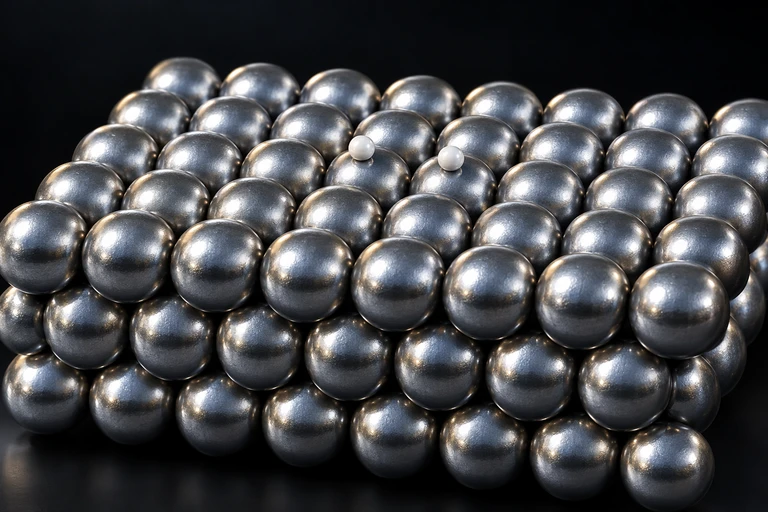
Hydrogen adsorption on a platinum surfaceHydrogen adsorbs at sites on a platinum surface during heterogeneous catalysis.
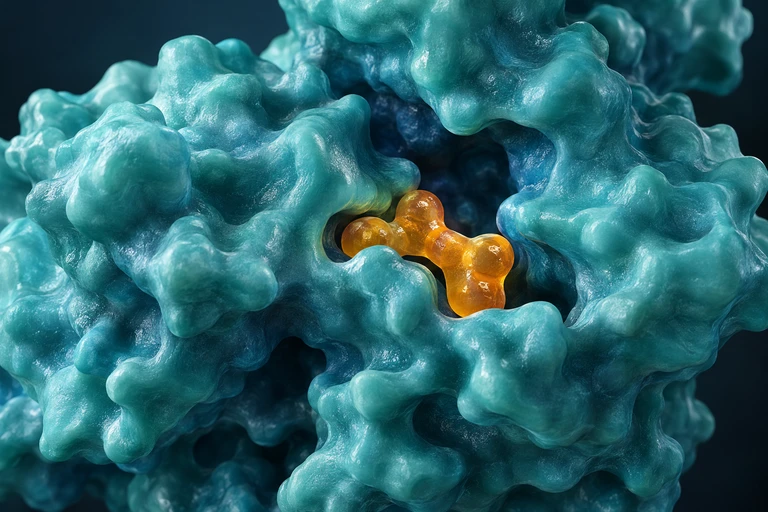
One schematic enzyme binding pocketAn enzyme binding pocket brings a substrate into contact with the catalytic environment.

SECTION 6

Worked Example: Identifying a Catalyst & Calculating Rate Enhancement

Catalyst Identification & Arrhenius Rate Enhancement

  1. 1

    Step 1 — Examine the Proposed Mechanism

    Consider the following two-step mechanism for the decomposition of H₂O₂: Step 1: H₂O₂(aq) + I⁻(aq) → H₂O(l) + IO⁻(aq) Step 2: H₂O₂(aq) + IO⁻(aq) → H₂O(l) + O₂(g) + I⁻(aq) We first identify each species' role. I⁻ is consumed in Step 1 and regenerated in Step 2—it is the catalyst. IO⁻ is produced in Step 1 and consumed in Step 2—it is the reaction intermediate.
    Catalyst: I⁻ | Intermediate: IO⁻
  2. 2

    Step 2 — Write the Overall Equation

    Adding Steps 1 and 2 and canceling species that appear on both sides (I⁻ and IO⁻): 2 H₂O₂(aq) → 2 H₂O(l) + O₂(g) Neither I⁻ nor IO⁻ appears in the net equation, confirming their roles as catalyst and intermediate, respectively.
    Net: 2 H₂O₂ → 2 H₂O + O₂
  3. 3

    Step 3 — Set Up the Rate Enhancement Calculation

    The uncatalyzed decomposition has Ea = 75.3 kJ·mol⁻¹, while the I⁻-catalyzed pathway has Ea = 56.5 kJ·mol⁻¹. At T = 298 K and assuming the same frequency factor A: kcat / kuncat = e^[(Ea,uncat − Ea,cat) / RT]
  4. 4

    Step 4 — Substitute and Calculate

    ΔEa = 75,300 − 56,500 = 18,800 J·mol⁻¹ RT = (8.314)(298) = 2,478 J·mol⁻¹ Exponent = 18,800 / 2,478 = 7.59 kcat / kuncat = e7.59e^{7.59} ≈ 1,980
    The I⁻ catalyst increases the rate by a factor of approximately 2,000 at 298 K.

SECTION 7

Catalysts vs. Other Rate-Altering Factors

Students frequently confuse the role of a catalyst with other methods of increasing reaction rate. While raising temperature, increasing concentration, and adding a catalyst all speed up reactions, the underlying mechanisms differ fundamentally. A clear comparison helps prevent the common AP exam error of claiming that a catalyst shifts equilibrium or that raising temperature changes Ea.

FactorMechanism of Rate IncreaseEffect on EₐEffect on K (Equilibrium)
CatalystProvides alternative pathway with lower EₐDecreases EₐNo change
↑ TemperatureIncreases fraction of molecules exceeding Eₐ (Boltzmann shift)No change in EₐChanges K (van 't Hoff equation)
↑ ConcentrationIncreases collision frequencyNo change in EₐNo change in K (but shifts Q toward equilibrium)
↑ Surface areaExposes more reactive sites (solids/heterogeneous systems)No change in EₐNo change

Comparison of rate-altering factors and their effects on kinetic and thermodynamic quantities

✦

KEY TAKEAWAY

Of all the methods to increase reaction rate, only a catalyst actually changes the activation energy. Raising temperature does not lower the energy barrier—it simply gives more molecules enough kinetic energy to clear the existing barrier. This distinction is analogous to the difference between lowering the bar in a high-jump competition (catalyst) versus making the athletes jump higher (raising temperature). Both approaches get more athletes over the bar, but the mechanism is entirely different.

SECTION 8

Connection to Advanced Theory: Enzyme Kinetics & Industrial Catalysis

The principles of catalysis explored in AP Chemistry serve as the gateway to more sophisticated models encountered in biochemistry and materials science. Enzyme kinetics, governed by the Michaelis-Menten model, extends the concept of homogeneous catalysis to biological systems where the catalyst (enzyme) forms a specific enzyme-substrate complex. The saturation behavior observed at high substrate concentrations—where increasing [S] no longer increases rate because all active sites are occupied—has no direct analogue in simple inorganic catalysis and introduces the concept of Vmax and KM.

ConceptAP Chemistry LevelAdvanced / College Level
Catalyst definitionLowers Eₐ, not consumed, does not change KTransition state theory: catalyst stabilizes ‡ complex, lowering ΔG‡
Biological catalysisEnzymes lower Eₐ for biological reactionsMichaelis-Menten kinetics: v = Vmax[S] / (KM + [S]); Lineweaver-Burk plots
Heterogeneous mechanismAdsorption / surface reaction / desorptionLangmuir-Hinshelwood and Eley-Rideal surface kinetics models
Catalyst deactivationPoisoning mentioned qualitativelySintering, coking, poisoning kinetics; regeneration strategies in industrial reactors

AP Chemistry vs. advanced treatment of catalysis concepts

For the AP exam, you should know that catalyst poisoning occurs when a substance binds irreversibly to a catalyst's active sites, rendering them inactive. Lead poisoning of catalytic converters is the classic example—one reason leaded gasoline was phased out. In enzyme systems, analogous phenomena include competitive and noncompetitive inhibition. While the quantitative treatment of inhibition is beyond the AP scope, recognizing that inhibitors reduce catalytic effectiveness by blocking or distorting the active site is valuable context for understanding catalytic specificity.

A blocked site on a catalyst surfaceA species bound to a catalyst surface can block a site that would otherwise participate in catalysis.

SECTION 9

Practice Problems

Question 1: CONCEPTUAL

A catalyst increases the rate of a chemical reaction by which of the following mechanisms?
  • A. Increasing the temperature of the system so that more molecules have sufficient kinetic energy
  • B. Providing an alternative reaction pathway with a lower activation energy
  • C. Increasing the equilibrium constant so that the products are thermodynamically more favored
  • D. Making the overall reaction more exothermic, thereby releasing energy that drives the reaction forward
Show answer (B)
B is correct. A catalyst works by providing an alternative mechanistic pathway with a lower activation energy, allowing a greater fraction of molecular collisions to be effective at a given temperature. A is incorrect because a catalyst does not raise the temperature—it lowers the energy barrier instead. C is incorrect because a catalyst does not change the equilibrium constant K; it accelerates both forward and reverse reactions equally. D is incorrect because a catalyst does not alter the enthalpy change (ΔH) of the reaction—the thermodynamic quantities remain unchanged.

Question 2: BASIC CALCULATION

The uncatalyzed decomposition of N₂O has an activation energy of 251 kJ·mol⁻¹. In the presence of a gold catalyst, the activation energy is reduced to 121 kJ·mol⁻¹. Assuming the same frequency factor, by approximately what factor does the rate constant increase at 600 K? (R = 8.314 J·mol⁻¹·K⁻¹)
  • A. e²⁶ ≈ 5 × 10¹¹
  • B. e¹³ ≈ 4 × 10⁵
  • C. 2.08 (approximately double)
  • D. e⁵⁰ ≈ 5 × 10²¹
Show answer (A)
A is correct. Using k_cat/k_uncat = e^[(Eₐ,uncat − Eₐ,cat)/RT]: ΔEₐ = 251,000 − 121,000 = 130,000 J·mol⁻¹. RT = 8.314 × 600 = 4,988 J·mol⁻¹. Exponent = 130,000/4,988 ≈ 26.1. So the ratio is e²⁶ ≈ 5 × 10¹¹. B is incorrect because it uses only half the correct ΔEₐ or an incorrect RT value. C is incorrect because a 130 kJ reduction in activation energy produces an enormous exponential effect, not a mere doubling. D is incorrect because it implies an exponent of 50, which would result from incorrectly doubling the ΔEₐ.

Question 3: INTERMEDIATE

Consider the following proposed mechanism for the catalyzed decomposition of ozone: Step 1: O₃ + Cl → O₂ + ClO (slow) Step 2: ClO + O → Cl + O₂ (fast) Which of the following correctly identifies the catalyst, the intermediate, and the rate law for the overall reaction?
  • A. Catalyst: ClO; Intermediate: Cl; Rate = k[O₃][O]
  • B. Catalyst: Cl; Intermediate: ClO; Rate = k[O₃][Cl]
  • C. Catalyst: O₂; Intermediate: ClO; Rate = k[O₃]²
  • D. Catalyst: Cl; Intermediate: ClO; Rate = k[ClO][O]
Show answer (B)
B is correct. Cl is consumed in Step 1 and regenerated in Step 2, making it the catalyst. ClO is produced in Step 1 and consumed in Step 2, making it the reaction intermediate. The rate law is determined by the slow (rate-determining) step: Rate = k[O₃][Cl]. A is incorrect because it reverses the identities of catalyst and intermediate, and the rate law includes O, which is not in the slow step. C is incorrect because O₂ is a product, not a catalyst, and [O₃]² would require both reactant molecules in the slow step to be O₃. D is incorrect because while the catalyst and intermediate are correctly identified, the rate law is based on the fast step (Step 2), not the slow rate-determining step.

Question 4: APPLIED

4 pts
The decomposition of hydrogen peroxide (2 H₂O₂ → 2 H₂O + O₂) can be catalyzed by MnO₂(s). (a) Explain how MnO₂ catalyzes this reaction and classify it as a homogeneous or heterogeneous catalyst. Justify your classification. (1 point) (b) A student measures the initial rate of O₂ production at 25°C with and without MnO₂. The uncatalyzed Ea is 75 kJ/mol and the catalyzed Ea is 58 kJ/mol. Calculate the ratio of the catalyzed to uncatalyzed rate constants at 25°C, assuming equal frequency factors. (2 points) (c) Does the addition of MnO₂ change the equilibrium yield of O₂? Explain. (1 point)
Show answer
Rubric: (a) 1 point: MnO₂ is a heterogeneous catalyst because it is a solid while the reactant H₂O₂ is in aqueous solution—they are in different phases. MnO₂ lowers the activation energy by providing an alternative reaction pathway (e.g., Mn cycling between oxidation states on the solid surface), allowing H₂O₂ to decompose more rapidly. (1 pt for correct classification with justification referencing different phases.) (b) 2 points: • 1 pt for correct setup: k_cat/k_uncat = e^[(Ea_uncat − Ea_cat)/(RT)] = e^[(75,000 − 58,000)/(8.314 × 298)] • 1 pt for correct calculation: ΔEa = 17,000 J/mol; RT = 2,478 J/mol; exponent = 17,000/2,478 = 6.86; ratio = e6.86e^{6.86} ≈ 950. The catalyzed reaction is approximately 950 times faster. (c) 1 point: No. MnO₂ does not change the equilibrium yield of O₂. A catalyst accelerates both the forward and reverse reactions equally, so the equilibrium constant K is unchanged. The system reaches the same equilibrium position, only faster. (1 pt for stating K is unaffected and providing correct reasoning.)

Question 5: CRITICAL THINKING

4 pts
A researcher studies the decomposition of a reactant A → products at 350 K under four different conditions. The data are shown below. | Trial | Conditions | Eₐ (kJ·mol⁻¹) | ln k | |-------|-----------|----------------|------| | 1 | No catalyst, 350 K | 100 | −10.3 | | 2 | Catalyst X, 350 K | 72 | −0.67 | | 3 | Catalyst Y, 350 K | 85 | −5.15 | | 4 | No catalyst, 400 K | 100 | −6.38 | (a) Using the data, rank the four trials from fastest to slowest reaction rate. Justify your ranking. (1 point) (b) Calculate the frequency factor A for Trial 1 using the Arrhenius equation. Show your work. (1 point) (c) Compare the effect of Catalyst X at 350 K (Trial 2) with the effect of raising the temperature to 400 K without a catalyst (Trial 4). Which strategy produces a larger rate constant, and what does this reveal about the relative power of catalysis versus temperature increases for this reaction? (1 point) (d) A student claims that Catalyst Y must be a 'weaker catalyst' than Catalyst X because Trial 3 has a higher Eₐ than Trial 2. Evaluate this claim and discuss one additional factor, beyond Eₐ, that could influence the observed rate constant for a catalyzed reaction. (1 point)
Show answer
Rubric: (a) 1 point: Fastest to slowest: Trial 2 > Trial 3 > Trial 4 > Trial 1. Since k = elnke^{ln k}, the largest ln k corresponds to the largest rate constant. ln k values: Trial 2 (−0.67) > Trial 3 (−5.15) > Trial 4 (−6.38) > Trial 1 (−10.3). A larger rate constant at the same concentration of A means a faster rate. (1 pt for correct ranking with justification using ln k values.) (b) 1 point: From the Arrhenius equation in logarithmic form, ln k = ln A − Eₐ/(RT). Substituting Trial 1 values: −10.3 = ln A − 100,000/(8.314 × 350). Computing the second term: 100,000/2,909.9 = 34.36. So ln A = −10.3 + 34.36 = 24.06. Therefore A = e24.06e^{24.06} ≈ 2.8 × 10¹⁰ s⁻¹ (units depend on reaction order). (1 pt for correct setup, substitution, and calculation of A.) (c) 1 point: Trial 2 (Catalyst X, 350 K) has ln k = −0.67, while Trial 4 (no catalyst, 400 K) has ln k = −6.38. Since −0.67 > −6.38, Catalyst X at 350 K produces a larger rate constant. The ratio is e−0.67−(−6.38)e^{−0.67 − (−6.38)} = e5.71e^{5.71} ≈ 300, meaning the catalyzed rate constant is roughly 300 times larger than that achieved by raising the temperature by 50 K alone. This demonstrates that lowering Eₐ via catalysis can be far more effective than moderate temperature increases, because the rate constant depends exponentially on Eₐ in the Arrhenius equation. (1 pt for correct comparison and explanation connecting the exponential dependence of k on Eₐ.) (d) 1 point: The student's claim is partially correct: Catalyst Y does provide a smaller reduction in Eₐ (lowering it by 15 kJ/mol vs. 28 kJ/mol for Catalyst X), and the data confirm a smaller rate constant for Trial 3 compared to Trial 2. However, a catalyst's effectiveness also depends on the frequency factor A, which may differ between catalyzed pathways. If Catalyst Y provided a more favorable molecular orientation (higher A), it could partially compensate for its higher Eₐ. Additionally, practical factors such as catalyst surface area, active-site accessibility, selectivity, and susceptibility to poisoning all influence the observed rate of a catalyzed reaction beyond just the activation energy. (1 pt for evaluating the claim and identifying at least one additional factor beyond Eₐ, such as the frequency factor A or a practical catalyst property.)

SUMMARY

Catalysts — Key Concepts Review

Summary

A catalyst increases the rate of a chemical reaction by providing an alternative reaction pathway with a lower activation energy (Eₐ). It is not consumed in the overall reaction—consumed in one elementary step and regenerated in another. The Arrhenius equation (k = Ae−Ea/RTAe^{−Eₐ/RT}) quantifies how a lower Eₐ exponentially increases the rate constant k. Critically, a catalyst does not change ΔH, ΔG, or the equilibrium constant K—it only affects how fast equilibrium is reached.

Homogeneous catalysts operate in the same phase as the reactants, while heterogeneous catalysts exist in a different phase and facilitate reactions through adsorption, surface reaction, and desorption. When analyzing multi-step mechanisms, distinguish the catalyst (consumed early, regenerated later) from the reaction intermediate (produced in one step, consumed in the next). Both cancel from the net equation, but their roles are mechanistically distinct—a distinction frequently tested on the AP Chemistry exam.

Varsity Tutors • AP Chemistry • Catalysts