AP Chemistry • Thermodynamics and Electrochemistry

Absolute Entropy and Entropy Change

Quantifying molecular disorder to predict the spontaneity of chemical reactions.

AP Chemistry illustration with a laboratory flask, atom, and microscope
Inside this lesson 10 sections 5 questions 9 figures

SECTION 1

Historical Context & Motivation

Thermodynamics emerged in the nineteenth century as scientists and engineers sought to understand the limits of steam engines and other heat-driven machines. While the first law of thermodynamics successfully accounted for energy conservation, it could not explain why certain processes occur spontaneously in one direction but never in reverse. A hot cup of coffee cools to room temperature, but the surroundings never spontaneously reheat it. The concept of entropy was introduced precisely to fill this explanatory gap, providing a quantitative measure of the dispersal of energy and matter within a system.

1824 • Carnot's Engine Analysis

Sadi Carnot published Reflections on the Motive Power of Fire, establishing that no engine can be more efficient than a reversible one and implicitly identifying the irreversibility at the heart of entropy.

1865 • Clausius Names Entropy

Rudolf Clausius coined the term entropy (from the Greek tropē, meaning transformation), defining it as dS = δq_rev / T, and declared that the entropy of the universe tends to a maximum.

1877 • Boltzmann's Statistical Interpretation

Ludwig Boltzmann connected entropy to the number of microstates (W) of a system through S = k ln W, grounding the macroscopic concept in the statistical behavior of atoms and molecules.

1906 • Nernst Heat Theorem

Walther Nernst proposed that entropy changes approach zero as temperature approaches absolute zero, laying the groundwork for the third law of thermodynamics.

1923 • Third Law Formalized

Building on Nernst's work, the third law was formally stated: the entropy of a perfect crystal at 0 K is exactly zero. This enabled the assignment of absolute (standard molar) entropy values to every substance.

The key question that emerged from this century of work is deceptively simple: can we assign an absolute numerical value to the entropy of any substance, and can we use those values to predict whether a chemical reaction will proceed spontaneously? Unlike enthalpy, which can only be measured as a change (ΔH), the third law of thermodynamics provides an unambiguous zero point for entropy, making absolute entropy values possible. Understanding how to look up, interpret, and combine these values is an essential skill for the AP Chemistry exam.

SECTION 2

Core Principles & Definitions

At its core, entropy quantifies the number of ways energy can be distributed among the particles in a system. A substance with many accessible microstates—many different arrangements of molecular positions and energies—possesses high entropy. To work quantitatively with entropy in chemistry, you need to master several foundational ideas that connect the microscopic picture to macroscopic, measurable quantities.

1

Third Law of Thermodynamics

The entropy of a perfect crystalline substance at absolute zero (0 K) is exactly zero. This provides the baseline from which all absolute entropies are measured.
2

Standard Molar Entropy (S°)

The standard molar entropy is the entropy content of one mole of a substance at 298.15 K and 1 atm (or 1 bar). It is always a positive value, reported in units of J/(mol·K).
3

Entropy Is a State Function

Entropy depends only on the current state of the system (temperature, pressure, phase, composition), not on how the system reached that state. This allows us to calculate ΔS° using tabulated S° values.
4

Entropy Change of a Reaction (ΔS°rxn)

For any balanced reaction, ΔS°rxn = ΣnS°(products) − ΣnS°(reactants), where n represents the stoichiometric coefficients.
5

Factors That Increase Entropy

Entropy increases with rising temperature, during phase transitions from solid to liquid to gas, when the number of gaseous moles increases, and when complex molecules form from simpler ones (more vibrational modes).
✦

KEY TAKEAWAY

Think of entropy like the number of ways you could arrange books on a shelf versus dumping them randomly on the floor. A perfect crystal at 0 K is the perfectly ordered shelf—only one arrangement exists (W = 1, so S = k ln 1 = 0). As you heat the substance, it's like loosening the constraint on where the books can go: molecular motions increase, more microstates become accessible, and entropy climbs. Unlike enthalpy, which has no natural zero, entropy has an absolute reference point, which is why we can tabulate absolute S° values rather than just changes.

SECTION 3

Visual Explanation — Entropy and Temperature

The standard molar entropy of a substance at 298 K is determined by integrating the heat capacity divided by temperature from 0 K up to that temperature, accounting for any phase transitions along the way. The following diagram illustrates how the entropy of a typical substance grows as it is heated from absolute zero through the solid, liquid, and gaseous phases. Notice the discontinuous jumps at the melting and boiling points—these correspond to the entropy of fusion and the entropy of vaporization, respectively.

Standard Molar Entropy vs. TemperatureTemperature (K)S° (J/(mol·K))SOLIDLIQUIDGAST_mT_bΔS_fusΔS_vap0 KS°= 0
Entropy increases steadily within each phase as temperature rises (the solid curves). At the melting point (Tm) and boiling point (Tb), there are sharp, discontinuous jumps corresponding to ΔSfus and ΔSvap (dashed yellow lines). The green dot at 0 K marks the third-law baseline where S° = 0 for a perfect crystal.

Several features of this diagram deserve emphasis. First, the curve within each phase is concave because the heat capacity Cp generally increases with temperature, and the slope dS/dT = Cp/T reflects both factors. Second, the jump at the boiling point (ΔSvap) is much larger than the jump at the melting point (ΔSfus), because the transition from a condensed phase to a gas vastly increases the number of accessible positional microstates. Third, the gas-phase portion of the curve is relatively flat, since most of the entropy has already been "unlocked" by vaporization.

SECTION 4

Mathematical Framework

The mathematical treatment of entropy in AP Chemistry revolves around two central equations: the Boltzmann equation that connects entropy to microstates, and the Hess's-law-style summation that allows you to calculate the entropy change of any reaction from tabulated standard molar entropies. A third equation—Clausius's definition—provides the bridge between heat flow and entropy change.

BOLTZMANN EQUATION

S=kBlnWS = k_B ln W

S = entropy of the system (J/K); kB = Boltzmann constant (1.381 × 10⁻²³ J/K); W = number of microstates (dimensionless). A microstate is a specific arrangement of molecular positions and energies consistent with the macroscopic state.

STANDARD ENTROPY CHANGE OF REACTION

ΔS°rxn=Σn⋅S°(products)−Σn⋅S°(reactants)ΔS°_rxn = Σ n·S°(products) − Σ n·S°(reactants)

ΔS°rxn = standard entropy change of reaction (J/(mol·K)); n = stoichiometric coefficient; S° = standard molar entropy (J/(mol·K)). Note that unlike ΔH°f values, which are zero for elements in their standard state, S° values for elements are not zero.

ENTROPY CHANGE FOR A PHASE TRANSITION

ΔStransition=ΔHtransition/TtransitionΔS_transition = ΔH_transition / T_transition

ΔStransition = entropy change at a phase transition (J/(mol·K)); ΔHtransition = enthalpy of the phase change (J/mol); Ttransition = temperature at which the transition occurs (K). This is valid at equilibrium (constant T and P).

GIBBS FREE ENERGY CONNECTION

ΔG°=ΔH°−TΔS°ΔG° = ΔH° − TΔS°

This equation links entropy change to the spontaneity criterion: when ΔG° < 0 the reaction is thermodynamically favorable at standard conditions. ΔS° plays a critical role in determining whether the −TΔS° term can overcome an unfavorable (positive) ΔH°, especially at high temperatures.

⚠

AP Exam Alert

A common error is treating S° values like ΔH°f values and assuming that the standard molar entropy of an element in its reference form is zero. This is incorrect. For example, S°(O₂(g)) = 205.2 J/(mol·K), not zero. All substances at temperatures above 0 K have positive S° values.

SECTION 5

Predicting the Sign and Magnitude of ΔS°

On the AP Chemistry exam, you will often be asked to predict the sign of ΔS° without performing a calculation—a qualitative skill that depends on understanding which physical changes increase or decrease the number of accessible microstates. The following diagram and table summarize the major factors that influence entropy, allowing you to make rapid sign predictions for any given reaction.

Factors Affecting EntropyLow Entropy (ordered) → High Entropy (disordered)Lower S°Higher S°1. PhaseSolid < Liquid < GasGases have far more2. TemperatureHigher T → Higher S°More kinetic energy states3. Moles of GasMore gas moles → ΔS > 0Dominant qualitative factor4. ComplexityLarger molecules → Higher S°More vibrational modes5. Mixing / DissolvingMixing increases SPositional microstates rise6. Molar MassHeavier atoms → Higher S°Denser energy-level spacingQuick ExamplesCaCO₃(s) → CaO(s) + CO₂(g) ΔS° > 0 (gas produced from solid)2 H₂(g) + O₂(g) → 2 H₂O(l) ΔS° < 0 (3 mol gas → 0 mol gas)N₂O₄(g) → 2 NO₂(g) ΔS° > 0 (1 mol gas → 2 mol gas)Ag⁺(aq) + Cl⁻(aq) → AgCl(s) ΔS° < 0 (ions in solution → solid)
The six major factors influencing entropy magnitude are shown as cards (top two rows). The bottom panel provides quick-prediction examples: the change in the number of gaseous moles is typically the most reliable qualitative predictor of the sign of ΔS°.
SubstancePhaseS° (J/(mol·K))
C(s, diamond)Solid2.4
C(s, graphite)Solid5.7
H₂O(l)Liquid69.9
H₂O(g)Gas188.8
O₂(g)Gas205.2
C₆H₁₂O₆(s)Solid212.1

Selected standard molar entropies at 298 K. Note that S° for diamond < graphite (graphite is less rigidly ordered), H₂O(g) >> H₂O(l), and glucose (a large molecule) has a high S° even as a solid.

SECTION 6

Worked Example — Calculating ΔS°rxn

Consider the combustion of methane: CH₄(g) + 2 O₂(g) → CO₂(g) + 2 H₂O(g). Using the standard molar entropies S°(CH₄(g)) = 186.3, S°(O₂(g)) = 205.2, S°(CO₂(g)) = 213.8, and S°(H₂O(g)) = 188.8 J/(mol·K), calculate ΔS°rxn and interpret the result.

Combustion of Methane — ΔS°rxn

  1. 1

    Step 1 — Write the balanced equation and list S° values

    CH₄(g) + 2 O₂(g) → CO₂(g) + 2 H₂O(g). The standard molar entropies are: S°(CH₄) = 186.3, S°(O₂) = 205.2, S°(CO₂) = 213.8, S°(H₂O) = 188.8 J/(mol·K). Note that all values are positive; none are zero.
  2. 2

    Step 2 — Sum the product entropies (weighted by coefficients)

    ΣnS°(products) = (1)(213.8) + (2)(188.8) = 213.8 + 377.6 = 591.4 J/(mol·K).
    ΣnS°(products) = 591.4 J/(mol·K)
  3. 3

    Step 3 — Sum the reactant entropies (weighted by coefficients)

    ΣnS°(reactants) = (1)(186.3) + (2)(205.2) = 186.3 + 410.4 = 596.7 J/(mol·K).
    ΣnS°(reactants) = 596.7 J/(mol·K)
  4. 4

    Step 4 — Calculate ΔS°rxn

    ΔS°rxn = 591.4 − 596.7 = −5.3 J/(mol·K).
    ΔS°rxn = −5.3 J/(mol·K)
  5. 5

    Step 5 — Interpret

    The negative sign indicates a slight decrease in entropy for the system. This makes sense because the reaction converts 3 total moles of gas (1 CH₄ + 2 O₂) to 3 moles of gas (1 CO₂ + 2 H₂O), so the mole count is unchanged. The small negative value arises from the slightly lower total S° of the products compared to the reactants—the product molecules happen to have slightly less rotational and vibrational entropy per mole. Despite this unfavorable ΔS°, the combustion of methane is still highly spontaneous because the large exothermic ΔH° (−802.3 kJ/mol) dominates the Gibbs free energy at 298 K.

SECTION 7

Strengths, Limitations & Common Misconceptions

StrengthsLimitations
Absolute S° values can be combined for any reaction via Hess's law, enabling prediction of spontaneity when paired with ΔH°.Standard molar entropies are tabulated at 298 K and 1 atm; calculations at other temperatures require heat-capacity integrations that are beyond the AP scope.
Qualitative sign predictions based on Δn(gas) are quick and remarkably reliable for most reactions.When Δn(gas) = 0, qualitative predictions become uncertain and a full calculation is required.
The third law provides an unambiguous zero reference, unlike enthalpy (which only has a convention-based reference).Residual entropy (e.g., in CO or N₂O ice) can make the 0 K entropy non-zero in practice, though this is rarely tested on the AP exam.
Entropy is a state function, so the path used to calculate ΔS does not matter—only the initial and final states.ΔS°rxn gives the entropy change of the system only; to determine spontaneity you must also account for ΔS of the surroundings or use ΔG.

Key strengths and limitations of using standard molar entropy values to analyze chemical reactions.

⚠️

COMMON MISCONCEPTION

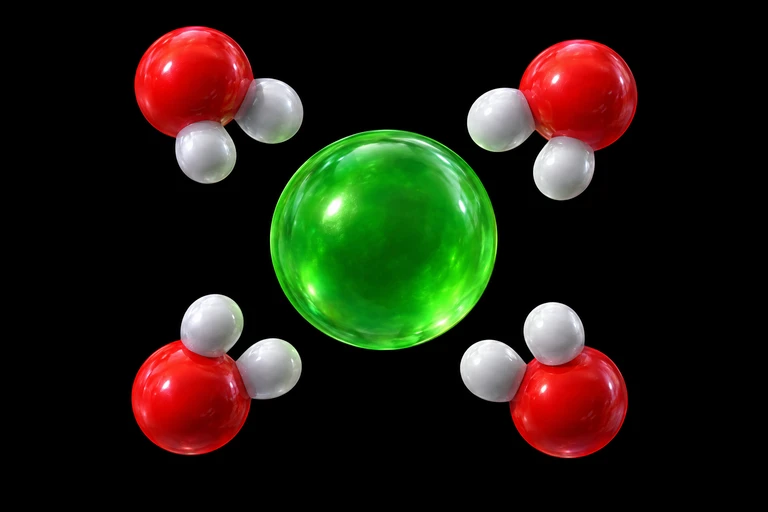
Students often confuse "disorder" with chaos or randomness in a colloquial sense. In thermodynamics, entropy is more precisely understood as a measure of energy dispersal—the number of microstates over which the system's energy is spread. A system with high entropy is not necessarily messy; it has many quantum-mechanically accessible configurations. Thinking of entropy as "how many ways can the energy be distributed?" rather than "how messy is it?" will help you reason correctly about subtle cases, such as why dissolving an ionic salt can sometimes decrease entropy (strong ion-dipole ordering of water molecules around the ions).

One chloride hydration environmentWater molecules orient their partially positive hydrogen atoms toward a chloride ion.

SECTION 8

Connection to Gibbs Free Energy and Statistical Mechanics

In the AP Chemistry curriculum, the standard entropy change of a reaction is one of two inputs—along with the standard enthalpy change—into the Gibbs free energy equation (ΔG° = ΔH° − TΔS°). This equation is the thermodynamic criterion for spontaneity: a negative ΔG° at a given temperature means the forward reaction is thermodynamically favored under standard conditions. The −TΔS° term reveals that entropy change becomes increasingly important as temperature rises, which is why endothermic reactions that produce more gas (positive ΔH° and positive ΔS°) can become spontaneous at sufficiently high temperatures. Conversely, exothermic reactions with negative ΔS° become non-spontaneous at high temperatures because the −TΔS° penalty eventually outweighs the favorable ΔH°.

ConceptAP Chemistry LevelAdvanced (College Physical Chemistry)
Entropy definitionS = kBk_B ln W (conceptual); S° from tablesDerived from partition functions (q) in statistical mechanics: S = kBk_B ln Q + U/T
Temperature dependenceQualitative: higher T → higher SQuantitative: S(T₂) = S(T₁) + ∫CpC_p/T dT with integration over heat-capacity data
SpontaneityΔG° = ΔH° − TΔS° at standard conditionsΔG = ΔG° + RT ln Q; equilibrium when ΔG = 0, giving K = e−ΔG°/RTe^{−ΔG°/RT}
Second lawΔS_univ > 0 for spontaneous processesClausius inequality: dS ≥ δq/T for all processes; equality only for reversible paths

How AP-level entropy concepts connect to more advanced physical chemistry.

If you continue into college-level physical chemistry or chemical engineering thermodynamics, you will encounter the full statistical-mechanical derivation of entropy through the partition function, which separates contributions from translational, rotational, vibrational, and electronic degrees of freedom. For now, knowing that each of these contributions increases with temperature, molecular size, and molar mass gives you strong qualitative tools for reasoning about entropy trends across the periodic table and across families of compounds.

SECTION 9

Practice Problems

Question 1: CONCEPTUAL

Which of the following statements correctly explains why the standard molar entropy of O₂(g) at 298 K is not zero?
  • A. Because O₂ is not in its standard state at 298 K and 1 atm.
  • B. Because the third law assigns S° = 0 only to perfect crystals at 0 K, and O₂ at 298 K has substantial translational, rotational, and vibrational energy that contribute to a large number of microstates.
  • C. Because O₂ is a diatomic molecule, and only monatomic elements have S° = 0 at standard conditions.
  • D. Because O₂ is a gas, and only solid elements can have S° = 0 at any temperature.
Show answer (B)
The correct answer is B. The third law of thermodynamics states that S° = 0 only for a perfect crystalline substance at absolute zero (0 K). At 298 K, O₂(g) molecules possess significant kinetic energy distributed across translational, rotational, and vibrational modes, giving rise to an enormous number of microstates and therefore a large positive S° value (205.2 J/(mol·K)). Choice A is wrong because O₂(g) at 298 K and 1 atm is in fact in its standard state—that doesn't make its entropy zero. Choice C is wrong because no element has S° = 0 at 298 K, regardless of being monatomic or diatomic. Choice D is wrong because even solid elements have S° > 0 at any temperature above 0 K.

Question 2: BASIC CALCULATION

For the reaction N₂(g) + 3 H₂(g) → 2 NH₃(g), given S°(N₂) = 191.6, S°(H₂) = 130.7, and S°(NH₃) = 192.8 J/(mol·K), what is ΔS°rxn?
  • A. −198.1 J/(mol·K)
  • B. +198.1 J/(mol·K)
  • C. −129.5 J/(mol·K)
  • D. −583.7 J/(mol·K)
Show answer (A)
The correct answer is A. Using ΔS°rxn = ΣnS°(products) − ΣnS°(reactants): Products = 2(192.8) = 385.6 J/(mol·K). Reactants = 1(191.6) + 3(130.7) = 191.6 + 392.1 = 583.7 J/(mol·K). Therefore ΔS°rxn = 385.6 − 583.7 = −198.1 J/(mol·K). The negative sign is expected because 4 moles of gas become 2 moles of gas, a large decrease in positional disorder. Choice B reverses the sign (reactants minus products instead of products minus reactants). Choice C appears to use only 2 mol of H₂ instead of 3. Choice D represents the sum of reactant entropies, not ΔS°.

Question 3: INTERMEDIATE

Consider the decomposition of calcium carbonate: CaCO₃(s) → CaO(s) + CO₂(g). Given ΔH° = +178.3 kJ/mol and ΔS° = +160.6 J/(mol·K), at approximately what temperature does this reaction become thermodynamically favorable under standard conditions?
  • A. 298 K
  • B. 835 K
  • C. 1110 K
  • D. 1780 K
Show answer (C)
The correct answer is C. The reaction becomes thermodynamically favorable when ΔG° < 0. At the crossover temperature, ΔG° = 0 = ΔH° − TΔS°, so T = ΔH°/ΔS° = (178,300 J/mol)/(160.6 J/(mol·K)) ≈ 1110 K. Above this temperature, the −TΔS° term exceeds ΔH° in magnitude, making ΔG° negative. Choice A (298 K) would give ΔG° = 178,300 − (298)(160.6) = +130,461 J/mol, which is positive (not spontaneous). Choice B (835 K) would give ΔG° = 178,300 − (835)(160.6) = +44,199 J/mol, still positive. Choice D (1780 K) would indeed be spontaneous, but it is not the crossover temperature—it overshoots.

Question 4: APPLIED

4 pts
The standard molar entropies at 298 K for the substances involved in the Haber process are given below. N₂(g): S° = 191.6 J/(mol·K) H₂(g): S° = 130.7 J/(mol·K) NH₃(g): S° = 192.8 J/(mol·K) The reaction is: N₂(g) + 3 H₂(g) → 2 NH₃(g), ΔH° = −92.2 kJ/mol. (a) Calculate ΔS°rxn for this reaction. (b) Determine ΔG° at 298 K and state whether the reaction is thermodynamically favorable at this temperature. (c) Using your answers from parts (a) and (b), predict and justify whether increasing the temperature will make the reaction more or less thermodynamically favorable. (d) Despite the thermodynamic favorability at 298 K, the industrial Haber process is carried out at approximately 700 K. Provide a thermodynamic or kinetic explanation for this choice.
Show answer
Point-by-point rubric: (a) 1 point: ΔS°rxn = Σ nS°(products) − Σ nS°(reactants) = 2(192.8) − [1(191.6) + 3(130.7)] = 385.6 − 583.7 = −198.1 J/(mol·K). The student earns the point for correct setup and arithmetic. (b) 1 point: ΔG° = ΔH° − TΔS° = (−92,200 J/mol) − (298 K)(−198.1 J/(mol·K)) = −92,200 + 59,034 = −33,166 J/mol ≈ −33.2 kJ/mol. Since ΔG° < 0, the reaction is thermodynamically favorable at 298 K. The student earns the point for a correct calculation and a correct conclusion about favorability. (c) 1 point: Because ΔH° is negative and ΔS° is negative, the term −TΔS° becomes increasingly positive as T increases. This makes ΔG° less negative and eventually positive. Therefore, increasing the temperature makes the reaction less thermodynamically favorable. The student earns the point for correct reasoning that connects the signs of ΔH° and ΔS° to the effect of temperature. (d) 1 point: Although the reaction is thermodynamically favorable at 298 K, the rate of reaction at that temperature is extremely slow because the activation energy for breaking the strong N≡N triple bond is very high. At 700 K, the rate is fast enough to produce reasonable yields of NH₃ in a practical time frame, even though the equilibrium constant K is smaller at higher T. This is a compromise between kinetics (faster at high T) and thermodynamics (better K at low T). The student earns the point for identifying the kinetic reason (slow rate at low T) and explaining the trade-off.

Question 5: CRITICAL THINKING

4 pts
A student measures the standard molar entropies of several noble gases at 298 K and 1 atm: He(g): 126.2 J/(mol·K) Ne(g): 146.3 J/(mol·K) Ar(g): 154.8 J/(mol·K) Kr(g): 164.1 J/(mol·K) Xe(g): 169.7 J/(mol·K) (a) Describe the trend in S° as you move down the group from He to Xe. (b) All five substances are monatomic ideal gases at the same temperature and pressure. Provide a molecular-level explanation for why S° increases with molar mass, even though all five gases have only translational degrees of freedom. (c) A second student claims that because noble gases are monatomic and have no intermolecular attractions, they should all have the same S° at the same T and P. Identify the flaw in this reasoning. (d) If you were to plot S° versus ln(M), where M is the molar mass, predict the shape of the graph and justify your prediction using the Sackur-Tetrode equation conceptually.
Show answer
Point-by-point rubric: (a) 1 point: S° increases monotonically as you move from He to Xe down the noble gas group. The increase is not linear—the increments between successive elements decrease (He→Ne is 20.1, Ne→Ar is 8.5, Ar→Kr is 9.3, Kr→Xe is 5.6). The student earns the point for correctly identifying the increasing trend. (b) 1 point: Even though all noble gases have only three translational degrees of freedom, heavier atoms have more closely spaced translational energy levels (the quantum-mechanical spacing of energy levels in a box is inversely proportional to the particle's mass). Closer spacing means more energy levels are thermally accessible at 298 K, increasing the number of microstates W and therefore S = kBk_B ln W. The student earns the point for connecting molar mass to translational energy-level spacing and microstates. (c) 1 point: The flaw in the second student's reasoning is the assumption that having the same types of degrees of freedom (only translational) means the same entropy. Entropy depends not on the number of types of motion but on the number of accessible quantum states for those motions. The translational quantum states are more densely packed for heavier particles, so heavier noble gases have higher S° even at the same T and P. The student earns the point for clearly identifying that number of accessible states, not just types of motion, determines entropy. (d) 1 point: The Sackur-Tetrode equation for the translational entropy of an ideal monatomic gas shows that S° depends on ln(M) (among other variables) with a positive coefficient (specifically S ∝ (3/2)R ln M plus other terms). Therefore a plot of S° versus ln(M) should be approximately linear with a positive slope of approximately (3/2)R ≈ 12.5 J/(mol·K). The student earns the point for predicting a roughly linear relationship with positive slope and providing a correct justification.

SUMMARY

Lesson Summary

Summary

The third law of thermodynamics establishes that the entropy of a perfect crystal at 0 K is exactly zero, providing the baseline for absolute (standard molar) entropy values, denoted S° and reported in J/(mol·K). Unlike standard enthalpies of formation, S° values for elements are never zero at 298 K. Entropy increases with temperature, molecular complexity, molar mass, and phase changes from solid to liquid to gas. The most reliable qualitative predictor of the sign of ΔS°rxn is the change in the number of moles of gas (Δngas).

To calculate ΔS°rxn, apply the equation ΔS°rxn = ΣnS°(products) − ΣnS°(reactants), taking care to multiply each S° by its stoichiometric coefficient. This entropy change feeds directly into the Gibbs free energy equation (ΔG° = ΔH° − TΔS°), which determines thermodynamic favorability. Remember that entropy is a state function, and that at the molecular level, it reflects the number of accessible microstates via S = kB ln W. Mastering both the qualitative predictions and the quantitative calculations ensures you are fully prepared for entropy questions on the AP Chemistry exam.

Varsity Tutors • AP Chemistry • Absolute Entropy and Entropy Change