Working with
Geometric Series
Master convergence, partial sums, and infinite series for sequences with a constant ratio between consecutive terms.
What Is a Geometric Series?
A geometric series is the sum of the terms of a geometric sequence: a sequence where each term is obtained by multiplying the previous term by a fixed number called the common ratio \( r \).
The key question in calculus: does this infinite sum converge to a finite value, or does it diverge to infinity?
Visualizing Shrinking Terms
When \( |r| < 1 \), each term gets smaller and smaller. The partial sums approach a finite limit. Below, the bars show terms of \( \sum 1 \cdot (0.5)^n \):
Why Geometric Series Matter
Geometric series appear throughout calculus, physics, economics, and computer science. They are one of the few infinite series with a closed-form sum.
The Convergence Theorem
The open circles at \( r = -1 \) and \( r = 1 \) indicate that the series diverges at those endpoints as well.
A bouncing ball leaves a shrinking ladder of travel
 A ball falls 10 m and rebounds to 60% of its preceding height. Count the initial fall once and each rebound twice: the geometric series gives 40 m of total travel.
A bouncing ball leaves a shrinking ladder of travel
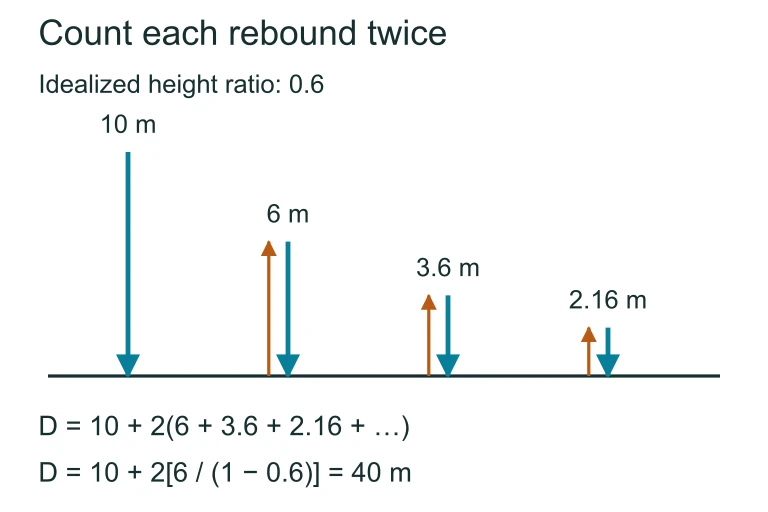 A ball falls 10 m and rebounds to 60% of its preceding height. Count the initial fall once and each rebound twice: the geometric series gives 40 m of total travel.
The Partial Sum Formula
Before tackling infinite sums, we need the finite partial sum of the first \( n \) terms:
Finite vs. Infinite Geometric Sums
| Finite Sum \( S_n \) | Infinite Sum \( S \) | |
|---|---|---|
| Formula | \( a \cdot \frac{1-r^n}{1-r} \) | \( \frac{a}{1-r} \) |
| Restriction on \( r \) | \( r \neq 1 \) (any other \( r \)) | \( |r| < 1 \) strictly |
| Number of terms | Exactly \( n \) terms | Infinitely many terms |
| Always finite? | Yes | Only if \( |r| < 1 \) |
| AP Exam usage | Less common | Very common |
Watch the Starting Index
Not every geometric series starts at \( n=0 \). The formula \( \frac{a}{1-r} \) applies when the first term is \( a \). If the series starts at \( n=k \), adjust accordingly:
First term is \( a \).
First term is \( ar \).
Step-by-Step Strategy
Example 1: Basic Convergent Series
Find the sum of \( \displaystyle\sum_{n=0}^{\infty} 3\left(\frac{1}{4}\right)^n \).
Example 2: Negative Common Ratio
Find the sum of \( \displaystyle\sum_{n=0}^{\infty} 5\left(-\frac{2}{3}\right)^n \).
Example 3: Non-Zero Starting Index
Evaluate \( \displaystyle\sum_{n=2}^{\infty} \frac{7}{5^n} \).
Partial Sums Approaching the Limit
For \( \sum_{n=0}^{\infty} 3(1/4)^n \), the partial sums \( S_n \) converge to 4:
Rewriting as Geometric Form
Many AP problems disguise geometric series. The key is rewriting into \( \sum ar^n \) form:
Common Mistakes to Avoid
Summary Reference Table
| Scenario | Formula | Result |
|---|---|---|
| Finite sum (\( n \) terms) | \( S_n = a \cdot \frac{1-r^n}{1-r} \) | Always a number |
| Infinite, \( |r| < 1 \) | \( S = \frac{a}{1-r} \) | Converges |
| Infinite, \( |r| \geq 1 \) | No formula applies | Diverges |
| Starts at \( n = k \) | \( S = \frac{a \cdot r^k}{1-r} \) | Use first term = \( ar^k \) |
| Negative \( r \) | \( S = \frac{a}{1+|r|} \) | Alternating signs |
Question 1 of 5
What is the sum of the geometric series \( \displaystyle\sum_{n=0}^{\infty} 6\left(\frac{1}{3}\right)^n \)?
Question 2 of 5
Which of the following geometric series diverges?
Question 3 of 5
Find the sum: \( \displaystyle\sum_{n=1}^{\infty} \frac{8}{3^n} \).
Question 4 of 5
Evaluate \( \displaystyle\sum_{n=0}^{\infty} \frac{(-2)^n}{5^n} \).
Question 5 of 5
The series \( \displaystyle\sum_{n=0}^{\infty} ar^n \) converges to \( 10 \). If \( a = 4 \), what is \( r \)?