Washer Method
Revolving Around \(x\)/\(y\) Axes
Master the technique for computing volumes of solids of revolution when the cross-section is an annular ring: the washer method.
What Is a Solid of Revolution?
When a planar region is rotated around a line (an axis of revolution), it sweeps out a three-dimensional solid. Computing the volume of that solid is a core skill in integral calculus.
Disk vs Washer: Cross-Sections
A transparent lathe reveals the hole inside a washer
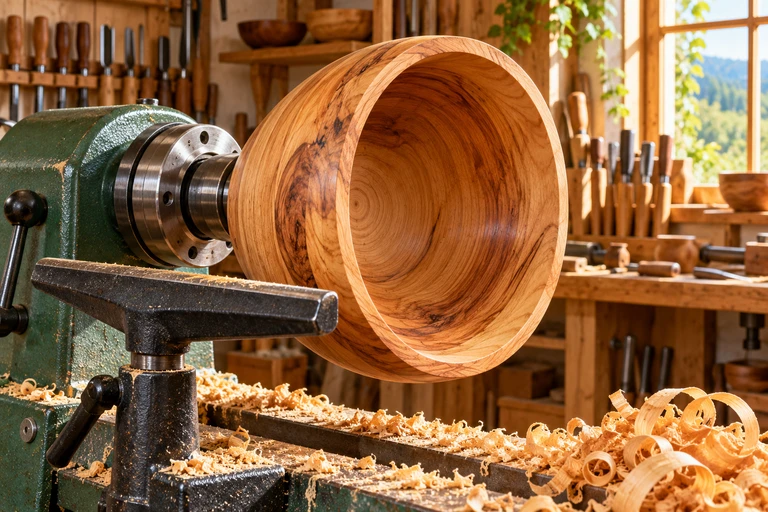 Rotate the region between y = √x and y = x² on [0,1] about the x-axis. A washer has area π(x − x⁴), and the volume is 3π/10.
A washer subtracts two disk areas
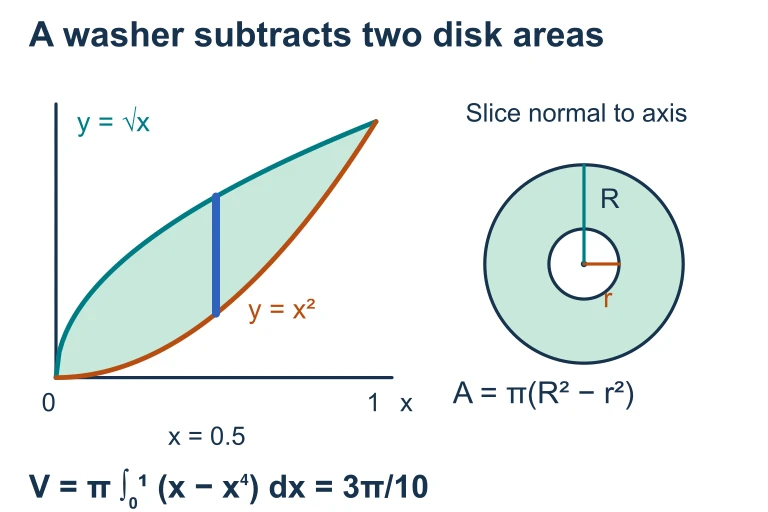 Rotate the region between y = √x and y = x² on [0,1] about the x-axis. A washer has area π(x − x⁴), and the volume is 3π/10.
Why Do We Need the Washer Method?
When the region being revolved is bounded by two curves (an outer curve and an inner curve), each cross-section is not a full disk: it has a hole. We subtract the inner area from the outer area at every slice.
This is a direct extension of the disk method: if \(r = 0\), the washer formula reduces to the disk formula.
The Washer Formula: Revolving Around \(x\)-Axis
The Washer Formula: Revolving Around \(y\)-Axis
Disk vs Washer: Key Distinction
| Disk Method | Washer Method | |
|---|---|---|
| Bounded by | One curve and the axis | Two curves (outer and inner) |
| Cross-section | Solid circle | Annular ring (donut) |
| Formula (x-axis) | \(\pi\!\int_a^b [f(x)]^2\,dx\) | \(\pi\!\int_a^b [R^2 - r^2]\,dx\) |
| Inner radius | \(r = 0\) | \(r \neq 0\) (gap exists) |
| When to use | Region touches the axis | Region has a gap from the axis |
Step-by-Step Washer Method
Example 1: Revolving Around the \(x\)-Axis
Find the volume of the solid formed by revolving the region between \(y = x^2\) and \(y = x\) about the \(x\)-axis.
Example 1: Solution
Example 2: Revolving Around the \(y\)-Axis
Find the volume when the region between \(x = y^2\) and \(x = y\) (for \(0 \leq y \leq 1\)) is revolved about the \(y\)-axis.
Example 2: Solution
Example 3: A Harder Problem
Find the volume when the region between \(y = \sqrt{x}\) and \(y = x^2\) is revolved about the \(x\)-axis.
Identifying \(R\) and \(r\) Correctly
Common Mistakes to Avoid
Question 1 of 5
The region between \(y = x\) and \(y = x^3\) on \([0,1]\) is revolved about the \(x\)-axis. Which integral gives the volume?
Question 2 of 5
When revolving a region about the \(y\)-axis using the washer method, the radii are:
Question 3 of 5
Compute: \(\displaystyle\pi\!\int_0^1\bigl[(\sqrt{x})^2 - (x^2)^2\bigr]\,dx\).
Question 4 of 5
The region between \(y = 4\) and \(y = x^2\) is revolved about the \(x\)-axis. What are the outer and inner radii?
Question 5 of 5
The region between \(x = y\) and \(x = y^2\) for \(0 \leq y \leq 1\) is revolved about the \(y\)-axis. What is the volume?