Washer Method
Revolving Around Other Axes
Master the technique of computing volumes of revolution when the axis of rotation is not a coordinate axis: horizontal lines \( y = k \) and vertical lines \( x = k \).
What Is the Washer Method?
When a region between two curves is revolved around an axis, every cross-section perpendicular to that axis looks like a washer: a disk with a hole. The volume is the integral of each washer's area.
Why Other Axes Matter
Most textbooks start with rotation about the \( x \)-axis or \( y \)-axis, where the radii are simply the function values. But when the axis shifts to a line like \( y = 4 \) or \( x = -1 \), every radius must be recalculated as a signed distance from the curve to that axis.
Visualizing the Radius Shift
Consider the region between \( y = x^2 \) and \( y = 2x \) revolved about \( y = 5 \). Each radius is the distance from the curve down to the line \( y = 5 \):
The General Washer Formula
Key insight: "far" and "near" are relative to the axis of rotation, not to the coordinate axes.
Determining R and r
\( r = k - f_{\text{upper}} \)
Both positive when region is below axis.
\( r = f_{\text{lower}} - k \)
Both positive when region is above axis.
A transparent lathe reveals the hole inside a washer
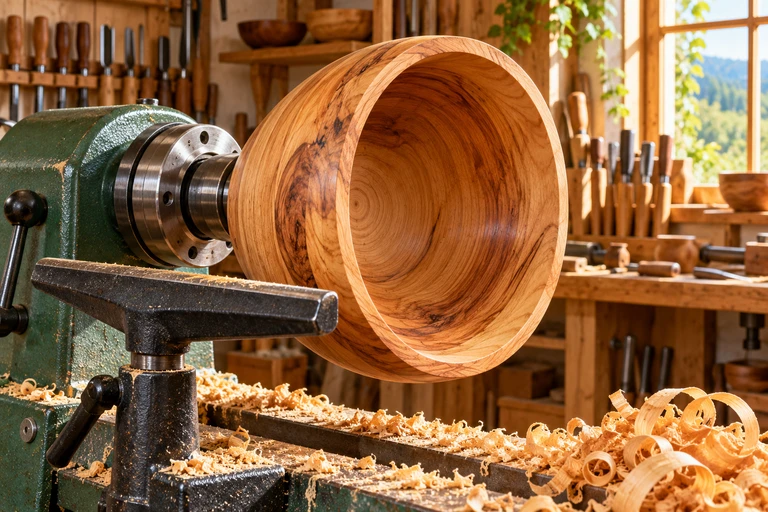 Rotate the region between y = x² and y = x on [0,1] about y = 2. The outer radius is 2 − x² and the inner radius is 2 − x, giving volume 8π/15.
Farther from the axis means outer
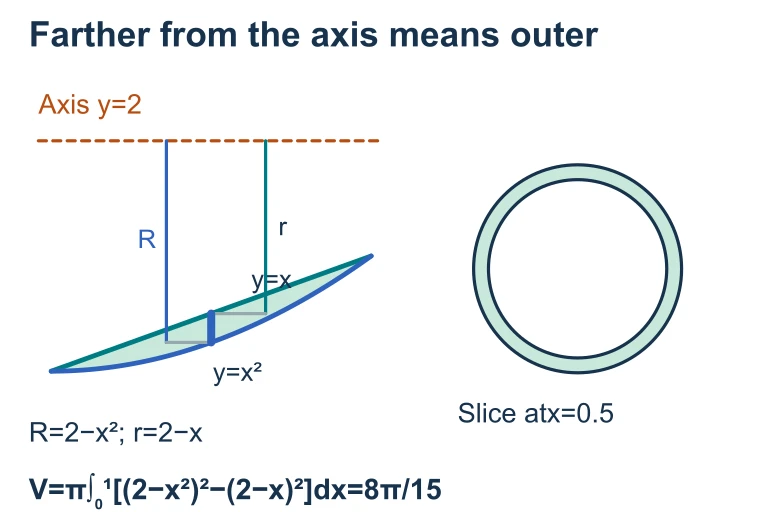 Rotate the region between y = x² and y = x on [0,1] about y = 2. The outer radius is 2 − x² and the inner radius is 2 − x, giving volume 8π/15.
Disk vs Washer vs Shell
| Disk | Washer | Shell | |
|---|---|---|---|
| Cross-section | Solid circle | Ring (annulus) | Thin cylinder |
| When to use | One boundary | Two boundaries | Perpendicular axis |
| Integrand | \( \pi R^2 \) | \( \pi(R^2 - r^2) \) | \( 2\pi r \cdot h \) |
| Slices ⊥ to | Axis of rotation | Axis of rotation | Axis of rotation (parallel) |
How to Apply the Washer Method
Example 1: Revolving About \( y = 4 \)
Find the volume when the region bounded by \( y = x^2 \) and \( y = 2x \) is revolved about the line \( y = 4 \).
Example 1: Solution
Example 2: Revolving About \( x = -1 \)
Find the volume when the region bounded by \( y = \sqrt{x} \) and \( y = x^2 \) is revolved about \( x = -1 \).
Example 2: Solution
Example 3: Axis Between Curves
Find the volume when the region between \( y = 4 \) and \( y = x^2 \) is revolved about \( y = 1 \).
Example Recap
| Example | Axis | Variable | Volume |
|---|---|---|---|
| 1 | \( y = 4 \) (above) | \( dx \) | \( \frac{32\pi}{5} \) |
| 2 | \( x = -1 \) (left) | \( dy \) | \( \frac{29\pi}{30} \) |
| 3 | \( y = 1 \) (between) | \( dx \) | \( \frac{448\pi}{15} \) |
Common Mistakes
Question 1 of 5
The region bounded by \( y = x \) and \( y = x^2 \) is revolved about \( y = -1 \). What is the outer radius \( R \)?
Question 2 of 5
When revolving about a vertical line \( x = k \), we should integrate with respect to:
Question 3 of 5
The region between \( y = \sqrt{x} \) and \( y = 0 \) on \( [0, 4] \) is revolved about \( y = 3 \). Which integral gives the volume?
Question 4 of 5
A student revolves the region between \( y = x^2 \) and \( y = 4 \) about \( y = 5 \) and writes \( R = 5 - x^2 \) and \( r = 1 \). Is this correct?
Question 5 of 5
The region between \( x = y^2 \) and \( x = 4 \) is revolved about \( x = 5 \). What is the volume?