01 / 21

Volumes with
Cross Sections

Learn to compute volumes of solids whose cross sections are triangles and semicircles using definite integrals.

AP Calculus BC

What Is a Solid with Known Cross Sections?

Imagine a region in the \(xy\)-plane that serves as the base of a three-dimensional solid. At every value of \(x\), a thin slice perpendicular to the \(x\)-axis has a specific geometric shape: a triangle, semicircle, square, or other figure. If we know that shape, we can find the solid's volume.

The Base Region Drives Everything

x y s(x) f(x) g(x) 0 1 2 3 4

Why Cross-Section Volumes Matter

AP Exam Staple
These problems appear on nearly every AP Calculus BC free-response section.
Beyond Disks/Washers
Not every solid is formed by revolution. Cross sections let you handle any shape.
Engineering Roots
Beams, wings, and tunnels are modeled as solids with prescribed cross sections.

The General Volume Formula

The area function \( A(x) \) depends on the shape of the cross section and the side length \( s(x) = f(x) - g(x) \), which comes from the base region.

Triangle
\( A = \frac{1}{2} \cdot \text{base} \cdot \text{height} \)
Semicircle
\( A = \frac{1}{2}\pi r^2 \) where the diameter equals \( s(x) \)

Triangular Cross Sections

s(x) h A B C
1
Equilateral triangle: Side = \( s(x) \), so \( A(x) = \frac{\sqrt{3}}{4}\,[s(x)]^2 \)
2
Isosceles right triangle (leg on base): Both legs = \( s(x) \), so \( A(x) = \frac{1}{2}[s(x)]^2 \)
3
Isosceles right triangle (hypotenuse on base): Hypotenuse = \( s(x) \), each leg = \( \frac{s(x)}{\sqrt{2}} \), so \( A(x) = \frac{1}{4}[s(x)]^2 \)

Semicircular Cross Sections

s(x) r diameter

Triangles vs. Semicircles

Equilateral Triangle Semicircle
Side length \( s(x) = f(x) - g(x) \) \( s(x) = f(x) - g(x) \)
Area formula \( \frac{\sqrt{3}}{4}[s(x)]^2 \) \( \frac{\pi}{8}[s(x)]^2 \)
Constant factor \( \frac{\sqrt{3}}{4} \approx 0.433 \) \( \frac{\pi}{8} \approx 0.393 \)
Key detail Height = \( \frac{s\sqrt{3}}{2} \) Radius = \( \frac{s}{2} \)

Step-by-Step Method

1
Sketch the base region and identify \( f(x) \) (top) and \( g(x) \) (bottom). Find the intersection points \( a \) and \( b \).
2
Write the side length: \( s(x) = f(x) - g(x) \).
3
Choose the area formula for the given cross-section shape. Express \( A(x) \) in terms of \( s(x) \).
4
Integrate: \( V = \int_a^b A(x)\,dx \). Factor constants out first.
5
Evaluate the definite integral and simplify. Keep \( \pi \) or \( \sqrt{3} \) exact unless told otherwise.

Example 1: Equilateral Triangle Setup

The base is the region bounded by \( y = \sqrt{x} \) and \( y = 0 \) from \( x = 0 \) to \( x = 4 \). Cross sections perpendicular to the \(x\)-axis are equilateral triangles.

Example 1: Computing the Volume

Example 2: Semicircular Cross Sections

The base is bounded by \( y = x^2 \) and \( y = 1 \). Cross sections perpendicular to the \( y \)-axis are semicircles.

Example 3: Isosceles Right Triangles

The base is bounded by \( y = \sin x \) and \( y = 0 \) for \(0 \le x \le \pi\). Cross sections perpendicular to the \( x \)-axis are isosceles right triangles with legs on the base.

Visualizing the 3D Solid

x envelope A(x) dx

Each thin slab has volume \( A(x)\,dx \). Stacking all slabs from \( a \) to \( b \) gives the total volume via the integral.

Common Mistakes to Avoid

Wrong Radius
For semicircles, the diameter is \( s(x) \), not the radius. Forgetting to halve gives an area 4 times too large.
Missing Constant
Using \( \frac{1}{2}bh \) without computing the correct height for equilateral triangles: height = \( \frac{s\sqrt{3}}{2} \), not \( s \).
Slicing Along Wrong Axis
If cross sections are perpendicular to the \( y \)-axis, you must express everything in terms of \( y \) and integrate \( dy \).

Summary of Area Formulas

Cross Section \( A(x) \) Constant
Square \( [s(x)]^2 \) 1
Equilateral Triangle \( \frac{\sqrt{3}}{4}[s(x)]^2 \) \( \frac{\sqrt{3}}{4} \approx 0.433 \)
Isosceles Right Triangle (leg on base) \( \frac{1}{2}[s(x)]^2 \) \( \frac{1}{2} = 0.5 \)
Isosceles Right Triangle (hyp. on base) \( \frac{1}{4}[s(x)]^2 \) \( \frac{1}{4} = 0.25 \)
Semicircle \( \frac{\pi}{8}[s(x)]^2 \) \( \frac{\pi}{8} \approx 0.393 \)

Worked Example

Let R be the region bounded by y = √x and y = x/2. Cross sections perpendicular to the x-axis are semicircles whose diameters lie in R. Find the volume of the resulting solid. Step 1 — Find the intersection points Set √x = x/2. Squaring: x = x²/4, so x² − 4x = 0, giving x(x − 4) = 0. The curves intersect at x = 0 and x = 4. Limits: a = 0, b = 4 Step 2 — Determine the base span s(x) On [0, 4], √x ≥ x/2. The diameter of each semicircle is s(x) = √x − x/2. s(x) = √x − x/2 Step 3 — Write the cross-sectional area For a semicircle with diameter s, A(x) = (π/8)[s(x)]² = (π/8)(√x − x/2)². A(x) = (π/8)(√x − x/2)² Step 4 — Expand the integrand (√x − x/2)² = x − 2(√x)(x/2) + x²/4 = x − x^(3/2) + x²/4. (√x − x/2)² = x − x^(3/2) + x²/4 Step 5 — Integrate term by term V = (π/8) ∫₀⁴ [x − x^(3/2) + x²/4] dx. Evaluate each term: ∫₀⁴ x dx = [x²/2]₀⁴ = 8; ∫₀⁴ x^(3/2) dx = [2x^(5/2)/5]₀⁴ = 2(32)/5 = 64/5; ∫₀⁴ x²/4 dx = [x³/12]₀⁴ = 64/12 = 16/3. Sum = 8 − 64/5 + 16/3 = (120 − 192 + 80)/15 = 8/15 Step 6 — Multiply by the constant V = (π/8)(8/15) = π/15. V = π/15
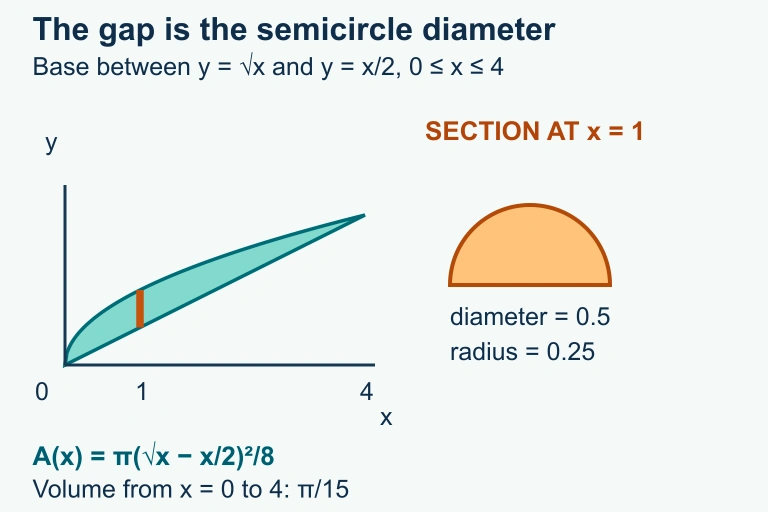
Base between y=√x and y=x/2, with a semicircular section of diameter 0.5 at x=1. Integrating the semicircle areas gives volume π/15.
A semicircle’s diameter is the gap √x−x/2, so its radius is half that gap and the solid’s volume isπ/15.
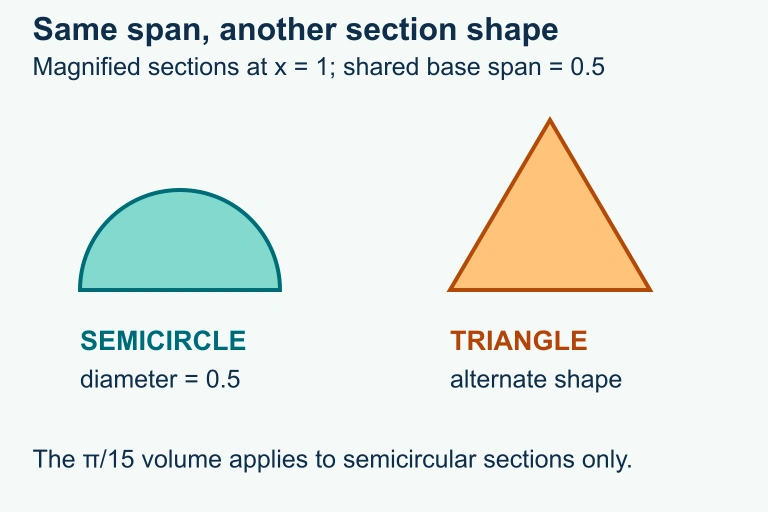
Equilateral-triangular and semicircular sections on the same diameter span 0.5. The volume π/15 applies to the semicircular-section solid.

Question 1 of 5

A solid has its base in the region bounded by \( y = x \) and \( y = 0 \) from \( x = 0 \) to \( x = 3 \). Cross sections perpendicular to the \( x \)-axis are equilateral triangles. Which integral gives the volume?

Question 2 of 5

The base of a solid is bounded by \( y = 4 - x^2 \) and \( y = 0 \). Cross sections perpendicular to the \( x \)-axis are semicircles. What is \( A(x) \)?

Question 3 of 5

Evaluate \( \displaystyle V = \int_0^4 \frac{\sqrt{3}}{4}\,x\,dx \).

Question 4 of 5

A solid's base is the region between \( y = \sin x \) and \( y = 0 \) for \(0 \le x \le \pi\). Cross sections perpendicular to the \( x \)-axis are isosceles right triangles with a leg on the base. What is the volume?

Question 5 of 5

For a semicircular cross section, the diameter equals \( s(x) \). Which statement about the radius is correct?