01 / 21

Volumes with
Cross Sections

Master computing volumes of solids using square and rectangular cross sections perpendicular to an axis: a core technique for the AP Calculus BC exam.

AP Calculus BC

What is a Solid with Known Cross Sections?

Imagine a region \( R \) in the \( xy \)-plane. Now raise a flat shape (a cross section) perpendicularly from every point along an axis. These stacked slices form a three-dimensional solid whose volume we can compute with integration.

Base region R on the xy-plane x slice slice slice

The Big Idea: Slicing

We already know that a definite integral sums up infinitely many infinitesimal pieces. For volumes, each piece is a thin slab of thickness \( dx \) (or \( dy \)).

Area of slice
\( A(x) \): the area of the cross section at position \( x \).
Volume of slab
\( A(x)\,dx \): the volume of one infinitesimally thin slab.
Total volume
\( \displaystyle V = \int_a^b A(x)\,dx \): sum all slabs from \( a \) to \( b \).

Why Squares and Rectangles?

Square and rectangular cross sections appear frequently on the AP exam because their area formulas are simple: the challenge lies in correctly identifying the side length from the base region.

Square
Side = distance across the base region.
\( A = s^2 \)
Rectangle
One dimension = distance across base; the other is given (often a multiple).
\( A = \ell \cdot w \)

Core Formula: Square Cross Sections

x y f(x) g(x) s(x) a b

Core Formula: Rectangle Cross Sections

For rectangles, one dimension of the cross section equals the distance across the base region, and the other dimension is specified (e.g., "the height is twice the base").

Perpendicular to \( x \) vs. Perpendicular to \( y \)

Perp. to x-axis Perp. to y-axis
Slices stand on Vertical lines (\( x = c \)) Horizontal lines (\( y = c \))
Side length \( f(x) - g(x) \) \( r(y) - l(y) \)
Integrate w.r.t. \( dx \) \( dy \)
Limits \( x = a \) to \( x = b \) \( y = c \) to \( y = d \)

How to Apply the Method

1
Sketch the base region and identify the bounding curves.
2
Determine the axis to which the cross sections are perpendicular.
3
Write the side length \( s \) as a function of the integration variable (top minus bottom, or right minus left).
4
Write the area \( A \) of the cross section in terms of \( s \). For squares: \( A = s^2 \). For rectangles: \( A = s \cdot h \).
5
Integrate \( A \) from the left (or bottom) boundary to the right (or top) boundary.

Example 1: Square Cross Sections

The base of a solid is the region bounded by \( y = \sqrt{x} \) and \( y = 0 \) from \( x = 0 \) to \( x = 4 \). Cross sections perpendicular to the \( x \)-axis are squares. Find the volume.

x y
\( y = \sqrt{x} \)
y = 0 s 0 4

Example 1: Solution

1
Side length: \( s(x) = \sqrt{x} - 0 = \sqrt{x} \)
2
Cross-section area (square): \( A(x) = [\sqrt{x}]^2 = x \)
3
Integrate: \( \displaystyle V = \int_0^4 x\,dx = \left[\frac{x^2}{2}\right]_0^4 = \frac{16}{2} = 8 \)

Example 2: Square Between Two Curves

The base is bounded by \( y = x^2 \) and \( y = 1 \). Cross sections perpendicular to the \( y \)-axis are squares. Find the volume.

x y y = 1
\( y = x^2 \)
\( s(y) = 2\sqrt{y} \)
0 1

Example 2: Solution

Since cross sections are perpendicular to the \( y \)-axis, we integrate with respect to \( y \). The right boundary is \( x = \sqrt{y} \) and the left boundary is \( x = -\sqrt{y} \).

1
Side length: \( s(y) = \sqrt{y} - (-\sqrt{y}) = 2\sqrt{y} \)
2
Area: \( A(y) = (2\sqrt{y})^2 = 4y \)
3
Integrate: \( \displaystyle V = \int_0^1 4y\,dy = \left[2y^2\right]_0^1 = 2 \)

Example 3: Rectangle Cross Sections

The base is bounded by \( y = \sin x \) and \( y = 0 \) for \( 0 \le x \le \pi \). Cross sections perpendicular to the \( x \)-axis are rectangles with height equal to 3 times the base. Find the volume.

1
Side length: \( s(x) = \sin x - 0 = \sin x \)
2
Height: \( h = 3\sin x \)
3
Area: \( A(x) = (\sin x)(3\sin x) = 3\sin^2 x \)
4
Integrate: \( \displaystyle V = \int_0^{\pi} 3\sin^2 x\,dx = 3\int_0^{\pi}\frac{1-\cos 2x}{2}\,dx = \frac{3}{2}\left[x - \frac{\sin 2x}{2}\right]_0^{\pi} \)

Visualizing the 3D Solid

It helps to picture stacking the cross sections along the axis. Each slice is a thin square (or rectangle) whose side changes with position.

0 π small tallest small

Common Mistakes

✕ Wrong variable
Using \( dx \) when the cross sections are perpendicular to the \( y \)-axis (you need \( dy \)).
✕ Forgetting to square
Writing \( A = s(x) \) instead of \( A = [s(x)]^2 \) for square cross sections.
✕ Wrong side length
Subtracting in the wrong order (bottom minus top) and getting a negative value.
✕ Mixing up dimensions
For rectangles: confusing which dimension is the distance across the base and which is the given height.
✕ Wrong limits
Using the wrong intersection points or forgetting to solve for where the curves meet.

Summary Table

Square Rectangle
Side length \( s(x) \) \( f(x) - g(x) \) \( f(x) - g(x) \)
Other dimension Same as \( s(x) \) Given: \( h(x) \)
Area \( A(x) \) \( [f(x)-g(x)]^2 \) \( [f(x)-g(x)] \cdot h(x) \)
Volume formula \( \displaystyle\int_a^b [f(x)-g(x)]^2\,dx \) \( \displaystyle\int_a^b [f(x)-g(x)] \cdot h(x)\,dx \)
Key check Square the whole expression Read the height relationship carefully

Worked practice: Practice Problems, Problem 4 — applied

Work through this original lesson problem, then reveal the solution and illustrations.

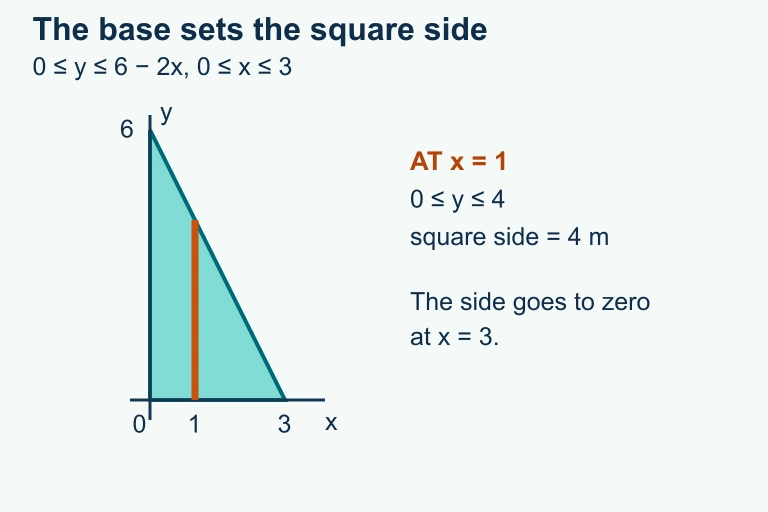
A flood-control channel has a cross-sectional shape that varies along its length. Engineers model the channel base as the region between y = 0 and y = 6 − 2x for 0 ≤ x ≤ 3 (in meters). At each position x along the channel, the cross section perpendicular to the x-axis is a square. Set up and evaluate the integral that gives the volume of material that must be excavated. (a) Write the area function A(x). (b) Set up the definite integral for the volume. (c) Evaluate the integral. (d) Interpret your result in context.

Show answer and explanation

Point 1 (1 pt): A(x) = [6 − 2x]². The side length of the square cross section at position x is s(x) = (6 − 2x) − 0 = 6 − 2x, and for a square, A(x) = s(x)² = (6 − 2x)². Point 2 (1 pt): V = ∫₀³ (6 − 2x)² dx. The limits are x = 0 to x = 3, the interval over which the base region exists (since 6 − 2x = 0 when x = 3). Point 3 (1 pt): Expanding: (6 − 2x)² = 36 − 24x + 4x². V = ∫₀³ (36 − 24x + 4x²) dx = [36x − 12x² + (4/3)x³]₀³ = [108 − 108 + 36] − 0 = 36. Alternatively, use substitution u = 6 − 2x, du = −2 dx: V = ∫₆⁰ u² · (−1/2) du = (1/2)∫₀⁶ u² du = (1/2)[u³/3]₀⁶ = (1/2)(72) = 36. Point 4 (1 pt): The volume of material that must be excavated is 36 cubic meters. This represents the total three-dimensional space enclosed by the channel from its widest opening (6 m at x = 0) tapering to zero width at x = 3 m.
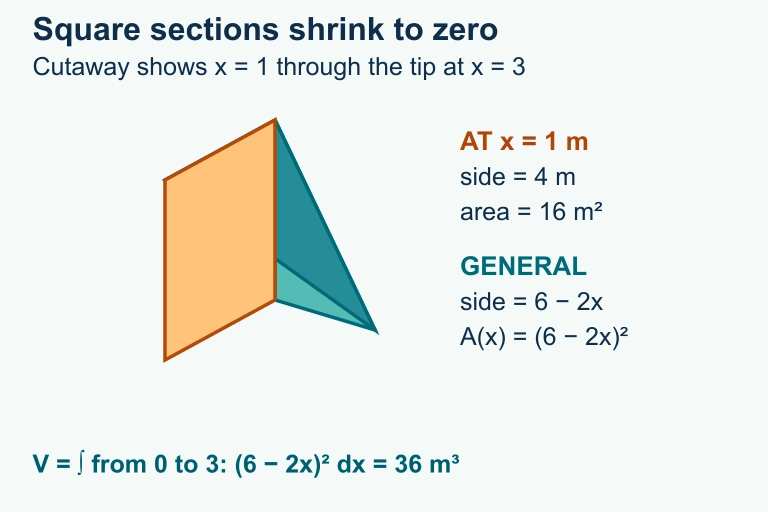
Square sections over a triangular base. At x=1 the square has side 4 and area 16. The shown cutaway spans x=1 to 3; the full solid spans x=0 to 3 and has volume 36 m³.
The square sections shrink with side 6−2 x; their areas integrate to 36 m³.
Triangular base 0≤y≤6−2x, 0≤x≤3, with a width-4 section at x=1 and width zero at x=3.

Question 1 of 5

The base of a solid is bounded by \( y = x \) and \( y = x^2 \). Cross sections perpendicular to the \( x \)-axis are squares. Which integral gives the volume?

Question 2 of 5

The base of a solid is bounded by \( y = 4 - x^2 \) and \( y = 0 \). Cross sections perpendicular to the \( x \)-axis are rectangles whose height is twice the base. What is the area function \( A(x) \)?

Question 3 of 5

A solid has its base in the region enclosed by \( y = \sqrt{x} \) and \( y = 0 \) from \( x = 0 \) to \( x = 9 \). If cross sections perpendicular to the \( x \)-axis are squares, what is the volume?

Question 4 of 5

For cross sections perpendicular to the \( y \)-axis, you express the side length in terms of \( y \) and integrate with respect to:

Question 5 of 5

The base of a solid is bounded by \( y = e^x \), \( y = 0 \), \( x = 0 \), and \( x = 1 \). Cross sections perpendicular to the \( x \)-axis are rectangles with height equal to twice the base. Which of the following equals the volume?