Solving
Optimization Problems
Master the art of finding maximum and minimum values using derivatives: from setting up constraints to identifying critical points and confirming extrema.
What is Optimization?
Optimization is the process of finding the greatest or least value that a function can achieve, subject to certain conditions. In calculus, we use derivatives to locate these extreme values efficiently.
The Core Idea: Extrema and Derivatives
At a local maximum or minimum on a smooth curve, the tangent line is horizontal: \( f'(x) = 0 \). These are critical points. Endpoints of a closed interval can also be extrema.
Key Vocabulary
The Closed Interval Method
If \( f \) is continuous on a closed interval \([a, b]\), then the Extreme Value Theorem guarantees that \( f \) attains both an absolute maximum and an absolute minimum on \([a, b]\).
First vs Second Derivative Test
| First Derivative Test | Second Derivative Test | |
|---|---|---|
| Requirement | \( f'(c) = 0 \) | \( f'(c) = 0 \) |
| Check | Sign change of \( f' \) around \( c \) | Sign of \( f''(c) \) |
| Local Max | \( f' \) changes + to − | \( f''(c) < 0 \) |
| Local Min | \( f' \) changes − to + | \( f''(c) > 0 \) |
| Inconclusive | No sign change | \( f''(c) = 0 \) |
Open Domain vs Closed Interval
The 5-Step Strategy
An open box taking shape on a designer's table
 For an open-top square-base box with 1,200 cm² of material, x² + 4xh = 1,200. Volume is largest at base side 20 cm and height 10 cm, giving 4,000 cm³.
A different constraint: material budget
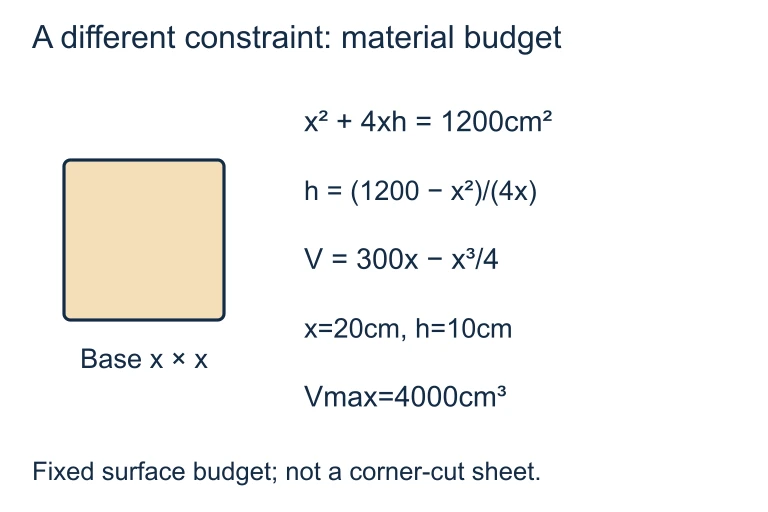 For an open-top square-base box with 1,200 cm² of material, x² + 4xh = 1,200. Volume is largest at base side 20 cm and height 10 cm, giving 4,000 cm³.
Example 1: Maximum Area
A farmer has 200 m of fencing to enclose a rectangular field along a river (no fence needed on the river side). Find the dimensions that maximize the area.
Example 1: Verification
Let's confirm that \( y = 50 \) gives a maximum using both tests.
Example 2: Minimum Surface Area
An open-top box with a square base must have a volume of 32 cm\(^3\). Find the dimensions that minimize the surface area.
Example 3: Closest Point on a Curve
Find the point on the parabola \( y = x^2 \) that is closest to the point \( (3, 0) \).
Why Minimize \( D^2 \) Instead of \( D \)?
The distance formula involves a square root: \( D = \sqrt{(x-3)^2 + x^4} \). Differentiating through the radical is messy. Since the square root is an increasing function, the value of \( x \) that minimizes \( D^2 \) also minimizes \( D \).
Common Mistakes
Optimization Checklist
| Step | Action | Watch For |
|---|---|---|
| 1. Setup | Diagram, label, identify objective | Units, positive quantities |
| 2. Model | Write objective and constraint equations | Correct formulas (area, volume, distance) |
| 3. Reduce | Eliminate variables using constraint | Solve for the right variable |
| 4. Differentiate | Set \( f'(x) = 0 \), solve | Don't forget quotient/chain rule |
| 5. Confirm | Derivative test or endpoint check | Max vs min, answer the actual question |
Question 1 of 5
A farmer uses 120 m of fencing to enclose a rectangular pen against a barn wall (3 sides fenced). If the side perpendicular to the barn has length \( x \), what value of \( x \) maximizes the area?
Question 2 of 5
To minimize the surface area of a closed cylindrical can with volume \( V \), the relationship between radius \( r \) and height \( h \) at the optimum is:
Question 3 of 5
Given \( f(x) = x^3 - 12x + 1 \) on \([-3, 5]\), what is the absolute maximum value?
Question 4 of 5
In a distance-minimization problem, why do we typically minimize \( D^2 \) instead of \( D \)?
Question 5 of 5
A continuous function on an open interval \((a, b)\) has exactly one critical point at \( x = c \), and \( f''(c) > 0 \). What can you conclude?