01 / 21
∑
\( x^n \)

Representing Series
as Power Series

Learn to express functions as infinite polynomial expansions, unlocking powerful tools for approximation, integration, and solving differential equations.

AP Calculus BC

What Is a Power Series?

A power series is an infinite series of the form:

$$ \sum_{n=0}^{\infty} c_n (x - a)^n = c_0 + c_1(x-a) + c_2(x-a)^2 + \cdots $$

where \( c_n \) are the coefficients, \( a \) is the center, and \( x \) is the variable. When \( a = 0 \), this is called a Maclaurin series.

The Geometric Foundation

The most fundamental power series comes from the geometric series:

$$ \frac{1}{1 - x} = \sum_{n=0}^{\infty} x^n = 1 + x + x^2 + x^3 + \cdots, \quad |x| < 1 $$
-1 0 1 1 2
\( f(x)=\tfrac{1}{1-x} \)
Partial sum |x| = 1 |x| = 1

A bouncing ball leaves a shrinking ladder of travel

An orange basketball rises above a gym floor while two faint silhouettes suggest earlier and later stages of diminishing rebounds; their heights are illustrative.A ball falls 10 m and rebounds to 60% of its preceding height. Count the initial fall once and each rebound twice: the geometric series gives 40 m of total travel.

A bouncing ball leaves a shrinking ladder of travel
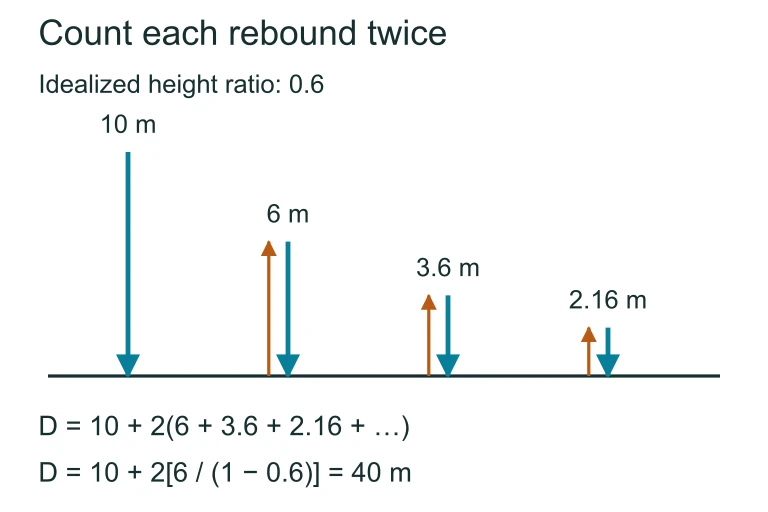
A ball falls 10 m and rebounds to 60% of its preceding height. Count the initial fall once and each rebound twice: the geometric series gives 40 m of total travel.A ball falls 10 m and rebounds to 60% of its preceding height. Count the initial fall once and each rebound twice: the geometric series gives 40 m of total travel.

Why Power Series Matter

Approximation
Truncate the series to get polynomial approximations of any desired accuracy.
Integration
Integrate term-by-term to evaluate integrals that have no closed-form antiderivative.
Differential Equations
Solve ODEs by assuming a power series solution and matching coefficients.

Core Technique: Manipulating \( \frac{1}{1-x} \)

Nearly every power series on the AP exam can be derived by modifying the geometric series. The key identity is:

$$ \frac{1}{1-u} = \sum_{n=0}^{\infty} u^n, \quad |u| < 1 $$

Replace \( u \) with any expression in \( x \) to build new series:

1
Substitution: Replace \( x \) with \( -x \), \( x^2 \), \( 3x \), etc.
2
Differentiation: Differentiate both sides term-by-term.
3
Integration: Integrate both sides term-by-term.
4
Multiplication: Multiply by constants or powers of \( x \).

Radius and Interval of Convergence

Every power series \( \sum c_n(x-a)^n \) converges on an interval centered at \( a \). The radius of convergence \( R \) determines how far from the center the series converges.

\( a \)
\( a - R \)
\( a + R \)
\( R \)
Diverges Diverges Converges

Taylor Series vs Power Series Representation

Taylor Series Approach
Compute \( f(a),\, f'(a),\, f''(a),\ldots \) and build \( \sum \frac{f^{(n)}(a)}{n!}(x-a)^n \). Requires all derivatives.
Algebraic Manipulation
Rewrite \( f(x) \) in terms of \( \frac{1}{1-u} \), then substitute into the known geometric series. Often faster.

Essential Known Series

Function Power Series Interval
\( \frac{1}{1-x} \) \( \sum_{n=0}^{\infty} x^n \) \( (-1,\,1) \)
\( e^x \) \( \sum_{n=0}^{\infty} \frac{x^n}{n!} \) \( (-\infty,\,\infty) \)
\( \sin x \) \( \sum_{n=0}^{\infty} \frac{(-1)^n x^{2n+1}}{(2n+1)!} \) \( (-\infty,\,\infty) \)
\( \cos x \) \( \sum_{n=0}^{\infty} \frac{(-1)^n x^{2n}}{(2n)!} \) \( (-\infty,\,\infty) \)
\( \ln(1+x) \) \( \sum_{n=1}^{\infty} \frac{(-1)^{n+1} x^n}{n} \) \( (-1,\,1] \)

How to Find a Power Series

1
Identify the target function. Write \( f(x) \) clearly and note its domain.
2
Rewrite in a known form. Algebraically manipulate \( f(x) \) into \( \frac{1}{1-u} \), \( e^u \), \( \sin u \), \( \cos u \), or \( \ln(1+u) \).
3
Substitute into the known series. Replace \( x \) (or the variable) with your expression \( u \).
4
Apply operations. If needed, differentiate, integrate, or multiply by \( x^k \).
5
Determine the interval of convergence. Use \( |u| < 1 \) (or the original series' interval) and check endpoints.

Example 1: Substitution

Find the power series for \( f(x) = \dfrac{1}{1+x^2} \).

1
Rewrite: \( \dfrac{1}{1+x^2} = \dfrac{1}{1-(-x^2)} \). Here \( u = -x^2 \).
2
Substitute into \( \sum u^n \): \( \sum_{n=0}^{\infty}(-x^2)^n = \sum_{n=0}^{\infty}(-1)^n x^{2n} \).
3
Convergence: \( |-x^2| < 1 \implies |x| < 1 \). Interval: \( (-1,\,1) \).

Example 2: Integration

Find the power series for \( f(x) = \arctan x \).

1
Notice that \( \dfrac{d}{dx}[\arctan x] = \dfrac{1}{1+x^2} \), so \( \arctan x = \int \dfrac{1}{1+x^2}\,dx \).
2
From Example 1: \( \dfrac{1}{1+x^2} = \sum_{n=0}^{\infty}(-1)^n x^{2n} \).
3
Integrate term-by-term: \( \arctan x = C + \sum_{n=0}^{\infty}\dfrac{(-1)^n x^{2n+1}}{2n+1} \).
4
Since \( \arctan(0)=0 \), we get \( C=0 \). Interval: \( [-1,\,1] \) (endpoints converge by AST).

Example 3: Differentiation

Find the power series for \( f(x) = \dfrac{1}{(1-x)^2} \).

1
Observe that \( \dfrac{d}{dx}\!\left[\dfrac{1}{1-x}\right] = \dfrac{1}{(1-x)^2} \).
2
Differentiate: \( \dfrac{d}{dx}\!\left[\sum_{n=0}^{\infty}x^n\right] = \sum_{n=1}^{\infty}n\,x^{n-1} \).
3
Reindex: \( \sum_{n=0}^{\infty}(n+1)\,x^n = 1 + 2x + 3x^2 + 4x^3 + \cdots \)

Example 4: Combining Techniques

Find the power series for \( f(x) = \dfrac{x}{(1+x)^2} \).

1
Start with \( \frac{1}{1-u} = \sum u^n \). Let \( u = -x \): \( \frac{1}{1+x} = \sum_{n=0}^{\infty}(-1)^n x^n \).
2
Differentiate: \( \frac{1}{(1+x)^2} = \sum_{n=1}^{\infty}(-1)^{n+1} n\, x^{n-1} \).
3
Multiply by \( x \): \( \frac{x}{(1+x)^2} = \sum_{n=1}^{\infty}(-1)^{n+1} n\, x^{n} \).

Visualizing Partial Sums

As we add more terms, the partial sums converge to the true function inside the interval:

x y 0 -1 1 2 1 2
\( e^x \)
n = 1 n = 2 n = 4

Common Mistakes

✕ Forgetting the form \( \frac{1}{1-u} \)
Writing \( \frac{1}{1+x} = \sum x^n \) instead of \( \sum(-x)^n = \sum(-1)^n x^n \). The sign matters.
✕ Wrong interval after substitution
If \( u = 3x \), then \( |u| < 1 \) means \( |3x| < 1 \implies |x| < \frac{1}{3} \). Don't keep the original \( |x| < 1 \).
✕ Forgetting the constant of integration
After integrating a series, use a known value (like \( f(0) \)) to find \( C \). Don't assume \( C = 0 \) without justification.

Summary of Techniques

Operation Effect on Series Effect on \( R \)
Substitute \( u \) for \( x \) Replace \( x^n \) with \( u^n \) Solve \( |u| < R \) for \( x \)
Differentiate \( \sum n c_n x^{n-1} \) Same \( R \), check endpoints
Integrate \( C + \sum \frac{c_n}{n+1} x^{n+1} \) Same \( R \), check endpoints
Multiply by \( x^k \) \( \sum c_n x^{n+k} \) Same \( R \)
Multiply by constant \( a \) \( \sum a\,c_n x^{n} \) Same \( R \)

Question 1 of 5

Which of the following is the power series representation of \( \dfrac{1}{1+3x} \)?

Question 2 of 5

The power series for \( \ln(1+x) \) is \( \sum_{n=1}^{\infty}\frac{(-1)^{n+1}x^n}{n} \). What is the power series for \( \ln(1+x^2) \)?

Question 3 of 5

If \( f(x) = \sum_{n=0}^{\infty} x^n = \frac{1}{1-x} \), what is \( \sum_{n=1}^{\infty} n\,x^{n-1} \) equal to?

Question 4 of 5

What is the radius of convergence of the power series for \( \dfrac{1}{1-5x} \)?

Question 5 of 5

Which operation is used to derive the power series for \( \arctan x \) from the series for \( \dfrac{1}{1+x^2} \)?