Rates of Change in
Applied Contexts
Master how derivatives model real-world rates: temperature, volume, cost, population, and more: beyond motion.
What Is a Rate of Change?
A rate of change measures how one quantity changes with respect to another. When we write \(\frac{dy}{dt}\), we are asking: "How fast is \(y\) changing as \(t\) changes?"
Beyond Motion: Real-World Derivatives
Velocity and acceleration are the classic examples, but derivatives appear everywhere. Any function that models a changing quantity has a derivative with a meaningful interpretation.
The Units Tell the Story
The derivative \(\frac{dy}{dx}\) always carries units of \(y\) per unit of \(x\). Reading units carefully is the fastest way to interpret any applied derivative.
The Derivative as an Applied Rate
The tangent line slope at any point on the curve equals the instantaneous rate. A steeper tangent means a faster rate of change.
Net Change via Integration
This is the Net Change Theorem: the integral of a rate of change gives the total accumulated change. It works for any applied context: volume gained, population increase, cost incurred.
Rate vs. Accumulation
| Rate (Derivative) | Accumulation (Integral) | |
|---|---|---|
| Notation | \(Q'(t)\) or \(\frac{dQ}{dt}\) | \(\int_a^b Q'(t)\,dt\) |
| Question | "How fast at this instant?" | "How much total change?" |
| Output | A single value (slope) | Net change over an interval |
| Units | \(\text{units of } Q / \text{unit of } t\) | Units of \(Q\) |
| Example | 3 gal/min at \(t=5\) | 18 gallons from \(t=0\) to \(t=10\) |
Follow the salt through a working mixing rig
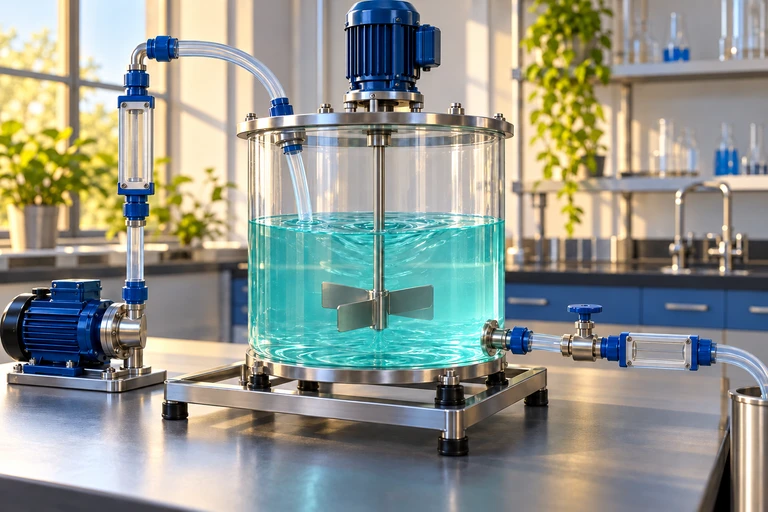 Suppose a tank receives and releases 4 gal/min for 5 minutes. Its 200 gal inventory stays constant while 20 gal enters and 20 gal leaves: net change is zero and total throughput is 40 gal.
Net inventory versus throughput
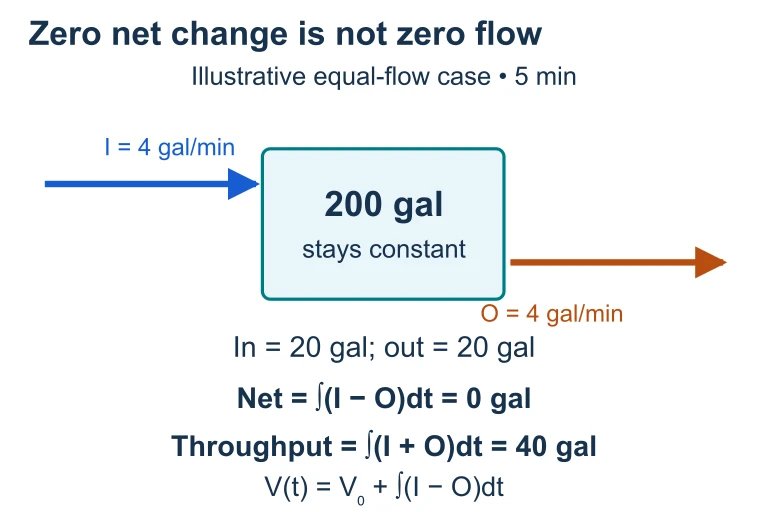 Suppose a tank receives and releases 4 gal/min for 5 minutes. Its 200 gal inventory stays constant while 20 gal enters and 20 gal leaves: net change is zero and total throughput is 40 gal.
Step-by-Step Strategy
Example 1: Water Tank
Water flows into a tank at a rate of \(R(t)=6t-t^2\) gallons per minute for \(0\leq t\leq 6\). How many gallons enter the tank during this interval?
Interpreting the Answer
We found \(\int_0^6 R(t)\,dt = 36\). Let's also find the instantaneous rate at \(t = 2\):
Example 2: Marginal Cost
A factory's total cost for producing \(q\) units is \(C(q) = 0.01q^3 - 0.6q^2 + 15q + 200\) dollars. Find the marginal cost at \(q = 20\) units.
Example 3: Population Growth
A bacteria population grows so that its rate of change is \(P'(t) = 200e^{0.1t}\) bacteria per hour. If \(P(0) = 500\), find \(P(10)\).
Interpretation: Starting with 500 bacteria, the population grows to approximately 3937 bacteria after 10 hours. The net change of 3437 bacteria came from integrating the growth rate.
Example 4: Cooling Temperature
A cup of coffee cools at a rate of \(\frac{dT}{dt} = -0.05(T - 20)\) degrees Celsius per minute, where \(T\) is the coffee's temperature and the room is \(20^{\circ}\text{C}\).
Sign of \(Q'(t)\) Matters
Common Mistakes
Question 1 of 5
Water leaks from a tank at a rate of \(R(t) = 3\sqrt{t}\) gallons per minute. How many gallons leak out during the first 4 minutes?
Question 2 of 5
If \(C(q) = 5q^2 + 200\) is total cost in dollars for \(q\) units, what is the marginal cost at \(q = 10\)?
Question 3 of 5
A population grows at a rate \(P'(t) = 50 - 2t\) individuals per year. At what time \(t\) does the population stop growing?
Question 4 of 5
A tank holds 100 gallons. Water drains at rate \(R(t) = 8 - 0.5t\) gal/min for \(0 \le t \le 16\). How much water remains at \(t = 8\)?
Question 5 of 5
The temperature of a rod is \(T(x) = 80 - 2x^2\) degrees, where \(x\) is distance in cm from the left end. What are the units of \(\frac{dT}{dx}\)?