Position, Velocity &
Acceleration Using Integrals
Learn how to recover position from velocity and velocity from acceleration using the power of integration and initial conditions.
What is Rectilinear Motion?
An object moving along a straight line has three fundamental kinematic quantities: position, velocity, and acceleration. Each is a function of time \( t \).
The Derivative Chain
In AP Calculus, you already know derivatives take you forward (position to velocity to acceleration). This unit focuses on using integrals to reverse that process.
Why Integrals Matter Here
In many real-world problems, you are given acceleration (from a force) or velocity (from a speedometer) and must find the object's position. Integration is the tool that recovers the original function from its rate of change.
The Fundamental Recovery Formulas
Displacement vs. Total Distance
Indefinite vs. Definite Integrals
| Indefinite Integral | Definite Integral | |
|---|---|---|
| Form | \( \int v(t)\,dt = s(t) + C \) | \( \int_{a}^{b} v(t)\,dt \) |
| Result | A family of position functions | A number: net change in position |
| Needs | Initial condition to find \( C \) | Bounds of integration |
| Use case | Find \( s(t) \) for all \( t \) | Find displacement on \([a, b]\) |
How to Apply the Formulas
Example 1: Velocity to Position
Example 2: Acceleration to Position
Example 3: Displacement & Distance
Graphical Interpretation
The signed area under \( v(t) \) gives displacement. Taking the absolute value \( |v(t)| \) before integrating counts all area as positive, giving total distance.
The Accumulation Form
A powerful alternative to finding \( +C \) is the accumulation form, which builds the initial condition directly into a definite integral:
Follow the salt through a working mixing rig
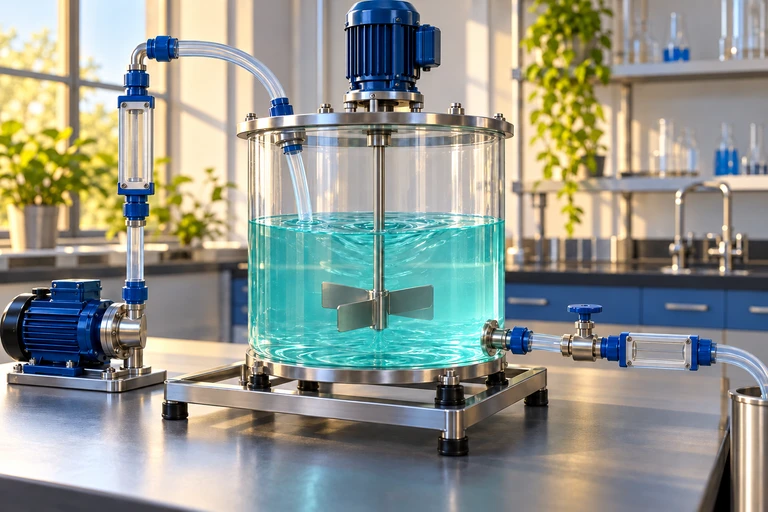 The distinction between net change and total movement also appears in flowing water. Suppose a tank receives and releases 4 gal/min for 5 minutes. Its 200 gal inventory stays constant while 20 gal enters and 20 gal leaves: net change is zero and total throughput is 40 gal.
Net inventory versus throughput
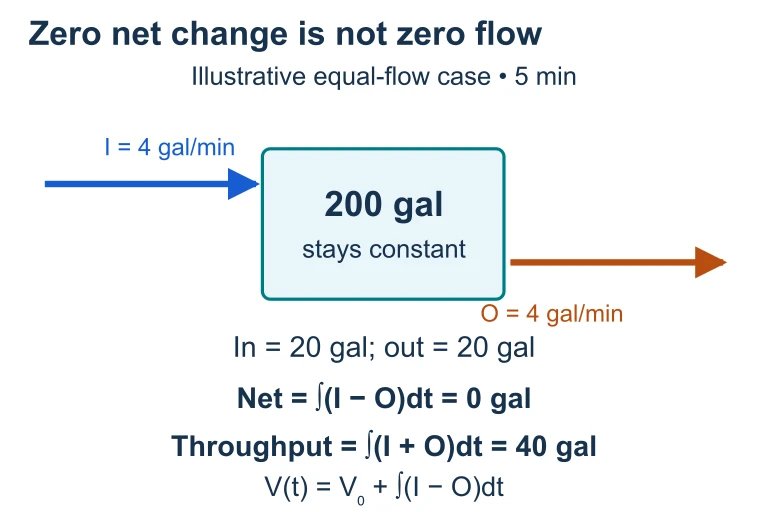 The distinction between net change and total movement also appears in flowing water. Suppose a tank receives and releases 4 gal/min for 5 minutes. Its 200 gal inventory stays constant while 20 gal enters and 20 gal leaves: net change is zero and total throughput is 40 gal.
When Velocity Changes Sign
When \( v(t) \) changes sign, the particle reverses direction. This is critical for computing total distance: you must split the integral at each zero of \( v(t) \).
Common Mistakes
Summary Table
| Quantity | Formula | What It Gives You |
|---|---|---|
| \( v(t) \) from \( a(t) \) | \( v(t_0) + \int_{t_0}^t a\,d\tau \) | Velocity at time \( t \) |
| \( s(t) \) from \( v(t) \) | \( s(t_0) + \int_{t_0}^t v\,d\tau \) | Position at time \( t \) |
| Displacement | \( \int_a^b v(t)\,dt \) | Net change in position |
| Total Distance | \( \int_a^b |v(t)|\,dt \) | Actual path length |
| \( s(t) \) from \( a(t) \) | Integrate twice with 2 ICs | Position function |
Question 1 of 5
A particle has velocity \( v(t) = 4t - 3 \) and \( s(0) = 2 \). What is \( s(t) \)?
Question 2 of 5
If \( a(t) = 10 \) (constant acceleration), \( v(0) = -3 \), what is \( v(t) \)?
Question 3 of 5
A particle has \( v(t) = t - 2 \) on \([0, 4]\). What is the total distance traveled?
Question 4 of 5
Given \( v(t) = \cos t \) and \( s(0) = 5 \), what is \( s\!\left(\frac{\pi}{2}\right) \)?
Question 5 of 5
Which expression represents the displacement of a particle on \([1, 5]\) given velocity \( v(t) \)?