Motion Problems
Parametric & Vector-Valued Functions
Master position, velocity, acceleration, and speed using parametric equations and vector-valued functions for the AP Calculus BC exam.
What Are Parametric Equations?
Instead of writing \( y \) as a function of \( x \), we express both coordinates as functions of a third variable, the parameter \( t \) (often representing time):
Visualizing a Parametric Path
Consider a particle with position \( \mathbf{r}(t) = \langle t^2 - 1,\, 2t \rangle \). As \( t \) increases, the particle traces a parabolic path.
Vector-Valued Functions
A vector-valued function packages parametric equations into a single vector. In the plane:
Each derivative of \( \mathbf{r}(t) \) has a physical interpretation in motion:
Core Motion Formulas
Slope: \( \frac{dy}{dx} \) for Parametric Curves
Do not simply take \( \frac{y''(t)}{x''(t)} \). You must differentiate the first derivative with respect to \( t \), then divide by \( \frac{dx}{dt} \).
Speed vs. Velocity
| Velocity \( \mathbf{v}(t) \) | Speed \( \|\mathbf{v}(t)\| \) | |
|---|---|---|
| Type | Vector | Scalar |
| Formula | \( \langle x'(t), y'(t) \rangle \) | \( \sqrt{[x'(t)]^2+[y'(t)]^2} \) |
| Can be negative? | Yes (components can) | No (always \( \geq 0 \)) |
| Gives direction? | Yes | No |
| Units | m/s (with direction) | m/s (magnitude only) |
How to Solve Motion Problems
Example 1: Finding Velocity & Speed
A particle moves with position \( x(t) = 3t^2 \) and \( y(t) = 2t^3 \). Find the velocity and speed at \( t = 1 \).
Example 2: Total Distance Traveled
A particle has velocity \( \mathbf{v}(t) = \langle 2t,\, 3 \rangle \). Find the total distance traveled from \( t = 0 \) to \( t = 4 \).
Example 3: Position from Velocity
A particle has \( \mathbf{v}(t) = \langle \cos t,\, e^t \rangle \) and initial position \( \mathbf{r}(0) = \langle 2, 1 \rangle \). Find \( \mathbf{r}(t) \).
Displacement vs. Distance
Always \( \geq 0 \), measures path length
A vector from start to end, can be negative in components
When Is a Particle Speeding Up?
A particle's speed is increasing when the velocity and acceleration vectors are working "together." Formally:
The dot product \( \mathbf{v} \cdot \mathbf{a} = x'(t)\,x''(t) + y'(t)\,y''(t) \) measures how much acceleration is in the direction of motion.
Position via Definite Integrals
If you know the velocity and an initial position, you can find position at any time \( t \) using integration:
This is the accumulation form of the Fundamental Theorem. The AP exam often gives velocity functions and an initial position, then asks for position at a later time.
Common Mistakes to Avoid
Summary of Key Formulas
| Quantity | Formula | Type |
|---|---|---|
| Position | \( \mathbf{r}(t) = \langle x(t), y(t) \rangle \) | Vector |
| Velocity | \( \mathbf{v}(t) = \langle x'(t), y'(t) \rangle \) | Vector |
| Speed | \( \sqrt{[x'(t)]^2+[y'(t)]^2} \) | Scalar |
| Acceleration | \( \mathbf{a}(t) = \langle x''(t), y''(t) \rangle \) | Vector |
| Slope | \( \frac{dy}{dx} = \frac{y'(t)}{x'(t)} \) | Scalar |
| Distance | \( \int_a^b \|\mathbf{v}(t)\|\, dt \) | Scalar |
Worked practice: Practice Problems, Problem 4 — applied
Work through this original lesson problem, then reveal the solution and illustrations.
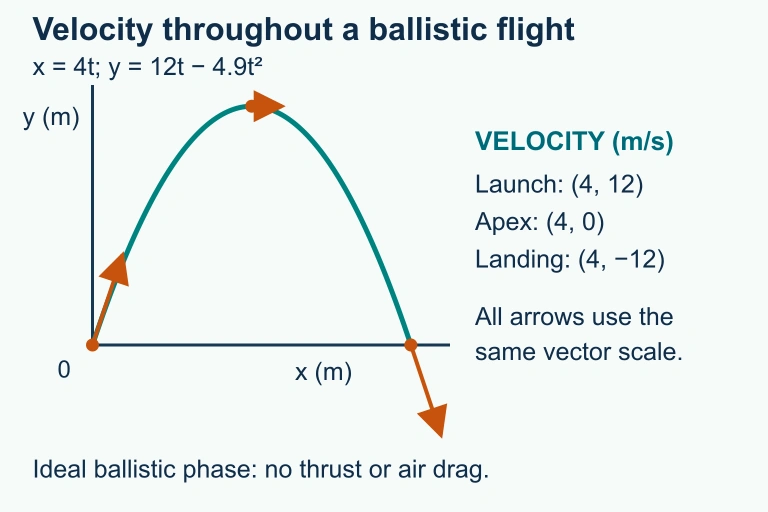
A drone follows the path x(t) = 4t and y(t) = 12t − 4.9t² (meters, with t in seconds) for t ≥ 0 until it hits the ground. (a) Find the velocity vector v(t). (b) Determine the time when the drone reaches its maximum height. (c) Set up, but do not evaluate, an integral that gives the total distance the drone travels from launch until it returns to y = 0.
Show answer and explanation
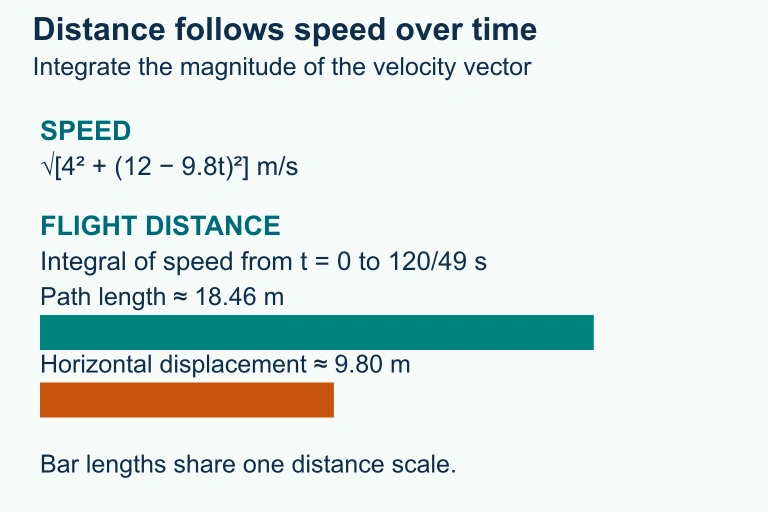
Point 1 (1 pt): Velocity vector. x′(t) = 4, y′(t) = 12 − 9.8t. So v(t) = ⟨4, 12 − 9.8t⟩. Point 2 (1 pt): Maximum height occurs when y′(t) = 0. Set 12 − 9.8t = 0, giving t = 12/9.8 = 60/49 ≈ 1.224 seconds. Point 3 (1 pt): Verify this is a maximum. Since y″(t) = −9.8 < 0, the critical point is indeed a maximum. Point 4 (1 pt): Find the time the drone returns to y = 0. Set y(t) = 12t − 4.9t² = t(12 − 4.9t) = 0, giving t = 0 (launch) and t = 12/4.9 = 120/49 ≈ 2.449 seconds. Point 5 (1 pt): Correct arc length integral setup. Distance = ∫₀^(120/49) √[(4)² + (12 − 9.8t)²] dt = ∫₀^(120/49) √[16 + (12 − 9.8t)²] dt. This integral represents the total path length of the drone's parabolic trajectory.
Question 1 of 5
A particle moves with position \( x(t) = t^3 \) and \( y(t) = t^2 \). What is the speed of the particle at \( t = 2 \)?
Question 2 of 5
For the parametric curve \( x(t) = \sin t \), \( y(t) = \cos(2t) \), what is \( \frac{dy}{dx} \) at \( t = \frac{\pi}{6} \)?
Question 3 of 5
A particle has velocity \( \mathbf{v}(t) = \langle 4t, 3 \rangle \) and position \( \mathbf{r}(0) = \langle 1, -2 \rangle \). What is \( \mathbf{r}(2) \)?
Question 4 of 5
Which integral gives the total distance traveled by a particle with velocity \( \mathbf{v}(t) = \langle e^t, t^2 \rangle \) from \( t = 0 \) to \( t = 3 \)?
Question 5 of 5
A particle has \( \mathbf{v}(t) = \langle 2, -6t \rangle \) and \( \mathbf{a}(t) = \langle 0, -6 \rangle \). At \( t = 1 \), is the particle speeding up or slowing down?