Modeling with
Differential Equations
Learn to translate real-world phenomena into the language of \(\frac{dy}{dx}\), then build equations that capture growth, decay, and change.
What Is a Differential Equation?
A differential equation (DE) is any equation that relates a function to one or more of its derivatives. Instead of asking "what is \(y\)?", we ask: "how does \(y\) change?"
Why Model with Differential Equations?
Many quantities in nature don't change at a constant rate: they change relative to their current value or relative to some other quantity. A DE captures this dynamic relationship.
Anatomy of a Differential Equation
The Core Modeling Principle
Three Classic Models
Each model captures a fundamentally different behavior: unbounded growth, approach to equilibrium, and bounded growth with a carrying capacity.
Exponential vs Logistic
| Exponential | Logistic | |
|---|---|---|
| DE | \(\frac{dy}{dt}=ky\) | \(\frac{dP}{dt}=kP(L-P)\) |
| Rate depends on | Current value only | Current value AND room to grow |
| Long-term behavior | \(y \to \infty\) | \(P \to L\) (carrying capacity) |
| Solution | \(y = Ce^{kt}\) | \(P = \frac{L}{1+Ae^{-kLt}}\) |
| Shape | J-curve | S-curve (sigmoid) |
An aquarium window connects population to growth rate
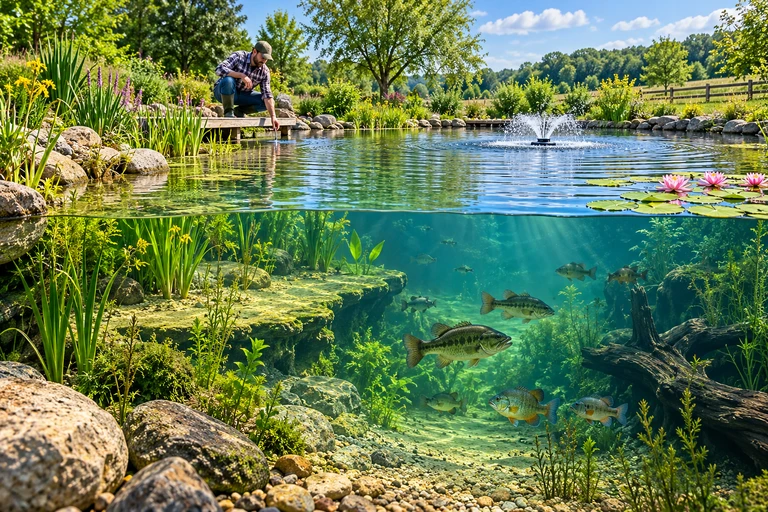 For a lake with carrying capacity 5,000 fish and 200 fish initially, observing 800 fish at 6 months determines k ≈ 0.2533 per month. The model predicts about 3,996 fish at 18 months.
A different lake: months, not years
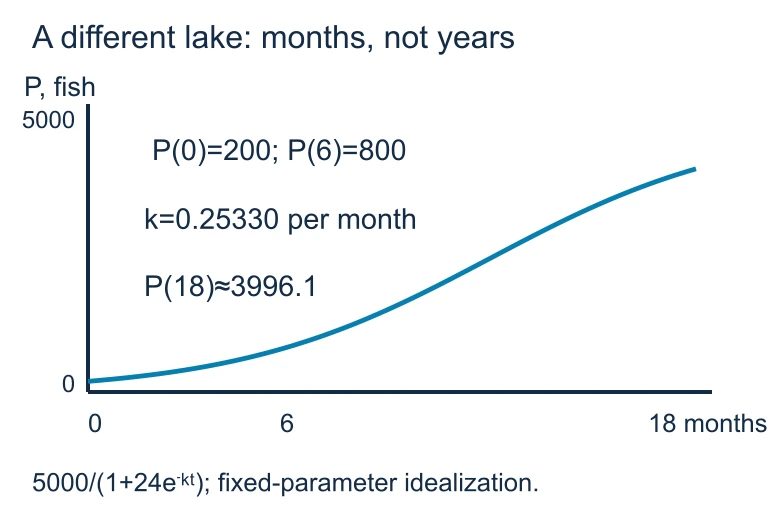 For a lake with carrying capacity 5,000 fish and 200 fish initially, observing 800 fish at 6 months determines k ≈ 0.2533 per month. The model predicts about 3,996 fish at 18 months.
Translating Words to Equations
| English Phrase | DE Translation |
|---|---|
| "rate of change of \(y\)" | \(\frac{dy}{dt}\) |
| "is proportional to \(y\)" | \(= ky\) |
| "is proportional to the difference between \(y\) and 100" | \(= k(y - 100)\) |
| "increases at a constant rate of 5 per hour" | \(= 5\) |
| "decreases at a rate proportional to \(y^2\)" | \(= -ky^2\) |
How to Set Up a DE Model
Example 1: Bacterial Growth
"A bacteria colony doubles every 3 hours. The rate of growth is proportional to the current population. At \(t = 0\), there are 500 bacteria."
Example 2: Newton's Cooling
"A cup of coffee at \(90°\)C is placed in a room at \(20°\)C. It cools at a rate proportional to the difference between its temperature and the room temperature."
Cooling coffee with temperature and rate shown separately
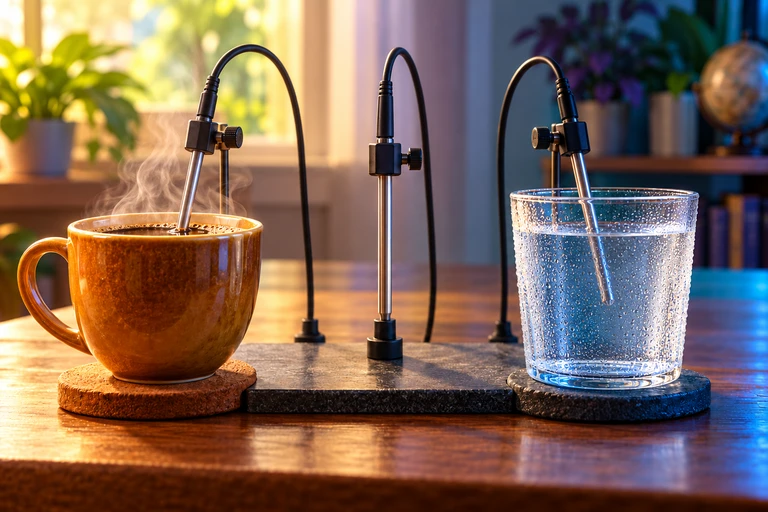 With ambient temperature 22 °C and k > 0, T′ = −k(T − 22). A warmer liquid cools and a cooler liquid warms, both approaching ambient temperature.
Excess temperature decays toward zero
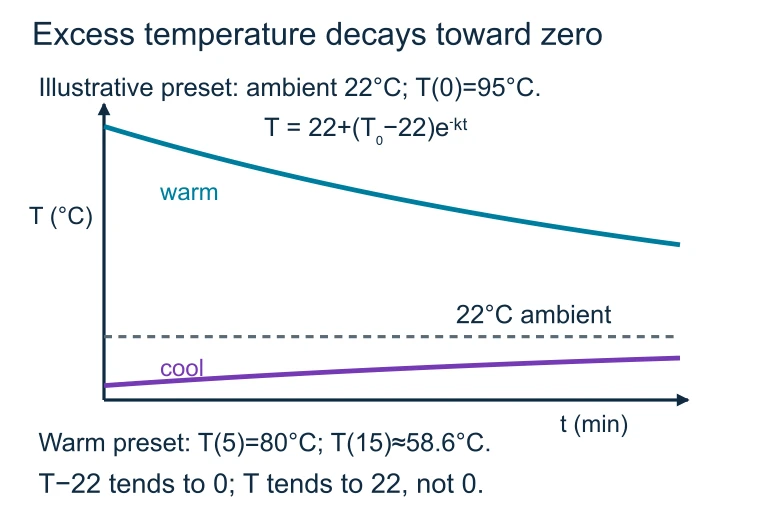 With ambient temperature 22 °C and k > 0, T′ = −k(T − 22). A warmer liquid cools and a cooler liquid warms, both approaching ambient temperature.
Example 3: Logistic Growth
"A lake can support at most 10,000 fish. The fish population grows at a rate proportional to both the current population and the remaining capacity."
Beyond the Standard Three
Not every AP problem fits neatly into exponential, cooling, or logistic. You must read carefully and translate each phrase independently.
The Role of Initial Conditions
A DE alone has infinitely many solutions (a family of curves). The initial condition \(y(t_0) = y_0\) picks exactly one curve from this family.
Common Mistakes
Summary of DE Models
| Scenario | DE Form | Key Feature |
|---|---|---|
| Exponential growth/decay | \(\frac{dy}{dt} = ky\) | Rate \(\propto\) value |
| Newton's cooling/heating | \(\frac{dT}{dt} = -k(T - T_e)\) | Rate \(\propto\) difference |
| Logistic growth | \(\frac{dP}{dt} = kP(L - P)\) | Rate \(\propto\) value \(\times\) remaining |
| Mixing/flow | \(\frac{dy}{dt} = \text{in} - \text{out}\) | Balance of competing rates |
Question 1 of 5
A radioactive substance decays at a rate proportional to the amount present. If \(Q\) is the amount at time \(t\), which DE models this?
Question 2 of 5
A metal rod at \(200°\)C is placed in a room at \(25°\)C. Its temperature changes at a rate proportional to the difference between its temperature and the room's. Which is the correct model?
Question 3 of 5
A population of deer in a forest grows logistically with carrying capacity \(L = 800\). Which DE models this?
Question 4 of 5
Water flows into a tank at \(3\) gallons/min and out at a rate of \(\frac{V}{20}\) gallons/min, where \(V\) is the volume in the tank. Which DE models the volume?
Question 5 of 5
If \(\frac{dy}{dt} = 0.3y\) and \(y(0) = 50\), what is the value of \(\frac{dy}{dt}\) at \(t = 0\)?