Introduction to
Optimization Problems
Learn how to use derivatives to find maximum and minimum values of functions under real-world constraints.
What Is Optimization?
Optimization is the process of finding the best possible value of a function: the greatest profit, the shortest distance, the least material, or the largest area. In calculus, we translate "best" into finding the absolute maximum or minimum of a function on a given domain.
Why Optimization Matters
The Optimization Landscape
The Closed Interval Method
To find the absolute maximum and minimum of a continuous function \( f \) on a closed interval \([a, b]\):
Open-Domain Optimization
When the domain is not a closed interval (e.g., \( x > 0 \)), you cannot simply check endpoints. Instead, use the First or Second Derivative Test to classify each critical point.
Closed vs. Open Domain
| Closed Interval \([a,b]\) | Open / Unbounded Domain | |
|---|---|---|
| Guaranteed extrema? | Yes (Extreme Value Theorem) | Not guaranteed |
| Check endpoints? | Always | No endpoints to check |
| Primary method | Evaluate & compare | 1st or 2nd Derivative Test |
| When to use | Physical constraints give a finite interval | Domain is naturally open or infinite |
The 5-Step Strategy
An open box taking shape on a designer's table
 For a 24 cm × 16 cm sheet, V(x) = x(24 − 2x)(16 − 2x), with 0 < x < 8. The maximizing cut is x = (20 − 4√7)/3 cm, about 3.14 cm.
24 × 16 sheet-cut preset
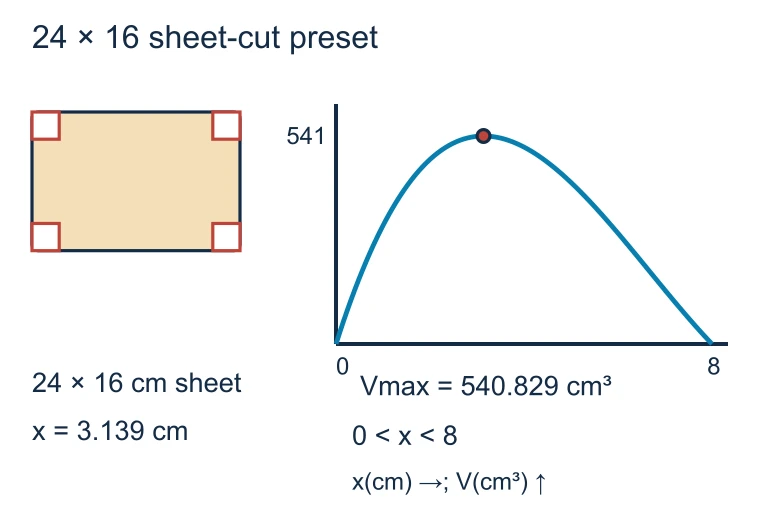 For a 24 cm × 16 cm sheet, V(x) = x(24 − 2x)(16 − 2x), with 0 < x < 8. The maximizing cut is x = (20 − 4√7)/3 cm, about 3.14 cm.
Example 1: Fencing a Garden
A farmer has 120 meters of fencing and wants to enclose a rectangular garden against a barn wall (so only three sides need fencing). What dimensions maximize the area?
Example 1: Solution
Example 2: Open-Top Box
An open-top box with a square base must have a volume of 32 cubic inches. Find the dimensions that minimize the surface area (material used).
Example 2: Solution
Example 3: Closest Point on a Curve
Find the point on the parabola \( y = x^2 \) that is closest to the point \( (0, 1) \).
Minimize \( D^2 \) Instead of \( D \)
A powerful shortcut: since the square root function is increasing, the value of \( x \) that minimizes \( D^2 \) also minimizes \( D \). This avoids differentiating a square root.
Common Mistakes
Optimization Checklist
| Step | Action | Key Question |
|---|---|---|
| 1 | Diagram & variables | What are the unknowns? |
| 2 | Objective function | What am I optimizing? |
| 3 | Constraint → one variable | What equation links variables? |
| 4 | Differentiate & solve | Where is \( f'(x) = 0 \)? |
| 5 | Verify & conclude | Is it a max or min? Did I answer the question? |
Question 1 of 5
A farmer has 200 meters of fencing and wants to enclose a rectangular field against a river (no fence needed on that side). What is the maximum area the farmer can enclose?
Question 2 of 5
When finding the absolute extrema of \( f(x) \) on a closed interval \([a, b]\), which of the following is required?
Question 3 of 5
For an open-top box with a square base and fixed volume \( V \), the surface area is \( S = x^2 + \frac{4V}{x} \). Which value of \( x \) minimizes \( S \)?
Question 4 of 5
Why is it valid to minimize \( D^2 \) instead of \( D \) when finding the shortest distance to a curve?
Question 5 of 5
A continuous function \( f \) on the open interval \( (0, \infty) \) has exactly one critical point at \( x = 3 \), where \( f''(3) > 0 \). What can we conclude?