Fundamental Theorem
of Calculus
Master the deep connection between differentiation and integration through accumulation functions and their derivatives.
What is an Accumulation Function?
An accumulation function measures the total "accumulated" quantity of a function from a fixed starting point \(a\) up to a variable endpoint \(x\). It is defined as:
As \(x\) changes, the integral accumulates more (or less) signed area under the curve \(f(t)\). The value \(F(x)\) is the net signed area between \(t = a\) and \(t = x\).
Follow the salt through a working mixing rig
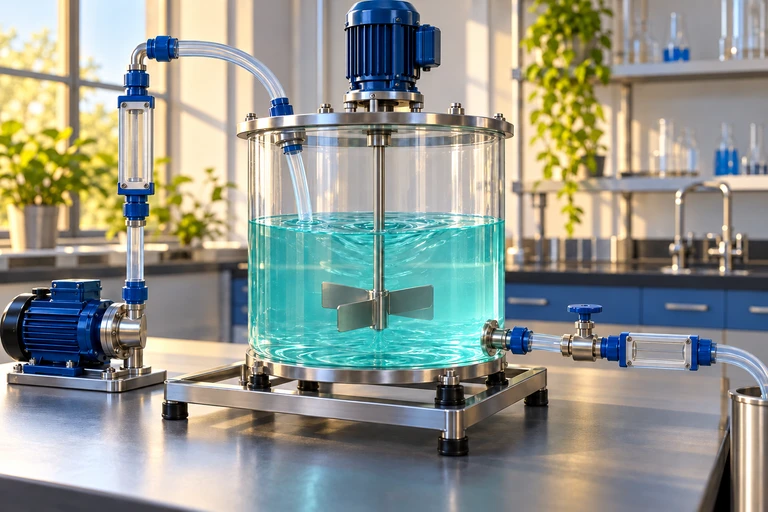 Suppose a tank receives and releases 4 gal/min for 5 minutes. Its 200 gal inventory stays constant while 20 gal enters and 20 gal leaves: net change is zero and total throughput is 40 gal.
Net inventory versus throughput
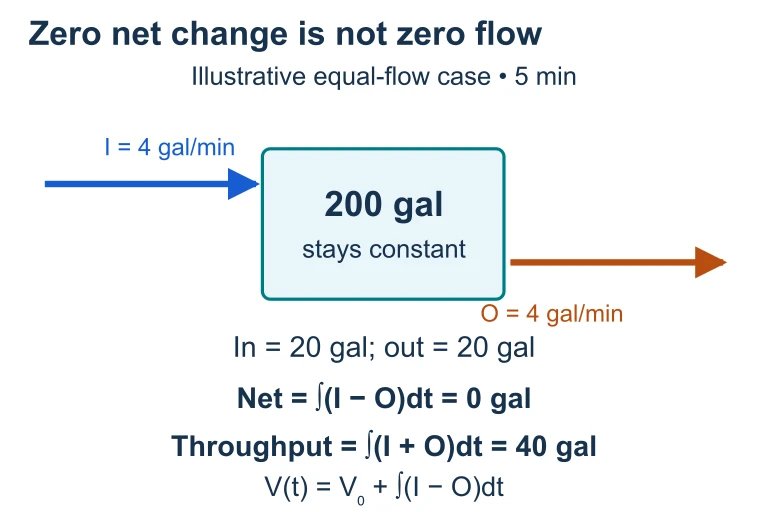 Suppose a tank receives and releases 4 gal/min for 5 minutes. Its 200 gal inventory stays constant while 20 gal enters and 20 gal leaves: net change is zero and total throughput is 40 gal.
Visualizing Signed Area
Why Does This Matter?
FTC Part 1: Differentiation of Integrals
If \(f\) is continuous on \([a, b]\) and we define:
then \(F\) is differentiable on \((a, b)\) and:
Seeing FTC Part 1 Graphically
FTC Part 2: Evaluation Theorem
If \(f\) is continuous on \([a, b]\) and \(F\) is any antiderivative of \(f\) (meaning \(F'(x) = f(x)\)), then:
Part 1 vs Part 2
| FTC Part 1 | FTC Part 2 | |
|---|---|---|
| Statement | \(\frac{d}{dx}\int_a^x f(t)\,dt = f(x)\) | \(\int_a^b f(x)\,dx = F(b) - F(a)\) |
| Direction | Integral → Derivative | Derivative → Integral |
| Purpose | Differentiate an accumulation function | Evaluate a definite integral |
| Output | A function: \(f(x)\) | A number: \(F(b) - F(a)\) |
| Requirement | \(f\) continuous on \([a, b]\) | \(F' = f\) on \([a, b]\) |
FTC Part 1 with the Chain Rule
When the upper limit is not simply \(x\) but a function \(g(x)\), we apply the chain rule:
Example: \(\frac{d}{dx}\int_1^{x^2} \cos(t)\,dt = \cos(x^2) \cdot 2x\).
Variable Lower and Upper Limits
What if both limits depend on \(x\)? Split using the additive property of integrals:
How to Apply FTC Part 1
Example 1: Basic FTC Part 1
Find \(\displaystyle\frac{d}{dx}\int_2^x (3t^2 + 1)\, dt\)
Example 2: Chain Rule Required
Find \(\displaystyle\frac{d}{dx}\int_0^{x^3} e^{-t^2}\, dt\)
Example 3: Both Limits Variable
Find \(\displaystyle\frac{d}{dx}\int_{\sin x}^{x^2} \ln(t+1)\, dt\)
Properties of Accumulation Functions
Common Mistakes to Avoid
Question 1 of 5
What is \(\displaystyle\frac{d}{dx}\int_1^x \sqrt{t^3 + 4}\, dt\)?
Question 2 of 5
What is \(\displaystyle\frac{d}{dx}\int_0^{\sin x} t^2\, dt\)?
Question 3 of 5
If \(F(x) = \displaystyle\int_2^x f(t)\,dt\) and \(f\) is continuous, which statement is always true?
Question 4 of 5
What is \(\displaystyle\frac{d}{dx}\int_{x}^{x^2} e^t\, dt\)?
Question 5 of 5
Suppose \(f\) is continuous, \(f(3) = 5\), and \(G(x) = \displaystyle\int_0^x f(t)\,dt\). What is the equation of the tangent line to \(G\) at \(x = 3\), given \(G(3) = 7\)?