Exponential Models
with Differential Equations
Master the relationship between differential equations and exponential growth and decay, the foundation of modeling in calculus.
What Is a Differential Equation?
A differential equation is any equation that relates a function to one or more of its derivatives. It tells us how a quantity changes rather than what the quantity is directly.
Solving a differential equation means finding the function \(y(t)\) that satisfies the relationship. In this unit, we focus on equations whose solutions are exponential functions.
The Exponential Growth and Decay Model
The simplest and most important differential equation in applied mathematics is:
Visualizing Growth vs Decay
Solving \(\dfrac{dy}{dt} = ky\) via Separation
Cooling coffee with temperature and rate shown separately
 With ambient temperature 22 °C and k > 0, T′ = −k(T − 22). A warmer liquid cools and a cooler liquid warms, both approaching ambient temperature.
Excess temperature decays toward zero
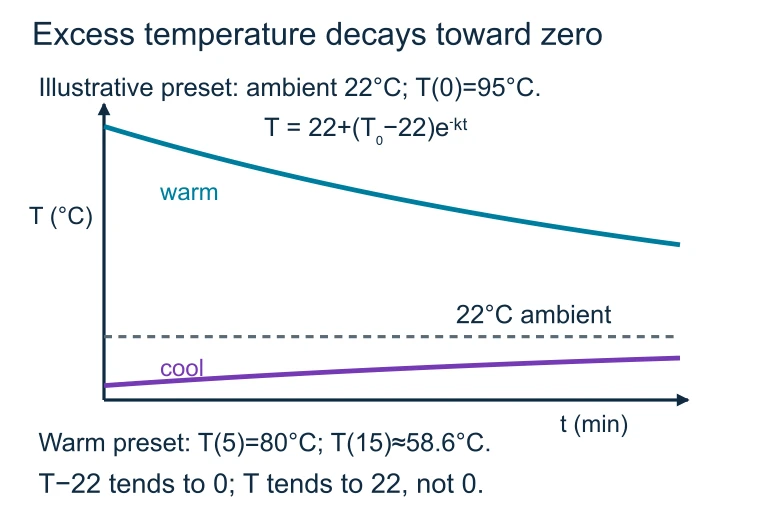 With ambient temperature 22 °C and k > 0, T′ = −k(T − 22). A warmer liquid cools and a cooler liquid warms, both approaching ambient temperature.
The Exponential Growth/Decay Theorem
The key insight: the exponential function is the only function that is proportional to its own derivative.
Growth Rate vs Growth Factor
| Growth Rate \(k\) | Growth Factor \(e^k\) | |
|---|---|---|
| Definition | Continuous rate of change | Multiplier per unit time |
| Appears in | \(\dfrac{dy}{dt} = ky\) | \(y = y_0 \cdot (e^k)^t\) |
| Sign meaning | \(k > 0\): growth; \(k < 0\): decay | \(e^k > 1\): growth; \(e^k < 1\): decay |
| Example | \(k = 0.06\) (6% per year) | \(e^{0.06} \approx 1.0618\) |
Continuous vs Discrete Models
Rate is applied at every instant. Uses \(\dfrac{dy}{dt} = ky\).
Rate is applied at fixed intervals. No differential equation needed.
How to Solve an Exponential Model Problem
Example 1: Population Growth
A bacteria colony grows at a rate proportional to its size. At \(t = 0\) there are 500 bacteria. After 3 hours, there are 1500. Find the population at \(t = 5\) hours.
Example 2: Radioactive Decay
A substance has a half-life of 8 years. If you start with 100 grams, how much remains after 20 years?
Example 3: Continuously Compounded Interest
You invest \$2000 at a continuously compounded annual rate of 4.5%. How long until the investment doubles?
Particular Solutions and Initial Conditions
Doubling Time and Half-Life
Common Mistakes to Avoid
Summary of Key Formulas
| Concept | Formula | When to Use |
|---|---|---|
| General DE | \(\dfrac{dy}{dt} = ky\) | Rate proportional to amount |
| General Solution | \(y = y_0 e^{kt}\) | Always, for this DE type |
| Doubling Time | \(t_d = \dfrac{\ln 2}{k}\) | When \(k > 0\), find time to double |
| Half-Life | \(t_{1/2} = \dfrac{\ln 2}{|k|}\) | When \(k < 0\), find time to halve |
| Finding \(k\) | \(k = \dfrac{\ln(y/y_0)}{t}\) | Given two data points |
Question 1 of 5
If \(\dfrac{dy}{dt} = -0.03y\) and \(y(0) = 200\), what is \(y(10)\)?
Question 2 of 5
A population doubles every 5 years. What is the continuous growth rate \(k\)?
Question 3 of 5
A substance decays according to \(\dfrac{dN}{dt} = -0.0866N\). What is the half-life?
Question 4 of 5
Which differential equation does NOT have an exponential solution?
Question 5 of 5
An investment of \$5000 grows continuously at rate \(k\). After 6 years it is worth \$7500. Find \(k\).